Aktuelle wissenschaftliche Veröffentlichungen nach Forschungsgebiet
Greifen Sie auf aktuelle wissenschaftliche Veröffentlichungen nach Disziplin zu, um für Ihre Analyse, Beobachtung oder Forschung relevante Arbeiten zu identifizieren.
Alzheimer's disease (AD) is one of the most prevalent neurodegenerative disorders worldwide. As it progresses, it leads to the deterioration of cognitive functions. Since AD is irreversible, early diagnosis is crucial for managing its progression. Mild Cognitive Impairment (MCI) represents an intermediate stage between Cognitively Normal (CN) individuals and those with AD, and is considered a transitional phase from normal cognition to Alzheimer's disease. Diagnosing MCI is particularly challenging due to the subtle differences between adjacent diagnostic categories. In this study, we propose EffNetViTLoRA, a generalized end-to-end model for AD diagnosis using the whole Alzheimer's Disease Neuroimaging Initiative (ADNI) Magnetic Resonance Imaging (MRI) dataset. Our model integrates a Convolutional Neural Network (CNN) with a Vision Transformer (ViT) to capture both local and global features from MRI images. Unlike previous studies that rely on limited subsets of data, our approach is trained on the full T1-weighted MRI dataset from ADNI, resulting in a more robust and unbiased model. This comprehensive methodology enhances the model's clinical reliability. Furthermore, fine-tuning large pretrained models often yields suboptimal results when source and target dataset domains differ. To address this, we incorporate Low-Rank Adaptation (LoRA) to effectively adapt the pretrained ViT model to our target domain. This method enables efficient knowledge transfer and reduces the risk of overfitting. Our model achieves a classification accuracy of 92.52% and an F1-score of 92.76% across three diagnostic categories: AD, MCI, and CN for full ADNI dataset.
Alzheimer's disease is an untreatable, progressive brain disorder that slowly
robs people of their memory, thinking abilities, and ultimately their capacity
to complete even the most basic tasks. Among older adults, it is the most
frequent cause of dementia. Although there is presently no treatment for
Alzheimer's disease, scientific trials are ongoing to discover drugs to combat
the condition. Treatments to slow the signs of dementia are also available.
Many researchers throughout the world became interested in developing
computer-aided diagnosis systems to aid in the early identification of this
deadly disease and assure an accurate diagnosis. In particular, image based
approaches have been coupled with machine learning techniques to address the
challenges of Alzheimer's disease detection. This study proposes a computer
aided diagnosis system to detect Alzheimer's disease from biomarkers captured
using neuroimaging techniques. The proposed approach relies on deep learning
techniques to extract the relevant visual features from the image collection to
accurately predict the Alzheimer's class value. In the experiments, standard
datasets and pre-trained deep learning models were investigated. Moreover,
standard performance measures were used to assess the models' performances. The
obtained results proved that VGG16-based models outperform the state of the art
performance.
Medium-horizon Alzheimer's disease progression prediction is difficult because future clinical scores can remain tied to baseline severity, while biomarker histories are irregular and incompletely observed. We develop an anchor-based analysis of 24-month Clinical Dementia Rating Sum of Boxes (CDR-SB) change using harmonized Alzheimer's Disease Neuroimaging Initiative (ADNI) tables. Each labeled sample is anchored at a mild cognitive impairment visit, uses only clinical and biomarker history observed at or before that anchor, and defines the response as CDR-SB at the future visit closest to 24 months within an 18--30 month window minus anchor CDR-SB. The analytic cohort contains 2,600 labeled anchors from 858 participants and 7,276 longitudinal rows. We propose a residual gap-aware transformer that combines a mixed-effects statistical reference with transformer-based residual learning from pre-anchor clinical and biomarker histories. The model uses participant-level random intercepts in the mixed-effects reference, observation-level triplet tokenization for irregular histories, and a learned nonnegative time-gap penalty inside self-attention. We compare the proposed model with a Bayesian-information-criterion-selected linear mixed-effects baseline, GRU-D, and STraTS under repeated participant-level train--test splits. Across five participant-level random seeds, the proposed model achieves the best mean test performance across all reported metrics, reducing MSE by 13.1% and increasing prediction--observation correlation by 26.4% relative to the mixed-effects baseline. It also improves over both GRU-D and STraTS in mean error and correlation. These results show that statistical anchoring and gap-aware residual learning provide a useful structure for medium-horizon Alzheimer's disease progression prediction. ;Preprint; includes appendix, 4 figures, and 6 tables
The association of epileptic activity and Alzheimer's disease (AD) has been increasingly reported in both clinical and experimental studies, suggesting that amyloid-$β$ accumulation may directly affect neuronal excitability. Capturing these interactions requires a quantitative description that bridges the molecular alterations of AD with the fast electrophysiological dynamics of epilepsy. We introduce a novel mathematical model that extends the Barreto-Cressman ionic formulation by incorporating multiple mechanisms of calcium dysregulation induced by amyloid-$β$, including formation of $\mathrm{Ca}^{2+}$-permeable pores, overactivation of voltage-gated $\mathrm{Ca}^{2+}$ channels, and suppression of $\mathrm{Ca}^{2+}$-sensitive potassium currents. The resulting ionic model is coupled with the monodomain equation and discretized using a $p$-adaptive discontinuous Galerkin method on polytopal meshes, providing an effective balance between efficiency and accuracy in capturing the sharp spatiotemporal electrical wavefronts associated with epileptiform discharges. Numerical simulations performed on idealized and realistic brain geometries demonstrate that progressive amyloid-\textbeta{} accumulation leads to severe alterations in calcium homeostasis, increased neuronal hyperexcitability, and pathological seizure propagation. Specifically, high amyloid-$β$ concentrations produce secondary epileptogenic sources and spatially heterogeneous wavefronts, indicating that biochemical inhomogeneities play a critical role in shaping seizure dynamics. These results illustrate how multiscale modeling provides new mechanistic insights into the interplay between neurodegeneration and epilepsy in Alzheimer's disease.
Alzheimer's disease (AD) is a leading neurodegenerative condition and the
primary cause of dementia, characterized by progressive cognitive decline and
memory loss. Its progression, marked by shrinkage in the cerebral cortex, is
irreversible. Numerous machine learning algorithms have been proposed for the
early diagnosis of AD. However, they often struggle with the issues of noise,
outliers, and class imbalance. To tackle the aforementioned limitations, in
this article, we introduce a novel, robust, and flexible membership scheme
called Flexi-Fuzz. This scheme integrates a novel flexible weighting mechanism,
class probability, and imbalance ratio. The proposed flexible weighting
mechanism assigns the maximum weight to samples within a specific proximity to
the center, with a gradual decrease in weight beyond a certain threshold. This
approach ensures that samples near the class boundary still receive significant
weight, maintaining their influence in the classification process. Class
probability is used to mitigate the impact of noisy samples, while the
imbalance ratio addresses class imbalance. Leveraging this, we incorporate the
proposed Flexi-Fuzz membership scheme into the least squares support vector
machines (LSSVM) framework, resulting in a robust and flexible model termed
Flexi-Fuzz-LSSVM. We determine the class-center using two methods: the
conventional mean approach and an innovative median approach, leading to two
model variants, Flexi-Fuzz-LSSVM-I and Flexi-Fuzz-LSSVM-II. To validate the
effectiveness of the proposed Flexi-Fuzz-LSSVM models, we evaluated them on
benchmark UCI and KEEL datasets, both with and without label noise.
Additionally, we tested the models on the Alzheimer's Disease Neuroimaging
Initiative (ADNI) dataset for AD diagnosis. Experimental results demonstrate
the superiority of the Flexi-Fuzz-LSSVM models over baseline models.
The development of monoclonal anti-amyloid antibodies, a disease-modifying treatment for Alzheimer’s disease (AD), has raised the necessity to identify the epidemiological profile of the possible target patients who would benefit from such therapy. These are patients in the early stages of AD with biomarker-confirmed brain amyloid positivity. In this study, the epidemiological profile of possible target patients in Austria and Vienna was estimated. The number of patients in the stage of amyloid-beta (Aβ)-positive prodromal AD in Austria and Vienna are 193,500 and 34,700 patients, respectively. The expected patient demand for the upcoming therapy in Austria and Vienna are 61,200 and 11,100 patients, respectively. In the memory clinic of the Vienna General Hospital, the number of treatment-eligible patients for an upcoming anti-amyloid antibody was on average 52.8 patients per year, which is about 10% of the total number of patients visiting the memory clinic every year. Several challenges to provide therapy to the general population include expanding the MCI screening in primary care and increasing the capacity of the healthcare system for biomarker testing, infusion delivery, and ARIA management. The study primarily addresses the status quo of identifying patients on memory clinics through cognitive screening and biomarker testing.
Alzheimer's disease detection requires expensive neuroimaging or invasive procedures, limiting accessibility. This study explores whether deep learning can enable non-invasive Alzheimer's disease detection through handwriting analysis. Using a dataset of 34 distinct handwriting tasks collected from healthy controls and Alzheimer's disease patients, we evaluate and compare three recurrent neural architectures (LSTM, GRU, RNN) against traditional machine learning models. A crucial distinction of our approach is that the recurrent models process pre-extracted features from discrete strokes, not raw temporal signals. This violates the assumption of a continuous temporal flow that recurrent networks are designed to capture. Results reveal that they exhibit poor specificity and high variance. Traditional ensemble methods significantly outperform all deep architectures, achieving higher accuracy with balanced metrics. This demonstrates that recurrent architectures, designed for continuous temporal sequences, fail when applied to feature vectors extracted from ambiguously segmented strokes. Despite their complexity, deep learning models cannot overcome the fundamental disconnect between their architectural assumptions and the discrete, feature-based nature of stroke-level handwriting data. Although performance is limited, the study highlights several critical issues in data representation and model compatibility, pointing to valuable directions for future research.
We present a connectome-informed LLM framework that encodes dynamic fMRI connectivity as temporal sequences, applies robust normalization, and maps these data into a representation suitable for a frozen pre-trained LLM for clinical prediction. Applied to early Alzheimer's detection, our method achieves sensitive prediction with error rates well below clinically recognized margins, with implications for timely Alzheimer's intervention.
Generative modeling frameworks have emerged as an effective approach to capture high-dimensional image distributions from large datasets without requiring domain-specific knowledge, a capability essential for disease progression modeling. Recent generative approaches have attempted to capture progression by mapping images to a latent space and guiding representations to generate follow-up images from previous time points. However, these methods impose constraints on distribution learning, resulting in latent spaces with limited controllability for generating follow-up images without paired subject-specific longitudinal guidance.
In order to enable controlled movements in the latent representational space and generate progression images from a previous time-point image without subject-specific guidance, we introduce a conditionable Diffusion Auto-encoder framework that forms a compact latent space capturing high-level semantics and providing means to control generation. Our approach leverages this latent space to condition and apply controlled shifts to the representations of previous time-point images by isolating progression and subject identity information for generating follow-up images. The shifts are implicitly guided by correlating with progression attributes and constraining to Alzheimer's disease specific regions, without paired longitudinal guidance. We validate the generations through image quality metrics, volumetric progression analysis, and downstream tasks in Alzheimer's disease datasets from different sources. This demonstrates the effectiveness of our approach for Alzheimer's progression modeling and longitudinal image generation. ;Accepted in IEEE Journal of Biomedical and Health Informatics ( https://ieeexplore.ieee.org/document/11579738 )
Early and accurate detection of Alzheimer's disease (AD) remains a major challenge in medical diagnosis due to its subtle onset and progressive nature. This research introduces an explainable ensemble learning Framework designed to classify individuals as Alzheimer's or Non-Alzheimer's using structured clinical, lifestyle, metabolic, and lifestyle features. The workflow incorporates rigorous preprocessing, advanced feature engineering, SMOTE-Tomek hybrid class balancing, and optimized modeling using five ensemble algorithms-Random Forest, XGBoost, LightGBM, CatBoost, and Extra Trees-alongside a deep artificial neural network. Model selection was performed using stratified validation to prevent leakage, and the best-performing model was evaluated on a fully unseen test set. Ensemble methods achieved superior performance over deep learning, with XGBoost, Random Forest, and Soft Voting showing the strongest accuracy, sensitivity, and F1-score profiles. Explainability techniques, including SHAP and feature importance analysis, highlighted MMSE, Functional Assessment Age, and several engineered interaction features as the most influential determinants.
The results demonstrate that the proposed framework provides a reliable and transparent approach to Alzheimer's disease prediction, offering strong potential for clinical decision support applications. ;6 pages, 7 figures, 2 tables. Preprint version
BACKGROUND: High-fat diet (HFD) consumption is linked to Alzheimer's disease (AD). Identifying changes in the mRNA expression due to the ingestion of HFD in the intestine—often called the second brain due to its dense enteric neurons—could offer insights into AD development and progression. OBJECTIVE: This study assesses whether the introduction of HFD at adult-age influence expression of AD-related genes in the intestines of Wild-type (WT) or the amyloid precursor protein/presenilin1 (APP/PS1)-overexpressing Transgenic (TG) rats. METHODS: Twelve-month-old WT and TG rats (male and female) were fed a control diet (CD; 8% energy from fat), or HFD (45% energy from fat) for six months. Ileal tissues were assessed for the mRNA expression of genes responsible for development/progression of AD. RESULTS: The WT HFD-fed rats (compared to CD-fed rats) showed increased mRNA expression of genes involved in the development of AD. In contrast, the TG HFD-fed female group, showed a higher number of upregulated genes compared to their respective CD-fed TG group. In TG HFD-fed rats there was higher mRNA expression of genes crucial for synaptic transmission such as Brain-derived neurotrophic factor in females and Choline acetyltransferase in males. Expression of Plasminogen was higher in HFD-fed TG female rats and HFD-fed WT male rats. Overall, the HFD-fed WT male showed mRNA expression of genes involved in the development of AD. However, HFD-fed TG females were more vulnerable for the progression of AD. It is likely that the enteric Plasminogen plays a major role in gut-brain axis for the development of AD in WT male, and progression of AD in TG female during the consumption of HFD. CONCLUSIONS: The consumption of HFD perturbed the expression of enteric genes known to be involved in amyloid-β generation, clearance, and degradation, in a sex-dependent manner.
Imaging and genomic data offer distinct and rich features, and their
integration can unveil new insights into the complex landscape of diseases. In
this study, we present a novel approach utilizing radiogenomic data including
structural MRI images and gene expression data, for Alzheimer's disease
detection. Our framework introduces a novel heterogeneous bipartite graph
representation learning featuring two distinct node types: genes and images.
The network can effectively classify Alzheimer's disease (AD) into three
distinct stages:AD, Mild Cognitive Impairment (MCI), and Cognitive Normal (CN)
classes, utilizing a small dataset. Additionally, it identified which genes
play a significant role in each of these classification groups. We evaluate the
performance of our approach using metrics including classification accuracy,
recall, precision, and F1 score. The proposed technique holds potential for
extending to radiogenomic-based classification to other diseases.
;Comment: 11 pages
In the past two years, large language model (LLM)-based chatbots, such as ChatGPT, have revolutionized various domains by enabling diverse task completion and question-answering capabilities. However, their application in scientific research remains constrained by challenges such as hallucinations, limited domain-specific knowledge, and lack of explainability or traceability for the response. Graph-based Retrieval-Augmented Generation (GraphRAG) has emerged as a promising approach to improving chatbot reliability by integrating domain-specific contextual information before response generation, addressing some limitations of standard LLMs. Despite its potential, there are only limited studies that evaluate GraphRAG on specific domains that require intensive knowledge, like Alzheimer's disease or other biomedical domains. In this paper, we assess the quality and traceability of two popular GraphRAG systems. We compile a database of 50 papers and 70 expert questions related to Alzheimer's disease, construct a GraphRAG knowledge base, and employ GPT-4o as the LLM for answering queries. We then compare the quality of responses generated by GraphRAG with those from a standard GPT-4o model. Additionally, we discuss and evaluate the traceability of several Retrieval-Augmented Generation (RAG) and GraphRAG systems. Finally, we provide an easy-to-use interface with a pre-built Alzheimer's disease database for researchers to test the performance of both standard RAG and GraphRAG.
This case reports a 74-year-old female from eastern China presented with memory loss, dyscalculia, language disorders, diagnosed with Alzheimer's disease and underwent deep cervical venous lymphatic anastomosis. After rigorous preoperative evaluation, surgical treatment, and postoperative care, the patient had no postoperative care-related complications and showed obvious improvement in her language and self-care skills. The patient's Mini-Mental State Examination score improved three months after surgery compared to the preoperative period (5 versus 0). This case illustrates the potential of related surgery in the treatment of Alzheimer's disease and emphasizes that proper medical and nursing care are essential for better recovery.
We study the emergence of spatial patterns for a system of reaction-diffusion equations, modeling the progression of Alzheimer's disease through the interaction of Aβ-monomers, oligomers, microglial cells, and interleukins with neurons. In our work, these spatial patterns stand for inert amyloid plaques, which are extracellular deposits of Aβ-proteins and a characteristic feature of this neurodegenerative disease. Using linear analysis and numerical simulations, we show the existence of spatially heterogeneous solutions and exhibit a wide variety of possible spatiallydependent solutions: time-oscillating, low-amplitude, and high-amplitude patterns. Moreover, we carry out an extensive analysis of high-amplitude patterns in the one-and two-dimensional domains. In particular, we study the stability of branches of heterogeneous steady states through bifurcation diagrams and their selection. From these numerical simulations, we develop some conjectures concerning the influence of inflammation and microglial cells in the formation of amyloid plaques. These findings offer insights into potential anti-inflammatory treatments that might be used to mitigate the progression of Alzheimer's disease and the emergence of inert amyloid plaques.
Early detection of Alzheimer's disease from spontaneous speech has emerged as a promising non-invasive screening approach. However, the influence of automatic speech recognition (ASR) quality on downstream clinical language modeling remains insufficiently understood. In this study, we investigate Alzheimer's disease detection using lexical features derived from Whisper ASR transcripts on the ADReSSo 2021 diagnosis dataset. We evaluate interpretable machine-learning models, including Logistic Regression and Linear Support Vector Machines, using TF-IDF text representations under repeated 5x5 stratified cross-validation.
Our results demonstrate that transcript quality has a statistically significant impact on classification performance. Models trained on Whisper-small transcripts consistently outperform those using Whisper-base transcripts, achieving balanced accuracy above 0.7850 with Linear SVM. Paired statistical testing confirms that the observed improvements are significant. Importantly, classifier complexity contributes less to performance variation than ASR transcription quality. Feature analysis reveals that cognitively normal speakers produce more semantically precise object- and scene-descriptive language, whereas Alzheimer's speech is characterized by vagueness, discourse markers, and increased hesitation patterns.
These findings suggest that high-quality ASR can enable simple, interpretable lexical models to achieve competitive Alzheimer's detection performance without explicit acoustic modeling. The study provides a reproducible benchmark pipeline and highlights ASR selection as a critical modeling decision in clinical speech-based artificial intelligence systems. ;22 pages, 7 figures
Understanding the distinction between causation and correlation is critical in Alzheimer's disease (AD) research, as it impacts diagnosis, treatment, and the identification of true disease drivers. This experiment investigates the relationships among clinical, cognitive, genetic, and biomarker features using a combination of correlation analysis, machine learning classification, and model interpretability techniques. Employing the XGBoost algorithm, we identified key features influencing AD classification, including cognitive scores and genetic risk factors. Correlation matrices revealed clusters of interrelated variables, while SHAP (SHapley Additive exPlanations) values provided detailed insights into feature contributions across disease stages. Our results highlight that strong correlations do not necessarily imply causation, emphasizing the need for careful interpretation of associative data. By integrating feature importance and interpretability with classical statistical analysis, this work lays groundwork for future causal inference studies aimed at uncovering true pathological mechanisms. Ultimately, distinguishing causal factors from correlated markers can lead to improved early diagnosis and targeted interventions for Alzheimer's disease.
Deep learning has become an important tool for Alzheimer's disease (AD) classification from structural MRI. Many existing studies analyze individual 2D slices extracted from MRI volumes, while clinical neuroimaging practice typically relies on the full three dimensional structure of the brain. From this perspective, volumetric analysis may better capture spatial relationships among brain regions that are relevant to disease progression. Motivated by this idea, this work proposes a multimodal 3D convolutional neural network for AD classification using raw OASIS 1 MRI volumes. The model combines structural T1 information with gray matter, white matter, and cerebrospinal fluid probability maps obtained through FSL FAST segmentation in order to capture complementary neuroanatomical information. The proposed approach is evaluated on the clinically labelled OASIS 1 cohort using 5 fold subject level cross validation, achieving a mean accuracy of 72.34% plus or minus 4.66% and a ROC AUC of 0.7781 plus or minus 0.0365. GradCAM visualizations further indicate that the model focuses on anatomically meaningful regions, including the medial temporal lobe and ventricular areas that are known to be associated with Alzheimer's related structural changes. To better understand how data representation and evaluation strategies may influence reported performance, additional diagnostic experiments were conducted on a slice based version of the dataset under both slice level and subject level protocols. These observations help provide context for the volumetric results. Overall, the proposed multimodal 3D framework establishes a reproducible subject level benchmark and highlights the potential benefits of volumetric MRI analysis for Alzheimer's disease classification. ;5 tables, 6 figures, Submitted to International Conference on Power, Electronics, Communications, Computing, and Intelligent Infrastructure 2026
Alzheimer's disease (AD) is the leading cause of dementia, and its early
detection is crucial for effective intervention, yet current diagnostic methods
often fall short in sensitivity and specificity. This study aims to detect
significant indicators of early AD by extracting and integrating various
imaging biomarkers, including radiomics, hippocampal texture descriptors,
cortical thickness measurements, and deep learning features. We analyze
structural magnetic resonance imaging (MRI) scans from the Alzheimer's Disease
Neuroimaging Initiative (ADNI) cohorts, utilizing comprehensive image analysis
and machine learning techniques. Our results show that combining multiple
biomarkers significantly improves detection accuracy. Radiomics and texture
features emerged as the most effective predictors for early AD, achieving AUCs
of 0.88 and 0.72 for AD and MCI detection, respectively. Although deep learning
features proved to be less effective than traditional approaches, incorporating
age with other biomarkers notably enhanced MCI detection performance.
Additionally, our findings emphasize the continued importance of classical
imaging biomarkers in the face of modern deep-learning approaches, providing a
robust framework for early AD diagnosis.
;Comment: SPIE Medical Imaging (MI25)
International audience;
Background<p>Many studies have investigated early predictors for Alzheimer's disease (AD), Parkinson's disease (PD), and amyotrophic lateral sclerosis (ALS). However, evidence is sparse regarding specific and common predictors for these diseases. We aimed to identify medication use, health conditions, and blood biomarkers that might be associated with the risk of AD, PD, and ALS ten years later.</p></div> <div>Methods<p>We conducted population-based nested case-control studies of AD, PD, and ALS using electronic medical records in Europe (France, the UK, and Sweden) and Australia. We retrieved data on medication use, diagnosed health conditions, and measured blood biomarkers from electronic medical records or biomedical cohorts. Conditional logistic regression models and meta-analysis were applied to assess the associations between these prodromal factors and the risk of receiving a diagnosis of AD, PD, or ALS.</p></div> <div>Findings<p>We included a total of 149,642 AD cases (mean age: 79.1-81.2 years), 252,696 PD cases (73.2-75.9 years), and 27,533 ALS cases (64.4-69.6 years). The prescription of psychoanaleptics and nasal preparations was consistently associated with an increased risk of AD, PD, and ALS 5-10 years later. Constipation and use of related medications were associated with an increased risk of AD and PD, while diabetes and use of antidiabetics were associated with a reduced risk of ALS. A higher level of triglycerides was associated with a lower risk of AD, whereas a higher level of Apolipoprotein B was associated with a lower risk of PD, 5-10 years later.</p></div> <div>Interpretation<p>Psychoanaleptics and nasal preparations may serve as common predictors for diagnosis of AD, PD, and ALS 5-10 years later. Conversely, the increased prevalence of constipation is specific to AD and PD, while the decreased prevalence of diabetes and use of antidiabetics are specific to ALS.</p></div> <div>Funding<p>EU Joint Programme -Neurodegenerative Disease Research.
Alzheimer's disease (AD) is a progressive neurodegenerative disorder
characterized by cognitive decline and memory loss. Early detection of AD is
crucial for effective intervention and treatment. In this paper, we propose a
novel approach to AD detection from spontaneous speech, which incorporates
pause information into language models. Our method involves encoding pause
information into embeddings and integrating them into the typical
transformer-based language model, enabling it to capture both semantic and
temporal features of speech data. We conduct experiments on the Alzheimer's
Dementia Recognition through Spontaneous Speech (ADReSS) dataset and its
extension, the ADReSSo dataset, comparing our method with existing approaches.
Our method achieves an accuracy of 83.1% in the ADReSSo test set. The results
demonstrate the effectiveness of our approach in discriminating between AD
patients and healthy individuals, highlighting the potential of pauses as a
valuable indicator for AD detection. By leveraging speech analysis as a
non-invasive and cost-effective tool for AD detection, our research contributes
to early diagnosis and improved management of this debilitating disease.
;Comment: accepted by ICASSP2025. Copyright 2025 IEEE. Personal use of this
material is permitted. Permission from IEEE must be obtained for all other
uses, in any current or future media, including reprinting/republishing this
material for advertising or promotional purposes, creating new collective
works, for resale or redistribution to servers or lists, or reuse of any
copyrighted component
Alzheimer's disease (AD) presents a complex, multifaceted challenge to patients, caregivers, and the healthcare system, necessitating integrated and dynamic support solutions. While artificial intelligence (AI) offers promising avenues for intervention, current applications are often siloed, addressing singular aspects of the disease such as diagnostics or caregiver support without systemic integration. This paper proposes a novel methodological framework for a comprehensive, multi-agent system (MAS) designed for holistic Alzheimer's disease management. The objective is to detail the architecture of a collaborative ecosystem of specialized AI agents, each engineered to address a distinct challenge in the AD care continuum, from caregiver support and multimodal data analysis to automated research and clinical data interpretation. The proposed framework is composed of eight specialized, interoperable agents. These agents are categorized by function: (1) Caregiver and Patient Support, (2) Data Analysis and Research, and (3) Advanced Multimodal Workflows. The methodology details the technical architecture of each agent, leveraging a suite of advanced technologies including large language models (LLMs) such as GPT-4o and Gemini, multi-agent orchestration frameworks, Retrieval-Augmented Generation (RAG) for evidence-grounded responses, and specialized tools for web scraping, multimodal data processing, and in-memory database querying. This paper presents a detailed architectural blueprint for an integrated AI ecosystem for AD care. By moving beyond single-purpose tools to a collaborative, multi-agent paradigm, this framework establishes a foundation for developing more adaptive, personalized, and proactive solutions. This methodological approach aims to pave the way for future systems capable of synthesizing diverse data streams to improve patient outcomes and reduce caregiver burden.
Researchers are constantly trying to develop therapeutic targets in neurodegenerative disorders like Alzheimer's dementia and Parkinson's disease. Despite enormous endeavors, there are several unmet needs. Several contradictory pathophysiological basis of neurodegenerative disorders are considered to be one of the most important cause underpinning. "Gut–brain dysbiosis" has been considered as one of the most crucial link to explore. Contemporary researches have suggested similar pathophysiological mechanisms underpinning Alzheimer's dementia and Parkinson's disease. "Gut–brain dysbiosis" may be the missing thread connecting Alzheimer's dementia and Parkinson's disease prior to the expression of their overt clinical phenotype. Recognition of preclinical phenotype of Alzheimer's dementia and Parkinson's disease have much broader perspective as it will help in building robust therapeutics at the earliest. Authors herein critically analyze the pathophysiological basis of Alzheimer's dementia and Parkinson's disease in relationship with "Gut–brain dysbiosis" and also try to search the preclinical phenotype/s of Alzheimer's dementia and Parkinson's disease pivoting around the Freudian hypothesis.
BACKGROUND: Because music-based interventions (MBIs) are not standard of care for Alzheimer's disease and Alzheimer's disease related dementias (AD/ADRD), it is likely that the application of them in different care communities differs widely. Additionally, there is no standardized use of personalized music listening and group music activities. OBJECTIVE: The purpose of this pilot study was to assess the current use of music in long-term care communities, to identify trends and patterns of music use and record the perceived benefits that music use provides. METHODS: This study utilized a qualitative research approach using semi-structured interviews with care community staff and care community observations to examine the role that music played as a therapeutic tool for individuals with AD/ADRD living in care communities. RESULTS: Of the five communities visited, interviews were conducted at four communities. Two staff members were interviewed at each participating community resulting in eight total interviews. Both live and recorded music was used actively and passively and was perceived to stimulate memory, increase engagement, and energize or calm as needed. CONCLUSIONS: Elder care community staff are finding ways to integrate music because they believe it to be helpful. The adaptability of music for use in many situations is makes it useful throughout most of the day across a wide range staff duties and resident needs. The evidence for benefit of MBIs is growing, however, further investigation into MBI's in this setting is needed to develop guidelines for best practices incorporating music into elder care for people with dementia.
Generative AI framework-based modeling and prediction of longitudinal human brain images offer an efficient mechanism to track neurodegenerative progression, essential for the assessment of diseases like Alzheimer's. Among the existing generative approaches, recent diffusion-based models have emerged as an effective alternative to generate disease progression images. Incorporating multi-modal and non-imaging attributes as conditional information into diffusion frameworks has been shown to improve controllability during such generations. However, existing methods do not explicitly ensure that information from non-imaging conditioning modalities is meaningfully aligned with image features to introduce desirable changes in the generated images, such as modulation of progression-specific regions. Further, more precise control over the generation process can be achieved by introducing progression-relevant structure into the internal representations of the model, lacking in the existing approaches. To address these limitations, we propose a diffusion autoencoder-based framework for disease progression modeling that explicitly enforces alignment between different modalities. The alignment is enforced by introducing an explicit objective function that enables the model to focus on the regions exhibiting progression-related changes. Further, we devise a mechanism to better structure the latent representational space of the diffusion auto-encoding framework. Specifically, we assign separate latent subspaces for integrating progression-related conditions and retaining subject-specific identity information, allowing better-controlled image generation. These results demonstrate that enforcing alignment and better structuring of the latent representational space of diffusion auto-encoding framework leads to more anatomically precise modeling of Alzheimer's disease progression.
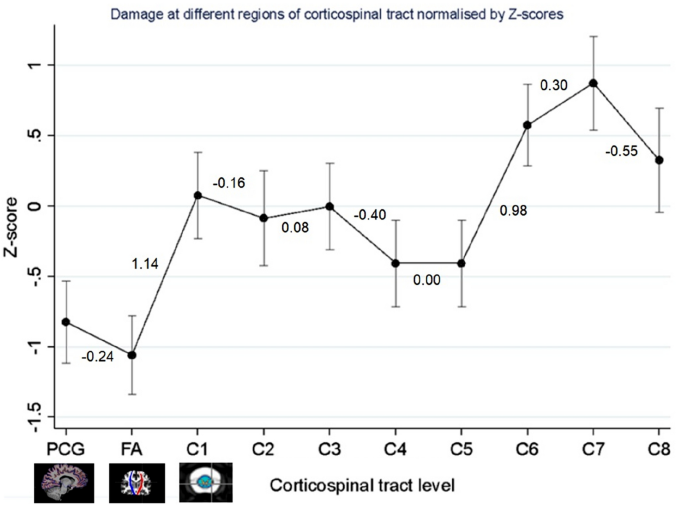
Background Magnetic resonance imaging (MRI) of the brain and cervical spinal cord is often performed in diagnostic evaluation of suspected motor neuron disease/amyotrophic lateral sclerosis (MND/ALS). Analysis of MRI-derived tissue damage metrics in a common domain facilitates group-level inferences on pathophysiology. This approach was applied to address competing hypotheses of directionality of neurodegeneration, whether anterograde, cranio-caudal dying-forward from precentral gyrus or retrograde, dying-back. Methods In this cross-sectional study, MRI was performed on 75 MND patients and 13 healthy controls. Precentral gyral thickness was estimated from volumetric T1-weighted images using FreeSurfer, corticospinal tract fractional anisotropy (FA) from diffusion tensor imaging using FSL, and cross-sectional cervical cord area between C1-C8 levels using Spinal Cord Toolbox. To analyse these multimodal data within a common domain, individual parameter estimates representing tissue damage at each corticospinal tract level were first converted to z -scores, referenced to healthy control norms. Mixed-effects linear regression models were then fitted to these z -scores, with gradients hypothesised to represent directionality of neurodegeneration. Results At group-level, z -scores did not differ significantly between precentral gyral and intracranial corticospinal tract tissue damage estimates (regression coefficient − 0.24, [95% CI − 0.62, 0.14], p = 0.222), but step-changes were evident between intracranial corticospinal tract and C1 (1.14, [95% CI 0.74, 1.53], p < 0.001), and between C5 and C6 cord levels (0.98, [95% CI 0.58, 1.38], p < 0.001). Discussion Analysis of brain and cervical spinal MRI data in a common domain enabled investigation of pathophysiological hypotheses in vivo. A cranio-caudal step-change in MND patients was observed, and requires further investigation in larger cohorts.
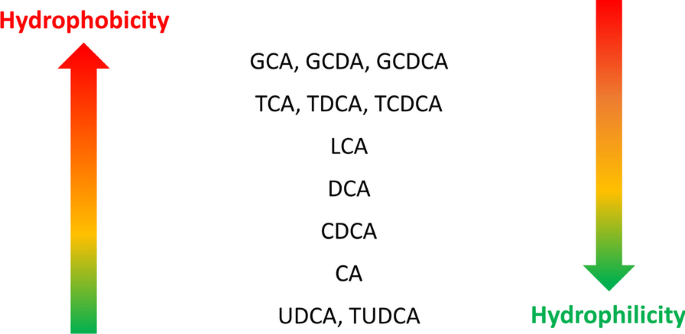
Most neurodegenerative disorders are diseases of protein homeostasis, with misfolded aggregates accumulating. The neurodegenerative process is mediated by numerous metabolic pathways, most of which lead to apoptosis. In recent years, hydrophilic bile acids, particularly tauroursodeoxycholic acid (TUDCA), have shown important anti-apoptotic and neuroprotective activities, with numerous experimental and clinical evidence suggesting their possible therapeutic use as disease-modifiers in neurodegenerative diseases. Experimental evidence on the mechanisms underlying TUDCA’s neuroprotective action derives from animal models of Alzheimer’s disease, Parkinson’s disease, Huntington’s diseases, amyotrophic lateral sclerosis (ALS) and cerebral ischemia. Preclinical studies indicate that TUDCA exerts its effects not only by regulating and inhibiting the apoptotic cascade, but also by reducing oxidative stress, protecting the mitochondria, producing an anti-neuroinflammatory action, and acting as a chemical chaperone to maintain the stability and correct folding of proteins. Furthermore, data from phase II clinical trials have shown TUDCA to be safe and a potential disease-modifier in ALS. ALS is the first neurodegenerative disease being treated with hydrophilic bile acids. While further clinical evidence is being accumulated for the other diseases, TUDCA stands as a promising treatment for neurodegenerative diseases.
Objective Amyotrophic lateral sclerosis (ALS) is a fatal neurodegenerative disorder associated with progressive loss of motor neurons. It is a growing and underestimated disease, prompting this epidemiological study to describe the characteristics of ALS in Egyptian patients. Methods This is a prospective hospital based study. ALS patients were recruited consecutively from Neuromuscular Unit in Ain Shams university Hospital from December 2018 to June 2023. Demographic data and disease related parameters were recorded. Results 203 ALS patients had a mean age of onset equal 39 years and an inter quartile range IQR of (28.00–51.00). 76% of the cases were spinal onset ALS. Median disease duration was 2 years with IQR of (1–4 years); male to female ratio was 2.5:1; 18% of patients were familial ALS (FALS), while 19% were Juvenile ALS (JALS). Median diagnostic delay was 12 ± (6–36) months. Median Amyotrophic Lateral Sclerosis Functional Rating Scale Revised scores (ALSFRS-R) at presentation was 34.5 IQR of (26.00–40.00). Also, the mean rate of disease progression ALSFRS-R decline [points/month] was 0.76 ± 0.51. Conclusion Our cohort was characterized by a younger age of onset, male predominance, more familial cases, within average Initial ALSFRS-R scores as well as diagnostic delay. Juvenile ALS patients were much more common in our population. These findings suggest an influential presence of genetic and epigenetic factors affecting the clinical phenotype of Egyptian ALS patients.
Background Amyotrophic lateral sclerosis (ALS) is a multifactorial neurodegenerative disease characterised by the loss of upper and lower motor neurons. Increasing evidence indicates that neuroinflammation mediated by microglia contributes to ALS pathogenesis. This microglial activation is evident in post-mortem brain tissues and neuroimaging data from patients with ALS. However, the role of microglia in the pathogenesis and progression of amyotrophic lateral sclerosis remains unclear, partly due to the lack of a model system that is able to faithfully recapitulate the clinical pathology of ALS. To address this shortcoming, we describe an approach that generates monocyte-derived microglia-like cells that are capable of expressing molecular markers, and functional characteristics similar to in vivo human brain microglia. Methods In this study, we have established monocyte-derived microglia-like cells from 30 sporadic patients with ALS, including 15 patients with slow disease progression, 6 with intermediate progression, and 9 with rapid progression, together with 20 non-affected healthy controls. Results We demonstrate that patient monocyte-derived microglia-like cells recapitulate canonical pathological features of ALS including non-phosphorylated and phosphorylated-TDP-43-positive inclusions. Moreover, ALS microglia-like cells showed significantly impaired phagocytosis, altered cytokine profiles, and abnormal morphologies consistent with a neuroinflammatory phenotype. Interestingly, all ALS microglia-like cells showed abnormal phagocytosis consistent with the progression of the disease. In-depth analysis of ALS microglia-like cells from the rapid disease progression cohort revealed significantly altered cell-specific variation in phagocytic function. In addition, DNA damage and NOD-leucine rich repeat and pyrin containing protein 3 (NLRP3) inflammasome activity were also elevated in ALS patient monocyte-derived microglia-like cells, indicating a potential new pathway involved in driving disease progression. Conclusions Taken together, our work demonstrates that the monocyte-derived microglia-like cell model recapitulates disease-specific hallmarks and characteristics that substantiate patient heterogeneity associated with disease subgroups. Thus, monocyte-derived microglia-like cells are highly applicable to monitor disease progression and can be applied as a functional readout in clinical trials for anti-neuroinflammatory agents, providing a basis for personalised treatment for patients with ALS.
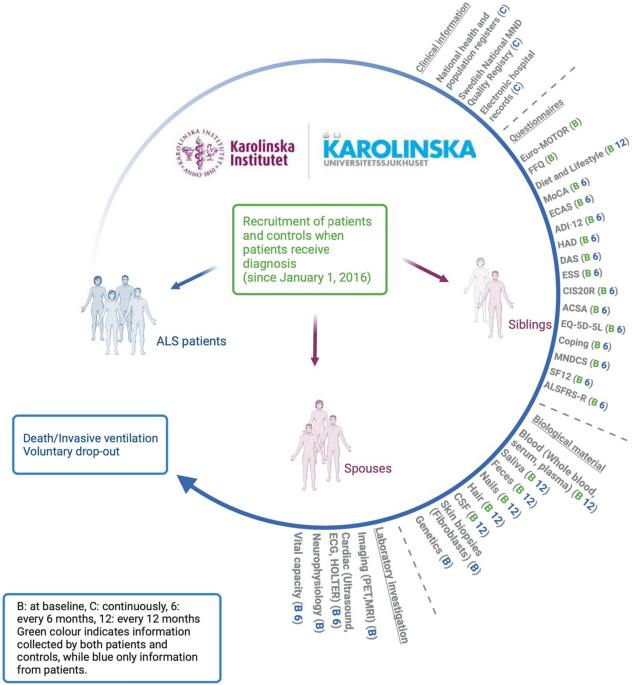
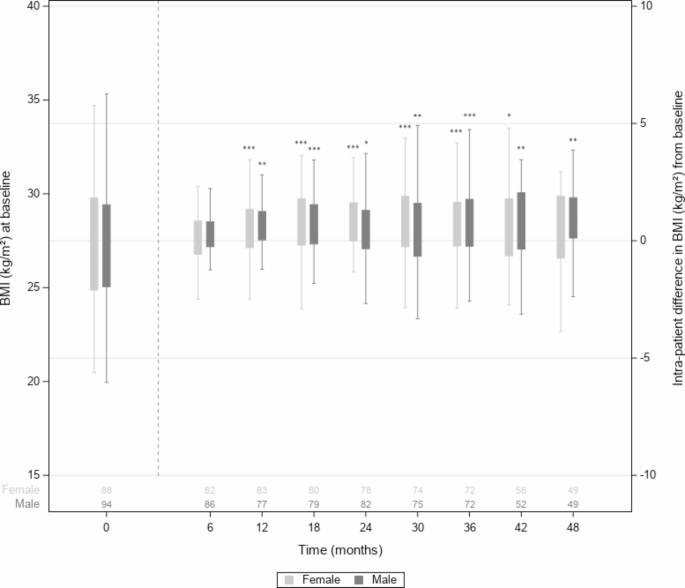
Background This study was an introduction to the Swedish ALSrisc Study and explored the association of lifestyle and medical conditions, with risk and progression of amyotrophic lateral sclerosis (ALS). Methods We included 265 newly diagnosed ALS patients during 2016–2022 in Stockholm and 207 ALS-free siblings and partners of the patients as controls. Information on body mass index (BMI), smoking, and history of head injuries, diabetes mellitus, hypercholesterolemia, and hypertension was obtained through the Euro-MOTOR questionnaire at recruitment. Patients were followed from diagnosis until death, invasive ventilation, or November 30, 2022. Results Higher BMI at recruitment was associated with lower risk for ALS (OR 0.89, 95%CI 0.83–0.95), especially among those diagnosed after 65 years. One unit increase in the average BMI during the 3 decades before diagnosis was associated with a lower risk for ALS (OR 0.94, 95%CI 0.89–0.99). Diabetes was associated with lower risk of ALS (OR 0.38, 95%CI 0.16–0.90), while hypercholesterolemia was associated with higher risk of ALS (OR 2.10, 95%CI 1.13–3.90). Higher BMI at diagnosis was associated with lower risk of death (HR 0.91, 95%CI 0.84–0.98), while the highest level of smoking exposure (in pack-years) (HR 1.90, 95%CI 1.20–3.00), hypercholesterolemia (HR 1.84, 95%CI 1.06–3.19), and hypertension (HR 1.76, 95%CI 1.03–3.01) were associated with higher risk of death, following ALS diagnosis. Conclusions Higher BMI and diabetes were associated with lower risk of ALS. Higher BMI was associated with lower risk of death, whereas smoking (especially in high pack-years), hypercholesterolemia, and hypertension were associated with higher risk of death after ALS diagnosis.
Background Uric acid (UA) has emerged as a factor that can modify cognitive function both in the general population and in people with neurodegenerative disorders. Since very few data are available concerning amyotrophic lateral sclerosis (ALS), we explored the correlation of UA levels and cognitive impairment in a large cohort of ALS patients. Methods We enrolled ALS patients consecutively seen at the Turin ALS expert center in the 2007–2018 period who underwent both cognitive/behavioral and UA evaluation at diagnosis. Patients were classified in 5 categories: normal cognition (ALS-CN), isolated cognitive impairment (ALSci), isolated behavioural impairment (ALSbi), cognitive and behavioural impairment (ALScbi), frontotemporal dementia (ALS-FTD). For this study, ALSci, ALSbi and ALScbi were merged as ALS with intermediate cognitive impairment (ALS-INT). Results Out of the 841 ALS patients, 422 had ALS-CN, 271 ALS-INT and 148 ALS-FTD. The mean values of UA were significantly different among the cognitive subgroups of patients, with the lowest values in the ALS-FTD (ALS-CN, 288.5 ± 78.0 (μmol/L; ALS-INT, 289.7 ± 75.5 μmol/L; ALS-FTD, 271.8 ± 74.9 μmol/L; p = 0.046). The frequency of ALS-FTD was significantly higher in the 1st tertile of UA. Lower UA levels were independently associated with FTD (OR 1.32, 95% c.i. 1.01–1.43; p = 0.038) in binary logistic regression. Conclusions We found that in ALS lower UA serum levels are correlated with reduced frequency of co-morbid FTD. Patients with intermediate cognitive impairment showed UA levels similar to ALS-CN but higher than ALS-FTD, implying that higher UA levels can prevent or delay cognitive function deterioration.
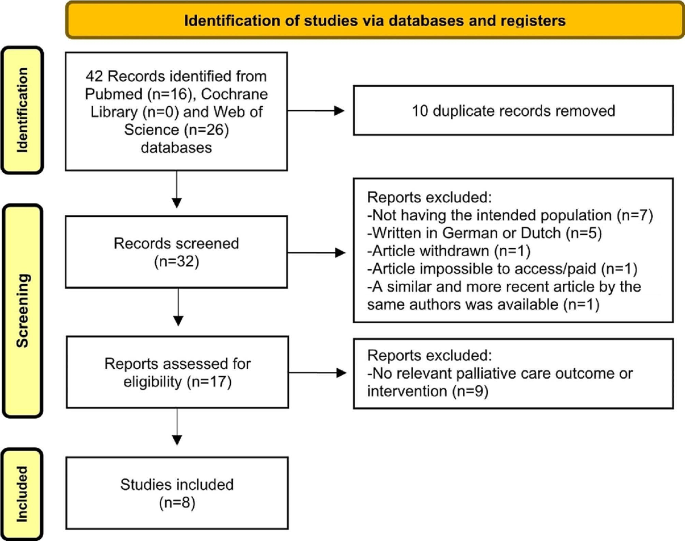
Background Breathlessness is a prevalent symptom affecting the quality of life (QOL) of Amyotrophic Lateral Sclerosis (ALS) patients. This systematic review explored the interventions for controlling breathlessness in ALS patients, emphasizing palliative care (PALC), non-invasive ventilation (NIV), opioids, and non-pharmacological strategies. Methods A comprehensive search of PubMed, Cochrane Library, and Web of Science databases was conducted. Eligibility criteria encompassed adults with ALS or motor neuron disease experiencing breathlessness. Outcomes included QOL and symptom control. Study designs comprised qualitative studies, cohort studies, and randomized controlled trials. Results Eight studies were included, most exhibiting low bias risk, comprising one randomized controlled trial, three cohort studies, two comparative retrospective studies, and two qualitative studies (interviews). Most studies originated from Europe, with one from the United States of America. The participants totaled 3423, with ALS patients constituting 95.6%. PALC consultations significantly improved symptom assessment, advance care planning, and discussions about goals of care. NIV demonstrated efficacy in managing breathlessness, with considerations for device limitations. Opioids were effective, though predominantly studied in non-ALS patients. Non-pharmacological strategies varied in efficacy among patients. Conclusion The findings underscore the need for individualized approaches in managing breathlessness in ALS. PALC, NIV, opioids, and non-pharmacological strategies each play a role, with unique considerations. Further research, especially ALS-specific self-management studies, is warranted.
Background The present study aimed at determining whether, net of motor confounders, neuropsychological features affect functional independence (FI) in activities of daily living (ADLs) in non-demented amyotrophic lateral sclerosis (ALS) patients. Methods N = 88 ALS patients without frontotemporal dementia were assessed for FI—Katz’s Basic ADL Scale (BADL) and Lawton-Brody’s Instrumental ADL Scale (IADL)—, cognition—Edinburgh Cognitive and Behavioural ALS Screen (ECAS)—and behaviour—Beaumont Behavioural Inventory and Dimensional Apathy Scale. The association between cognitive and behavioural measures and BADL/IADL scores was assessed by covarying for demographics, anxiety and depression levels, disease duration and motor confounders—i.e. ALS Functional Rating Scale-Revised (ALSFRS-R) scores, progression rate and both King’s and Milano-Torino stages. Results Higher scores on the ECAS-Language were associated with higher IADL scores ( p = 0.005), whilst higher apathetic features—as measured by the Dimensional Apathy Scale (DAS)—were inversely related to the BADL ( p = 0.003). Whilst IADL scores were related to all ECAS-Language tasks, the DAS-Initiation was the only subscale associated with BADL scores. Patients with abnormal ECAS-Language ( p = 0.023) and DAS ( p = 0.008) scores were more functionally dependent than those without. Discussion Among non-motor features, language changes and apathetic features detrimentally affect FI in non-demented ALS patients.
Background Amyotrophic lateral sclerosis (ALS) is a progressive and fatal motor neuron disease. Due to the limited knowledge about potential biomarkers that help in early diagnosis and monitoring disease progression, today’s diagnoses are based on ruling out other diseases, neurography, and electromyography examination, which takes a time-consuming procedure. Methods PubMed, ScienceDirect, and Web of Science were explored to extract articles published from January 2015 to June 2023. In the searching strategy following keywords were included; amyotrophic lateral sclerosis, biomarkers, cerebrospinal fluid, serum, and plama. Results A total number of 6 studies describing fluid-based exosomal biomarkers were included in this study. Aggregated proteins including SOD1, TDP-43, pTDP-43, and FUS could be detected in the microvesicles (MVs). Moreover, TDP-43 and NFL extracted from plasma exosomes could be used as prognostic biomarkers. Also, downregulated miR-27a-3p detected through exoEasy Maxi and exoQuick Kit in the plasma could be measured as a diagnostic biomarker. Eventually, the upregulated level of CORO1A could be used to monitor disease progression. Conclusion Based on the results, each biomarker alone is insufficient to evaluate ALS. CNS-derived exosomes contain multiple ALS-related biomarkers (SOD1, TDP-43, pTDP-43, FUS, and miRNAs) that are detectable in cerebrospinal fluid and blood is a proper alternation. Exosome detecting kits listed as exoEasy, ExoQuick, Exo-spin, ME kit, ExoQuick Plus, and Exo-Flow, are helpful to reach this purpose.
The most prominent genetic cause of both amyotrophic lateral sclerosis (ALS) and frontotemporal lobar degeneration (FTLD) is a repeat expansion in the gene C9orf72 . Importantly, the transcriptomic consequences of the C9orf72 repeat expansion remain largely unclear. Here, we used short-read RNA sequencing (RNAseq) to profile the cerebellar transcriptome, detecting alterations in patients with a C9orf72 repeat expansion. We focused on the cerebellum, since key C9orf72 -related pathologies are abundant in this neuroanatomical region, yet TDP-43 pathology and neuronal loss are minimal. Consistent with previous work, we showed a reduction in the expression of the C9orf72 gene and an elevation in homeobox genes, when comparing patients with the expansion to both patients without the C9orf72 repeat expansion and control subjects. Interestingly, we identified more than 1000 alternative splicing events, including 4 in genes previously associated with ALS and/or FTLD. We also found an increase of cryptic splicing in C9orf72 patients compared to patients without the expansion and controls. Furthermore, we demonstrated that the expression level of select RNA-binding proteins is associated with cryptic splice junction inclusion. Overall, this study explores the presence of widespread transcriptomic changes in the cerebellum, a region not confounded by severe neurodegeneration, in post-mortem tissue from C9orf72 patients.
Background Growing evidence suggests a mutual interaction between gut microbiome alterations and ALS pathogenesis. However, previous studies were susceptible to potential confounding factors and reverse causation bias, likely leading to inconsistent and biased results. Objectives To decipher the potentially mutual relationship between gut microbiota and ALS, we used a bidirectional two-sample MR approach to examine the associations between the gut microbiome and ALS. Results Using the inverse variance-weighted method, OTU10032 unclassified Enterobacteriaceae species-level OTU and unclassified Acidaminococcaceae were associated with a higher risk of ALS (per relative abundance: OR, 1.04; 95% CI, 1.01–1.07; P = 0.011 and OR, 1.02; 95% CI, 1.01–1.04; P = 0.009, respectively). Importantly, Gamma-Glu-Phe was showed potential deleterious effects on the risk of ALS (genetically predicted per a 1-standard deviation increase in the level of Gamma-Glu-Phe: OR, 1.96; 95% CI, 1.50–2.55; P = 0.012). Sensitivity analysis of the two candidate genera and metabolites using the MR-Egger and weighted-median methods produced similar estimates, and no horizontal pleiotropy or outliers were observed. Intriguingly, genetically predicted ALS was associated with an increase in the relative abundance of OTU4607_Sutterella (per 1-unit higher log odds: β, 2.23; 95% CI, 1.27–3.18; P = 0.020) and Lactobacillales_ORDER (per 1-unit higher log odds: β, 0.51; 95% CI, 0.09–0.94; P = 0.019). Conclusions Our findings provide novel evidence supporting the bidirectional relationship between the gut microbiota and ALS. These results may contribute to designing microbiome- and microbiome-dependent metabolite interventions in future ALS clinical trials.
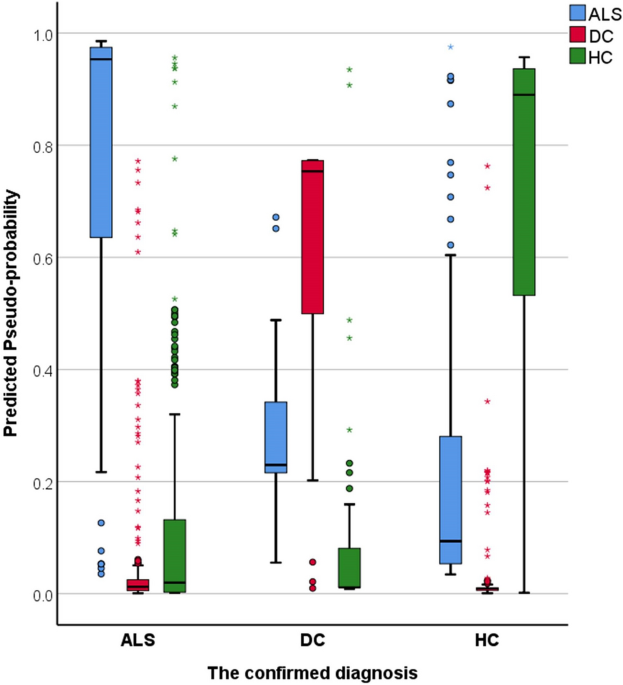
The description of group-level, genotype- and phenotype-associated imaging traits is academically important, but the practical demands of clinical neurology centre on the accurate classification of individual patients into clinically relevant diagnostic, prognostic and phenotypic categories. Similarly, pharmaceutical trials require the precision stratification of participants based on quantitative measures. A single-centre study was conducted with a uniform imaging protocol to test the accuracy of an artificial neural network classification scheme on a cohort of 378 participants composed of patients with ALS, healthy subjects and disease controls. A comprehensive panel of cerebral volumetric measures, cortical indices and white matter integrity values were systematically retrieved from each participant and fed into a multilayer perceptron model. Data were partitioned into training and testing and receiver-operating characteristic curves were generated for the three study-groups. Area under the curve values were 0.930 for patients with ALS, 0.958 for disease controls, and 0.931 for healthy controls relying on all input imaging variables. The ranking of variables by classification importance revealed that white matter metrics were far more relevant than grey matter indices to classify single subjects. The model was further tested in a subset of patients scanned within 6 weeks of their diagnosis and an AUC of 0.915 was achieved. Our study indicates that individual subjects may be accurately categorised into diagnostic groups in an observer-independent classification framework based on multiparametric, spatially registered radiology data. The development and validation of viable computational models to interpret single imaging datasets are urgently required for a variety of clinical and clinical trial applications.
Amyotrophic Lateral Sclerosis (ALS) is a devastating neurodegenerative disease in which many processes are detected including (neuro)inflammation. Many drugs have been tested for ALS in clinical trials but most have failed to reach their primary endpoints. The development and inclusion of different types of biomarkers in diagnosis and clinical trials can assist in determining target engagement of a drug, in distinguishing between ALS and other diseases, and in predicting disease progression rate, drug responsiveness, or an adverse event. Ideally, among other characteristics, a biomarker in ALS correlates highly with a disease process in the central nervous system or with disease progression and is conveniently obtained in a peripheral tissue. Here, we describe the state of biomarkers of inflammation in ALS by focusing on peripherally detectable and cellular responses from blood cells, and provide new (combinatorial) directions for exploration that are now feasible due to technological advancements.
Background While amyotrophic lateral sclerosis (ALS) incidence has increased during the last decades, structured evidence on increased prevalence is lacking. After reporting a significant yearly increase of ALS incidence over a 10-year period, we checked for increased prevalence in Southern Sardinia over a quinquennium. Methods ALS patients (El Escorial Criteria) recruited from the study area and followed at ALS Centre, University of Cagliari, were included. Prevalence was computed for January 1, 2015 and January 1, 2019 and was calculated for the overall ALS population as well as for tracheostomized and non-tracheostomized patients. Results We observed a non-significant trend for greater ALS prevalence in 2019 than in 2015 (18.31 per 100,000 vs. 15.26 per 100,000; rate ratio: 1.83, p = 0.01). By contrast, a significantly raising 2015 to 2019 ALS prevalence was observed in tracheostomized patients. No significant difference could be detected in non-tracheostomized. Conclusions We provided the highest prevalence rate to date reported in the worldwide literature, and also showed a non-significant raising ALS prevalence in the Sardinian population over a quinquennium. The trend in raising ALS prevalence was likely due to extended survival due to invasive interventions.
Background Fasciculation is an important sign for the diagnosis of amyotrophic lateral sclerosis (ALS). Our study aimed to analyze the difference in fasciculation detected with muscle ultrasonography (MUS) between ALS patients and non-ALS patients with symptoms resembling ALS. Methods Eighty-eight ALS patients and fifty-four non-ALS (eight multifocal motor neuropathy, 32 chronic inflammatory demyelinating polyneuropathy/Charcot-Marie-Tooth, and 14 cervical spondylopathy or lumbar spondylopathy) patients were recruited. MUS was performed on 19 muscle groups in cervical, lumbosacral, bulbar, and thoracic regions for each patient. The intensity of fasciculation was divided into five grades based on firing frequency and number in the involved muscle groups. Results The overall detection rates were 72.8% in ALS and 18% in non-ALS patients. The fasciculation grades (median [IQR]) were 2 (0–3) in ALS and 0 (0–0) in non-ALS patients ( P < 0.001). Fasciculations were observed in four regions for ALS patients and primarily distributed in proximal limbs. Fasciculations in non-ALS patients were primarily low-grade and mostly distributed in distal limbs. Discussion The fasciculation grade was higher in ALS than non-ALS patients. The distribution pattern of fasciculation was different between ALS and non-ALS patients. Conclusions The fasciculation grade and distribution pattern detected with MUS could help distinguish ALS from non-ALS patients.
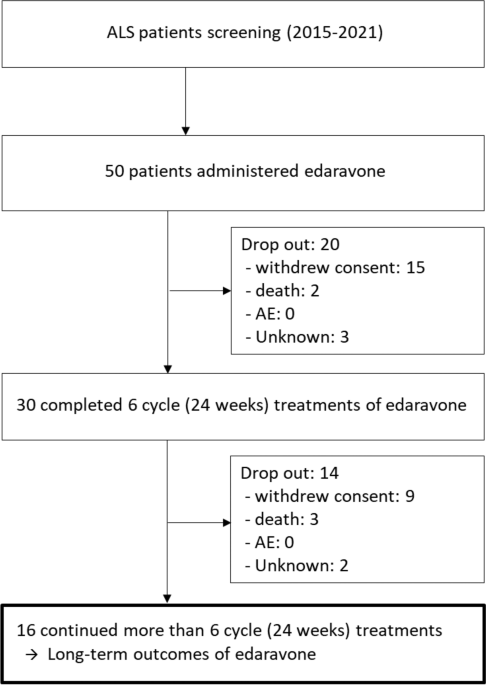
Background Amyotrophic lateral sclerosis (ALS) is a lethal neurodegenerative disease characterized by the gradual loss of upper and lower motor neurons that leads to progressive muscle atrophy and weakness. Edaravone, a free-radical scavenger, was approved as an ALS treatment in 2015 in South Korea. Methods This study investigated the long-term effects and safety of edaravone by reviewing the medical records of 16 Korean patients with ALS who received extended edaravone between 2015 and 2021 in a single tertiary ALS center. Results Among sixteen patients, eleven patients underwent extended edaravone therapy for more than 18 cycles (72 weeks). The mean monthly changes in the revised ALS Functional Rating Scale (ALSFRS-R) were − 0.96 ± 0.83 (0–24 weeks), − 0.70 ± 0.76 (24–48 weeks), − 1.18 ± 1.67 (48–72 weeks), and − 0.81 ± 0.60 (0–72 weeks). The mean decline in forced vital capacity (FVC) was 17.4 ± 24.1. The changes were significant in both ALSFRS-R ( p < 0.001) and FVC ( p = 0.048); however, the mean change in compound muscle action potential of phrenic nerves was not. Patients experienced only minor adverse events, which were well tolerated. Conclusions This study verifies previous reported outcomes of edaravone in 16 Korean ALS patients, indicating a modest effect with a favorable safety profile.
Background Amyotrophic lateral sclerosis (ALS) is known to cause generalized muscle atrophy and respiratory complications. Anesthetic agents and methods for patients with ALS are extremely important because they critically influence postoperative outcomes. In this clinical case, we mainly used remimazolam for safe anesthesia management. Case presentation A 66-year-old man had a gradual onset of numbness and weakness in his extremities over 2 years. He was diagnosed with ALS after the appearance of dysarthria and restrictive ventilation disorder. Due to the rapid progression of respiratory dysfunction, the patient was placed on artificial respiration, and a tracheostomy was planned. General anesthesia was induced with remimazolam (6 mg/kg/h) and remifentanil (0.5 μg/kg/min). Tracheal intubation was performed without muscle relaxants, followed by total intravenous anesthesia (TIVA) with continuous administration of remimazolam 0.8–1.2 mg/kg/h and remifentanil 0.3–0.5 μg/kg/min. At the end of the surgery, the anesthetic effect of remimazolam was reversed with 0.4 mg of flumazenil. The patient was discharged from the operating room with stable breathing, and changes to preoperative ventilator settings were not necessary. Conclusions We safely performed tracheostomy for a patient with ALS using remimazolam during general anesthesia.
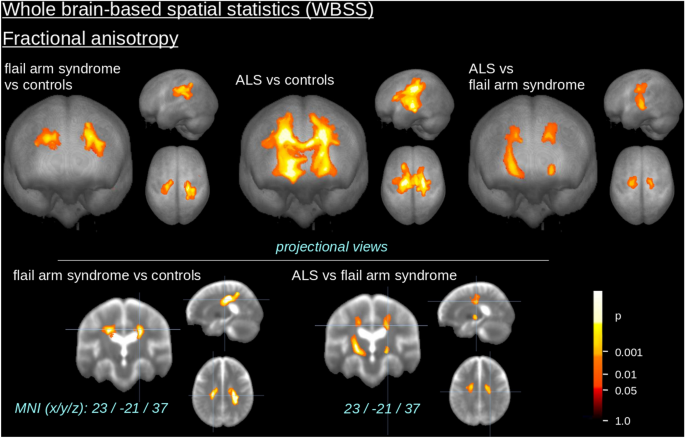
Background Flail arm syndrome is a restricted phenotype of motor neuron disease that is characterized by progressive, predominantly proximal weakness and atrophy of the upper limbs. Objective The study was designed to investigate specific white matter alterations in diffusion tensor imaging (DTI) data from flail arm syndrome patients using a hypothesis-guided tract-of-interest-based approach to identify in vivo microstructural changes according to a neuropathologically defined amyotrophic lateral sclerosis (ALS)-related pathology of the cortico-efferent tracts. Methods DTI-based white matter mapping was performed both by an unbiased voxel-wise statistical comparison and by a hypothesis-guided tract-wise analysis of fractional anisotropy (FA) maps according to the neuropathological ALS-propagation pattern for 43 flail arm syndrome patients vs 43 ‘classical’ ALS patients vs 40 matched controls. Results The analysis of white matter integrity demonstrated regional FA reductions for the flail arm syndrome group predominantly along the CST. In the tract-specific analysis according to the proposed sequential cerebral pathology pattern of ALS, the flail arm syndrome patients showed significant alterations of the specific tract systems that were identical to ‘classical’ ALS if compared to controls . Conclusions The DTI study including the tract-of-interest-based analysis showed a microstructural involvement pattern in the brains of flail arm syndrome patients, supporting the hypothesis that flail arm syndrome is a phenotypical variant of ALS.
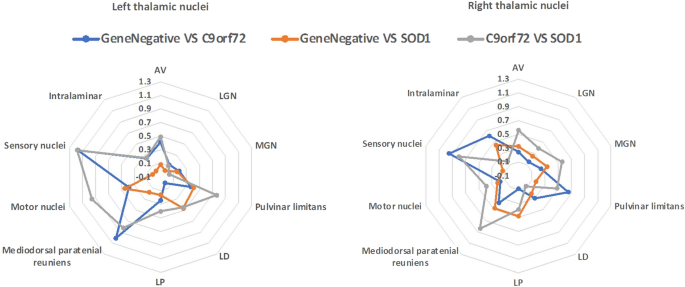
Background The characterisation of presymptomatic disease-burden patterns in asymptomatic mutation carriers has a dual academic and clinical relevance. The understanding of disease propagation mechanisms is of considerable conceptual interests, and defining the optimal time of pharmacological intervention is essential for improved clinical trial outcomes. Methods In a prospective, multimodal neuroimaging study, 22 asymptomatic C9orf72 GGGGCC hexanucleotide repeat carriers, 13 asymptomatic subjects with SOD1 , and 54 “gene-negative” ALS kindreds were enrolled. Cortical and subcortical grey matter alterations were systematically appraised using volumetric, morphometric, vertex, and cortical thickness analyses. Using a Bayesian approach, the thalamus and amygdala were further parcellated into specific nuclei and the hippocampus was segmented into anatomically defined subfields. Results Asymptomatic GGGGCC hexanucleotide repeat carriers in C9orf72 exhibited early subcortical changes with the preferential involvement of the pulvinar and mediodorsal regions of the thalamus, as well as the lateral aspect of the hippocampus. Volumetric approaches, morphometric methods, and vertex analyses were anatomically consistent in capturing focal subcortical changes in asymptomatic C9orf72 hexanucleotide repeat expansion carriers. SOD1 mutation carriers did not exhibit significant subcortical grey matter alterations. In our study, none of the two asymptomatic cohorts exhibited cortical grey matter alterations on either cortical thickness or morphometric analyses. Discussion The presymptomatic radiological signature of C9orf72 is associated with selective thalamic and focal hippocampal degeneration which may be readily detectable before cortical grey matter changes ensue. Our findings confirm selective subcortical grey matter involvement early in the course of C9orf72 -associated neurodegeneration.
Introduction The absence of nigrosome 1 on brain MRI and the hyperechogenicity of substantia nigra (SNh) by transcranial sonography are two useful biomarkers in the diagnosis of parkinsonisms. We aimed to evaluate the absence of nigrosome 1 in amyotrophic lateral sclerosis (ALS) and to address its meaning. Methods 136 ALS patients were recruited, including 16 progressive muscular atrophy (PMA) and 22 primary lateral sclerosis (PLS) patients. The SNh area was measured planimetrically by standard protocols. The nigrosome 1 status was qualitatively assessed by two blind evaluators in susceptibility weight images of 3T MRI. Demographic and clinical data were collected and the C9ORF72 expansion was tested in all patients. Results Nigrosome 1 was absent in 30% of ALS patients (36% of PLS, 29% of classical ALS and 19% of PMA patients). There was no relationship between radiological and clinical laterality, nor between nigrosome 1 and SNh area. Male sex (OR = 3.63 [1.51, 9.38], p = 0.005) and a higher upper motor neuron (UMN) score (OR = 1.10 [1.02, 1.2], p = 0.022) were independently associated to nigrosome 1 absence, which also was an independent marker of poor survival (HR = 1.79 [1.3, 2.8], p = 0.013). Conclusion In ALS patients, the absence of nigrosome 1 is associated with male sex, UMN impairment and shorter survival. This suggests that constitutional factors and the degree of pyramidal involvement are related to the substantia nigra involvement in ALS. Thus, nigrosome 1 could be a marker of a multisystem degeneration, which in turn associates to poor prognosis.
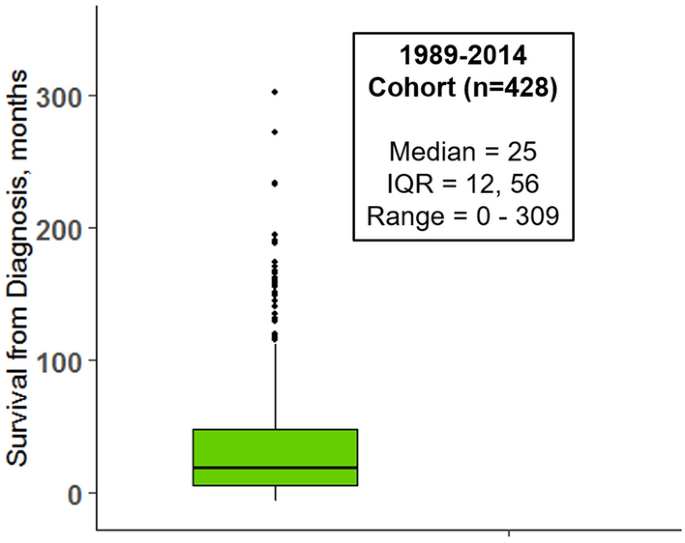
Background We investigated the phenotypes and genotypes of a cohort of ‘long-surviving’ individuals with motor neuron disease (MND) to identify potential targets for prognostication. Methods Patients were recruited via the Clinical Audit Research and Evaluation for MND (CARE-MND) platform, which hosts the Scottish MND Register. Long survival was defined as > 8 years from diagnosis. 11 phenotypic variables were analysed. Whole genome sequencing (WGS) was performed and variants within 49 MND-associated genes examined. Each individual was screened for C9orf72 repeat expansions. Data from ancestry-matched Scottish populations (the Lothian Birth Cohorts) were used as controls. Results 58 long survivors were identified. Median survival from diagnosis was 15.5 years. Long survivors were significantly younger at onset and diagnosis than incident patients and had a significantly longer diagnostic delay. 42% had the MND subtype of primary lateral sclerosis (PLS). WGS was performed in 46 individuals: 14 (30.4%) had a potentially pathogenic variant. 4 carried the known SOD1 p.(Ile114Thr) variant. Significant variants in FIG4 , hnRNPA2B1, SETX, SQSTM1, TAF15, and VAPB were detected. 2 individuals had a variant in the SPAST gene suggesting phenotypic overlap with hereditary spastic paraplegia (HSP). No long survivors had pathogenic C9orf72 repeat expansions. Conclusions Long survivors are characterised by younger age at onset, increased prevalence of PLS and longer diagnostic delay. Genetic analysis in this cohort has improved our understanding of the phenotypes associated with the SOD1 variant p.(Ile114Thr). Our findings confirm that pathogenic expansion of C9orf72 is likely a poor prognostic marker. Genetic screening using targeted MND and/or HSP panels should be considered in those with long survival, or early-onset slowly progressive disease, to improve diagnostic accuracy and aid prognostication.
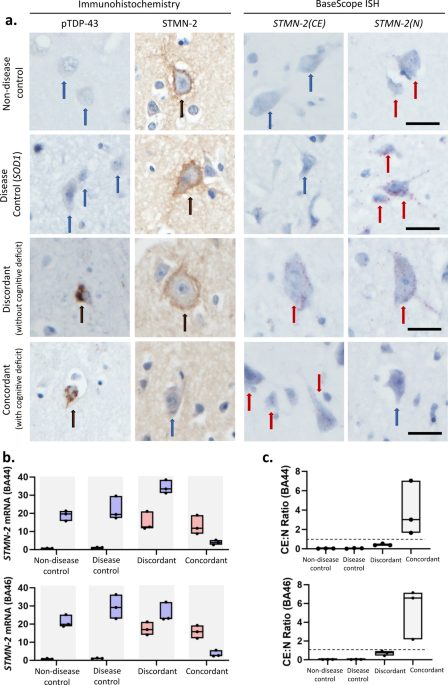
TDP-43 is an aggregation-prone protein which accumulates in the hallmark pathological inclusions of amyotrophic lateral sclerosis (ALS). However, the analysis of deeply phenotyped human post-mortem samples has shown that TDP-43 aggregation, revealed by standard antibody methods, correlates poorly with symptom manifestation. Recent identification of cryptic-splicing events, such as the detection of Stathmin-2 ( STMN-2 ) cryptic exons, are providing evidence implicating TDP-43 loss-of-function as a potential driving pathomechanism but the temporal nature of TDP-43 loss and its relation to the disease process and clinical phenotype is not known. To address these outstanding questions, we used a novel RNA aptamer, TDP-43^APT, to detect TDP-43 pathology and used single molecule in situ hybridization to sensitively reveal TDP-43 loss-of-function and applied these in a deeply phenotyped human post-mortem tissue cohort. We demonstrate that TDP-43^APT identifies pathological TDP-43, detecting aggregation events that cannot be detected by classical antibody stains. We show that nuclear TDP-43 pathology is an early event, occurring prior to cytoplasmic accumulation and is associated with loss-of-function measured by coincident STMN-2 cryptic splicing pathology. Crucially, we show that these pathological features of TDP-43 loss-of-function precede the clinical inflection point and are not required for region specific clinical manifestation. Furthermore, we demonstrate that gain-of-function in the form of extensive cytoplasmic accumulation, but not loss-of-function, is the primary molecular correlate of clinical manifestation. Taken together, our findings demonstrate implications for early diagnostics as the presence of STMN-2 cryptic exons and early TDP-43 aggregation events could be detected prior to symptom onset, holding promise for early intervention in ALS.
Amyotrophic lateral sclerosis (ALS) is a progressive neurodegenerative disease involving both upper and lower motor neurons, leading to paralysis and eventually death. Symptomatic treatments such as inhibition of salivation, alleviation of muscle cramps, and relief of spasticity and pain still play an important role in enhancing the quality of life. To date, riluzole and edaravone are the only two drugs approved by the Food and Drug Administration for the treatment of ALS in a few countries. While there is adequate consensus on the modest efficacy of riluzole, there are still open questions concerning the efficacy of edaravone in slowing the disease progression. Therefore, identification of novel therapeutic strategies is urgently needed. Impaired autophagic process plays a critical role in ALS pathogenesis. In this review, we focus on therapies modulating autophagy in the context of ALS. Furthermore, stem cell therapies, gene therapies, and newly-developed biomaterials have great potentials in alleviating neurodegeneration, which might halt the disease progression. In this review, we will summarize the current and prospective therapies for ALS.
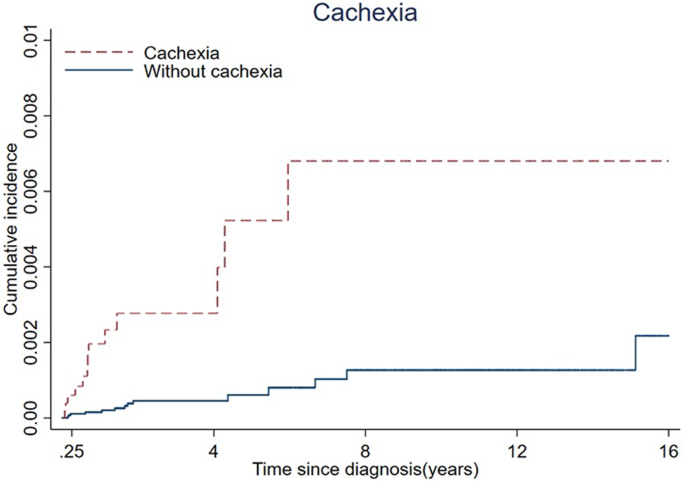
In the present study, we investigated the associations of cachexia (loss of muscle, weight and fat) and frailty (loss of weight and muscle) status with the risk of developing amyotrophic lateral sclerosis, because these specific terms are rarely used in this research area. In this prospective study, we extracted cachexia and frailty status from the UK Biobank cohort to study the associations of these conditions (as determined via international classification of disease-10 codes) with amyotrophic lateral sclerosis. There was a greater risk of developing amyotrophic lateral sclerosis among individuals with cachexia and frailty status after adjusting for age, sex, income (pounds), body mass index, UK Biobank centers and smoking status. Among individuals with frailty status: a grip strength of < 21 kg, a slow walking speed, and exhaustion (more than half the days or nearly every day) increase the risk of developing amyotrophic lateral sclerosis. We believe that studying cachexia and frailty status can be used to help define and treat amyotrophic lateral sclerosis.
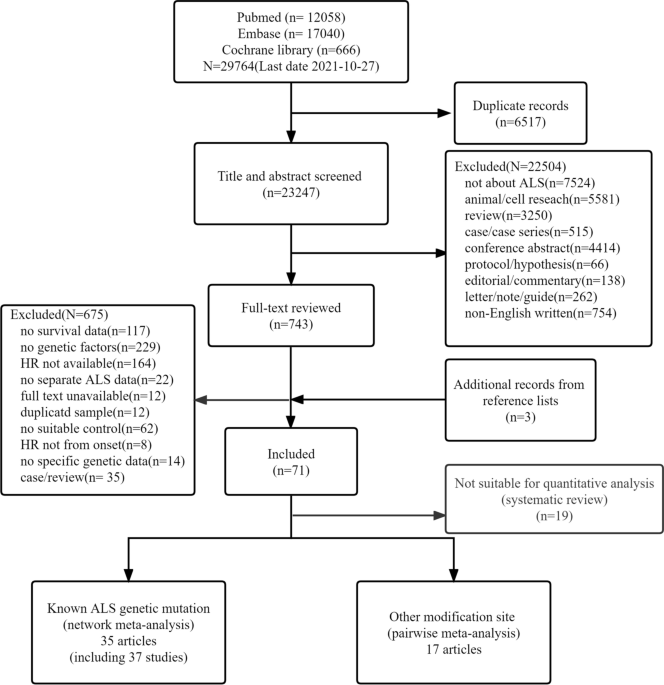
Background The time of survival in patients with amyotrophic lateral sclerosis (ALS) varies greatly, and the genetic factors that contribute to the survival of ALS are not well studied. There is a lack of a comprehensive study to elucidate the role of genetic factors in the survival of ALS. Methods The published studies were systematically searched and obtained from PubMed, EMBASE, and the Cochrane Library without any language restrictions from inception to Oct 27, 2021. A network meta-analysis for ALS causative/risk genes and a systematic review and pairwise meta-analysis for other genetic modifiers were conducted. The PROSPERO registration number: CRD42022311646. Results A total of 29,764 potentially relevant references were identified, and 71 papers were eligible for analysis based on pre-decided criteria, including 35 articles in network meta-analysis for 9 ALS causative/risk genes, 17 articles in pairwise meta-analysis for four genetic modifiers, and 19 articles described in the systematic review. Variants in three genes, including ATXN2 (HR: 3.6), C9orf72 (HR: 1.6), and FUS (HR:1.8), were associated with short survival of ALS, but such association was not identified in SOD1 , TARDBP , TBK1 , NEK1 , UBQLN2 , and CCNF . In addition, UNC13A rs12608932 CC genotype and ZNF521B rs2275294 C allele also caused a shorter survival of ALS; however, APOE ε4 allele and KIFAP3 rs1541160 did not be found to have any effect on the survival of ALS. Conclusions Our study summarized and contrasted evidence for prognostic genetic factors in ALS and would help to understand ALS pathogenesis and guide clinical trials and drug development.
Purpose Histological grading of tumours is a well-established biomarker used to guide treatment in female breast cancer. However, its significance in male breast cancer remains unclear. This systematic review investigates the prognostic significance of tumour grade in relation to breast cancer-specific survival (BCSS) in male breast cancer patients undergoing surgery. Methods MEDLINE, PUBMED Central and EMBASE databases were searched to identify randomised trials and observational studies related to male breast neoplasms, tumour grading, recurrence, and survival. Results A total of fifteen observational type studies were included in the review. A significant association between tumour grade and BCSS was reported in a majority of studies. This association was most evident with regard to high-grade (grade III) compared to low grade (grade I) tumours, with a significant relationship in 4 out of 4 studies. For intermediate-grade II tumours an association was demonstrated in a minority of studies. Conclusions This study confirms an association between high-grade male breast cancers and poorer disease-specific survival, however, the significance of intermediate-grade tumours remains unclear. Further research is required to investigate the biology of male breast cancer in relation to histological grade and optimally define intermediate-grade disease.
As our understanding of biological systems reaches single-cell and high spatial resolutions, it becomes imperative that pharmacological approaches match this precision to understand drug actions. This need is particularly urgent for the targeted covalent inhibitors that are currently re-entering the stage for cancer treatments. Therefore, we developed 3D volumetric clearing-assisted tissue click chemistry (vCATCH) to image in vivo target-bound drugs by leveraging the unique kinetics of click reactions. In mice, vCATCH overcomes limitations of existing methods to achieve high-throughput volumetric chemical labeling through simple and passive incubation steps, thus enabling unbiased cellular resolution drug imaging in entire animals. We combined vCATCH with HYBRiD imaging and virtual reality to visualize and quantify in vivo targets of two clinical cancer drugs, afatinib and ibrutinib, which recapitulated their known pharmacological distribution and revealed previously unreported tissue and cell type engagement potentially linked to off-target effects. vCATCH provides a body-wide, unbiased platform to map covalent drug engagements at unprecedented scale and precision.
Aims The transition from pediatric to adult healthcare is crucial for adolescent cancer survivors due to the potential lifelong late effects of their treatment. Despite the importance of ongoing follow-up care, attendance often declines after transitioning to adult services. This study explores the perspectives of adolescent and adult pediatric cancer survivors and their families on this transition process. Methods Using the Theory of Planned Behaviour, we developed interview guidelines and conducted 36 episodic narrative interviews with survivors and their parents. Our analysis focuses on their transition experiences and expectations, as part of the broader VersKiK-Study aimed at improving (long-term) follow-up care for pediatric cancer survivors in Germany. Results Findings show that although transitioning is viewed as a significant step toward adulthood, a lack of preparedness and anxiety can hinder a shift between healthcare systems. Survivors expressed the need to initiate the transition process while still under pediatric care. Clear and effective communication was identified as key to ensuring a smooth transition. Adult survivors acknowledged the transition's importance in fostering self-reliance and independence. Conclusions To facilitate better outcomes, transition planning should include early introductions to adult care providers and strong communication strategies to address the emotional and psychosocial challenges faced by adolescent cancer survivors. Aligning transition practices with the needs and concerns of survivors could enhance follow-up care engagement, ultimately improving long-term outcomes for pediatric cancer survivors.
Background Cytological screening remains a high-impact practice, particularly in low-resource settings, for preventing cervical cancer. The examination of screening practices over time and the prevalence of epithelial abnormalities have not been investigated in longitudinal studies in one of the largest countries in the Middle East and Africa. Methods Routine healthcare data, between March 1981 and December 2022, were extracted from the database of the Early Cancer Detection Unit in a tertiary referral university hospital in the Greater Cairo Region, Egypt. Cervical smears were obtained using a standardized technique and sent to the cytopathology laboratory for conventional cytology examination by expert pathologists. The anonymous data were analyzed to determine the temporal trend of the number of women screened each year and the prevalence of epithelial abnormalities. Results Data included the results of satisfactory smears from 95120 women. The mean age (SD) of the women at the time of screening was 38.5 (10.5). None of the included women received an HPV vaccine. Abnormal epithelial cells were reported in 5174 women (5.44%). Of these epithelial abnormalities, the majority were low-grade squamous intraepithelial lesions in 4144 women (4.36%). Other abnormalities included atypical squamous cells in 378 women (0.40%), high-grade squamous intraepithelial lesions in 226 women (0.24%), atypical glandular cells not otherwise specified in 184 women (0.19%), adenocarcinoma in 165 women (0.17%), squamous cell carcinoma in 70 women (0.07%), and atypical glandular cells favoring neoplasms in 7 women (0.01%). Women who were at an early age at first intercourse, those who opted for routine cervical cytology screening, and those who were older at screening were more likely to have epithelial abnormalities. The yearly number of screened women was positively associated with the detection of low-grade squamous intraepithelial lesions (correlation coefficient [95% CI] = 0.84 [0.72, 0.91]) and negatively associated with the detection of squamous cell carcinoma (correlation coefficient [95% CI] = -0.55 [-0.73, -0.29]). Conclusions The small number of annually screened Egyptian women and the temporal trend in epithelial abnormalities critically demonstrate the need for establishing and scaling up a structured population-based program to achieve the goal of eliminating cervical cancer.
Background Endometrial cancer represents a significant health challenge, with rising incidence and complex prognostic challenges. This study aimed to develop a robust predictive model integrating programmed cell death-related genes and advanced machine learning techniques. Methods Utilizing transcriptomic data from TCGA-UCEC and GSE119041 datasets, we employed a comprehensive approach involving 117 machine learning algorithms. Key methodologies included differential gene expression analysis, weighted gene co-expression network analysis, functional enrichment studies, immune landscape evaluation, and multi-dimensional risk stratification. Results We identified 10 critical genes (PTGIS, TIMP3, SRPX, SNCA, HIC1, BAK1, STXBP2, TRIB3, RTKN2, E2F1) and constructed a prognostic model with superior predictive performance. The StepCox[forward] + plsRcox algorithm combination demonstrated excellent predictive accuracy (AUC > 0.8). Kaplan–Meier analysis revealed significant survival differences between high- and low-risk groups in both training (HR = 3.37, p < 0.001) and validation cohorts (HR = 2.05, p = 0.021). The model showed strong correlations with clinical characteristics, immune cell infiltration patterns, and potential therapeutic responses. Conclusions This study presents a novel, comprehensive approach to endometrial cancer prognosis, integrating machine learning and molecular insights to provide a more precise risk stratification tool with potential clinical translation.
Purpose of Review This review examines racial, ethnic, and socioeconomic disparities in cardio-oncology care, evaluating current evidence and proposing evidence-based strategies to address inequities in cardiovascular care for cancer patients. Recent Findings Significant disparities exist in cardio-oncology outcomes and access across populations. Racial and ethnic minoritized groups face higher cardiovascular mortality and increased cardiotoxicity risks during cancer treatment. These populations also preset with more advanced-stage cancer diagnoses and increased burden of cardiovascular risk factors. Social vulnerability indices strongly correlate with worse outcomes, while geographic location and environmental factors create additional risks. Rural populations particularly struggle with access to specialized care and clinical trials. Summary Multiple factors contribute to disparities in cardio-oncology, including social determinants of health, disproportionate burden of cardiovascular risk factors, barriers to access, and environmental exposures. Key solutions include expanding access to subspecialty care, creation of collaborations between academic centers and community hospitals, particularly those in underserved communities, enhancing community engagement and public health education, improving clinical trial representation, increasing workforce diversity, and enhancing cultural competency. These findings emphasize the need for systematic healthcare delivery changes and resource allocation to achieve equitable cardio-oncology care for all populations.
Artificial intelligence may assist healthcare systems in meeting increasing
demand for pathology services while maintaining diagnostic quality and reducing
turnaround time and costs. We aimed to investigate the performance of an
institutionally developed system for prostate cancer detection, grading, and
workflow optimization and to contrast this with commercial alternatives. From
August 2021 to March 2023, we scanned 21,396 slides from 1,147 patients
receiving prostate biopsy. We developed models for cancer detection, grading,
and screening of equivocal cases for IHC ordering. We compared the performance
of task-specific prostate models with general-purpose foundation models in a
prospectively collected dataset that reflects our patient population. We also
evaluated the contributions of a bespoke model designed to improve sensitivity
to small cancer foci and perception of low-resolution patterns. We found high
concordance with pathologist ground-truth in detection (area under curve 98.5%,
sensitivity 95.0%, and specificity 97.8%), ISUP grading (Cohen's kappa 0.869),
grade group 3 or higher classification (area under curve 97.5%, sensitivity
94.9%, specificity 96.6%). Screening models could correctly classify 55% of
biopsy blocks where immunohistochemistry was ordered with a 1.4% error rate. No
statistically significant differences were observed between task-specific and
foundation models in cancer detection, although the task-specific model is
significantly smaller and faster. Institutions like academic medical centers
that have high scanning volumes and report abstraction capabilities can develop
highly accurate computational pathology models for internal use. These models
have the potential to aid in quality control role and to improve resource
allocation and workflow in the pathology lab to help meet future challenges in
prostate cancer diagnosis.
Intratumour phenotypic heterogeneity is nowadays understood to play a critical role in disease progression and treatment failure. Accordingly, there has been increasing interest in the development of mathematical models capable of capturing its role in cancer cell adaptation. This can be systematically achieved by means of models comprising phenotype-structured nonlocal partial differential equations, tracking the evolution of the phenotypic density distribution of the cell population, which may be compared to gene and protein expression distributions obtained experimentally. Nevertheless, given the high analytical and computational cost of solving these models, much is to be gained from reducing them to systems of ordinary differential equations for the moments of the distribution. We propose a generalised method of model-reduction, relying on the use of a moment generating function, Taylor series expansion and truncation closure, to reduce a nonlocal reaction-advection-diffusion equation, with general phenotypic drift and proliferation rate functions, to a system of moment equations up to arbitrary order. Our method extends previous results in the literature, which we address via two examples, by removing any a priori assumption on the shape of the distribution, and provides a flexible framework for mathematical modellers to account for the role of phenotypic heterogeneity in cancer adaptive dynamics, in a simpler mathematical framework.
Oncogene amplification is a key driver of cancer pathogenesis and is often mediated by extrachromosomal DNA (ecDNA). EcDNA amplifications are associated with increased pathogenicity of cancer and poorer outcomes for patients. EcDNA can be detected accurately using fluorescence in situ hybridization (FISH) when cells are arrested in metaphase. However, the majority of cancer cells are non-mitotic and must be analyzed in interphase, where it is difficult to discern extrachromosomal amplifications from chromosomal amplifications. Thus, there is a need for methods that accurately predict oncogene amplification status from interphase cells. Here, we present interSeg, a deep learning-based tool to cytogenetically determine the amplification status as EC-amp, HSR-amp, or not amplified from interphase FISH images. We trained and validated interSeg on 652 images (40,446 nuclei). Tests on 215 cultured cell and tissue model images (9,733 nuclei) showed 89% and 97% accuracy at the nuclear and sample levels, respectively. The neuroblastoma patient tissue hold-out set (67 samples and 1,937 nuclei) also revealed 97% accuracy at the sample level in detecting the presence of focal amplification. In experimentally and computationally mixed images, interSeg accurately predicted the level of heterogeneity. The results showcase interSeg as an important method for analyzing oncogene amplifications.
International audience;
Prostate cancer can be treated using either brachytherapy or high-intensity focused ultrasound (HIFU), which are less invasive than surgery. Although both approaches have proved effective, few studies have looked at the specific causes of hospitalisation due to complications, following these treatments. The aim of this study was to compare the causes of hospitalisation. Methods: A retrospective study was carried out examining the records of patients who had undergone brachytherapy or HIFU treatment for localized prostate cancer in 2019 and 2020, using the French national database: Programme de Médicalisation du Système d Information − Médecine, Chirurgie, Obstétrique (PMSI-MSO). Data on post-treatment hospitalisations were analyzed. Results: 3090 patients were included in the study, of whom 1699 underwent brachytherapy and 1391 HIFU procedures. The incidence of hospitalisation was much higher after HIFU than after brachytherapy, notably due to a higher rate of obstructive complications (12.94% vs 2.77%). Large differences were also found for infections (8.20% vs 1.47%) and bleeding (6.76% vs 2.18%) leading to hospitalisation. Most of the complications occurred at the initial hospitalization: 12% for HIFU, and 1.4% for brachytherapy. Conclusion: Complications were more frequent after treatment with HIFU than with brachytherapy in the year following treatment for localized prostate cancer. Further the causes of hospitalisation differed between the two treatments. These differences need to be taken into account in the therapeutic strategy, as well as in post-treatment management.
Objectives Primary objective was to compare the performance of proadrenomedullin (ProADM) and procalcitonin (PCT) for diagnosing clinically documented infections (CDI)/microbiologically documented infections (MDI)/fever without focus (NF) in children with cancer having febrile neutropenia (FN). The secondary objective was to compare the prognostic utility of PCT and ProADM for identifying adverse clinical outcome. Methods Cancer patients (aged ≤ 18 years) presenting with FN were included; those who had received antibiotics within the last 14 days were excluded. Serum PCT and ProADM were estimated on days 1, 3 and 7 of enrolment. Adverse outcome was defined in terms of clinical non-response and day 30 mortality. Results We recruited 345 children. PCT in children with MDI were significantly higher than those with CDI on day 1 ( P = 0.031) and day 7 ( P < 0.001); PCT ≥ 0.21 ng/mL on day 1 had a 77% sensitivity and 44% specificity for diagnosis of MDI; the area under receiver operating characteristic curve (95 CI%) 0.601 (0.49, 0.71). ProADM did not differentiate between MDI and CDI. PCT and ProADM on day 1 did not predict the need for second line antibiotics. PCT ≥ 0.21 ng/mL on day 1 was predictive of MDI ( P = 0.041) and PCT ≥ 1.77 ng/mL on day 7 was an independent predictor of day-30 mortality. Conclusions PCT is effective in differentiating between MDI, CDI, and NF in children with FN, and also predicts the day 30 mortality.
Purpose To examine how live birth rates, preterm birth, and major birth defects are affected by parental cancer history and conception method. Methods IVF births were identified by linking the Society for Assisted Reproductive Technology Clinic Outcomes Reporting System to birth certificates in three States. For each IVF-conceived birth, the subsequent 10 naturally conceived births (from birth certificates) created the comparison group. Parental cancer history was identified by linkage to state cancer registries. Preterm birth (PTB) was defined from birth certificates; birth defects (BD) from state BD registries. Adjusted odds ratios (aOR) and 95% confidence intervals (CI) for PTB and BDs were calculated with logistic regression. Results Overall, 30.5% of female cancer survivors who underwent IVF had a live birth. Of 814,658 total births, 9.1% were PT and 4.4% had BDs. IVF was associated with increased risk of PTB and major BDs regardless of parental cancer history. Maternal, but not paternal, cancer history was associated with an increased risk of PTB. No increase in BDs was observed with parental cancer history alone. Risks of both PTB and BDs were highest among multiple births. Conclusions IVF use was associated with increased risk of PTB and major BDs. Parental cancer history did not elevate the risk of BDs, which remains low. Based on these data, cancer survivors attempting to conceive with or without IVF can be counseled that the magnitude of risk for PTB and major BD was similar for cancer survivors compared with those who conceive without a parental cancer history.
IntroductionThe emergence of AI models for the analysis of 18FDG PET/CT images has opened the way for automatic quantification of clinically-relevant parameters in metastatic cancer patients such as e.g. the number, metabolic volume, and dispersion of lesions. However, current approaches lack specificity as they do not provide information about the localisation of lesions, which is a major clinical parameter for patient management. These methods also lack generality, as they fail to integrate the medical community's body of anatomical knowledge, which can nowadays be found in machine-readable ontology formats. Such integration may improve analysis depth as well as reusability for secondary purposes of the data, by enabling reasoning at different anatomical scales and linking with other sources of information, such as clinical records. To fill this gap, we present in this work a novel framework for the enrichment of 18FDG PET-based lesion annotations through the automatic segmentation of anatomical structures and inclusion of ontological knowledge.MethodsStarting from aligned whole body 18FDG PET/CT images from a cohort of metastatic non-small cell lung cancer (NSCLC) patients undergoing immunotherapy treatment (n=101), we obtain automatic organ segmentations for over 100 anatomical structures using the publicly available TotalSegmentator (TS) tool applied on CT scans, and combine them with manual lesion annotation (including both segmentation and gold-standard anatomic labels of lesions) by nuclear physicians on the PET images. We map the TotalSegmentator structures to the Foundational Model of Anatomy (FMA) ontology, which in turn allows us to associate each structure with the gold standard labels by querying the ontology for relationships such as subClassOf, part_of, and others.We then compute the intersection between the lesion volumes contoured by human experts on PET and the anatomical structure segmentations on CT, and combine intersections belonging to the same class as defined by the gold standard label. We localise lesions by finding the class with the maximal intersection, allowing us to directly compare to the expert annotations.We insert the lesion location information into a Knowledge Graph (KG) integrating the FMA ontology, restricting our analysis to locations present in the set of structures segmented by TotalSegmentator. From our KG we extract the co-occurrence of lesions for each patient at two semantic scales: the raw TotalSegmentator structures and the gold standard anatomic labels. In both cases, we perform KMeans clustering to identify patterns of lesion co-occurrence. ResultsWe found a good overlap between gold-standard anatomic localisations of lesions and automatically segmented anatomical structures by TS: compared to gold-standard labels, our method successfully localized 1568 out of 1926 lesions (79.9 %). The co-occurrence of lesions across selected anatomical structures is shown in Figure 1. Unsupervised clustering of the co-occurrence patterns shows distinct groups of lesion distributions associated with different survival likelihood. The most pathological clusters mapped to liver and bones (OS 24M rate resp. 0.12 and 0.29), in accordance with published literature (PMID: 25130083). On the contrary, clusters mapping to lesions in muscles and adrenal glands were associated with better prognosis (OS 24M rate resp. 1.00 and 0.73). When applying the clustering on the segmented structures directly, without ontologies, no clinically-relevant subgroups were found (OS 24M rates from 0.33 to 0.46). ConclusionThis study introduces the methodology of augmenting annotations of tumor lesions on 18FDG PET images with automatic organ segmentation from CT and anatomical knowledge from ontologies. Our approach improved disease phenotyping by automatically characterizing the distribution of lesions across clinically relevant anatomical groupings and identifying patterns of lesion dispersion correlating with survival parameters.
Colégio Brasileiro de Cirurgia DigestivaJanuar 2025Krebs
BACKGROUND: The COVID-19 pandemic has overloaded healthcare systems worldwide. Other diseases, such as neoplasms, including gastric cancer, remained prevalent and had their treatment compromised. AIMS: The aim of this study was to evaluate the impact of the COVID-19 pandemic on the treatment of gastric cancer and adherence to the recommended preoperative COVID-19 screening protocol. METHODS: A retrospective study evaluated patients diagnosed with gastric adenocarcinoma who underwent surgical treatment between 2015 and 2023. RESULTS: A total of 769 patients with gastric cancer were evaluated and organized into two groups: (i) pre-COVID group and (ii) COVID group. The pre-COVID group consisted of 527 patients operated on between 2015 and 2019, and the COVID group consisted of 242 patients from 2020 to 2023. The average number of surgical procedures per year in the pre-COVID group was 105 and 81 in the COVID group. There was a statistically significant difference between ASA classification (p=0.002) and clinical staging (p=0.015), which were worse in the COVID group. We observed an increase in diagnostic surgeries (p=0.026), with an increase in the minimally invasive route (p<0.001). In patients undergoing curative surgery, there was a greater indication for postoperative ICU (p=0.022) and neoadjuvant chemotherapy (p<0.001). There was no difference in 30- and 90-day mortality. CONCLUSIONS: The surgical and oncological outcomes for patients operated on during the pandemic remained uncompromised, even though many presented with more advanced initial stages and poorer clinical performance. High adherence to protocols and a low rate of complications related to coronavirus indicate that surgeries were performed safely during this period.
Whole slide image (WSI) classification is a crucial problem for cancer
diagnostics in clinics and hospitals. A WSI, acquired at gigapixel size, is
commonly tiled into patches and processed by multiple-instance learning (MIL)
models. Previous MIL-based models designed for this problem have only been
evaluated on individual tasks for specific organs, and the ability to handle
multiple tasks within a single model has not been investigated. In this study,
we propose MECFormer, a generative Transformer-based model designed to handle
multiple tasks within one model. To leverage the power of learning multiple
tasks simultaneously and to enhance the model's effectiveness in focusing on
each individual task, we introduce an Expert Consultation Network, a projection
layer placed at the beginning of the Transformer-based model. Additionally, to
enable flexible classification, autoregressive decoding is incorporated by a
language decoder for WSI classification. Through extensive experiments on five
datasets involving four different organs, one cancer classification task, and
four cancer subtyping tasks, MECFormer demonstrates superior performance
compared to individual state-of-the-art multiple-instance learning models.
;Comment: Accepted for presentation at ACCV2024
Purpose Prolonged treatment delay often leads to adverse cancer prognosis. However, the demographic and clinical predictors of higher treatment delay burden in the Philippines have not been thoroughly evaluated. Methods We conducted a population-based retrospective cohort study on patients diagnosed with common cancers who received cancer treatment, to quantify the burden of prolonged treatment delay in the Philippines among this population. We analyzed 20,654 patients with common cancers from the Department of Health-Rizal Cancer Registry. The Poisson regression model with robust variance was used to identify demographic and clinical predictors of prolonged treatment delay. In addition, we examined the associations among those receiving different initial treatment types, including surgery, radiotherapy, and chemotherapy. Results We found 35.1 % of the studied cancer patients experienced initial treatment delay of more than 30 days, as well as 25.2 % and 20.0 % experiencing treatment delays exceeding 60 and 90 days, respectively. We found higher risk of prolonged treatment delay of more than 90 days in those with 0–19 years of age at diagnosis, male gender, cancer treatment at non-private hospitals, diagnoses during the 1990s, more advanced cancer stages, and non-surgical initial treatments. For patients with surgery as the initial treatment, younger age at cancer diagnosis was not significantly associated with increased burden of prolonged treatment delay, unlike for those initially treated with radiotherapy or chemotherapy. Conclusion By identifying the characteristics of treated cancer patients with higher risk of protracted treatment delay, our findings will inform the national cancer control program to especially target those patients for treatment delay reduction.
Background Circumportal pancreas is a rare morphological variant with clinical significance due to the high risk of postoperative pancreatic fistula in patients undergoing pancreaticoduodenectomy. Type IIIA (suprasplenic anteportal) is the most common type of circumportal pancreas. We present two cases of type IIIA treated with minimally invasive pancreaticoduodenectomy, and review the literature on patients with circumportal pancreas who underwent pancreatic surgery. Case presentation Case 1 : Laparoscopic Pancreaticoduodenectomy for Non-functioning Pancreatic Neuroendocrine Neoplasm with Circumportal Pancreas. A 69-year-old female with no prior medical history presented with a pancreatic head mass detected during routine ultrasound. CT revealed a 20 mm hypervascular tumor in pancreas head and a suprasplenic circumportal pancreas with an anteportal duct. The main pancreatic duct (MPD) was not in the parenchyma on the dorsal side of the portal vein (PV). Laparoscopic pancreaticoduodenectomy was performed. The anteportal side was resected with an ultrasonic device, and the retroportal side with a mesh-reinforced stapler. Pancreaticojejunostomy was performed without complications. Case 2 : Robot-assisted Pancreaticoduodenectomy for Pancreatic Head Cancer and Non-functioning Pancreatic Neuroendocrine Neoplasm in the pancreatic tail with Circumportal Pancreas. A 72-year-old male with no prior medical history presented with a dilated main pancreatic duct on ultrasound. Diagnosed with pancreatic head cancer (Stage IIA), he underwent neoadjuvant chemotherapy. Contrast-enhanced CT revealed pancreatic cancer in the head and a tumor in the tail with unknown pathology. Robot-assisted pancreaticoduodenectomy was performed, and pancreatectomy on the left side of the tail tumor was planned. Intraoperative findings revealed a circumportal pancreas with the MPD not running through the dorsal parenchyma. After resected the parenchyma on the left side of the tail tumor, parenchyma on the dorsal side of the PV was dissected using SynchroSeal®. Pancreaticojejunostomy was performed without complications. The postoperative course was uneventful. Conclusions The optimal location and method of pancreatic resection should be selected according to the type of circumportal pancreas and the location of the lesion to be resected to minimize the risk of pancreatic fistula. Minimally invasive surgery for circumportal pancreas remains challenging even for surgical teams with sufficient experience and skills, and careful consideration are necessary for its application.
BACKGROUND: The eradication of the Hepatitis C Virus (HCV) reduce the risk of liver cancer (LC), but lifestyle changes after cure may counterbalance its benefit. Our study investigates lifestyle changes that occur in HCV patients with Sustained Virological Response (SVR) after direct-acting antiviral (DAA) treatment. METHODS: In this prospective, single-center study, HCV patients with advanced liver disease (F3/F4) treated and cured with DAA were invited to fill a lifestyle habits questionnaire in and perform abdominal ultrasound (US), blood extraction and anthropometric measurements within the 1st month after SVR and every 6 months thereafter until 48 months of follow-up, LC development, death, or loss to follow-up. RESULTS: This prospective cohort included 182 patients with SVR after DAA in this first analysis through the 4 years of follow-up. At the time of SVR, 65.9% had cirrhosis, median BMI was 27.1 kg/m(2), 74.2% were overweight or obese and 6.6% had an US with hepatic steatosis. Within a year of SVR, 9% of males and 4% of females progressed from normal weight to overweight/obesity and 19.4% increased alcohol consumption. At 48 months, there were statistically significant increases in BMI (0.75, p = 0.001) and alcohol consumption (6.4% p = 0.007). CONCLUSIONS: In this prospective cohort, successful HCV therapy was followed by significant changes in lifestyle habits translating into increases in BMI and alcohol consumption. These post-SVR changes raise concerns that the chemopreventive benefits of HCV cure may be counterbalanced by increased risks of liver disease progression and LC development from metabolic risk factors and alcohol use. Post-SVR, patients may benefit from intensive counseling and pharmacotherapy to address obesity and alcohol use. TRIAL REGISTRATION/ CLINICAL TRIAL NUMBER: Not applicable. SUPPLEMENTARY INFORMATION: The online version contains supplementary material available at 10.1186/s12876-025-03611-w.
The integration of histology images and gene profiles has shown great promise for improving survival prediction in cancer. However, current approaches often struggle to model intra- and inter-modal interactions efficiently and effectively due to the high dimensionality and complexity of the inputs. A major challenge is capturing critical prognostic events that, though few, underlie the complexity of the observed inputs and largely determine patient outcomes. These events, manifested as high-level structural signals such as spatial histologic patterns or pathway co-activations, are typically sparse, patient-specific, and unannotated, making them inherently difficult to uncover. To address this, we propose SlotSPE, a slot-based framework for structural prognostic event modeling. Specifically, inspired by the principle of factorial coding, we compress each patient's multimodal inputs into compact, modality-specific sets of mutually distinctive slots using slot attention. By leveraging these slot representations as encodings for prognostic events, our framework enables both efficient and effective modeling of complex intra- and inter-modal interactions, while also facilitating seamless incorporation of biological priors that enhance prognostic relevance. Extensive experiments on ten cancer benchmarks show that SlotSPE outperforms existing methods in 8 out of 10 cohorts, achieving an overall improvement of 2.9%. It remains robust under missing genomic data and delivers markedly improved interpretability through structured event decomposition. ;37 pages, 14 Figures
Clustered regularly interspaced short palindromic repeat Cas endonuclease (CRISPR-Cas) systems, such as RNA-editing CRISPR-Cas13d, are poised to advance the gene therapy of various diseases. However, their clinical development has been challenged by 1) the limited biostability of linear guide RNAs (lgRNAs) susceptible to degradation, 2) the immunogenicity of prokaryotic microorganism-derived Cas proteins in human that restrains their long-term therapeutic efficacy, and 3) off-targeting gene editing caused by the prolonged Cas expression from DNA vectors. Here, we report the development of highly stable circular gRNAs (cgRNAs) and transiently-expressing Cas13d-encoding mRNA for efficient CRISPR-Cas13d editing of target mRNA. We first optimized cgRNA for CRISPR-Cas13d editing of adenosine deaminase acting on RNA type I ( Adar1 ) transcript for the combination immunotherapy of triple negative breast cancer (TNBC). cgRNAs were synthesized by enzymatic ligation of lgRNA precursors. cgRNAs enhanced biostability with comparable Cas13d-binding affinity relative to lgRNA. Next, using ionizable lipid nanoparticles (LNPs), we co-delivered the resulting Adar1 -targeting cgRNA with an mRNA encoding RfxCas13d (mRNA-RfxCas13d), a widely used Cas13d variant, to TNBC cells. As a result, relative to lgRNA, cgRNA significantly enhanced the efficiency of Adar1 knockdown with minimal collateral activity, which sensitized the cancer cells for cytokine-mediated cell apoptosis. In a 4T1 murine TNBC tumor model in syngeneic mice, Adar1 -targeting cgRNA outperformed lgRNA for tumor immunotherapy in combination with immune checkpoint blockade (ICB). Collectively, these results demonstrate the great potential of cgRNA and mRNA-RfxCas13d for RNA-targeted gene editing.
The EphB4-ephrinB2 signaling axis has been heavily implicated in metastasis across numerous cancer types. Our emerging understanding of the dichotomous roles that EphB4 and ephrinB2 play in head and neck squamous cell carcinoma (HNSCC) poses a significant challenge to rational drug design. We find that EphB4 knockdown in cancer cells enhances metastasis in preclinical HNSCC models by augmenting immunosuppressive cells like T regulatory cells (Tregs) within the tumor microenvironment. EphB4 inhibition in cancer cells also amplifies their ability to metastasize through increased expression of genes associated with epithelial mesenchymal transition and hallmark pathways of metastasis. In contrast, vascular ephrinB2 knockout coupled with radiation therapy (RT) enhances anti-tumor immunity, reduces Treg accumulation into the tumor, and decreases metastasis. Notably, targeting the EphB4-ephrinB2 signaling axis with the engineered EphB4 ligands EFNB2-Fc-His and Fc-TNYL-RAW-GS reduces local tumor growth and distant metastasis in a preclinical model of HNSCC. Our data suggest that targeted inhibition of vascular ephrinB2 while avoiding inhibition of EphB4 in cancer cells could be a promising strategy to mitigate HNSCC metastasis.
Background Breast cancer is the most diagnosed cancer in the world, with a worse prognosis documented in low- and middle-income countries. Inequalities pertaining to breast cancer outcomes are observed at within-country level, with demographics and socioeconomic status as major drivers. Aim This review aims to aggregate all available evidence from low- and middle-income countries on public health interventions that can be utilized to reduce breast cancer inequalities within the breast cancer continuum. Methods The study was a systematic review and narrative synthesis of available literature, with the literature search conducted between September and October 2021. The search was re-run in September 2022 to update the review. PubMed, Scopus, Embase, African Index Medicus and LILACS were searched, based on predetermined criteria. Randomized controlled trials, cohort studies and quasi-experimental studies were included for review, while studies without an intervention and comparator group were excluded. The Joanna Briggs Institute family of checklists was used for quality assessment of the included studies. Data pertaining to study design, quality control and intervention effectiveness was extracted. Results A total of 915 studies were identified for screening and 21 studies met the selection criteria. Only one study specifically evaluated the impact of an intervention on breast cancer inequalities. Diverse, multi-level interventions that can be utilized to address breast cancer inequalities through targeted application to disadvantaged subpopulations were identified. Educational interventions were found to be effective in improving screening rates, downstaging through early presentation as well as improving time to diagnosis. Interventions aimed at subsidizing or eliminating screening payments resulted in improved screening rates. Patient navigation was highlighted to be effective in improving outcomes throughout the breast cancer continuum. Conclusion Findings from the systematic review underline the importance of early detection in breast cancer management for low- and middle-income countries. This can be achieved through a variety of interventions, including population education, and addressing access barriers to public health services such as screening, particularly among under-served populations. This study provides a comprehensive database of public health interventions relevant to low- and middle-income countries that can be utilized for planning and decision-making purposes. Findings from the review highlight an important research gap in primary studies on interventions aimed at reducing breast cancer inequalities in low- and middle-income countries. Systematic review registration PROSPERO registration number: CRD42021289643.
Treatment of estrogen receptor-positive (ER+) breast cancer is significantly hindered by endocrine resistance. We identified PML1 as a key therapeutic entity that can be targeted to overcome resistance. Endocrine-resistant breast cancer cells share three key characteristics: elevated PML1 protein levels, enhanced activity of PI3K, MAPK, or both signaling pathways, and reduced ER activity. We developed a PML1 gene signature that predicts poor prognosis and correlates strongly with PI3K, MAPK, and endocrine resistance gene signatures, as evident by cellular studies, scRNA-seq analysis, and spatial transcriptomics of endocrine therapy-treated tumors. This signature is present in endocrine-resistant breast cancer cells harboring the Y537S ER mutation. We consistently demonstrate high PML1 protein levels across cells resistant to various treatments, including 4-hydroxytamoxifen, fulvestrant, elacestrant, and CDK4/6 inhibitors. Furthermore, treatments with these therapeutic agents or knockdown of ESR1 mRNA also increase PML1 protein levels. Mechanistically, we show that ER inhibition through fulvestrant treatment activates PI3K and MAPK signaling, which enhance PML1 protein stability and synthesis. PML1 then drives a feedforward loop by stimulating the expression of cytokine and growth factor mRNAs, including CCL5 and HBEGF , further amplifying PI3K and MAPK signaling. Consequently, in endocrine-resistant cells, endocrine therapies, while inactivating ER, paradoxically reinforce this loop through increased PI3K/MAPK activation and PML1 protein accumulation, ultimately compromising therapeutic efficacy. Finally, we demonstrated that arsenic trioxide, an FDA-approved, PML-reducing drug, effectively disrupts this feedforward loop, offering a promising strategy for treating resistant metastatic breast cancer. STATEMENT OF SIGNIFICANCE: Endocrine resistance remains a major obstacle in treating estrogen receptor-positive metastatic breast cancer. Our study identifies PML1 as a central mediator of this resistance, revealing how it maintains a self-reinforcing signaling network through PI3K and MAPK pathways by enhancing the production of cytokines and growth factors. The clinical significance of our findings is threefold: we establish PML1 as a biomarker for therapy resistance, demonstrate its mechanistic role in treatment failure, and show that FDA-approved arsenic trioxide can disrupt PML1-driven resistance. These insights provide a direct path to clinical translation, as combining arsenic trioxide with existing therapies could benefit patients with limited treatment options.
Purpose Improvements in neoadjuvant therapy for locally advanced cT4 rectal cancer have led to improved tumour response and thus a variety of suitable management strategies. The aim of this study was to report management and outcomes of patients with cT4 rectal cancer undergoing a spectrum of treatment strategies from organ preservation (OP) to pelvic exenteration (PE). Methods Patients who underwent elective treatment for cT4 rectal cancer between 2016 and 2021 were included. All patients were treated with curative intent. Surgical management was adapted to tumour response. Kaplan–Meier curves were generated to compare 3-year overall survival (3y-OS), local recurrence (3y-LR) and distant metastases (3y-DM) between different strategies. Results Among 152 patients included, 13 (8%) underwent OP, 71 (47%) TME and 68 (45%) APR/PE. The median follow-up was 31.3 months. Patients undergoing OP had a lower tumour pretreatment ( p < 0.001). Compared to patients with TME, those with APR/PE had a higher rate of ypT4 ( p = 0.001) with a lower R0 rate ( p = 0.044). The 3y-OS and 3y-DM were 78% and 15.1%, respectively, without significant differences. The 3y-LR was 6.6%, and patients with OP had a significantly worse 3y-local regrowth compared to 3y-LR in patients with TME and APR/PE (30.2% vs. 5.4% vs. 2%, p = 0.008). Conclusion cT4 tumours may be suitable for the full spectrum of rectal cancer management from organ preservation to pelvic exenteration depending on tumour response to neoadjuvant therapy. However, careful attention is required in OP as local regrowth in up to 30% of cases reinforces the need for sustained active surveillance in Watch&Wait programmes.
We consider the problem of sharing correlated data under a perfect information-theoretic privacy constraint. We focus on redaction (erasure) mechanisms, in which data are either withheld or released unchanged, and measure utility by the average cardinality of the released set, equivalently, the expected Hamming distortion. Assuming the data are generated by a finite time-homogeneous Markov chain, we study the protection of the initial state while maximizing the amount of shared data. We establish a connection between perfect privacy and window-based redaction schemes, showing that erasing data up to a strong stationary time preserves privacy under suitable conditions. We further study an optimal sequential redaction mechanism and prove that it admits an equivalent window interpretation. Interestingly, we show that both mechanisms achieve the optimal distortion while redacting only a constant average number of data points, independent of the data length~$N$. ;11 pages
An r-partite graph is an interval r-graph if corresponding to each vertex we can assign an interval of the real line such that two vertices u and v of different partite sets are adjacent if and only if their corresponding intervals intersect. In this paper, we provide two vertex-ordering characterizations of interval r-graphs and identify forbidden patterns for interval r-graphs in terms of specific orderings of their vertices.
Recent advancements in mobile and wireless networks are unlocking the full potential of robotic autonomy, enabling robots to take advantage of ultra-low latency, high data throughput, and ubiquitous connectivity. However, for robots to navigate and operate seamlessly, efficiently and reliably, they must have an accurate understanding of both their surrounding environment and the quality of radio signals. Achieving this in highly dynamic and ever-changing environments remains a challenging and largely unsolved problem. In this paper, we introduce MapViT, a two-stage Vision Transformer (ViT)-based framework inspired by the success of pre-train and fine-tune paradigm for Large Language Models (LLMs). MapViT is designed to predict both environmental changes and expected radio signal quality. We evaluate the framework using a set of representative Machine Learning (ML) models, analyzing their respective strengths and limitations across different scenarios. Experimental results demonstrate that the proposed two-stage pipeline enables real-time prediction, with the ViT-based implementation achieving a strong balance between accuracy and computational efficiency. This makes MapViT a promising solution for energy- and resource-constrained platforms such as mobile robots. Moreover, the geometry foundation model derived from the self-supervised pre-training stage improves data efficiency and transferability, enabling effective downstream predictions even with limited labeled data. Overall, this work lays the foundation for next-generation digital twin ecosystems, and it paves the way for a new class of ML foundation models driving multi-modal intelligence in future 6G-enabled systems. ;This paper has been accepted for publication at IEEE International Conference on Communications (ICC) 2026
Mechanistic Interpretability (MI) has emerged as a vital approach to demystify the opaque decision-making of Large Language Models (LLMs). However, existing reviews primarily treat MI as an observational science, summarizing analytical insights while lacking a systematic framework for actionable intervention. To bridge this gap, we present a practical survey structured around the pipeline: "Locate, Steer, and Improve." We formally categorize Localizing (diagnosis) and Steering (intervention) methods based on specific Interpretable Objects to establish a rigorous intervention protocol. Furthermore, we demonstrate how this framework enables tangible improvements in Alignment, Capability, and Efficiency, effectively operationalizing MI as an actionable methodology for model optimization. The curated paper list of this work is available at https://github.com/rattlesnakey/Awesome-Actionable-MI-Survey.
In this paper, we propose difficulty-guided sampling (DGS) to bridge the target gap between the distillation objective and the downstream task, therefore improving the performance of dataset distillation. Deep neural networks achieve remarkable performance but have time and storage-consuming training processes. Dataset distillation is proposed to generate compact, high-quality distilled datasets, enabling effective model training while maintaining downstream performance. Existing approaches typically focus on features extracted from the original dataset, overlooking task-specific information, which leads to a target gap between the distillation objective and the downstream task. We propose leveraging characteristics that benefit the downstream training into data distillation to bridge this gap. Focusing on the downstream task of image classification, we introduce the concept of difficulty and propose DGS as a plug-in post-stage sampling module. Following the specific target difficulty distribution, the final distilled dataset is sampled from image pools generated by existing methods. We also propose difficulty-aware guidance (DAG) to explore the effect of difficulty in the generation process. Extensive experiments across multiple settings demonstrate the effectiveness of the proposed methods. It also highlights the broader potential of difficulty for diverse downstream tasks.
Generative recommendation has recently emerged as a transformative paradigm that directly generates target items, surpassing traditional cascaded approaches. It typically involves two components: a tokenizer that learns item identifiers and a recommender trained on them. Existing methods often decouple tokenization from recommendation or rely on asynchronous alternating optimization, limiting full end-to-end alignment. To address this, we unify the tokenizer and recommender under the ultimate recommendation objective via differentiable soft item identifiers, enabling joint end-to-end training. However, this introduces three challenges: training-inference discrepancy due to soft-to-hard mismatch, item identifier collapse from codeword usage imbalance, and collaborative signal deficiency due to an overemphasis on fine-grained token-level semantics.
To tackle these challenges, we propose UniGRec, a unified generative recommendation framework that addresses them from three perspectives. UniGRec employs Annealed Inference Alignment during tokenization to smoothly bridge soft training and hard inference, a Codeword Uniformity Regularization to prevent identifier collapse and encourage codebook diversity, and a Dual Collaborative Distillation mechanism that distills collaborative priors from a lightweight teacher model to jointly guide both the tokenizer and the recommender. Extensive experiments on real-world datasets demonstrate that UniGRec consistently outperforms state-of-the-art baseline methods. Our codes are available at https://github.com/Jialei-03/UniGRec. ;11 pages, 6 figures
Learning representative embeddings for different types of speaking styles, such as emotion, age, and gender, is critical for both recognition tasks (e.g., cognitive computing and human-computer interaction) and generative tasks (e.g., style-controllable speech generation). In this work, we introduce ParaMETA, a unified and flexible framework for learning and controlling speaking styles directly from speech. Unlike existing methods that rely on single-task models or cross-modal alignment, ParaMETA learns disentangled, task-specific embeddings by projecting speech into dedicated subspaces for each type of style. This design reduces inter-task interference, mitigates negative transfer, and allows a single model to handle multiple paralinguistic tasks such as emotion, gender, age, and language classification. Beyond recognition, ParaMETA enables fine-grained style control in Text-To-Speech (TTS) generative models. It supports both speech- and text-based prompting and allows users to modify one speaking styles while preserving others. Extensive experiments demonstrate that ParaMETA outperforms strong baselines in classification accuracy and generates more natural and expressive speech, while maintaining a lightweight and efficient model suitable for real-world applications. ;9 pages, 7 figures, Accepted to AAAI-26 (Main Technical Track)
Cellular automata (CA), originally developed as computational models of natural processes, have become a central subject in the study of complex systems and generative visual forms. Among them, the Ulam-Warburton Cellular Automaton (UWCA) exhibits recursive growth and fractal-like characteristics in its spatial evolution. However, exact self-similar fractal structures are typically observable only at specific generations and remain visually obscured in conventional binary renderings. This study introduces a Recursive Gradient Profile Function (RGPF) that assigns grayscale values to newly activated cells according to their generation index, enabling latent self-similar structures to emerge cumulatively in spatial visualizations. Through this gradient-based mapping, recursive geometric patterns become perceptible across scales, revealing fractal properties that are not apparent in standard representations. We further extend this approach to UWCA variants with alternative neighborhood configurations, demonstrating that these rules also produce distinct yet consistently fractal visual patterns when visualized using recursive gradient profile. Beyond computational analysis, the resulting generative forms resonate with optical and cultural phenomena such as infinity mirrors, video feedback, and mise en abyme in European art history, as well as fractal motifs found in religious architecture. These visual correspondences suggest a broader connection between complexity science, computational visualization, and cultural art and design. ;8 pages, 10 figures, submitted to SIGGRAPH 2026
Multimodal Large Language Models (MLLMs) are making significant progress in multimodal reasoning. Early approaches focus on pure text-based reasoning. More recent studies have incorporated multimodal information into the reasoning steps; however, they often follow a single task-specific reasoning pattern, which limits their generalizability across various multimodal tasks. In fact, there are numerous multimodal tasks requiring diverse reasoning skills, such as zooming in on a specific region or marking an object within an image. To address this, we propose unified generative multimodal reasoning, which unifies diverse multimodal reasoning skills by generating intermediate images during the reasoning process. We instantiate this paradigm with Omni-R1, a two-stage SFT+RL framework featuring perception alignment loss and perception reward, thereby enabling functional image generation. Additionally, we introduce Omni-R1-Zero, which eliminates the need for multimodal annotations by bootstrapping step-wise visualizations from text-only reasoning data. Empirical results show that Omni-R1 achieves unified generative reasoning across a wide range of multimodal tasks, and Omni-R1-Zero can match or even surpass Omni-R1 on average, suggesting a promising direction for generative multimodal reasoning. ;Accepted by ACL2026 Findings
Progress in Type 1 Diabetes (T1D) algorithm development is limited by the fragmentation and lack of standardization across existing T1D management datasets. Current datasets differ substantially in structure and are time-consuming to access and process, which impedes data integration and reduces the comparability and generalizability of algorithmic developments. This work aims to establish a unified and accessible data resource for T1D algorithm development. Multiple publicly available T1D datasets were consolidated into a unified resource, termed the MetaboNet dataset. Inclusion required the availability of both continuous glucose monitoring (CGM) data and corresponding insulin pump dosing records. Additionally, auxiliary information such as reported carbohydrate intake and physical activity was retained when present. The MetaboNet dataset comprises 3135 subjects and 1228 patient-years of overlapping CGM and insulin data, making it substantially larger than existing standalone benchmark datasets. The resource is distributed as a fully public subset available for immediate download at https://metabo-net.org/ , and with a Data Use Agreement (DUA)-restricted subset accessible through their respective application processes. For the datasets in the latter subset, processing pipelines are provided to automatically convert the data into the standardized MetaboNet format. A consolidated public dataset for T1D research is presented, and the access pathways for both its unrestricted and DUA-governed components are described. The resulting dataset covers a broad range of glycemic profiles and demographics and thus can yield more generalizable algorithmic performance than individual datasets. ;30 pages, 5 figures, 1 Table, 10 supplementary figures, 3 supplementary tables, submitted to JDST
Large Language Models have demonstrated profound utility in the medical domain. However, their application to autonomous Electronic Health Records~(EHRs) navigation remains constrained by a reliance on curated inputs and simplified retrieval tasks. To bridge the gap between idealized experimental settings and realistic clinical environments, we present AgentEHR. This benchmark challenges agents to execute complex decision-making tasks, such as diagnosis and treatment planning, requiring long-range interactive reasoning directly within raw and high-noise databases. In tackling these tasks, we identify that existing summarization methods inevitably suffer from critical information loss and fractured reasoning continuity. To address this, we propose RetroSum, a novel framework that unifies a retrospective summarization mechanism with an evolving experience strategy. By dynamically re-evaluating interaction history, the retrospective mechanism prevents long-context information loss and ensures unbroken logical coherence. Additionally, the evolving strategy bridges the domain gap by retrieving accumulated experience from a memory bank. Extensive empirical evaluations demonstrate that RetroSum achieves performance gains of up to 29.16% over competitive baselines, while significantly decreasing total interaction errors by up to 92.3%. ;37 pages, 12 figures
Graph-structured data is foundational to numerous web applications, and watermarking is crucial for protecting their intellectual property and ensuring data provenance. Existing watermarking methods primarily operate on graph structures or entangled graph representations, which compromise the transparency and robustness of watermarks due to the information coupling in representing graphs and uncontrollable discretization in transforming continuous numerical representations into graph structures. This motivates us to propose DRGW, the first graph watermarking framework that addresses these issues through disentangled representation learning. Specifically, we design an adversarially trained encoder that learns an invariant structural representation against diverse perturbations and derives a statistically independent watermark carrier, ensuring both robustness and transparency of watermarks. Meanwhile, we devise a graph-aware invertible neural network to provide a lossless channel for watermark embedding and extraction, guaranteeing high detectability and transparency of watermarks. Additionally, we develop a structure-aware editor that resolves the issue of latent modifications into discrete graph edits, ensuring robustness against structural perturbations. Experiments on diverse benchmark datasets demonstrate the superior effectiveness of DRGW. ;Published at The Web Conference 2026 (WWW '26)
Large language models (LLMs) often rely on user-specific memories distilled from past interactions to enable personalized generation. A common practice is to concatenate these memories with the input prompt, but this approach quickly exhausts the limited context available in on-device LLMs. Compressing memories by averaging can mitigate context growth, yet it frequently harms performance due to semantic conflicts across heterogeneous memories. In this work, we introduce a clustering-based memory compression strategy that balances context efficiency and personalization quality. Our method groups memories by similarity and merges them within clusters prior to concatenation, thereby preserving coherence while reducing redundancy. Experiments demonstrate that our approach substantially lowers the number of memory tokens while outperforming baseline strategies such as naive averaging or direct concatenation. Furthermore, for a fixed context budget, clustering-driven merging yields more compact memory representations and consistently enhances generation quality. ;Accepted at ICASSP 2026
Transformer architectures deliver state-of-the-art accuracy via dense full-attention, but their quadratic time and memory complexity with respect to sequence length limits practical deployment. Linear attention mechanisms offer linear or near-linear scaling yet often incur performance degradation. Hybrid models that integrate full and linear attention layers promise a balance between efficiency and expressiveness, but face two major challenges: training such hybrid models from scratch is computationally expensive, and manually designing the optimal placement of attention types is highly nontrivial. We propose DtR (Distill-then-Replace), which first transfers weights from the pretrained full-attention modules to its linear attention counterparts through blockwise local distillation, and then applies a greedy layer replacement strategy that iteratively substitutes full attention blocks with linear ones while monitoring validation performance on the target task. DtR yields a task-specific hybrid model in a single efficient pass, without costly re-training or neural architecture search, and can be applied to any pretrained full-attention backbone for diverse downstream tasks.
Fine-grained opinion analysis of text provides a detailed understanding of expressed sentiments, including the addressed entity. Although this level of detail is valuable, annotating opinions in datasets for model training requires considerable human effort and substantial cost, especially across diverse domains and real-world applications. To address this shortage of domain-specific labelled datasets, we explore the feasibility of LLMs as automatic annotators for fine-grained opinion analysis. We use a declarative annotation pipeline, an approach that reduces the variability of manual prompt engineering when using LLMs to identify fine-grained opinion spans in text. We also present a dedicated methodology for an LLM to adjudicate multiple labels and produce final annotations. We trial the pipeline with models of different sizes for the Aspect Sentiment Triplet Extraction (ASTE) and Aspect-Category-Opinion-Sentiment (ACOS) analysis tasks. In this work, we attempt to develop fully autonomous LLM-based annotators, but our results reveal an uneven picture characterised by a critical performance bifurcation: LLMs are reliable at the span level yet struggle to faithfully reproduce the relational structures that connect those spans. This suggests that LLMs are better positioned as high-fidelity annotation assistants and data augmentation tools to expand fine-grained opinion-annotated datasets, rather than replacing human annotators entirely.
Accurate transcription and speaker diarization of child-adult spoken interactions are crucial for developmental and clinical research. However, manual annotation is time-consuming and challenging to scale. Existing automated systems typically rely on cascaded speaker diarization and speech recognition pipelines, which can lead to error propagation. This paper presents a unified end-to-end framework that extends the Whisper encoder-decoder architecture to jointly model ASR and child-adult speaker role diarization. The proposed approach integrates: (i) a serialized output training scheme that emits speaker tags and start/end timestamps, (ii) a lightweight frame-level diarization head that enhances speaker-discriminative encoder representations, (iii) diarization-guided silence suppression for improved temporal precision, and (iv) a state-machine-based forced decoding procedure that guarantees structurally valid outputs. Comprehensive evaluations on two datasets demonstrate consistent and substantial improvements over two cascaded baselines, achieving lower multi-talker word error rates and demonstrating competitive diarization accuracy across both Whisper-small and Whisper-large models. These findings highlight the effectiveness and practical utility of the proposed joint modeling framework for generating reliable, speaker-attributed transcripts of child-adult interactions at scale. The code and model weights are publicly available ;Under review for IEEE
The alternating direction method of multipliers (ADMM) has gained increasing popularity in embedded model predictive control (MPC) due to its code simplicity and pain-free parameter selection. However, existing ADMM solvers either target general quadratic programming (QP) problems or exploit sparse MPC formulations via Riccati recursions, which are inherently sequential and therefore difficult to parallelize for long prediction horizons. This technical note proposes a novel \textit{parallel-in-horizon} and \textit{construction-free} nonlinear MPC algorithm, termed $π$MPC, which combines a new variable-splitting scheme with a velocity-based system representation in the ADMM framework, enabling horizon-wise parallel execution while operating directly on system matrices without explicit MPC-to-QP construction. Numerical experiments and accompanying code are provided to validate the effectiveness of the proposed method. ;8 pages
Selected Basis Diagonalization (SBD) plays a central role in Sample-based Quantum Diagonalization (SQD), where iterative diagonalization of the Hamiltonian in selected configuration subspaces forms the dominant classical workload. We present a GPU-accelerated implementation of SBD using the Thrust library. By restructuring key components -- including configuration processing, excitation generation, and matrix-vector operations -- around fine-grained data-parallel primitives and flattened GPU-friendly data layouts, the proposed approach efficiently exploits modern GPU architectures. In our experiments, the Thrust-based SBD achieves up to $\sim$40$\times$ speedup over CPU execution and substantially reduces the total runtime of SQD iterations. These results demonstrate that GPU-native parallel primitives provide a simple, portable, and high-performance foundation for accelerating SQD-based quantum-classical workflows.
In LLM inference, the same prompt may yield different outputs across different runs. At the system level, this non-determinism arises from floating-point non-associativity combined with dynamic batching and GPU kernels whose reduction orders vary with batch size. A straightforward way to eliminate non-determinism is to disable dynamic batching during inference, but doing so severely degrades throughput. Another approach is to make kernels batch-invariant; however, this tightly couples determinism to kernel design, requiring new implementations. This coupling also imposes fixed runtime overheads, regardless of how much of the workload actually requires determinism.
Inspired by ideas from speculative decoding, we present LLM-42, a scheduling-based approach to enable determinism in LLM inference. Our key observation is that if a sequence is in a consistent state, the next emitted token is likely to be consistent even with dynamic batching. Moreover, most GPU kernels use shape-consistent reductions. Leveraging these insights, LLM-42 decodes tokens using a non-deterministic fast path and enforces determinism via a lightweight verify-rollback loop. The verifier replays candidate tokens under a fixed-shape reduction schedule, commits those that are guaranteed to be consistent across runs, and rolls back those violating determinism. LLM-42 mostly re-uses existing kernels unchanged and incurs overhead only in proportion to the traffic that requires determinism. ;https://github.com/microsoft/llm-42
Medical imaging datasets often suffer from class imbalance and limited availability of pathology-rich cases, which constrains the performance of machine learning models for segmentation, classification, and vision-language tasks. To address this challenge, we propose POWDR, a pathology-preserving outpainting framework for 3D MRI based on a conditioned wavelet diffusion model. Unlike conventional augmentation or unconditional synthesis, POWDR retains real pathological regions while generating anatomically plausible surrounding tissue, enabling diversity without fabricating lesions.
Our approach leverages wavelet-domain conditioning to enhance high-frequency detail and mitigate blurring common in latent diffusion models. We introduce a random connected mask training strategy to overcome conditioning-induced collapse and improve diversity outside the lesion. POWDR is evaluated on brain MRI using BraTS datasets and extended to knee MRI to demonstrate tissue-agnostic applicability. Quantitative metrics (FID, SSIM, LPIPS) confirm image realism, while diversity analysis shows significant improvement with random-mask training (cosine similarity reduced from 0.9947 to 0.9580; KL divergence increased from 0.00026 to 0.01494). Clinically relevant assessments reveal gains in tumor segmentation performance using nnU-Net, with Dice scores improving from 0.6992 to 0.7137 when adding 50 synthetic cases. Tissue volume analysis indicates no significant differences for CSF and GM compared to real images.
These findings highlight POWDR as a practical solution for addressing data scarcity and class imbalance in medical imaging. The method is extensible to multiple anatomies and offers a controllable framework for generating diverse, pathology-preserving synthetic data to support robust model development.
Recent years have witnessed the remarkable success of deep learning in remote sensing image interpretation, driven by the availability of large-scale benchmark datasets. However, this reliance on massive training data also brings substantial storage and computational costs. To address this challenge, this study introduces the concept of dataset distillation into the field of remote sensing image interpretation for the first time. Specifically, we propose discriminative prototype-guided diffusion (DPD), a diffusion-based generative distillation framework that condenses a large-scale remote sensing dataset into a compact and representative distilled dataset. To improve the semantic fidelity and diversity of the synthesized samples, we extract representative prototypes for each category in the latent space. We then construct hyperspherical semantic anchors around the prototypes to guide the reverse denoising trajectory. Furthermore, to enhance the discriminative quality of the generated samples, multiple candidates are generated for each prototype and ranked by a latent classifier using a logit-margin criterion, with the most discriminative candidates selected to form the final distilled dataset. Experiments on three high-resolution remote sensing scene classification benchmarks show that the proposed method can distill realistic, diverse, and discriminative samples for downstream model training. Code and pre-trained models are available online (https://github.com/YonghaoXu/DPD).
Graph-based methods have proven to be effective in capturing relationships among points for 3D point cloud analysis. However, these methods often suffer from suboptimal graph structures, particularly due to sparse connections at boundary points and noisy connections in junction areas. To address these challenges, we propose a novel method that integrates a graph smoothing module with an enhanced local geometry learning module. Specifically, we identify the limitations of conventional graph structures, particularly in handling boundary points and junction areas. In response, we introduce a graph smoothing module designed to optimize the graph structure and minimize the negative impact of unreliable sparse and noisy connections. Based on the optimized graph structure, we improve the feature extract function with local geometry information. These include shape features derived from adaptive geometric descriptors based on eigenvectors and distribution features obtained through cylindrical coordinate transformation. Experimental results on real-world datasets validate the effectiveness of our method in various point cloud learning tasks, i.e., classification, part segmentation, and semantic segmentation. ;Accepted by AAAI 2026
Federated Learning struggles under temporal concept drift where client data distributions shift over time. We demonstrate that standard FedAvg suffers catastrophic forgetting under seasonal drift on Fashion-MNIST, with accuracy dropping from 74% to 28%. We propose client-side experience replay, where each client maintains a small buffer of past samples mixed with current data during local training. This simple approach requires no changes to server aggregation. Experiments show that a 50-sample-per-class buffer restores performance to 78-82%, effectively preventing forgetting. Our ablation study reveals a clear memory-accuracy trade-off as buffer size increases. ;8 pages, 5 figures. Course project for Neural Networks & Deep Learning COMSW4776 course at Columbia University
FIRRTL is an intermediate representation language for Register Transfer Level (RTL) hardware designs. In FIRRTL programs, the bit widths of many components are not specified explicitly and must be inferred during compilation. In mainstream FIRRTL compilers, such as the official compiler firtool, width inference is conducted by a compilation pass referred to as InferWidths, which may fail even for simple FIRRTL programs. In this paper, we thoroughly investigate the width inference problem for FIRRTL programs. We show that, if the constraints obtained from a FIRRTL program are satisfiable, there exists a unique least solution. Based on this result, we propose a complete procedure for solving the width inference problem. We implement it in the interactive theorem prover Rocq and prove its functional correctness. From the Rocq implementation, we extract an OCaml implementation, which is the first formally verified implementation of the InferWidths pass. Extensive experiments demonstrate that our approach can solve more instances than the official InferWidths pass in firtool, normally with high efficiency. ;Arxiv version for the European Symposium on Programming (ESOP 2026)(to appear) This work was supported by the Strategic Priority Research Program of the Chinese Academy of Sciences, Grant No.~XDA0320101, and partially supported by NSFC-RGC Collaborative Research Grant No.~62561160151. D.N. Jansen is supported by Beijing Natural Science Foundation Project No.~IS25071
Effective pandemic control requires timely and coordinated policymaking across administrative regions that are intrinsically interdependent. However, human-driven responses are often fragmented and reactive, with policies formulated in isolation and adjusted only after outbreaks escalate, undermining proactive intervention and global pandemic mitigation. To address this challenge, here we propose a large language model (LLM) multi-agent policymaking framework that supports coordinated and proactive pandemic control across regions. Within our framework, each administrative region is assigned an LLM agent as an AI policymaking assistant. The agent reasons over region-specific epidemiological dynamics while communicating with other agents to account for cross-regional interdependencies. By integrating real-world data, a pandemic evolution simulator, and structured inter-agent communication, our framework enables agents to jointly explore counterfactual intervention scenarios and synthesize coordinated policy decisions through a closed-loop simulation process. We validate the proposed framework using state-level COVID-19 data from the United States between April and December 2020, together with real-world mobility records and observed policy interventions. Compared with real-world pandemic outcomes, our approach reduces cumulative infections and deaths by up to 63.7% and 40.1%, respectively, at the individual state level, and by 39.0% and 27.0%, respectively, when aggregated across states. These results demonstrate that LLM multi-agent systems can enable more effective pandemic control with coordinated policymaking... ;20pages, 6 figures, a 60-page supporting material pdf file
BACKGROUND: Over 10,000 rare diseases (RDs) affect more than 300 million people globally, yet their influence on COVID-19 severity, reinfection risk, and long COVID remains poorly understood. This study evaluates the impact of RDs on these outcomes and examines the effectiveness of vaccination and antiviral treatments among individuals with and without RDs. METHODS: We conducted a retrospective cohort study using harmonized electronic health records (EHRs) from the National COVID Cohort Collaborative (N3C), encompassing 21,704,702 individuals, including 4,825,605 with confirmed SARS-CoV-2 infection between Jan 1, 2020, and Jan 4, 2024. RDs were defined using 12,003 conditions curated from GARD and Orphanet, mapped to OMOP concepts, and classified into 18 RD classes based on medical specialty involvement. Primary outcomes included: (1) COVID-19 severity (hospitalization and life-threatening disease), (2) long COVID, and (3) SARS-CoV-2 reinfection. We applied multivariable logistic regression with inverse probability of treatment weighting and reported adjusted odds ratios with 95% confidence intervals and associated p-values. Models were controlled for demographics, comorbidities, and exposure to vaccination and antiviral treatments. FINDINGS: Of 21,704,702 individuals, we identify 4,825,605 COVID-19 positive individuals, 6.36% had RDs, with markedly higher rates of rare disease (RD) patients that have life-threatening illness (16% vs. 6.1% without life-threatening illness) and that are hospitalized (13% vs. 6.0% without hospitalization). Otorhinolaryngologic diseases showed the highest risk of life-threatening outcomes (OR 4.51; 95% CI 3.81-5.33), followed by developmental defect during embryogenesis (OR 1.84; 95% CI 1.72-1.98) and cardiac conditions (OR 1.79; 95% CI 1.51-2.11). Hospitalization risk was highest for otorhinolaryngologic (OR 2.90; 95% CI 2.61-3.23), developmental defect during embryogenesis (OR 2.06; 95% CI 1.97-2.16), and hematologic and endocrine diseases (OR 1.81; 95% CI 1.75-1.87 and OR 1.81; 95% CI 1.64-1.99, respectively). In patients with RDs, vaccination alone or antiviral treatment alone was associated with reduced odds of life-threatening COVID-19 disease compared to non-vaccinated individuals (OR 0.71; 95% CI 0.66-0.77 and OR 0.33; 95% CI 0.26-0.42, respectively). The combination of both vaccination and antiviral treatment showed the greatest reduction in odds ratio (OR 0.24; 95% CI 0.20-0.27). Similar results were observed in patients without RDs. In contrast, vaccination or antiviral therapy alone, compared to no intervention, did not significantly reduce long COVID risk in RD patients, although these interventions alone did result in a lower odds ratio in patients without RD. However, their combination was protective in both groups. Vaccination alone, compared to no vaccination, also reduced the risk of reinfection across RD and non-RD populations. INTERPRETATION: RD patients face elevated risks of severe COVID-19 outcomes. While vaccination and antivirals significantly reduce the acute severity of illness, their impact on long COVID appears limited in this population. Notably, vaccination was protective against COVID-19 reinfection in both RD and non-RD populations. These findings highlight the need for targeted strategies to protect RD patients beyond current interventions, particularly in preventing long-term complications. FUNDING: This work was supported in part by the intramural and extramural programs at NCATS (ZIA ZICTR000410).
As a novel virus, COVID introduced considerable uncertainty into the daily
lives of people all over the globe since late 2019. Relying on twenty-three
semi-structured interviews with parents whose children contracted COVID, we
analyzed how the use of social media moderated parental uncertainty about the
symptoms, prognosis, long-term potential health ramifications of infection,
vaccination, and other issues. We framed our findings using Mishel's
Uncertainty in Illness theory. We propose new components to the theory that
account for technological mediation in uncertainty. We also propose design
recommendations to help parents cope with health uncertainty using social
media.
Long COVID, previously known as Post-Acute Sequelae of SARS-CoV-2 (PASC), refers to prolonged symptoms or diagnosable conditions following COVID-19 infection. The neuropsychiatric profile of Long COVID patients remains ambiguous. This study aimed to assess neuropsychiatric symptoms in a retrospective cohort of Long COVID patients (N = 162) at a Rehabilitation Medicine clinic in South Texas. Clinical data from patient records were used to calculate a Symptom Score, and screening tools for stress/PTSD (PCL-5), depression (PHQ-9), anxiety (GAD-7), and quality of life (SWL) were employed to evaluate if Long COVID duration and severity could predict neuropsychiatric outcomes. The majority were female (71%) and Hispanics (53%) who presented for treatment of Long COVID symptoms during the study period, including fatigue (93%), coughing/shortness of breath (81%), fever (67%), anosmia (58%), ageusia (54%), and weight loss (56%). A minority of participants were hospitalized (N = 49) or required ventilator support (N = 5) during acute infection. There was a high burden of neuropsychiatric symptoms, including subjective cognitive impairment (79%), headache (74%), and insomnia (58%). Symptom Score (median = 9, IQR [8,11]) was significantly correlated with increased depression (PHQ-9; p < 0.05), anxiety (GAD-7; p < 0.05) and elevated stress/PTSD (PCL-5; p < 0.05) symptoms. Long COVID patients taking stimulants or mood stabilizers had higher GAD-7 (p < 0.031, p < 0.035) and PHQ-9 (p < 0.034, p < 0.009) scores but not PCL-5 scores. Importantly, duration of Long COVID symptomatology also did not predict PCL-5 scores. No patient factors (e.g., sex, age, BMI, ethnicity) mediated Symptom Score. Nonetheless, historically marginalized groups, such as women and Hispanics, have been disproportionately affected by COVID-19. This study is the first to utilize validated screening tools to determine the presence and severity of neuropsychiatric symptoms in Long COVID patients. These findings may guide clinical management and future research on Long COVID, especially in historically excluded populations. SCOPE STATEMENT: We enthusiastically submit our Original Research article, entitled “ Assessing Neuropsychiatric Symptoms in Long COVID: A Retrospective Cohort Study from a South Texas Long COVID Clinic ” for consideration for publication in the journal Frontiers in Neurology. We believe the scope of our article aligns well with the scope and aim of the journal’s Neurorehabilitation Section. Long COVID is a debilitating neurological disorder with prominent and enduring cognitive and psychological impact. This study sought to characterize Long COVID symptoms from a cohort of patients at a Rehabilitation Medicine/Long COVID clinic in Southwest Texas. We stratified symptoms using validated psychiatric evaluation tools (e.g., PCL-5, GAD-7, PHQ-9, SWL) to determine if and to what extent psychiatric comorbidity exacerbated Long COVID symptoms. Our findings suggest that a Long COVID patient’s depression, anxiety, and stress/post traumatic stress scores are highly correlated with other neurological symptoms. We advance the implementation of a Long COVID “Symptom Score”, as well as the use of validated screening instruments to identify psychiatric features of Long COVID with the goal of maximizing life satisfaction and function over the course of treatment.
The 2020 SARS-CoV-2 coronavirus pandemic highlighted the urgent need for novel small molecule antiviral drugs. (S)- x38 DNDI-6510 is a non-covalent SARS-CoV-2 main protease inhibitor developed by the open science collaboration COVID Moonshot. Here, we report on the metabolic and toxicologic optimization of the lead series previously disclosed by the COVID Moonshot Initiative, leading up to the selection of (S)- x38 DNDI-6510 as the preclinical candidate. We describe the thorough profiling of the series, identifying key risks such as formation of genotoxic metabolites and high clearance, which were successfully addressed during lead optimization. In addition, we disclose the in vitro and in vivo evaluation of (S)- x38 DNDI-6510 in pharmacokinetic and pharmacodynamic models, exploring multiple approaches to ameliorate rodent-specific metabolic clearance, and show that both co-dosing of (S)- x38 DNDI-6510 with an ABT inhibitor and utilizing a metabolically humanized mouse model (8HUM) achieve significant improvements in exposure. Through comparisons of ABT co-dosing and humanized mouse models in efficacy experiments, we demonstrate that continuous exposure over cellular EC (90) is required for SARS-CoV-2 antiviral efficacy in vivo in an antiviral model using a mouse-adapted SARS-CoV-2 strain. Finally, (S)- x38 DNDI-6510 was assessed in maximum tolerated dose experiments in two species, demonstrating significant in vivo PXR-linked auto-induction of metabolism, leading to the discontinuation of this compound. In summary, we report the successful effort to overcome series-specific AMES liabilities in a lead development program. Downstream optimization of existing series will require in-depth optimization of rodent-specific liabilities and metabolic induction profile.
BACKGROUND: The COVID 19 pandemic led to significant disruptions in health services, including immunisation programs, which contributed to a major post-pandemic diphtheria outbreak in Kano State, Nigeria. This region accounted for 85% of the nation's documented diphtheria cases. METHODS: This study examined the epidemiology, clinical characteristics, and mortality outcomes of cases diagnosed between February 2022 and April 2024. Data were collected through the Surveillance Outbreak Response Management and Analysis System (SORMAS), and case definitions followed WHO guidelines. Case fatality rate (CFR) was calculated, and a logistic regression model was used to assess mortality-related risk factors, reporting adjusted odds ratios (AOR). FINDINGS: A total of 18,320 cases were analysed, with the outbreak showing a bimodal distribution. The primary peak occurred in August 2023, followed by a smaller secondary peak in early 2024. The case fatality rate (CFR) was 4.5%. Patients who were not vaccinated had more than double the likelihood of death compared to fully vaccinated individuals (AOR 2.45; 95% CI: 2.05, 2.94, p < 0.0001; logistic regression). Similarly, patients without vaccination documentation also had greater odds, with more than 87% increase likelihood of mortality compared to fully vaccinated individuals (AOR 1.87, 95% CI: 1.27, 2.68, p < 0.0001; logistic regression). INTERPRETATION: Our study reinforces previous reports of the weakening preventive health delivery systems in resource constrained settings, particularly after the disruptions caused by the COVID 19 pandemic leading to the resurgence of vaccine preventable diseases, such as diphtheria. These highlight the need for improved vaccination coverage and surveillance systems. FUNDINGS: This research did not receive any external funding.
Objective To examine the relationship between physical rehabilitation parameters including an approach to quantifying dosage with hospital outcomes for patients with critical COVID-19. Design Retrospective practice analysis from March 5, 2020, to April 15, 2021. Setting Intensive care units (ICU) at four medical institutions. Patients n = 3780 adults with ICU admission and diagnosis of COVID-19. Interventions We measured the physical rehabilitation treatment delivered in ICU and patient outcomes: (1) mortality; (2) discharge disposition; and (3) physical function at hospital discharge measured by the Activity Measure-Post Acute Care (AM-PAC) “6-Clicks” (6–24, 24 = greater functional independence). Physical rehabilitation dosage was defined as the average mobility level scores in the first three sessions (a surrogate measure of intensity) multiplied by the rehabilitation frequency (PT + OT frequency in hospital). Measurements and main results The cohort was a mean 64 ± 16 years old, 41% female, mean BMI of 32 ± 9 kg/m^2 and 46% (n = 1739) required mechanical ventilation. For 2191 patients who received rehabilitation, the dosage and AM-PAC at discharge were moderately, positively associated (Spearman’s rho [r] = 0.484, p < 0.001). Multivariate linear regression (model adjusted R^2 = 0.68, p < 0.001) demonstrates mechanical ventilation (β = − 0.86, p = 0.001), average mobility score in first three sessions (β = 2.6, p < 0.001) and physical rehabilitation dosage (β = 0.22, p = 0.001) were predictive of AM-PAC scores at discharge when controlling for age, sex, BMI, and ICU LOS. Conclusions Greater physical rehabilitation exposure early in the ICU is associated with better physical function at hospital discharge.
Nearly 7.5% U.S. adults have long COVID. Recent epidemiological studies indicated that long COVID, is significantly associated with subsequent brain structure changes. However, it remains unknown if long COVID is causally associated with brain structure change. Here we applied two Mendelian Randomization (MR) methods – Inverse Variance Weighting MR method (IVW) for correlated instrument variables and Component analysis-based Generalized Method of Moments (PC-GMM) – to examine the potential causal relationships from long COVID to brain structure changes. The MR study was based on an instrumental variable analysis of data from a recent long COVID genome-wide association study (GWAS) (3,018 cases and 994,582 controls), the Enhancing NeuroImaging Genetics through Meta Analysis (ENIGMA) (Global and regional cortical measures, N = 33,709; combined hemispheric subcortical volumes, N = 38,851), and UK Biobank (left/right subcortical volumes, N = 19,629). We found no significant causal relationship between long COVID and brain structure changes. As we gain more insights into long COVID and its long-term health outcomes, future works are necessary to validate our findings and understand the mechanisms underlying the observed associations, though not causal, of long COVID with subsequent brain structure changes.
Aim Long-haul COVID-19 poses a profound burden to public health. According to the CDC, approximately one in five people who contract COVID-19 have lingering COVID-related symptoms 3 months after testing positive for COVID-19. This paper examines how overall symptom severity in the acute COVID-19 period is related to the risk of developing long COVID and experiencing severe long COVID-related symptoms within the US Veteran population. Subject and methods This study used the Ipsos KnowledgePanel technique to survey 3340 US Veterans and their experiences with COVID-19. Of those surveyed, 658 Veterans had tested positive for COVID-19 and 302 (46%) had symptoms that lasted more than 4 weeks. Veterans reported the types of symptoms they had, the severity of each symptom, and the duration of each symptom. The survey was conducted in October and November of 2021. Results The most common symptoms experienced 4 weeks after testing positive were fatigue, joint pain, headaches, coughing, and fever. Older patients were more likely to experience long COVID, but age was not statistically associated with severity of symptoms experienced during long COVID. The strongest predictors of whether or not a person would develop long COVID and/or severe long COVID symptoms was the severity of their symptoms during the acute phase. Conclusion Understanding the risk factors associated with developing long COVID and severe long COVID will help identify people who would benefit from an intervention that can either mitigate or at least manage the symptoms to prevent further health problems.
Long COVID represents an unprecedented case of patient-led illness definition, emerging through Twitter in May 2020 when patients began collectively naming, documenting, and legitimizing their condition before medical institutions recognized it. This study examines 2.8 million tweets containing #LongCOVID to understand how contested illness communities construct knowledge networks and respond to epistemic injustice. Through topic modeling, reflexive thematic analysis, and exponential random graph modeling (ERGM), we identify seven discourse themes spanning symptom documentation, medical dismissal, cross-illness solidarity, and policy advocacy. Our analysis reveals a differentiated ecosystem of user roles -- including patient advocates, research coordinators, and citizen scientists -- who collectively challenge medical gatekeeping while building connections to established ME/CFS advocacy networks. ERGM results demonstrate that tie formation centers on epistemic practices: users discussing knowledge sharing and community building formed significantly more network connections than those focused on policy debates, supporting characterization of this space as an epistemic community. Long COVID patients experienced medical gaslighting patterns documented across contested illnesses, yet achieved WHO recognition within months -- contrasting sharply with decades-long struggles of similar conditions. These findings illuminate how social media affordances enable marginalized patient populations to rapidly construct alternative knowledge systems, form cross-illness coalitions, and contest traditional medical authority structures.
Based on recent studies, some COVID-19 symptoms can persist for months after
infection, leading to what is termed long COVID. Factors such as vaccination
timing, patient characteristics, and symptoms during the acute phase of
infection may contribute to the prolonged effects and intensity of long COVID.
Each patient, based on their unique combination of factors, develops a specific
risk or intensity of long COVID. In this work, we aim to achieve two
objectives: (1) conduct a statistical analysis to identify relationships
between various factors and long COVID, and (2) perform predictive analysis of
long COVID intensity using these factors. We benchmark and interpret various
data-driven approaches, including linear models, random forests, gradient
boosting, and neural networks, using data from the Lifelines COVID-19 cohort.
Our results show that Neural Networks (NN) achieve the best performance in
terms of MAPE, with predictions averaging 19\% error. Additionally,
interpretability analysis reveals key factors such as loss of smell, headache,
muscle pain, and vaccination timing as significant predictors, while chronic
disease and gender are critical risk factors. These insights provide valuable
guidance for understanding long COVID and developing targeted interventions.
;Comment: 8 pages, 9 figures, 2 tables, initially submitted in IJCNN 2025, but
rejected because of the high number of contributions (requested to be
presented as a poster in the conference without being published in conference
proceedings)
Long COVID continues to challenge public health by affecting a significant
segment of individuals who have recovered from acute SARS-CoV-2 infection yet
endure prolonged and often debilitating symptoms. Social media has emerged as a
vital resource for those seeking real-time information, peer support, and
validating their health concerns related to Long COVID. This paper examines
recent works focusing on mining, analyzing, and interpreting user-generated
content on social media platforms such as Twitter, Reddit, Facebook, and
YouTube to capture the broader discourse on persistent post-COVID conditions. A
novel transformer-based zero-shot learning approach serves as the foundation
for classifying research papers in this area into four primary categories:
Clinical or Symptom Characterization, Advanced NLP or Computational Methods,
Policy, Advocacy, or Public Health Communication, and Online Communities and
Social Support. This methodology showcases the adaptability of advanced
language models in categorizing research papers without predefined training
labels, thus enabling a more rapid and scalable assessment of existing
literature. This review highlights the multifaceted nature of Long COVID
research, where computational techniques applied to social media data reveal
insights into narratives of individuals suffering from Long COVID. This review
also demonstrates the capacity of social media analytics to inform clinical
practice and contribute to policy-making related to Long COVID.
The global pandemic due to emergence of COVID 19 has created the unrivaled
public health crisis. It has huge morbidity rate never comprehended in the
recent decades. Researchers have made many efforts to find the optimal solution
of this pandemic. Progressively, drug repurposing is an emergent and powerful
strategy with saving cost, time, and labor. Lacking of identified repurposed
drug candidates against COVID 19 demands more efforts to explore the potential
inhibitors for effective cure. In this study, we used the combination of
molecular docking and machine learning regression approaches to explore the
potential inhibitors for the treatment of COVID 19. We calculated the binding
affinities of these drugs to multitarget proteins using molecular docking
process. We perform the QSAR modeling by employing various machine learning
regression approaches to identify the potential inhibitors against COVID 19.
Our findings with best scores of R2 and RMSE demonstrated that our proposed
Decision Tree Regression (DTR) model is the most appropriate model to explore
the potential inhibitors. We proposed five novel promising inhibitors with
their respective Zinc IDs ZINC (3873365, 85432544, 8214470, 85536956, and
261494640) within the range of -19.7 kcal/mol to -12.6 kcal/mol. We further
analyzed the physiochemical and pharmacokinetic properties of these most potent
inhibitors to examine their behavior. The analysis of these properties is the
key factor to promote an effective cure for public health. Our work constructs
an efficient structure with which to probe the potential inhibitors against
COVID-19, creating the combination of molecular docking with machine learning
regression approaches.
;Comment: 22 pages
ABSTRACT IMPORTANCE: Over seven million U.S. adults experience "long COVID", or persistent health issues after COVID-19. Multiple guidelines recommend the inclusion of functional status in long COVID diagnostic criteria, but more evidence is needed to guide this recommendation. This study explores the adjusted odds of developing long COVID by pre-infection symptoms and functional status, and the feasibility of estimating functional status using health records data. DESIGN: Retrospective cohort study in a multicenter national longitudinal cohort of U.S. adults with history of COVID-19, using health records and survey responses through July 2022 (All of Us CDR 7.0). EXPOSURE(S): Pre-infection (-5 years) incidences of (a) at least one symptom common in long COVID, and (b) functional status, indicated by All of Us baseline survey responses and diagnostic/procedure/billing codes. Disease and demographic data covariates were included in the adjusted models. RESULTS: N = 65,464 met inclusion criteria (n=40,655 had post-infection occurrences of at least one symptom (long COVID group), while n=24,809 had none). Adjusted odds ratios within 99% confidence intervals [99% CI] of developing long COVID increased with lower pre-infection self-reported mental health ("Good" compared to "Excellent" AOR=1.14 [1.04,1.25], P>0.000), and more pre-infection symptoms (compared to the median of four, people with zero had much lower odds (AOR=0.15 [0.04,0.61], P=0.008). Adjusted odds were not significantly affected by any single pre-infection symptom, self-rated physical ability, or clinical documentation of functional impairment. CONCLUSIONS. Greater pre-illness symptom burden and lower self-rated mental health increased the odds of long COVID symptoms, after adjusting for demographics, variant, functional status, and individual symptoms. Long COVID represents a change from baseline functioning and health, even in people with pre-infection incident symptoms and functional impairments. This estimation of pre-infection functional status using harmonized electronic health records data demonstrated the feasibility of these data in developing the diagnostic utility of functional status changes in long COVID.
In this chapter provides a comprehensive overview of Long COVID and its most prevalent manifestation, fatigue, tracing the evolution of our understanding from the emergence of COVID-19 in December 2019 through 2024. First, the chapter examines the societal and economic impact of long COVID, affecting an estimated 400 million individuals globally by 2023, with annual economic costs reaching approximately $1 trillion. Through careful analysis of major research milestones and epidemiological studies, the text explores the condition’s prevalence, with fatigue affecting approximately 75% of Long COVID patients. The chapter presents detailed visualizations illustrating the chronological development of COVID-19 and Long COVID research, global cumulative incidence, economic impact across major Western economies, and the distribution of major symptoms. Special attention is given to the complex socioeconomic implications of the condition, including its disproportionate impact on marginalized communities and women and its threat to sustainable development goals. The chapter also examines workforce participation effects, with studies showing affected individuals being 10% less likely to be employed and working 25–50% fewer hours when employed. The text concludes by emphasizing the urgent need for continued research into underlying mechanisms and effective treatment strategies, setting the foundation for the book’s exploration of this significant public health challenge.
OBJECTIVES: Long COVID is a debilitating condition that impacts millions of Americans, but patients and clinicians have little information on how to prevent this disorder. Vaccination is a vital tool in preventing acute COVID-19 and may confer additional protection against Long COVID. There is limited evidence regarding the optimal timing of COVID-19 vaccination (i.e., vaccination schedule) to minimize the risk of Long COVID. METHODS: We applied Longitudinal Targeted Maximum Likelihood Estimation to electronic health record (EHR) data from a retrospective cohort of patients vaccinated against COVID-19 between December 2021 and September 2022. We evaluated the association between binary COVID-19 vaccination status (two or more doses vs. zero doses) and 12-month Long COVID risk among patients diagnosed with acute COVID-19 between December 2021 and September 2022. In addition, we compared the 12-month cumulative risk of Long COVID (ICD-10 code U09.9) among patients diagnosed with acute COVID-19 one to three months after vaccination, three to five months after vaccination, or five to seven months after vaccination while adjusting for relevant high-dimensional baseline and time-dependent covariates. RESULTS: We analyzed EHR data from a retrospective cohort of 1,558,018 patients. In our binary cohort (n = 519,980), we found that vaccinated patients had a lower risk of Long COVID than unvaccinated patients (adjusted marginal risk ratio 0.84 (0.81, 0.88)). In our longitudinal cohort (n = 1,085,291), we did not find a significant difference in Long COVID risk comparing patients who were diagnosed with acute COVID-19 one to three months after vaccination versus patients who were diagnosed with COVID-19 three to five months (adjusted marginal risk ratio 0.93 (95% CI 0.62, 1.41) or 5 to 7 months (adjusted marginal risk ratio 1.06 (95% CI 0.72, 1.56)) after vaccination. CONCLUSIONS: We found that COVID-19 vaccination before SARS-CoV-2 infection was protective against Long COVID, and we did not find that this protection significantly waned within 7 months after vaccination. These findings suggest that COVID-19 vaccination protects against Long COVID.
Background Since the declaration of COVID-19 as a pandemic in 2020, its main symptoms have primarily affected the respiratory system. However, it also presents other systemic manifestations, including symptoms related to the larynx and pharynx. COVID-19 has evolved into subsequent variants, starting from the alpha variant and currently dominated by the Omicron variant, with the Delta variant being the most severe. The study aimed to elucidate the laryngo pharyngeal manifestations related to Delta and Omicron variants of COVID-19 as well as the associated risk factors. Results This study adopted a case–control design. The data were collected from patients who attended the phoniatric outpatient clinic at Menoufia University Hospital from January to December 2022. Patients were categorized into three groups (50 patients each). Group I consisted of patients who exhibited COVID-19 Laryngo pharyngeal symptoms during the Delta wave (Group 1) and the Omicron wave (Group 2). The control group included non-COVID-19 participants. The symptoms related to the larynx and pharynx were documented. In addition, laryngoscopic and stroboscopic examinations were done. The age of individuals affected by the Delta variant was higher. Delta cases exhibited a higher rate of smoking, diabetes, hypertension, and COPD compared to Omicron cases. Additionally, Delta cases displayed greater severity. Dysphagia, dysphonia, choking attacks related to swallowing, and stridor had significant higher rate in the Delta variant compared to the Omicron variant. The Delta variant primarily exhibited unilateral vocal fold paralysis in 38% of cases, as well as bilateral vocal fold paresis and paralysis in 20% and 22% of cases, respectively. In contrast, Omicron cases predominantly showed vocal fold congestion (80% of cases). Delta cases were more prone to experiencing abnormalities in amplitude, symmetry, and periodicity. Conclusions The Delta variant is more prone to neurologic affection of the vocal folds manifesting as paresis and paralysis, whereas the Omicron variant, which has maintained its dominance thus far, experiences milder affection, primarily manifesting as congestion. Consequently, laryngeal affection with various degrees of severity is still suspected.
Background Public transportation plays a major role in the transmission of SARS-CoV2, the virus that causes COVID-19, due to the confined spaces in vehicles. It is therefore very crucial to apply COVID-19 prevention measures in public transportation to reduce risk of COVID-19 transmission. The implementation of these measures depends largely on the public transportation users. We explored the awareness, perceptions and challenges among public transport operators during the implementation of COVID-19 preventive measures in Eastern Uganda. Methods This qualitative study was done in Eastern Uganda in January and February 2021. We conducted four focus group discussions, six in-depth interviews and three key informant interviews to document the awareness, perceptions and challenges faced by public transport operators including 10 boda boda riders, 19 taxi operators and 11 truck (cargo) transporters. All interviews were audio-recorded, transcribed verbatim, and analyzed with the help of NVIVO software version 12 plus using a thematic framework approach. Results We relied on the health belief model to report on four broad themes including: Perceived threat, perceived benefits, perceived barriers and cues to action. Perceived threat Participants were aware of the gravity / seriousness of COVID-19. They were aware that it is an unusual flu whose symptoms are severe and clearly distinguishable from the common flu. They also knew that COVID-19 is easily and quickly transmitted. However they were not aware of the cause of COVID-19. Perceived benefits: the participants perceived a number covid 19 preventive measures as beneficial in preventing COVID-19. These included: COVID 19 vaccination, observing hand hygiene, avoiding touching the ‘soft parts’ (eyes, nose and mouth), quarantining in a hospital setting, wearing a face mask, social distancing,. Perceived barriers: participants reported barriers to implementing COVID 19 preventive measures included Misconceptions about COVID 19, scepticism about COVID-19 vaccination, not breathing well or respiratory problems hinders use of face masks, fear of covid 19 transmission during home isolation, design of the vehicles do not favour social distancing, passengers unwilling to pay the fare, natural reflexes come in the way of not touching soft parts, financial constraints, hostility from passengers due to increased transport fares, law enforcement officials prioritizing the driving permit over implementation of the measures, hostility from law enforcement officials, religious beliefs against the use of alcohol, competing for passengers among public transporters. Cues to action included Mass sensitization by the Ugandan government through the ministry of health with the help of media platforms like television. Conclusions and recommendation Our study brings to light the likely barriers that impede the use of preventive measures in public transportation use during an epidemic / pandemic like COVID-19 which could potentially escalate transmission. During cues to action like sensitization through media, focus should be put to the demystification of myths on COVID-19, highlighting on benefits of using preventive measures and risk of disease. Public transport passengers should be sensitized on risk of COVID-19 transmission during public transportation use and on the importance of complying with COVID-19 preventive measures. We recommend further exploration on the challenges faced by the public transportation passengers in implementing preventive measures in the event of an epidemic like COVID-19. Future research is required to establish a more robust transport model in crisis situations such as a pandemic. In addition, there is need for integration between the public health and public transportation sectors to foster epidemic preparedness for future crises in the context of public transportation.
Background People with long COVID report prolonged, multisystem involvement and significant disability. This study aimed to determine long COVID prevalence and factors associated with it among US adults using nationally representative data. Methods This cross-sectional analysis utilized data from 2022 Behavioral Risk Factor Surveillance System survey, a nationally representative telephone survey conducted among noninstitutionalized adults aged ≥ 18 years residing in the United States. Age-adjusted prevalence of long COVID was calculated using weighted survey analysis. Poisson regression was employed to assess adjusted prevalence ratios (aPRs) associated with long COVID across various demographic, socioeconomic and health-related characteristics. Results Among 390,233 participants, 120,178 reported COVID-19, with 25,582 experiencing long COVID. Age-adjusted prevalence of self-reported COVID-19 and long COVID were estimated at 34.1% (95% CI, 33.7–34.4%) and 7.2% (95% CI, 7.0–7.4%) as of 2022, respectively. Among adults reporting COVID-19, 20.9% (95% CI, 20.5–21.4%) had ever experienced long COVID. An inverted U-shaped association was observed between long COVID risk and age, with the highest prevalence (23.5%) in the 45–54 age group. Long COVID was more prevalent among women (aPR, 1.40 [95% CI, 1.34–1.47]), individuals without a spouse (aPR, 1.06 [95% CI, 1.00–1.13]), uninsured (aPR, 1.16 [95% CI, 1.06–1.27]), and those with a high school education (aPR, 1.17 [95% CI, 1.12–1.23]), cardiovascular disease (aPR, 1.17 [95% CI, 1.09–1.25]), depressive disorder (aPR, 1.41 [95% CI, 1.34–1.48]), chronic obstructive pulmonary disease (aPR, 1.33 [95% CI, 1.24–1.43]), asthma (aPR, 1.28 [95% CI, 1.21–1.35]), and kidney disease (aPR, 1.11 [95% CI, 1.01–1.21]). Long COVID was less prevalent among non-Hispanic Black (aPR, 0.87 [95% CI, 0.81–0.95]), students (aPR, 0.87 [95% CI, 0.76–0.99]) or retired individuals (aPR, 0.89 [95% CI, 0.82–0.98]), and those with household incomes ≥$100,000 (aPR, 0.85 [95% CI, 0.79–0.92]). Conclusions Long COVID affects 7.2% of US adults, with higher vulnerability among women, middle-aged individuals, White individuals, socioeconomically disadvantaged groups, and those with chronic conditions. These findings underscore the need for targeted public health strategies to address disparities in long COVID burden and support high-risk populations.
Post-acute sequelae of SARS-CoV-2 infection (Long COVID) frequently persists for months, yet drivers of clinical remission remain incompletely defined.
Here we analyzed 97,564 longitudinal PASC assessments from 13,511 participants with linked vaccination histories to disentangle passive temporal progression from vaccine-associated change.
Using a clinically validated threshold (PASC $\geq 12$), trajectories separated into three phenotypes: Protected (persistently sub-threshold), Refractory (persistently symptomatic), and Responders (transitioning from symptomatic to recovered).
Across the full cohort, symptom severity increased modestly with elapsed time ($r=0.0521$, $P=1.26\times10^{-59}$), whereas cumulative vaccination showed an inverse association with severity ($r=-0.0434$, $P=5.95\times10^{-42}$). In summary, baseline Long COVID severity appears clinically deterministic. In the absence of intervention, symptoms typically persist without spontaneous resolution. Recovery is primarily associated with repeated immunization.
The public confidence and trust in online healthcare information have been greatly dented following the COVID-19 pandemic, which triggered a significant rise in online health misinformation. Existing literature shows that different datasets have been created to aid with detecting false information associated with this COVID infodemic. However, most of these datasets contain mostly unimodal data, which comprise primarily textual cues, and not visual cues, like images, infographics, and other graphic data components. Prior works point to the fact that there are only a handful of multimodal datasets that support COVID misinformation identification, and they lack an organized, processed and analyzed repository of visual cues. The novel CoVCues dataset, which represents a varied set of image artifacts, addresses this gap and advocates for the use of visual cues towards detecting online health misinformation. As part of validating the contents and utility of our CoVCues dataset, we have conducted a preliminary user assessment study, where different participants have been surveyed through a set of questionnaires to determine how effectively these dataset images contribute to the user perceived information reliability. These survey responses helped provide early insights into how different stakeholder groups interpret visual cues in the context of online health information and communication. The findings from this novel user assessment study offer valuable feedback for refining our CoVCues dataset and for supporting our claim that visual cues are underutilized but useful in combating the COVID infodemic. To our knowledge, this user assessment research study, as described in this paper, is the first of its kind work, involving COVID visual cues, that demonstrates the important role that our CoVCues dataset can potentially play in aiding COVID infodemic related future research work. ;10 pages, To Be Published In Proceedings Of The 1st IEEE Workshop on Healthcare and Medical Device Security, Privacy, Resilience, and Trust (IEEE HMD-SPiRiT), Accepted & Presented At The 7th IEEE International Conference on Trust, Privacy & Security in Intelligent Systems, and Applications (IEEE TPS 2025) on Nov. 11, 2025 in Pittsburgh, PA, USA
Long COVID is a heterogeneous condition characterized by a wide range of symptoms that persist for 90 days or more following SARS-CoV-2 infection. Now more than five years out from the onset of the SARS-CoV-2 pandemic, the mechanisms driving Long COVID are just beginning to be elucidated. Adipose tissue has been proposed as a potential reservoir for viral persistence and tissue dysfunction contributing to symptomology seen in Long COVID. To test this hypothesis, we analyzed subcutaneous adipose tissue (SAT) from two cohorts: participants with subacute COVID-19 (28–89 days post-infection) compared to pre-pandemic controls, and participants with Long COVID compared to those with those classified as “indeterminate” based on the RECOVER-Adult Long COVID Research Index (12-47 months post-infection). We found no evidence of persistent SARS-CoV-2 RNA in adipose tissue in any participant. SAT from participants with subacute COVID-19 displayed significant transcriptional remodeling, including depleted immune activation pathways and upregulated Hox genes and integrin interactions, suggesting resident immune cell exhaustion and perturbations in tissue function. However, no consistent changes in gene expression were observed between Long COVID samples and samples from indeterminant participants. Thus, SAT may contribute to inflammatory dysregulation following COVID-19, but does not appear to play a clear role in Long COVID pathophysiology. Further research is needed to clarify the role of adipose tissue in COVID-19 recovery.
Since the outbreak in Wuhan (China) at the end of 2019, the Coronavirus Disease 2019 (COVID-19) pandemic has caused instability at various levels of society. While most patients completely recover from their SARS-CoV-2 infection, 10–20% of infected persons and up to 60% of infected patients with cancer develop long COVID. Long COVID is defined as the continuation of symptoms, which cannot be explained by alternative causes, that last longer than four weeks after initial infection. Even though it is generally accepted that patients with cancer are at increased risk of developing severe COVID-19, it is still unclear how long COVID manifests and whether long COVID impacts quality of life in this cohort. Hence, this study observed that patients with cancer reported a negative impact of the enforced COVID-19 restrictions on the emotional and psychological wellbeing. While patients with cancer experience similar long COVID symptoms as healthy controls, the prevalence is remarkably higher possibly due to their compromised immune system and weakened physiological reserve. Introduction: Long COVID is defined as the continuation of symptoms, unexplainable by alternative diagnosis, longer than four weeks after SARS-CoV-2 infection. These symptoms might hinder daily activities and overall well-being, ultimately impacting quality of life (QoL). Several studies have reported fatigue as the most common symptom, followed by dyspnoea, headache and myalgia. Although it is assumed that long COVID affects 10–20% of SARS-CoV-2 infected individuals, recently numbers up to 60% were described for patients with cancer. This study uncovers the impact of the COVID-19 pandemic on QoL of patients with cancer and how long COVID manifests in this cohort. Methods: A group of 96 patients with cancer was followed from March 2022 till March 2023. Online questionnaires assessing symptoms associated with long COVID, anxiety and depression (HADS), quality of life (EORTC-QLQ-C30) and cognitive functioning (CFQ) were sent every three months during this period. Furthermore, a semi-structured focus group was organised for qualitative data collection. Results: Overall, these patients reported a negative impact of the enforced COVID-19 restrictions on the emotional and psychological wellbeing. Forty nine patients with cancer (51.0%) were infected with SARS-CoV-2 over the course of the study, of which 39 (79.6%) reported long COVID symptoms. The most commonly reported symptoms were myalgia (46.2%), fatigue (38.5%) and disturbed sleep (35.9%) and it was observed that male sex is associated with poor long COVID outcomes. Conclusion: While patients with cancer experience similar long COVID symptoms as healthy controls, the prevalence is remarkably higher possibly due to their compromised immune system and weakened physiological reserve.
BACKGROUND: Severe COVID and multisystem inflammatory syndrome (MIS-C) are characterized by excessive inflammatory cytokines/chemokines. In adults, disease severity is associated with SARS-CoV-2-specific IgG Fc afucosylation, which induces pro-inflammatory cytokine secretion from innate immune cells. This study aimed to define spike IgG Fc glycosylation following SARS-CoV-2 infection in adults and children and following SARS-CoV-2 vaccination in adults and the relationships between glycan modifications and cytokine/chemokine levels. METHODS: We analyzed longitudinal (n=146) and cross-sectional (n=49) serum/plasma samples from adult and pediatric COVID patients, MIS-C patients, adult vaccinees, and adult and pediatric healthy controls. We developed methods for characterizing bulk and spike IgG Fc glycosylation by capillary electrophoresis (CE) and measured levels of ten inflammatory cytokines/chemokines by multiplexed ELISA. RESULTS: Spike IgG were more afucosylated than bulk IgG during acute adult COVID and MIS-C. We observed an opposite trend following vaccination, but it was not significant. Spike IgG were more galactosylated and sialylated and less bisected than bulk IgG during adult COVID, with similar trends observed during pediatric COVID/MIS-C and following SARS-CoV-2 vaccination. Spike IgG glycosylation changed with time following adult COVID or vaccination. Afucosylated spike IgG exhibited inverse and positive correlations with inflammatory markers in MIS-C and following vaccination, respectively; galactosylated and sialylated spike IgG inversely correlated with pro-inflammatory cytokines in adult COVID and MIS-C; and bisected spike IgG positively correlated with inflammatory cytokines/chemokines in multiple groups. CONCLUSIONS: We identified previously undescribed relationships between spike IgG glycan modifications and inflammatory cytokines/chemokines that expand our understanding of IgG glycosylation changes that may impact COVID and MIS-C immunopathology.
We leverage a recently published dataset of Amazon purchase histories,
crowdsourced from thousands of US consumers, to study how online purchasing
behaviors have changed over time, how changes vary across demographic groups,
the impact of the COVID-19 pandemic, and relationships between online and
offline retail. This work provides a case study in how consumer-level purchases
data can reveal purchasing behaviors and trends beyond those available from
aggregate metrics. For example, in addition to analyzing spending behavior, we
develop new metrics to quantify changes in consumers' online purchase frequency
and the diversity of products purchased, to better reflect the growing ubiquity
and dominance of online retail. Between 2018 and 2022 these consumer-level
metrics grew on average by more than 85%, peaking in 2021. We find a steady
upward trend in individuals' online purchasing prior to COVID-19, with a
significant increase in the first year of COVID, but without a lasting effect.
Purchasing behaviors in 2022 were no greater than the result of the
pre-pandemic trend. We also find changes in purchasing significantly differ by
demographics, with different responses to the pandemic. We further use the
consumer-level data to show substitution effects between online and offline
retail in sectors where Amazon heavily invested: books, shoes, and grocery.
Prior to COVID we find year-to-year changes in the number of consumers making
online purchases for books and shoes negatively correlated with changes in
employment at local bookstores and shoe stores. During COVID we find online
grocery purchasing negatively correlated with in-store grocery visits. This
work demonstrates how crowdsourced, open purchases data can enable economic
insights that may otherwise only be available to private firms.
Background The use of telemedicine has grown significantly since the COVID-19 pandemic and has the potential to improve access to specialized care for otherwise underserved populations. Incarcerated people living with HIV (PLWH) could potentially benefit from expanded access to HIV care through telemedicine. Methods All PLWH who were incarcerated within the Tennessee Department of Corrections and received care through the HIV telemedicine clinic at Regional One Hospital between 5/1/2019 through 2/28/2022 were identified from the electronic health records (EHR). Demographics, laboratory data, vaccine history, and treatment outcomes were abstracted from the EHR. Retention in care and viral suppression were defined using Centers for Disease Control and Prevention definitions. Results Of the 283 incarcerated PLWH receiving care from this telemedicine clinic, 78% remained retained in care and 94% achieved or maintaining viral suppression at 12 months. Many preventative care measures remained unperformed or undocumented, including vaccinations and testing for concurrent sexually transmitted infections. There were 56 patients (20%) found to have chronic hepatitis C in this population, with 71% either cured or still on treatment in this study period. Conclusions Retention in care and viral suppression rates were excellent among incarcerated PLWH receiving telemedicine care for their HIV. HIV related primary health care screenings and vaccinations, however, were less consistently documented and represent areas for improvement.
Background Globally, the HIV pandemic makes preconception care even more crucial due to the additional risks for sexual and vertical transmission of HIV. However, there is limited evidence on the utilization of preconception care among high-risk women in Ethiopia. The purpose of this research is to assess preconception care utilization and associated factors among HIV-positive women of reproductive age who attend ART clinics in public hospitals in the Hadiya zone of Southern Ethiopia in 2023. Methods A cross-sectional study design employing a mixed methods approach was used among 297 study participants from July 1-Semptember 1, 2022. Data were collected by pretested structured questionnaires. The data were analyzed by SPSS statistical software version 25. Logistic regression, Adjusted Odds Ratio (AOR) with a 95% confidence interval was computed, and variables with a p-value < 0.05 were considered statistically significant. Qualitative data were analyzed using open code version 4.03. Results This study revealed that 19.9% (95%Cl: 15.4, 24.2) of study participants use preconception care. Women’s autonomy (AOR = 3.65; 95% CI: 1.14, 11.68; P = 0.03), knowledge of PCC (AOR = 3.05; 95% CI: 1.13, 8.22; P = 0.001), getting family/husband support (AOR = 4.06; 95% CI: 1.56, 10.53; P = 0.022), discussions with healthcare providers (AOR = 5.60; 95% CI: 2.26, 13.90; P = 0.002), availability of room for PCC (AOR = 3.77; 95% CI: 1.38, 10.31; P = 0.009), getting all laboratory services (AOR = 4.19; 95% CI: 1.61, 10.94; P = 0.002), and history of medical problems (AOR = 2.94; 95% CI: 11.01, 8.62; P = 0.036) were significantly associated with PCC use. Conclusion The level of PCC use in the current study area is low. Women’s autonomy, knowledge of PCC, obtaining support from family or husband, engaging in discussions with healthcare providers, having access to a PCC room, access to all laboratory services, and having a history of medical problems are significantly associated with PCC use. Our findings suggest integrating PCC into routine HIV care, boosting women’s autonomy, and integrating family support with healthcare providers.
Background The prevalence of suicidal ideation (SI) among HIV-positive pregnant women is a complex issue influenced by multiple risk factors. By addressing these risk factors and focusing on vulnerable regions, healthcare providers and policymakers can strive to alleviate the burden of SI in this population. The objective of this systematic review, meta-analysis, and meta-regression was to estimate the prevalence and identify risk factors for SI among HIV-positive pregnant women. Methods The review systematically searched PubMed, Scopus and Web of Science to identify relevant studies published until December 2024. A meta-analysis was conducted to summarize the prevalence and risk factors for SI among pregnant women with HIV infection. Sensitivity and meta-regression analysis were performed to explore the potential sources of heterogeneity in the distribution and determinants of suicidal behaviors within this at-risk group. Results The review identified 18 studies involving 5,242 participants. The overall prevalence of SI was 20.5%; 95% CI: 14.6 – 28.0% in pregnant women living with HIV, 19.8%; 95% CI: 12.6 – 29.6% in perinatal, and 14.9%; 95% CI: 7.8 – 26.5% in prenatal. The prevalence of SI was 17.1%, 20.3%, and 34.5% for the periods 2020–2024, 2015–2019, and 2000–2014, respectively. By gross domestic product (GDP), the prevalence was 16.9% in low, 23.0% in moderate, and 24.1% in high GDP countries, with the highest prevalence in the USA (24.2%). Among various risk factors, partner violence (OR = 1.44; 95% CI: 1.05–1.98), and higher education (OR = 0.80; 95% CI: 0.64–0.99) were identified as significant risk factors and protective factors, respectively. Meta-regression analysis indicated that GDP, partner violence, year, age, and depression were potential sources of heterogeneity, respectively. Conclusion The results indicated a high prevalence of SI among perinatal women living with HIV. The educational level, GDP, partner violence, and year were significant risk factors and potential sources of heterogeneity. It is crucial to incorporate specific questions about suicidal ideation into routine prenatal care for this population, even when depressive symptoms are not apparent. These findings underscore the need for a multifaceted approach to addressing suicidal ideation in HIV-positive prenatal women.
The Japanese Society of Internal MedicineAugust 2024HIV
OBJECTIVE: This study explored the prognostic factors of in-hospital mortality in patients with Pneumocystis pneumonia (PCP) without human immunodeficiency virus (HIV) infection, using a Japanese nationwide inpatient database. METHODS: We extracted the data of patients with PCP without HIV infection between July 2010 and March 2022 from the Diagnosis Procedure Combination database. We performed multivariable logistic regression analyses to identify the prognostic factors of in-hospital mortality in with PCP without HIV infection. RESULTS: We identified 1,704 patients with PCP without HIV infection and 404 (23.7%) in-hospital deaths. Higher in-hospital mortality was associated with advanced age, male sex [odds ratio (OR), 1.45; 95% confidence interval (CI), 1.06-2.00], a low Barthel index score, non-hematological malignancy (OR, 1.81; 95% CI, 1.22-2.70), receipt of mechanical ventilation (OR, 2.49; 95% CI, 1.47-4.21), and administration of antibiotics (OR, 1.52; 95% CI, 1.12-2.06) and antifungal drugs (OR, 1.83; 95% CI, 1.26-2.67). Lower in-hospital mortality was associated with connective tissue disease and vasculitis (OR, 0.55; 95% CI, 0.37-0.81), hematological malignancy (OR, 0.59; 95% CI, 0.38-0.93), and early trimethoprim-sulfamethoxazole treatment (OR, 0.63; 95% CI, 0.44-0.90). CONCLUSION: These findings will help physicians identify patients who may benefit from early aggressive therapeutic interventions.
Background Cardiovascular disease (CVD) morbidity and mortality is increasing in Africa, largely due to undiagnosed and untreated hypertension. Approaches that leverage existing primary health systems could improve hypertension treatment and reduce CVD, but cost-effectiveness is unknown. We evaluated the cost-effectiveness of population-level hypertension screening and implementation of chronic care clinics across eastern, southern, central, and western Africa. Methods We conducted a modelling study to simulate hypertension and CVD across 3000 scenarios representing a range of settings across eastern, southern, central, and western Africa. We evaluated two policies compared to current hypertension treatment: 1) expansion of HIV primary care clinics into chronic care clinics that provide hypertension treatment for all persons regardless of HIV status (chronic care clinic or CCC policy), and 2) CCC plus population-level hypertension screening of adults ≥40 years by community health workers (CHW policy). For our primary analysis, we used a cost-effectiveness threshold of US $500 per disability-adjusted life-year (DALY) averted, a 3% annual discount rate, and a 50-year time horizon. A strategy was considered cost-effective if it led to the lowest net DALYs, which is a measure of DALY burden that takes account of the DALY implications of the cost for a given cost-effectiveness threshold. Findings Among adults 45-64 years, CCC implementation would improve population-level hypertension control (the proportion of people with hypertension whose blood pressure is controlled) from mean 4% (90% range 1-7%) to 14% (6-26%); additional CHW screening would improve control to 44% (35-54%). Among all adults, CCC implementation would reduce ischemic heart disease (IHD) incidence by 10% (3-17%), strokes by 13% (5-23%), and CVD mortality by 9% (3-15%). CCC plus CHW screening would reduce IHD by 28% (19-36%), strokes by 36% (25-47%), and CVD mortality by 25% (17-34%). CHW screening was cost-effective in 62% of scenarios, CCC in 31%, and neither policy was cost-effective in 7% of scenarios. Pooling across setting-scenarios, incremental cost-effectiveness ratios were $69/DALY averted for CCC and $389/DALY averted adding CHW screening to CCC. Interpretation Leveraging existing healthcare infrastructure to implement population-level hypertension screening by CHWs and hypertension treatment through integrated chronic care clinics is expected to reduce CVD morbidity and mortality and is likely to be cost-effective in most settings across Africa.
Background Blood transfusions save millions of lives each year, but are also associated with significant health risks, including transfusion-transmitted infections (TTIs). The World Health Organization recommends mandatory screening for human immunodeficiency virus (HIV), hepatitis B virus surface antigen (HBsAg), hepatitis C virus antibody (anti-HCV), and syphilis prior to transfusion. This study presents the first screening results from a public blood bank in Somaliland. Method Records from blood donors attending the blood bank of Hargeisa Group Hospital, Somaliland from January 2020 throughout December 2022 were reviewed retrospectively. Blood donations were screened using rapid diagnostic tests for HIV, HBsAg, anti-HCV and syphilis. Screening results and baseline demographic data were collected from all unique blood donors. Results Among the 19,021 blood donors, 18,989 (99.8%) were male and the median age was 29 (interquartile range 25–35) years. A total of 310 (1.6%) individuals had one of the four TTIs screened for, of whom 226 (73%) were HBsAg positive. The seroprevalence of HIV was 0.1%; HBsAg 1.2%; anti-HCV 0.1%; and syphilis 0.3%. No co-infections were found. Conclusion The most common TTI was hepatitis B virus infection. The reported seroprevalence of TTIs was low compared to other studies in the region.
Option B + provides lifelong ART to pregnant and breastfeeding women with HIV to reduce mother-to-child transmission of HIV (eMTCT) and improve maternal health. The effectiveness of Option B + relies on continuous engagement, but suboptimal monitoring of HIV care hinders our measurements of engagement. Process mapping and quality improvement (PROMAQI) is a quality improvement strategy for healthcare workers (HCWs) to optimize complex processes such as monitoring HIV care. We assessed the acceptability and feasibility of the PROMAQI among HCWs and identified barriers and facilitators for PROMAQI implementation. A cross-sectional study using a mixed method approach was conducted from August 2021 to March 2022 across five urban health facilities participating in PROMAQI implementation n the Lilongwe district, Malawi. We assessed PROMAQI acceptability and feasibility at the end of the study. A 5-point Likert (1 = worst to 5 = best) scale tool was administered to 110 HCWs ( n = 15–33 per facility) involved in PROMAQI implementationThese data were analysed using descriptive statistics Among the 110 HCWs, twenty-two (QI team ( n = 11) and QI implementers ( n = 11)) were purposively selected for in-depth interviews. Thematic analysis was conducted using deducted and inductive approaches. The theoretical framework for acceptability (TFA) was used to identify reasons for acceptability. The Consolidated Framework for Implementation Research (CFIR) was used to characterize the barriers and facilitators of PROMAQI implementation. HCWs recruited had a median age of 37 (32–43) years, 82.0% of whom were female. Most (42%) had completed secondary education, and 84% were nurses and community health workers. The median (IQR) acceptability and feasibility scores for the PROMAQI were 5 (IQR 4–5) and 4 (IQR 4–5), respectively. Reasons for high PROMAQI acceptability included addressing a relevant gap and improving performance. Perceived implementation barriers included poor work attitudes, time constraints, resource limitations, knowledge gaps, and workbook difficulties. The facilitators included communication, mentorship, training, and financial incentives. PROMAQI is a highly acceptable and feasible tool for monitoring engagement of women in Option B + . Addressing these barriers may optimize the implementation of PROMAQI. Scaling up PROMAQI may enhance retention in the Option B + program and facilitate eMTCT.
BACKGROUND: Cardiovascular disease (CVD) is the leading cause of mortality among people with HIV (PWH), but the influence of co-infections like tuberculosis (TB) on CVD risk remains underexplored. We aimed to compare cardiometabolic profiles of PWH with and without prior TB to determine if prior TB is associated with distinct cardiometabolic profiles. METHODS: We conducted a comparative, cross-sectional study at a tertiary hospital in Kampala, Uganda. Participants were randomly sampled PWH aged ≥18 years on antiretroviral therapy. Specifically, we enrolled PWH with and without prior active TB (ratio of 1:1). Anthropometric measurements, blood pressure, fasting blood glucose (FBG), lipid profile, and glycated hemoglobin were assessed. RESULTS: A total of 396 participants were enrolled (196 TB survivors and 200 controls). TB survivors had higher median FBG (5.5 vs. 5.1 mmol/l, p<0.001) and a higher prevalence of DM (17.9% vs. 9.5%, p=0.015). However, they had lower body mass index (23.0 vs. 25.1 kg/m², p<0.001) and waist circumference (81.0 vs. 84.0 cm, p=0.026). TB survivors had higher HDL-c levels (1.0 vs. 0.8 mmol/l, p<0.001), lower LDL-c levels (2.7 vs. 3.1 mmol/l, p<0.001) and lower prevalence of dyslipidemia (81.7% vs. 96.5%, p<0.001). Prior TB was independently associated with higher prevalence of elevated FBG (adjusted prevalence ratio (aPR) 1.79, 95% CI 1.10-2.92) and DM (aPR 2.34, 95% CI 1.11-4.94), but decreased risk of obesity (aPR 0.42, 95% CI 0.20-0.88). CONCLUSION: TB survivors with HIV exhibit a higher risk of DM but lower risk of obesity compared to those without a history of TB, indicating a need for blood glucose monitoring among TB survivors.
Simian immunodeficiency virus (SIV)-infected rhesus macaques are valuable models for HIV cure research, offering insights into tissue reservoirs and testing reservoir-reduction strategies. Despite this utility, low frequencies of latently infected cells in vivo limit mechanistic studies of viral latency ex vivo. In vitro latency models have addressed this limitation for HIV, advancing our understanding of viral persistence. However, no comparable models exist for SIV. To address this gap, we developed an in vitro model of SIV latency in primary rhesus macaque CD4(+) T cells, optimizing conditions to promote viral entry while maintaining cells in a minimally activated, non-proliferating state. After 12 days in culture, ~1–3.3% of cells harbored SIV DNA, primarily as intact proviruses within central and transitional memory CD4(+) T cell subsets. These cells remained quiescent, exhibiting minimal spontaneous viral protein production, but could be reactivated by potent T-cell stimulation and benchmark latency-reversing agents. Collectively, this model generates SIV-latently infected cells that resemble predominant cellular reservoirs in vivo—quiescent memory CD4(+) T cells carrying inducible proviruses. This system provides a platform for investigating mechanisms of SIV latency, identifying shared and virus-specific features of HIV and SIV persistence, and evaluating strategies to reactivate or silence viral reservoirs.
OBJECTIVES: Sex hormone-binding globulin (SHBG) and testosterone are differentially associated with type 2 diabetes (T2D) risk. We investigated whether these associations differ by HIV and menopausal status in Black South African women living with (WLWH) and without HIV (WLWOH). DESIGN: Cross-sectional observational. METHODS: Eighty one premenopausal (57 WLWOH, 24 WLWH) and 280 postmenopausal (236 WLWOH, 44 WLWH) women from the Middle-Aged Soweto Cohort (MASC) completed the following measures: circulating SHBG and sex hormones, body composition (dual energy x-ray absorptiometry), oral glucose tolerance test to estimate insulin sensitivity (Matsuda index), secretion (insulinogenic index, IGI) and clearance, and beta-cell function (disposition index, DI). Dysglycaemia was defined as either impaired fasting or postprandial glucose or T2D. RESULTS: SHBG was higher and total and free testosterone were lower in postmenopausal WLWH than WLWOH (all p < 0.023). Irrespective of HIV serostatus, SHBG was positively associated with Matsuda index, insulin clearance and DI and inversely with HOMA-IR (all p<0.011). The association between SHBG and Matsuda index was stronger in premenopausal than postmenopausal women (p=0.043 for interaction). Free testosterone (and not total testosterone) was only negatively associated with basal insulin clearance (p=0.021), and positively associated with HOMA-IR in premenopausal and not post-menopausal women (p=0.015 for interaction). CONCLUSIONS: We show for the first time that midlife African WLWH have higher SHBG and lower total and free testosterone than WLWOH, which corresponded to their higher beta-cell function, suggesting a putative protective effect of SHBG on T2D risk in WLWH. SIGNIFICANCE STATEMENT: This study in midlife Black African women suggest that higher sex hormone binding protein (SHBG) and lower free testosterone in women living with HIV (WLWH) may be associated with reduced risk of type 2 diabetes (T2D) compared to women living without HIV. Further, this study provides a putative mechanism underlying the lower prevalence of T2D in WLWH and obesity compared to women living with obesity but without HIV. However, longitudinal studies are required to understand the clinical implications of these findings.
Objectif L’objectif de cette étude était de caractériser les nouveaux diagnostics de VIH dans les principales villes de l’Ontario, afin de comprendre les facteurs liés à la transmission continue du VIH et d’informer les efforts de dépistage et de prévention du VIH. Méthodes Des examens de dossiers ont été effectués dans quatre sites cliniques de l’Ontario, au Canada. La population étudiée comprenait les personnes qui ont été diagnostiquées avec le VIH à Ottawa, Hamilton et Toronto entre le 1er janvier 2018 et le 31 décembre 2020 et qui n’avaient aucune preuve antérieure de VIH documentée. Résultats Le nombre total de personnes dans cette analyse était de 359, provenant de Toronto ( n = 201), Ottawa ( n = 88) et Hamilton ( n = 70). Plus de la moitié des diagnostics ont été posés par des personnes ayant immigré au Canada, et un grand nombre d’entre elles ont été diagnostiquées (11%) au cours de l’année de leur arrivée. Un nombre non négligeable de participants ont été diagnostiqués tardivement (43,2%), et si 116 (32,3%) avaient des antécédents de dépistage du VIH en Ontario, 155 n’en avaient pas (43,2%). Un grand nombre de participants étaient des hommes ayant des relations sexuelles avec d’autres hommes (HSH) et avaient déjà reçu un diagnostic de gonorrhée ou de chlamydia ( n = 27; 7,5%) ou de syphilis ( n = 39; 10,9%). Parmi les femmes et les hommes hétérosexuels, un diagnostic d’hépatite C ( n = 18; 5,0%) semblait signaler un risque de diagnostic du VIH. Conclusion Ces données montrent que les stratégies de dépistage et de prévention du VIH devraient être ciblées sur: 1) les HSH ayant des antécédents de syphilis, de gonorrhée ou de chlamydia, 2) les femmes et les hommes hétérosexuels ayant des antécédents d’hépatite C et 3) les immigrants au cours des cinq premières années de leur migration. Pour faire face à l’évolution de l’épidémie, il sera nécessaire de recourir à des mesures ciblées de dépistage et de prévention du VIH. Objective The objective of this study was to characterize new HIV diagnoses in key Ontario cities, in order to understand current drivers of continued HIV transmission to inform HIV testing and prevention efforts. Methods Chart reviews were carried out at four clinical sites in Ontario, Canada. The study population included individuals who were diagnosed with HIV in Ottawa, Hamilton, and Toronto between January 1, 2018, and December 31, 2020, and had no previous evidence of HIV documented. Results The total number of persons in this analysis was 359, from Toronto ( n = 201), Ottawa ( n = 88), and Hamilton ( n = 70). More than half of the diagnoses were among those who immigrated to Canada, and many were diagnosed (11%) during the year they arrived. Many participants experienced a late diagnosis (43.2%), and while 116 (32.3%) had HIV testing history in Ontario, 155 did not (43.2%). Many participants were men who have sex with men (MSM) and had a previously recorded diagnosis of gonorrhea or chlamydia ( n = 27; 7.5%) or syphilis ( n = 39; 10.9%). Among women and heterosexual men, a diagnosis of hepatitis C ( n = 18; 5.0%) appeared to signal a risk of HIV diagnosis. Conclusion These data show that HIV testing and prevention strategies should be targeted to (1) MSM with a history of syphilis, gonorrhea, or chlamydia; (2) heterosexual men and women with a history of hepatitis C; and (3) immigrants within the first 5 years of migration. To address the evolving epidemic, it will be necessary to employ targeted HIV screening and prevention measures.
INTRODUCTION: HIV-negative adolescent girls and young women (AGYW), and male partners, have disproportionately high HIV incidence in many African countries. We used a new HIV Prevention Cascade (HPC) approach to quantify levels of, and barriers to, prevention method use to guide interventions to increase effective uptake of primary HIV prevention. METHODS: Data from the Manicaland HPC pilot study (2018-19; N=9803) in Zimbabwe were used to measure levels of sexual risk behaviour and construct HPCs for male condom, PrEP (females), VMMC (males) and combination prevention use by HIV-negative sexually-active AGYW (15-24-years) and male partners (15-29-years). RESULTS: 19% of AGYW (N=1140) and 37% of young men (N=955) who had started sex reported one or more HIV risk behaviour and met the definition of the priority populations for HIV prevention. Of these, 63% of females and 87% of males were motivated to use an HIV prevention method, 28% and 63% had access to a method, and 16% and 53% used a method. Male condoms were the most commonly used prevention method, accounting for 97% of use in females and 55% in males. Barriers to motivation, access and capacity to use were reported for all priority populations and methods. Some barriers were common across HPCs (e.g. lack of risk perception, social unacceptability, and lack of acceptable provision); others were specific to particular prevention methods or priority populations (e.g. lack of availability). CONCLUSION: HIV risk behaviours were commonly reported, but use of prevention methods is low in young people in Manicaland. Population survey measurements of HPCs revealed large gaps in all steps in the cascade (lack of motivation, lack of access and lack of capacity to use prevention) but also provided information on the reasons for these gaps that can aid in designing interventions that reduce new infections.
Background Males have accounted for a significant share of new HIV infections among young people in the recent years. This study aimed to identify the factors associated with risky sexual behaviors, including early sexual debut, multiple sexual partnership and condomless sex, among sexually active male college students and provide implications for tailored health interventions. Methods The cross-sectional study was conducted from December 2020 to December 2021 in 16 colleges that were located in Sichuan Province, one of the high-risk areas in China. Overall 1640 male college students who reported sexually experienced were analyzed in this study. Multivariable logistic regression analysis was applied to determine factors associated with early sexual debut, multiple sexual partnership and condomless sex. Results The average age of included male students was 19.95 ± 1.56. Of them, 27.74% initiated sexual behavior early, 48.60% reported multiple sexual partnership, and 16.52% did not use condoms at the latest sexual intercourse. Students who were younger (age ≤ 19, AOR = 7.60, 95%CI: 4.84–11.93; age20-21, AOR = 3.26, 95%CI: 2.04–5.21) and self-identified as sexual minorities (AOR = 2.38, 95%CI: 1.69–3.36) were more likely to have early sexual debut. The odds of having multiple sexual partners were higher among those who were ethnic minorities (AOR = 1.79, 95%CI: 1.33–2.41) and accepted extramarital sex (AOR = 1.33, 95%CI: 1.03–1.71). The likelihood of engaging in condomless sex at the latest sexual intercourse was lower among those who had sufficient knowledgeable about HIV (AOR = 0.63, 95%CI: 0.44–0.89), were very confident in condom use efficacy (AOR = 0.26, 95%CI: 0.16–0.43) and confident (AOR = 0.48, 95%CI: 0.34–0.69). Early sexual debut was positively associated with multiple sexual partnership (AOR = 3.64, 95%CI: 2.82–4.71) and condomless sex at the latest intercourse (AOR = 1.53, 95%CI: 1.07–2.20), respectively. Conclusion Early sexual debut, multiple sexual partnership and condomless sex were of considerable concern among male college students. Comprehensive sex education curricula were advised by developing customized information on HIV prevention, sexuality and empowering students with assertiveness and negotiation skills with regard to condom use during and before college.
Ending the HIV epidemic requires timely identification of new HIV infections and promptly linking patients to high-quality care. Innovative methods are needed to capture real-time HIV incidence data to more effectively identify persons in need of HIV care access. Emerging advancements in wastewater surveillance (WWS) offer the potential to identify geographic areas with elevated prevalence of detectable viral loads among people who are undiagnosed or no longer receiving care, enabling more targeted interventions to reduce HIV transmission. The introduction of new public health technologies requires balancing potential risks with the significant clinical and population-level benefits of decreasing the number of people with untreated HIV. In this paper, we turn attention to public health ethics principles-such as preventing stigma and bias, protecting the public's privacy and confidentiality, and ensuring that data gathered is only used to promote the public's health-to offer useful guidance and applicability to HIV wastewater surveillance.
Human immunodeficiency virus (HIV) phylogenetic analysis has been introduced in a select number of jurisdictions globally for the purposes of HIV public health surveillance. Using this epidemiological tool in this way can enhance public health efforts aimed at managing HIV transmission. This application, however, presents many legal and ethical concerns that may counter such efforts, particularly in regulatory environments where HIV transmission can be subject to criminal prosecution. This article uses Victoria, Australia, as a case study and analyses the current regulatory frameworks relevant to HIV transmission and explores how these may influence the future implementation of phylogenetic analysis in this setting. The article concludes by offering a series of regulatory recommendations including considerations relevant to law and policy reform; procedures and practice; education and guidance; and community engagement and research.
BACKGROUND: In the Liraglutide for Obesity in HIV (LIROH) trial, we evaluated the efficacy and acceptability of liraglutide plus lifestyle counselling on weight and cardiometabolic health markers, along with the effect of discontinuation of therapy, among people with HIV (PWH) and a body mass index (BMI) ≥ 30 kg/m(2) in rural South Africa. METHODS: From May – September 2024, we enrolled 40 PWH in KwaZulu-Natal in a Phase IV, open-label clinical trial of liraglutide 3.0 mg daily for 12 weeks. Key cardiometabolic health outcomes included changes in weight, waist circumference, and hemoglobin A1c (HbA1c). We also assessed depression, quality of life (QoL) and sleep quality. We also assessed acceptability of the intervention based on enrollment fraction and retention at 12 weeks and 24 weeks. RESULTS: We screened 52 participants, of whom 44 (85%) were eligible and 40 (91%) consented to enroll. Thirty-eight (95%) completed the study, with 2 (5%) discontinuing treatment due to relocation. Participants experienced substantial reductions in weight and waist circumference, and mean HbA1c (Weight: −2.9% [(−1.0 – 4.5%]; waist: −5.6 cm [−8.2 to −2.9]; HbA1c: −0.3% [−0.4 to −0.2]). Moreover, depressive symptoms, sleep quality, and psychological QoL all improved significantly with treatment. Weight and waist circumference rebounded significantly off treatment. The changes in depression, sleep quality and QoL were negligible post-treatment. CONCLUSIONS: This trial is among the first studies of GLP-1 RAs in Southern Africa and demonstrates that this class for obesity treatment among PWH in this region has efficacy to improve metabolic health and that the study intervention was acceptable in this population.
Background People who use substances (PWUS) experience disproportionately higher burden of sexually transmitted and bloodborne infections (STBBIs) compared to the general population. Harm reduction supply distribution sites are recognized as potential access points for STBBI testing among PWUS. However, little is known about the uptake of STBBI testing among PWUS who access these sites. This study aimed to identify factors associated with recent STBBI testing among PWUS accessing harm reduction sites. Methods We analyzed cross-sectional data from the 2023 Harm Reduction Client Survey in British Columbia, Canada, which included 433 respondents across 23 sites. Sociodemographic, substance use, and harm reduction-related factors associated with recent testing (previous 12 months) for HIV, hepatitis C virus (HCV), or syphilis were examined. Adjusted risk ratios (aRRs) and corresponding 95% confidence intervals (CIs) were estimated using Poisson regression with robust standard errors. Analysis and interpretation were guided by people with lived or living experience of substance use and/or STBBIs. Results Over one-third of respondents (38%) had not been tested for an STBBI in the previous 12 months. Those participating in smaller communities (aRR = 0.70; 95% CI: 0.48, 1.03), from health regions outside Vancouver Coastal (Fraser Health aRR = 0.66; 95% CI: 0.43–1.02), and women (aRR = 0.85; 95% CI = 0.64, 1.12) were less likely to have been recently tested. Participants prescribed alternatives to the toxic drug supply (aRR = 1.21; 95% CI: 0.93, 1.59) were more likely to report recent testing. Among those who reported a previous STBBI test, either within the previous 12 months or earlier ( n = 281), HIV testing was the most common (93%), followed by syphilis (88%) and HCV (83%). Nearly one-quarter (23%) of respondents did not know their test results. The majority of respondents (73%) expressed interest in accessing STBBI self-testing kits through harm reduction sites. Conclusions Many PWUS accessing harm reduction sites reported no recent STBBI testing, particularly women and those outside large urban centres. Distributing self-testing kits through these sites could potentially help reduce the disproportionate burden of STBBIs among PWUS and contribute to progress toward eliminating STBBIs as a public health threat. Clinical trial number Not applicable.
Introduction Intracranial fungal infections’ (IcFIs) varying clinical manifestations lead to difficulties in diagnosis and treatment. African populations are disproportionately affected by the high burden of the disease. There is a lack of clarity as to the diagnostic and treatment modalities employed across the continent. In this review, we aim to detail the management, and outcome of IcFIs across Africa. Methods This scoping review was conducted using the Arksey and O'Malley framework. MEDLINE, EMBASE, Cochrane Library, African Index Medicus, and African Journals Online were searched for relevant articles from database inception to August 10th, 2021. The Preferred Reporting Items for Systematic Review and Meta-Analysis extension for Scoping Reviews guidelines were used to report the findings of the review. Results Of the 5,779 records identified, 131 articles were included. The mean age was 35.6 years, and the majority (56.4%) were males. The majority ( n = 8,433/8,693, 97.0%) of IcFIs presented as a meningitis, the most common communicable predisposing factor of IcFIs was HIV/AIDS ( n = 7,815/8,693, 89.9%), and the most common non-communicable risk factor was diabetes mellitus ( n = 32/8,693, 0.4%). Cryptococcus species was the most common ( n = 8,428/8,693, 97.0%) causative organism. The most commonly used diagnostic modality was cerebrospinal (CSF) cultures ( n = 4,390/6,830, 64.3%) for diffuse IcFIs, and MRI imaging (n = 12/30, 40%) for focal IcFIs. The most common treatment modality was medical management with antifungals only ( n = 4,481/8,693, 51.6%). The most commonly used antifungal agent in paediatric, and adult patients was amphotericin B and fluconazole dual therapy (51.5% vs 44.9%). The overall mortality rate was high ( n = 3,475/7,493, 46.3%), and similar for both adult and paediatric patients (47.8% vs 42.1%). Conclusion Most IcFIs occurred in immunosuppressed individuals, and despite the new diagnostic techniques, CSF culture was mostly used in Africa. Antifungals regimens used was similar between children and adults. The outcome of IcFIs in Africa was poor for both paediatric and adult patients.
Background Immunocompromised hosts (ICH) experience more breakthrough infections and worse clinical outcomes following infection with COVID-19 than immunocompetent people. Prophylactic monoclonal antibody therapies can be challenging to access, and escape variants emerge rapidly. Immunity conferred through vaccination remains a central prevention strategy for COVID-19. COVID-19 vaccines do not elicit optimal immunity in ICH but boosting, through additional doses of vaccine improves humoral and cellular immune responses. This trial aims to assess the immunogenicity and safety of different COVID-19 vaccine booster strategies against SARS-CoV-2 for ICH in Australia. Methods Bringing optimised COVID-19 vaccine schedules to immunocompromised populations (BOOST-IC) is an adaptive randomised trial of one or two additional doses of COVID-19 vaccines 3 months apart in people living with HIV, solid organ transplant (SOT) recipients, or those who have haematological malignancies (chronic lymphocytic leukaemia, non-Hodgkin lymphoma or multiple myeloma). Key eligibility criteria include having received 3 to 7 doses of Australian Therapeutic Goods Administration (TGA)-approved COVID-19 vaccines at least 3 months earlier, and having not received SARS-CoV-2-specific monoclonal antibodies in the 3 months prior to receiving the study vaccine. The primary outcome is the geometric mean concentration of anti-spike SARS-CoV-2 immunoglobulin G (IgG) 28 days after the final dose of the study vaccine. Key secondary outcomes include anti-spike SARS-CoV-2 IgG titres and the proportion of people seroconverting 6 and 12 months after study vaccines, local and systemic reactions in the 7 days after vaccination, adverse events of special interest, COVID-19 infection, mortality and quality of life. Discussion This study will enhance the understanding of COVID-19 vaccine responses in ICH, and enable the development of safe, and optimised vaccine schedules in people with HIV, SOT, or haematological malignancy. Trial registration ClinicalTrials.gov NCT05556720. Registered on 23rd August 2022.
People living with HIV face a high burden of comorbidities, yet early detection is often limited by symptom-driven screening. We evaluate the potential of AI to predict multiple comorbidities from routinely collected Electronic Health Records. Using data from 2,200 HIV-positive patients in South East London, comprising 30 laboratory markers and 7 demographic/social attributes, we compare demographic-aware models (which use both laboratory/social variables and demographic information as input) against demographic-unaware models (which exclude all demographic information). Across all methods, demographic-aware models consistently outperformed unaware counterparts. Demographic recoverability experiments revealed that gender and age can be accurately inferred from laboratory data, underscoring both the predictive value and fairness considerations of demographic features. These findings show that combining demographic and laboratory data can improve automated, multi-label comorbidity prediction in HIV care, while raising important questions about bias and interpretability in clinical AI. ;accepted at ICCV 2025
We piloted a Motivational Interviewing (MI) training program for lay counsellors in South Africa (SA) to assess its impact on retention and viral suppression among newly diagnosed individuals living with HIV (PLHIV) at 12 months post-diagnosis. We randomized eight primary healthcare clinics (PHC) in Johannesburg to either the intervention clinics (n=4) where all lay counsellors were supported for 12 months before the PLHIV enrolment or the standard of care (n=4 clinics). Overall, 548 adults (≥ 18 years) PLHIV were recruited after HIV diagnosis from March 2020 to August 2021 (n=291 intervention, n=257 control). We conducted Poisson regression modelling to assess the intervention effect on patient attendance status (out of care – being ≥28 days late for the last appointment) and viral suppression (<50 copies/ml) at 12 months, reporting risk ratios (RR) with 95% confidence intervals (CIs). Of the 548 eligible participants enrolled, 56.3% were ≥28 days late (52.9% intervention vs 60.9% controls, RR 0.9, 95% CI: 0.7-1.0). Retention at 12 months positively correlated with baseline counselor MI skill levels (Cultivating change talk, RR 1.6, 95%CI: 1.1-2.5; Softening sustain talk, RR 1.5, 95%CI: 0.8-2.9; Empathy, RR 1.4, 95%CI: 1.0-1.8; Partnership RR 1.5, 95%CI: 1.2-1.9). Among those retained at 12 months, 65.3% of intervention participants were virally suppressed compared to 49.3% controls (RR 1.3, 95%CI: 1.0-1.7). Compared to control participants, the intervention group reported more positive counseling experiences, fewer concerns about HIV disclosure (RR 0.8 for high vs low-medium concerns, 95% CI: 0.7–1.0) and ART (RR 0.8, 95% CI: 0.7–1.0), and were more likely to express high confidence to take treatment in public (47.4% vs 28.8%, RR 1.4, 95% CI: 1.0–1.8) after counselling.
HIV is highly comorbid with cocaine use disorder (CUD). Relapse is a major challenge in the treatment of CUD, and people living with HIV (PLWH) exhibit shorter time to relapse. One driver of relapse may be re-exposure to cocaine, which can be modeled in rodents using cocaine-primed reinstatement. This process involves neuroadaptations within the medial prefrontal cortex (mPFC) and nucleus accumbens (NAc) shell, regions that mediate cocaine reward learning and relapse-related behavior. HIV infection interacts with cocaine to alter corticostriatal circuits, which may further dysregulate cocaine seeking. To investigate the impact of HIV infection on cocaine reward learning and reinstatement and the role of mPFC-NAc circuits, we utilized the EcoHIV mouse model, a chimeric form of HIV-1 which can infect wild-type mice. Our findings demonstrate that EcoHIV infection enhances cocaine-primed reinstatement. We also observed increased cocaine-induced expression of the cellular activation marker cFos in the NAshell in EcoHIV-infected mice. Given the role of the mPFC-NAshell circuit in cocaine-seeking behaviors, we further demonstrated that chemogenetic activation of this circuit could reverse the behavioral deficits induced by EcoHIV. We propose that HIV infection contributes to neuroadaptations in the mPFC-NAshell circuit, and enhancing its activity may inhibit relapse-related behavior. These findings indicate that key neuronal circuits underlying cocaine reinstatement are similarly implicated in HIV infection and suggest potential strategies for managing relapse in PLWH.
BACKGROUND: Illicitly manufactured fentanyl (IMF) increases overdose mortality, but its role in infectious disease transmission is unknown. We examined whether IMF use predicts hepatitis C virus (HCV) and human immunodeficiency virus (HIV) incidence among a cohort of people who inject drugs (PWID) in San Diego, California and Tijuana, Mexico. METHODS: PWID were recruited during 2020–2022, undergoing semi-annual interviewer-administered surveys and HIV and HCV serological rapid tests through 2024. Cox regression was conducted to examine predictors of seroconversion considering self-reported IMF use as a 6-month lagged, time-dependent covariate. RESULTS: Of 398 PWID at baseline, 67% resided in San Diego, 70% were male, median age was 43 years, 42% reported receptive needle sharing, and 25% reported using IMF. HCV incidence was 14.26 per 100 person-years (95% confidence interval [CI]: 11.49–17.02), and HIV incidence was 1.29 (95% CI: .49–2.10). IMF was associated with HCV seroconversion, with a univariable hazard ratio (HR) of 1.64 (95% CI: 1.09–2.40), and multivariable HR of 1.57 (95% CI: 1.03–2.40). The direction of the relationship with HIV was similar, albeit not significant (HR 2.39; 95% CI: .66–8.64). CONCLUSIONS: We document a novel association between IMF and HCV seroconversion among PWID in Tijuana–San Diego. Few HIV seroconversions (n = 10) precluded our ability to assess if a similar relationship held for HIV. IMF's short half-life may destabilize PWID—increasing the need for repeat dosing and sharing smoking materials and syringes. New preventive care approaches may reduce HCV transmission in the fentanyl era.
Large language models (LLMs) are emerging as valuable tools to support clinicians in routine decision-making. HIV management is a compelling use case due to its complexity, including diverse treatment options, comorbidities, and adherence challenges. However, integrating LLMs into clinical practice raises concerns about accuracy, potential harm, and clinician acceptance. Despite their promise, AI applications in HIV care remain underexplored, and LLM benchmarking studies are scarce. This study evaluates the current capabilities of LLMs in HIV management, highlighting their strengths and limitations. We introduce HIVMedQA, a benchmark designed to assess open-ended medical question answering in HIV care. The dataset consists of curated, clinically relevant questions developed with input from an infectious disease physician. We evaluated seven general-purpose and three medically specialized LLMs, applying prompt engineering to enhance performance. Our evaluation framework incorporates both lexical similarity and an LLM-as-a-judge approach, extended to better reflect clinical relevance. We assessed performance across key dimensions: question comprehension, reasoning, knowledge recall, bias, potential harm, and factual accuracy. Results show that Gemini 2.5 Pro consistently outperformed other models across most dimensions. Notably, two of the top three models were proprietary. Performance declined as question complexity increased. Medically fine-tuned models did not always outperform general-purpose ones, and larger model size was not a reliable predictor of performance. Reasoning and comprehension were more challenging than factual recall, and cognitive biases such as recency and status quo were observed. These findings underscore the need for targeted development and evaluation to ensure safe, effective LLM integration in clinical care.
Viruses rely on host cellular machinery for replication. After entering the nucleus, the HIV genome accumulates in nuclear niches where it undergoes reverse transcription and integrates into neighboring chromatin, promoting high transcription rates and new virus progeny. Despite anti-retroviral treatment, viral genomes can persist in these nuclear niches and reactivate if treatment is interrupted, likely contributing to the formation of viral reservoirs. The post-nuclear entry dynamics of HIV remain unclear, and understanding these steps is critical for revealing how viral reservoirs are established. In this study, we elucidate the formation of HIV-induced CPSF6 puncta and the domains of CPSF6 essential for this process. We also explore the roles of nuclear speckle scaffold factors, SON and SRRM2, in the biogenesis of these puncta. Through genetic manipulation and depletion experiments, we demonstrate the key role of the intrinsically disordered region of SRRM2 in enlarging nuclear speckles in the presence of the HIV capsid. We identify the FG domain of CPSF6 as essential for both puncta formation and binding to the viral core, which serves as the scaffold for CPSF6 puncta. While the low-complexity regions (LCRs) modulate CPSF6 binding to the viral capsid, they do not contribute to puncta formation, nor do the disordered mixed charge domains (MCDs) of CPSF6. These results demonstrate how HIV evolved to hijack host nuclear factors, enabling its persistence in the host. Of note, this study provides new insights into the underlying interactions between host factors and viral components, advancing our understanding of HIV nuclear dynamics and offering potential therapeutic targets for preventing viral persistence. HIGHLIGHTS: The formation of HIV-induced CPSF6 puncta is critical for restoring HIV-1 nuclear reverse transcription (RT). CPSF6 protein lacking the FG peptide cannot bind to the viral core, thereby failing to form HIV-induced CPSF6 puncta. The FG peptide, rather than low-complexity regions (LCRs) or the mixed charge domains (MCDs) of the CPSF6 protein, drives the formation of HIV-induced CPSF6 puncta. HIV-induced CPSF6 puncta form individually and later fuse with nuclear speckles (NS) via the intrinsically disordered region (IDR) of SRRM2.
International audience;
Background:Influenza-like illness (ILI) incidence estimates in individuals treated withimmunosuppressants and/or biologics and/or corticosteroid for an autoimmune orchronic inflammatory disease are scarce. We compared the ILI incidence amongimmunocompromised population and the general population.Method:We conducted a prospective cohort study during the 2017–2018 seasonalinfluenza epidemic, on theGrippeNet.frelectronic platform, which allows the collec-tion of epidemiological crowdsourced data on ILI, directly from the French generalpopulation. The immunocompromised population were adults treated with systemiccorticosteroids, immunosuppressants, and/or biologics for an autoimmune or chronicinflammatory disease, recruited directly onGrippeNet.frand also among patients ofthe departments of a single university hospital that were asked to incorporateGrippeNet.fr. The general population consisted of adults reporting none of the abovetreatments or diseases participating inGrippeNet.fr. The incidence of ILI was esti-mated on a weekly basis and compared between the immunocompromised popula-tion and the general population, during the seasonal influenza epidemic. Results:Among the 318 immunocompromised patients assessed for eligibility,177 were included. During the 2017–2018 seasonal influenza epidemic period,immunocompromised population had 1.59 (95% CI: 1.13–2.20) higher odds to expe-rience an ILI episode, compared to the general population (N=5358). An influenzavaccination was reported by 58% of the immunocompromised population, comparedto 41% of the general population (p< 0.001).Conclusion:During a seasonal influenza epidemic period, the incidence of influenza-like illness was higher in patients treated with immunosuppressants, biologics, and/orcorticosteroids for an autoimmune or chronic inflammatory disease, compared to the general population.
Acute influenza-like illnesses (ILIs) are primarily caused by influenza type A or type B viruses. Several factors influence the risk of the spread of ILIs. The present study investigated the epidemiological characteristics, differences, and epidemiological trends of influenza viruses, noninfluenza respiratory pathogens, and locations where clusters occurred in Taiwan between 2011 and 2020. The study analyzed publicly available data on 1,545 confirmed ILI clusters, with the data obtained from the Taiwan Centers for Disease Control. In total, 1,334 ILI clusters were caused by influenza virus infection, 11 ILI clusters were caused by noninfluenza respiratory pathogens, and 78 ILI clusters were caused by pathogens not detected in routine testing. Additionally, for 122 ILI clusters, no pathogen detection was initiated. Significant differences were observed ( p < 0.001) in the number of ILI clusters between influenza and noninfluenza respiratory pathogens in 2011–2020. In addition, significant differences were observed ( p < 0.001 ) in the number of ILI clusters between locations in 2011–2020. In terms of specific pathogens within ILI clusters, single infections with influenza A virus accounted for the highest number of cases (69.6%, 1076/1358, odds ratio: 1.740–2.957, p < 0.001–0.012), followed by adenovirus infections among noninfluenza respiratory pathogens (58.3%, 7/12). Schools had the highest number of ILI clusters (47.3%, 731/1545) among the investigated institutions (odds ratio: 1.438–1.556, p < 0.001–0.012). This study provides valuable insights into ILI cluster transmission patterns in Taiwan over a 10-year period and highlights the importance of long-term studies covering a wide geographic area as a means of understanding the implications of such patterns.
Highly pathogenic avian influenza A(H5) viruses globally impact wild and domestic birds, and mammals, including humans, underscoring their pandemic potential. The antigenic evolution of the A(H5) hemagglutinin (HA) poses challenges for pandemic preparedness and vaccine design. Here, the global antigenic evolution of the A(H5) HA was captured in a high-resolution antigenic map. The map was used to engineer immunogenic and antigenically central vaccine HA antigens, eliciting antibody responses that broadly cover the A(H5) antigenic space. In ferrets, a central antigen protected as well as homologous vaccines against heterologous infection with two antigenically distinct viruses. This work showcases the rational design of subtype-wide influenza A(H5) pre-pandemic vaccines and demonstrates the value of antigenic maps for the evaluation of vaccine-induced immune responses through antibody profiles.
[Image: see text] Reverse genetics (RG) systems have been instrumental for determining the molecular aspects of viral replication, pathogenesis, and for the development of therapeutics. Here, we demonstrate that genes encoding the influenza surface antigens hemagglutinin and neuraminidase have varying stability when cloned into a common RG plasmid and transformed into Escherichia coli. Using GFP as a reporter, we demonstrate that E. coli expresses the target genes in the RG plasmid at low levels. Incorporating lac operators or a transcriptional terminator into the plasmid reduced expression and stabilized the viral genes to varying degrees. Sandwiching the viral gene between two lac operators provided the largest contribution to stability and we confirmed the stabilization is Lac repressor-dependent and crucial for subsequent plasmid propagations in E. coli. Viruses rescued from the lac operator-stabilized plasmid displayed similar kinetics and titers to the original plasmid in two different viral backbones. Together, these results indicate that silencing transcription from the plasmid in E. coli helps to maintain the correct influenza gene sequence and that the lac operator addition does not impair virus production. It is envisaged that sandwiching DNA segments between lac operators can be used for reducing DNA segment instability in any plasmid that is propagated in E. coli which express the Lac repressor.
Bloodstream infection (BSI) caused by bacteria is highly pathogenic and lethal, and easily develops whole-body inflammatory state. Immediate identification of disease-causing bacteria can improve patient prognosis. Traditional testing methods are not only time-consuming, but such tests are limited to laboratories. Recombinase polymerase amplification combined with lateral flow dipstick (RPA-LFD) holds great promise for rapid nucleic acid detection, but the uncapping operation after amplification easily contaminates laboratories. Therefore, the establishment of a more effective integrated isothermal amplification system has become an urgent problem to be solved. In this study, we designed and fabricated a hermetically sealed integrated isothermal amplification system. Combining with this system, a set of RPA-LFD assays for detecting S. aureus , K. peneumoniae , P. aeruginosa , and H. influenza in BSI were established and evaluated. The whole process could be completed in less than 15 min and the results can be visualized by the naked eye. The developed RPA-LFD assays displayed a good sensitivity, and no cross-reactivity was observed in seven similar bacterial genera. The results obtained with 60 clinical samples indicated that the developed RPA-LFD assays had high specifcity and sensitivity for identifying S. aureus , K. peneumoniae , P. aeruginosa , and H. influenza in BSI. In conclusion, our results showed that the developed RPA-LFD assay is an alternative to existing PCR-based methods for detection of S. aureus , K. peneumoniae , P. aeruginosa , and H. influenza in BSI in primary hospitals.
BACKGROUND: Reduced influenza transmission during the COVID-19 pandemic prompted concern about waning of population immunity that could lead to subsequent surges in circulation. We evaluated this by comparing longitudinal influenza antibody titers in Michigan and Hong Kong, two regions with reduced influenza transmission during the COVID-19 pandemic. METHODS: In two prospective cohort studies (HIVE, Michigan; EPI-HK, Hong Kong), we analyzed longitudinal serum samples collected from 2020 through 2023 from participants without documented influenza virus infection or vaccination. Sera were tested using hemagglutination inhibition assays (HAI) against relevant vaccine strains. Geometric mean titers (GMTs) and fold changes were estimated by region and time. Linear mixed-effects models were used to assess temporal trends. RESULTS: We analyzed 173 sera from 57 HIVE participants and 259 sera from 60 EPI-HK participants. Initial GMTs in 2020–21 ranged from 12.3–123.4 in HIVE and 6.3–40.9 in EPI-HK (B/Yamagata–H1N1). Fold changes in GMTs ranged from 1.2–2.6 in HIVE and 0.7–1.0 in EPI-HK. In HIVE models, no significant change in HAI titers over time was detected. In EPI-HK, small but statistically significant monthly declines were observed for select H1N1 (A/Michigan) and H3N2 (A/Hong Kong) strains (e.g., A/Hong Kong: −0.98%, 95% CI: −1.82% to −0.11%). CONCLUSION: Minimal HAI titer waning was observed in both regions. In some cases, antibody levels increased in Michigan, possibly indicating cryptic circulation of strains prior to the 2022/23 influenza season. These findings do not support an “immunity debt” during pandemic restrictions and could help explain the lack of a substantial surge in influenza impact after the COVID-19 pandemic.
OBJECTIVE: To study the efficacy and safety of arbidol hydrochloride tablets as a treatment for influenza-like diseases. METHODS: In this multicenter, randomized, controlled, open label study, a total of 412 influenza-like cases were collected from 14 hospitals in seven regions of Hebei Province from September 2021 to March 2022. Patients were randomly divided into two groups. The control group (n = 207) were administered oseltamivir phosphate capsules for five days and the experimental group (n = 205) were administered arbidol hydrochloride tablets for five days. The primary endpoint was the time to normal body temperature, and the secondary endpoints included the time to remission of influenza symptoms, incidence of influenza-like complications, and incidence of adverse reactions. RESULTS: Before treatment, there was no significant difference between the two groups in general conditions, blood routine, body temperature, or symptom severity. After treatment, there was no significant difference between the groups in the mean time to fever remission (59.24 h ± 25.21 vs. 61.05 h ± 29.47) or the mean time to remission of influenza symptoms (57.31 h ± 30.19 vs. 62.02 h ± 32.08). Survival analyses using Log-rank and Wilcoxon bilateral tests showed that there was no significant difference in fever relief time or influenza symptom relief time between the two groups. Regarding the incidence of complications and adverse events, there was only one case of tracheitis, one case of nausea, one case of vomiting, and one case of dizziness in the control group. In the experimental group, there was one case of nausea, one case of vomiting, and one case of drowsiness. In addition, one patient in the control group was hospitalized for urinary calculi. CONCLUSION: There was no significant difference between the patients with influenza-like cases treated with arbidol hydrochloride tablets and those treated with oseltamivir phosphate capsules. Further, the patients treated with arbidol hydrochloride tablets had fewer adverse reactions, and thus, the tablets were safe to use.
INTRODUCTION: Detailed and up-to-date data on the epidemiology and healthcare costs of Influenza are fundamental for public health decision-making. We analyzed inpatient data on Influenza-associated hospitalizations (IAH), selected complications and risk factors, and their related direct costs for Germany during ten consecutive years. METHODS: We conducted a retrospective cost-of-illness study on patients with laboratory-confirmed IAH (ICD-10-GM code J09/J10 as primary diagnosis) by ICD-10-GM-based remote data query using the Hospital Statistics database of the German Federal Statistical Office. Clinical data and associated direct costs of hospital treatment are presented stratified by demographic and clinical variables. RESULTS: Between January 2010 to December 2019, 156,097 persons were hospitalized due to laboratory-confirmed Influenza (J09/J10 primary diagnosis). The annual cumulative incidence was low in 2010, 2012 and 2014 (1.3 to 3.1 hospitalizations per 100,000 persons) and high in 2013 and 2015-2019 (12.6 to 60.3). Overall direct per patient hospitalization costs were mean (SD) 3521 EUR (± 8896) and median (IQR) 1805 EUR (1502; 2694), with the highest mean costs in 2010 (mean 8965 EUR ± 26,538) and the lowest costs in 2012 (mean 2588 EUR ± 6153). Mean costs were highest in 60-69 year olds, and in 50-59, 70-79 and 40-49 year olds; they were lowest in 10-19 year olds. Increased costs were associated with conditions such as diabetes (frequency 15.0%; 3.45-fold increase compared to those without diabetes), adiposity (3.3%; 2.09-fold increase) or immune disorders (5.6%; 1.88-fold increase) and with Influenza-associated complications such as Influenza pneumonia (24.3%; 1.95-fold), bacterial pneumonia (6.3%; 3.86-fold), ARDS (1.2%; 10.90-fold increase) or sepsis (2.3%; 8.30-fold). Estimated overall costs reported for the 10-year period were 549.6 Million euros (95% CI 542.7-556.4 million euros). CONCLUSION: We found that the economic burden of IAH in Germany is substantial, even when considering solely laboratory-confirmed IAH reported as primary diagnosis. The highest costs were found in the elderly, patients with certain underlying risk factors and patients who required advanced life support treatment, and median and mean costs showed considerable variations between single years. Furthermore, there was a relevant burden of disease in middle-aged adults, who are not covered by the current vaccination recommendations in Germany. SUPPLEMENTARY INFORMATION: The online version contains supplementary material available at 10.1186/s12889-022-12505-5.
Objectives We aimed to characterize the proportion of clients presenting to community pharmacies with influenza-like illness (ILI) and the severity of their illness; the proportion with detectable influenza A, influenza B, and other pathogens (i.e., parainfluenza I, II, and III, adenovirus, respiratory syncytial virus, human metapneumovirus); and to describe their self-medication practices. Methods A cross-sectional study was conducted in six pharmacies in Guatemala City. Study personnel collected nasopharyngeal and oropharyngeal swabs from participants who met the ILI case definition and who were self-medicating for the current episode. Participants were tested for influenza A and B and other pathogens using real-time RT-PCR. Participants’ ILI-associated self-medication practices were documented using a questionnaire. Results Of all patients entering the pharmacy during peak hours who responded to a screening survey ( n = 18,016) 6% ( n = 1029) self-reported ILI symptoms, of which 45% ( n = 470/1029) met the study case definition of ILI. Thirty-one percent (148/470) met inclusion criteria, of which 87% (130/148) accepted participation and were enrolled in the study. Among 130 participants, nearly half tested positive for viral infection ( n = 55, 42.3%) and belonged to groups at low risk for complications from influenza. The prevalence of influenza A was 29% ( n = 35). Thirteen percent of the study population ( n = 17) tested positive for a respiratory virus other than influenza. Sixty-four percent of participants ( n = 83) reported interest in receiving influenza vaccination if it were to become available in the pharmacy. Medications purchased included symptom-relieving multi-ingredient cold medications ( n = 43/100, 43%), nonsteroidal anti-inflammatory drugs ( n = 23, 23%), and antibiotics ( n = 16, 16%). Antibiotic use was essentially equal among antibiotic users regardless of viral status. The broad-spectrum antibiotics ceftriaxone and azithromycin were the most common antibiotics purchased. Conclusions During a typical influenza season, a relatively low proportion of all pharmacy visitors were experiencing influenza symptoms. A high proportion of clients presenting to pharmacies with ILI tested positive for a respiratory virus. Programs that guide appropriate use of antibiotics in this population are needed and become increasingly important during pandemics caused by respiratory viral pathogens.
Background Evidence regarding the association between acute respiratory infections during pregnancy and congenital anomalies in babies, is limited and conflicting. The aim of this study was to examine the association between acute respiratory infections during the first trimester of pregnancy and congenital anomalies in babies using record linkage. Methods We linked a perinatal register to hospitalisation and disease notifications in the Australian state of New South Wales (NSW) between 2001 to 2016. We quantified the risk of congenital anomalies, identified from the babies’ linked hospital record in relation to notifiable respiratory and other infections during pregnancy using generalized Estimating Equations (GEE) adjusted for maternal sociodemographic and other characteristics. Results Of 1,453,037 birth records identified from the perinatal register between 2001 and 2016, 11,710 (0.81%) mothers were hospitalised for acute respiratory infection, 2850 (0.20%) had influenza and 1011 (0.07%) had high risk infections (a record of cytomegalovirus, rubella, herpes simplex, herpes zoster, toxoplasmosis, syphilis, chickenpox (varicella) and zika) during the pregnancy. During the first trimester, acute respiratory infection, influenza and high-risk infections were reported by 1547 (0.11%), 399 (0.03%) and 129 (0.01%) mothers. There were 15,644 (1.08%) babies reported with major congenital anomalies, 2242 (0.15%) with cleft lip/ plate, 7770 (0.53%) with all major cardiovascular anomalies and 1746 (0.12%) with selected major cardiovascular anomalies. The rate of selected major cardiovascular anomalies was significantly higher if the mother had an acute respiratory infection during the first trimester of pregnancy (AOR 3.64, 95% CI 1.73 to 7.66). The rates of all major congenital anomalies and all major cardiovascular anomalies were also higher if the mother had an acute respiratory infection during the first trimester of pregnancy, however the difference was no statistically significant. Influenza during the first trimester was not associated with major congenital anomalies, selected major cardiovascular anomalies or all major cardiovascular anomalies in this study. Conclusion This large population-based study found severe acute respiratory infection in first trimester of pregnancy was associated with a higher risk of selected major cardiovascular anomalies in babies. These findings support measures to prevent acute respiratory infections in pregnant women including through vaccination.
Background Influenza virus infections in immunologically naïve children (primary infection) may be more severe than in children with re-infections who are already immunologically primed. We compared frequency and severity of influenza virus primary and re-infections in pre-school children requiring outpatient treatment. Methods Influenza-unvaccinated children 1–5 years of age presenting at pediatric practices with febrile acute respiratory infection < 48 h after symptom onset were enrolled in a prospective, cross-sectional, multicenter surveillance study (2013–2015). Influenza types/subtypes were PCR-confirmed from oropharyngeal swabs. Influenza type/subtype-specific IgG antibodies serving as surrogate markers for immunological priming were determined using ELISA/hemagglutination inhibition assays. The acute influenza disease was defined as primary infection/re-infection by the absence/presence of influenza type-specific immunoglobulin G (IgG) and, in a second approach, by the absence/presence of subtype-specific IgG. Socio-demographic and clinical data were also recorded. Results Of 217 influenza infections, 178 were due to influenza A (87 [49%] primary infections, 91 [51%] re-infections) and 39 were due to influenza B (38 [97%] primary infections, one [3%] re-infection). Children with “influenza A primary infections” showed fever with respiratory symptoms for a shorter period than children with “influenza A re-infections” (median 3 vs. 4 days; age-adjusted p = 0.03); other disease characteristics were similar. If primary infections and re-infections were defined based on influenza A subtypes, 122 (87%) primary infections (78 “A(H3N2) primary infections”, 44 “A(H1N1)pdm09 primary infections”) and 18 (13%) re-infections could be classified (14 “A(H3N2) re-infections” and 4 “A(H1N1)pdm09 re-infections”). Per subtype, primary infections and re-infections were of similar disease severity. Children with re-infections defined on the subtype level usually had non-protective IgG titers against the subtype of their acute infection (16 of 18; 89%). Some patients infected by one of the influenza A subtypes showed protective IgG titers (≥ 1:40) against the other influenza A subtype (32/140; 23%). Conclusions Pre-school children with acute influenza A primary infections and re-infections presented with similar frequency in pediatric practices. Contrary to expectation, severity of acute “influenza A primary infections” and “influenza A re-infections” were similar. Most “influenza A re-infections” defined on the type level turned out to be primary infections when defined based on the subtype. On the subtype level, re-infections were rare and of similar disease severity as primary infections of the same subtype. Subtype level re-infections were usually associated with low IgG levels for the specific subtype of the acute infection, suggesting only short-time humoral immunity induced by previous infection by this subtype. Overall, the results indicated recurring influenza virus infections in this age group and no or only limited heterosubtypic antibody-mediated cross-protection.
Equine influenza virus (EIV) remains a threat to horses, despite the availability of vaccines. Strategies to monitor the virus and prevent potential vaccine failure revolve around serological assays, RT-qPCR amplification, and sequencing the viral hemagglutinin (HA) and neuraminidase (NA) genes. These approaches overlook the contribution of other viral proteins in driving virulence. This study assesses the potential of long-read nanopore sequencing for fast and precise sequencing of circulating equine influenza viruses. Therefore, two French Florida Clade 1 strains, including the one circulating in winter 2018–2019 exhibiting more pronounced pathogenicity than usual, as well as the two currently OIE-recommended vaccine strains, were sequenced. Our results demonstrated the reliability of this sequencing method in generating accurate sequences. Sequence analysis of HA revealed a subtle antigenic drift in the French EIV strains, with specific substitutions, such as T163I in A/equine/Paris/1/2018 and the N188T mutation in post-2015 strains; both substitutions were in antigenic site B. Antigenic site E exhibited modifications in post-2018 strains, with the N63D substitution. Segment 2 sequencing also revealed that the A/equine/Paris/1/2018 strain encodes a longer variant of the PB1-F2 protein when compared to other Florida clade 1 strains (90 amino acids long versus 81 amino acids long). Further biological and biochemistry assays demonstrated that this PB1-F2 variant has enhanced abilities to abolish the mitochondrial membrane potential ΔΨm and permeabilize synthetic membranes. Altogether, our results highlight the interest in rapidly characterizing the complete genome of circulating strains with next-generation sequencing technologies to adapt vaccines and identify specific virulence markers of EIV.
International audience;
Background - Influenza surveillance systems vary widely between countries and there is no framework to evaluate national surveillance systems in terms of data generation and dissemination. This study aimed to develop and test a comparative framework for European influenza surveillance.Methods - Surveillance systems were evaluated qualitatively in five European countries (France, Germany, Italy, Spain, and the United Kingdom) by a panel of influenza experts and researchers from each country. Seven surveillance sub-systems were defined: non-medically attended community surveillance, virological surveillance, community surveillance, outbreak surveillance, primary care surveillance, hospital surveillance, mortality surveillance). These covered a total of 19 comparable outcomes of increasing severity, ranging from non-medically attended cases to deaths, which were evaluated using 5 comparison criteria based on WHO guidance (granularity, timing, representativeness, sampling strategy, communication) to produce a framework to compare the five countries. Results - France and the United Kingdom showed the widest range of surveillance sub-systems, particularly for hospital surveillance, followed by Germany, Spain, and Italy. In all countries, virological, primary care and hospital surveillance were well developed, but non-medically attended events, influenza cases in the community, outbreaks in closed settings and mortality estimates were not consistently reported or published. The framework also allowed the comparison of variations in data granularity, timing, representativeness, sampling strategy, and communication between countries. For data granularity, breakdown per risk condition were available in France and Spain, but not in the United Kingdom, Germany and Italy. For data communication, there were disparities in the timeliness and accessibility of surveillance data.Conclusions - This new framework can be used to compare influenza surveillance systems qualitatively between countries to allow the identification of structural differences as well as to evaluate adherence to WHO guidance. The framework may be adapted for other infectious respiratory diseases.
Influenza is primarily considered an acute respiratory infection but can lead to a myriad of medium and long-term sequelae across every major organ system in the body. Increasing awareness, gaining broader understanding of its mechanistic pathways, identifying at-risk individuals, and determining how to better protect them could help minimize its impact. The aim of this podcast, featuring Dr Stefania Maggi, Dr Annemarijn de Boer, and Dr Melissa K. Andrew, is to outline the main influenza complications and their impact beyond acute respiratory disease, as well as highlighting vaccination as a tool at our disposal. Both physical and cognitive function can be affected as a result of influenza infection, notably in frailer individuals, which in turn may lead to a loss of independence. Observational studies have identified beneficial effects of vaccination for cardioprotection as well as preventing dementia, but more evidence is required. In conclusion, influenza can cause a wide array of complications, which vaccination may help prevent. Podcast available for this article.
Rationale Acute respiratory distress syndrome (ARDS) is a life-threatening critical care syndrome commonly associated with infections such as COVID-19, influenza, and bacterial pneumonia. Ongoing research aims to improve our understanding of ARDS, including its molecular mechanisms, individualized treatment options, and potential interventions to reduce inflammation and promote lung repair. Objective To map and compare metabolic phenotypes of different infectious causes of ARDS to better understand the metabolic pathways involved in the underlying pathogenesis. Methods We analyzed metabolic phenotypes of 3 ARDS cohorts caused by COVID-19, H1N1 influenza, and bacterial pneumonia compared to non-ARDS COVID-19-infected patients and ICU-ventilated controls. Targeted metabolomics was performed on plasma samples from a total of 150 patients using quantitative LC–MS/MS and DI-MS/MS analytical platforms. Results Distinct metabolic phenotypes were detected between different infectious causes of ARDS. There were metabolomics differences between ARDSs associated with COVID-19 and H1N1, which include metabolic pathways involving taurine and hypotaurine, pyruvate, TCA cycle metabolites, lysine, and glycerophospholipids. ARDSs associated with bacterial pneumonia and COVID-19 differed in the metabolism of D-glutamine and D-glutamate, arginine, proline, histidine, and pyruvate. The metabolic profile of COVID-19 ARDS (C19/A) patients admitted to the ICU differed from COVID-19 pneumonia (C19/P) patients who were not admitted to the ICU in metabolisms of phenylalanine, tryptophan, lysine, and tyrosine. Metabolomics analysis revealed significant differences between C19/A, H1N1/A, and PNA/A vs ICU-ventilated controls, reflecting potentially different disease mechanisms. Conclusion Different metabolic phenotypes characterize ARDS associated with different viral and bacterial infections.
Introduction Respiratory tract infections (RTIs) stand out as the most frequent causes leading to visits to the emergency department and hospitalizations. This study aims to assess the types and prevalence of respiratory infections across two years following the end of the COVID-19 pandemic. Methods Patients presenting with an influenza-like illness (ILI) were tested using multiplex RT-PCR (QIAstat-Dx, Qiagen). The multiplexed RT- PCR test detects 21 respiratory viruses and bacteria. Results During the study period, PCR test was done on a total of 1,790 samples were tested, and 712 (40%) were positive for a total of 796 pathogens. The mean age (± SD) of the participants was 20.1 ± 28.4 years in 2022 and 21.9 ± 27.6 years in 2023. Among the detected pathogens, the most prevalent were Rhinovirus/Enterovirus 222 (12.4%), followed by RSV A&B (103 cases, 5.7%), and H1N1 Influenza (77 cases, 4.3%). Additionally, Influenza A/B constituted 172 (9.6%) while parainfluenza constituted (58, 3.2%). SARS-CoV-2 was identified in 3.97% of the samples. Over the two-year period, the monthly pattern of the identified pathogens exhibited fluctuations in the prevalence. Furthermore, variations were observed in the detected pathogens across different age groups. Conclusion In addition to adding significant knowledge to the field of respiratory viral infections, this study emphasizes the necessity of ongoing research and surveillance for the detection and characterization of respiratory viruses, particularly those with the potential for emergence. Such studies would also require setting up a strategy for genotyping and/or sequencing of viruses.
Background Health-care workers (HCWs) are at a higher occupational risk of contracting and transmitting influenza. Annual vaccination is an essential tool to prevent seasonal influenza infection. However, HCWs vaccine hesitancy remains a leading global health threat. This study aims to evaluate the flu vaccination coverage rates among Lebanese HCWs and to assess their knowledge, attitudes, practices, perceived barriers, and benefits toward the flu vaccine during the COVID-19 pandemic. In addition, we sought to identify the factors associated with flu vaccine uptake. Methods A cross-sectional study using an online survey was conducted in Lebanon among HCWs between 14 and 28 October 2020. Multivariable logistic regression was carried out to identify the factors associated with influenza vaccine uptake. Results A total of 560 HCWs participated in the survey of whom 72.9% were females, and 53.9% were aged between 30-49 years. Regarding Flu vaccination uptake, the rate has risen from 32.1% in 2019-2020 to 80.2% in 2020-2021 flu season. The majority of HCWs had a good knowledge level and a positive attitude toward flu vaccination. Regarding their practices, less than 50% of HCW were currently promoting the importance of getting the flu vaccine. The majority (83.3%) ranked the availability of a sufficient quantity of vaccines as the most significant barrier to flu vaccination. The main perceived flu vaccination benefits were enhancing patient safety, minimizing the viral reservoir in the population, decreasing hospital admission, and avoiding influenza and COVID-19 co-infection. The odds of influenza vaccine uptake was lower in unmarried compared to married HCWs (OR = 0.527, CI (0.284-0.978). However, HCWs having received the influenza vaccine in the previous season (OR = 6.812, CI (3.045-15.239)), those with good knowledge level (OR = 3.305, CI (1.155-9.457)), low perceived barriers (OR = 4.130, CI (1.827-9.334)) and high perceived level of the benefits (OR = 6.264, CI (2.919-13.442)) of the flu vaccination were found more prone to get the flu vaccine. Conclusion Flu vaccination uptake has increased among HCWs during the 2020-2021 flu season compared with the previous one. Continuing education as well as ensuring free, equitable, and convenient access to vaccination are still required to increase the annual flu vaccination uptake among HCWs.
Background Influenza viruses cause seasonal epidemics worldwide with a significant morbimortality burden. Clinical spectrum of Influenza is wide, being respiratory failure (RF) one of its most severe complications. This study aims to elaborate a clinical prediction rule of RF in hospitalized Influenza patients. Methods A prospective cohort study was conducted during two consecutive Influenza seasons (December 2016–March 2017 and December 2017–April 2018) including hospitalized adults with confirmed A or B Influenza infection. A prediction rule was derived using logistic regression and recursive partitioning, followed by internal cross-validation. External validation was performed on a retrospective cohort in a different hospital between December 2018 and May 2019. Results Overall, 707 patients were included in the derivation cohort and 285 in the validation cohort. RF rate was 6.8% and 11.6%, respectively. Chronic obstructive pulmonary disease, immunosuppression, radiological abnormalities, respiratory rate, lymphopenia, lactate dehydrogenase and C-reactive protein at admission were associated with RF. A four category-grouped seven point-score was derived including radiological abnormalities, lymphopenia, respiratory rate and lactate dehydrogenase. Final model area under the curve was 0.796 (0.714–0.877) in the derivation cohort and 0.773 (0.687–0.859) in the validation cohort (p < 0.001 in both cases). The predicted model showed an adequate fit with the observed results (Fisher’s test p > 0.43). Conclusion we present a simple, discriminating, well-calibrated rule for an early prediction of the development of RF in hospitalized Influenza patients, with proper performance in an external validation cohort. This tool can be helpful in patient’s stratification during seasonal Influenza epidemics.
Respiratory viruses, such as influenza, decrease airway cilia function and expression, which leads to reduced mucociliary clearance and inhibited overall immune defense. Ubiquitination is a posttranslational modification using E3 ligases, which plays a role in the assembly and disassembly of cilia. We examined the role of membrane-associated RING-CH (MARCH) family of E3 ligases during influenza infection and determined that MARCH10, specifically expressed in ciliated epithelial cells, is significantly decreased during influenza infection in mice, human lung epithelial cells, and human lung tissue. Cellular depletion of MARCH10 in differentiated human bronchial epithelial cells (HBECs) using CRISPR/Cas9 showed a decrease in ciliary beat frequency. Furthermore, MARCH10 cellular knockdown in combination with influenza infection selectively decreased immunoreactive levels of the ciliary component, dynein axonemal intermediate chain 1. Cellular overexpression of MARCH10 significantly decreased influenza hemagglutinin protein levels in the differentiated HBECs and knockdown of MARCH10 increased IL-1β cytokine expression, whereas overexpression had the reciprocal effect. These findings suggest that MARCH10 may have a protective role in airway pulmonary host defense and innate immunity during influenza infection.
BACKGROUND: Although the World Health Organization and health authorities in most countries recommend that pregnant women receive inactivated influenza virus vaccines, coverage remains low. This study aimed to investigate (1) the proportion of pregnant women who received an influenza vaccination and influencing factors and (2) the proportion of obstetrics and gynecology (OBGYN) doctors who routinely recommend influenza vaccination to pregnant women and influencing factors. METHODS: Two separate, anonymized questionnaires were developed for physicians and pregnant and postpartum women and were distributed to multicenters and clinics in South Korea. The proportions of women who received influenza vaccination during pregnancy and OBGYN doctors who routinely recommend the influenza vaccine to pregnant women were analyzed. Independent influencing factors for both maternal influenza vaccination and OBGYN doctors’ routine recommendations to pregnant women were analyzed using log-binomial regression analysis. RESULTS: The proportion of self-reported influenza vaccination during pregnancy among 522 women was 63.2%. Pregnancy-related independent factors influencing maternal influenza vaccination were “(ever) received information about influenza vaccination during pregnancy” (OR 8.9, 95% CI 4.17–19.01), “received vaccine information about from OBGYN doctors” (OR 11.44, 95% CI 5.46–24.00), “information obtained from other sources” (OR 4.38, 95% CI 2.01–9.55), and “second/third trimester” (OR 2.41, 95% CI 1.21–4.82).. Among 372 OBGYN doctors, 76.9% routinely recommended vaccination for pregnant women. Independent factors effecting routine recommendation were “working at a private clinic or hospital” (OR 5.33, 95% CI 2.44–11.65), “awareness of KCDC guidelines” (OR 3.11, 95% CI 1.11–8.73), and “awareness of the 2019 national free influenza vaccination program for pregnant women” (OR 4.88, 95% CI 2.34–10.17). OBGYN doctors most commonly chose ‘guidelines proposed by the government or public health (108, 46%) and academic committees (59, 25%), as a factor which expect to affect the future recommendation CONCLUSION: This study showed that providing information about maternal influenza vaccination, especially by OBGYN doctors, is crucial for increasing vaccination coverage in pregnant women. Closer cooperation between the government and OBGYN academic societies to educate OBGYN doctors might enhance routine recommendations. SUPPLEMENTARY INFORMATION: The online version contains supplementary material available at 10.1186/s12884-021-03984-2.
HAL CCSD;American College of Chest PhysiciansJanuar 2022Influenza
International audience;
Background: The characteristics and outcomes of adult patients with respiratory syncytial virus (RSV) infection who require ICU admission are poorly defined. Although several studies in adults with RSV infection have been published in recent years, they did not focus specifically on critically ill patients.Research question: What are the characteristics and outcomes of adult patients in the ICU with RSV infection and how do they compare with those of patients in the ICU with influenza infection?Study design and methods: This retrospective, multicenter study in France and Belgium (17 sites) compared the characteristics and outcomes of adult patients in the ICU with RSV infection vs those with influenza infection between November 2011 and April 2018. Each patient with RSV infection was matched by institution and date of diagnosis with a patient with influenza infection. In-hospital mortality was compared between the two groups, with adjustment for prognostic factors in a multivariate model (sex, age, main underlying conditions, and concurrent bloodstream infection).Results: Data from 618 patients (309 with RSV infection and 309 with influenza infection) were analyzed. Patients with RSV infection were significantly more likely to have an underlying chronic respiratory condition (60.2% vs 40.1%; P < .001) and to be immunocompromised (35% vs 26.2%; P = .02) than patients with influenza infection. Several differences in clinical signs and biological data at diagnosis were found between the groups. In-hospital mortality was not significantly different between the two groups (23.9% in the RSV group vs 25.6% in the influenza group; P = .63), even after adjustment for prognostic factors in a multivariate model.Interpretation: Adult patients in the ICU with RSV infection differ from adult patients in the ICU with influenza in terms of comorbidities and characteristics at diagnosis. RSV infection was associated with high in-hospital mortality, approaching 25%. In multivariate analysis, RSV infection was associated with a similar odds of in-hospital death compared with influenza infection.
American Academy of PediatricsFebruar 2022Influenza
OBJECTIVES: To examine inpatient vaccine delivery across a national sample of children’s hospitals. METHODS: We conducted a retrospective cohort study examining vaccine administration at 49 children’s hospitals in the Pediatric Health Information System database. Children <18 years old admitted between July 1, 2017, and June 30, 2019, and age eligible for vaccinations were included. We determined the proportion of hospitalizations with ≥1 dose of any vaccine type administered overall and by hospital, the type of vaccines administered, and the demographic characteristics of children who received vaccines. We calculated adjusted hospital-level rates for each vaccine type by hospital. We used logistic and linear regression models to examine characteristics associated with vaccine administration. RESULTS: There were 1 185 667 children and 1 536 340 hospitalizations included. The mean age was 5.5 years; 18% were non-Hispanic Black, and 55% had public insurance. There were ≥1 vaccine doses administered in 12.9% (95% confidence interval: 12.8–12.9) of hospitalizations, ranging from 1% to 45% across hospitals. The most common vaccines administered were hepatitis B and influenza. Vaccine doses other than the hepatitis B birth dose and influenza were administered in 1.9% of hospitalizations. Children had higher odds of receiving a vaccine dose other than the hepatitis B birth dose or influenza if they were <2 months old, had public insurance, were non-Hispanic Black race, were medically complex, or had a length of stay ≥3 days. CONCLUSIONS: In this national study, few hospitalizations involved vaccine administration with substantial variability across US children's hospitals. Efforts to standardize inpatient vaccine administration may represent an opportunity to increase childhood vaccine coverage.
Background The SARS-CoV-2 pandemic underscored the need for pandemic preparedness, with respiratory-transmitted viruses considered as a substantial risk. In pandemics, long‐term care facilities (LTCFs) are a high-risk setting with severe outbreaks and burden of disease. Non‐pharmacological interventions (NPIs) constitute the primary defence mechanism when pharmacological interventions are not available. However, evidence on the effectiveness of NPIs implemented in LTCFs remains unclear. Methods We conducted a systematic review assessing the effectiveness of NPIs implemented in LTCFs to protect residents and staff from viral respiratory pathogens with pandemic potential. We searched Medline, Embase, CINAHL, and two COVID-19 registries in 09/2022. Screening and data extraction was conducted independently by two experienced researchers. We included randomized controlled trials and non-randomized observational studies of intervention effects. Quality appraisal was conducted using ROBINS-I and RoB2. Primary outcomes encompassed number of outbreaks, infections, hospitalizations, and deaths. We synthesized findings narratively, focusing on the direction of effect. Certainty of evidence (CoE) was assessed using GRADE. Results We analysed 13 observational studies and three (cluster) randomized controlled trials. All studies were conducted in high-income countries, all but three focused on SARS-CoV-2 with the rest focusing on influenza or upper-respiratory tract infections. The evidence indicates that a combination of different measures and hand hygiene interventions can be effective in protecting residents and staff from infection-related outcomes (moderate CoE). Self-confinement of staff with residents, compartmentalization of staff in the LTCF, and the routine testing of residents and/or staff in LTCFs, among others, may be effective (low CoE). Other measures, such as restricting shared spaces, serving meals in room, cohorting infected and non-infected residents may be effective (very low CoE). An evidence gap map highlights the lack of evidence on important interventions, encompassing visiting restrictions, pre-entry testing, and air filtration systems. Conclusions Although CoE of interventions was low or very low for most outcomes, the implementation of NPIs identified as potentially effective in this review often constitutes the sole viable option, particularly prior to the availability of vaccinations. Our evidence-gap map underscores the imperative for further research on several interventions. These gaps need to be addressed to prepare LTCFs for future pandemics. Trial registration CRD42022344149.
INTRODUCTION: Influenza infection in the United States results in hundreds of thousands of hospitalizations and 12,000 to 60,000 yearly deaths. Influenza season sees a sharp increase in emergency department (ED) patients nationwide, as primary care offices become overwhelmed. Because the ED is unique in its reach of underserved communities, ED vaccination programs can help maximize the number of people protected by vaccination. Influenza vaccination is one of the only vaccines that occurs yearly; therefore, successes with ED distribution of the influenza vaccine can potentially be translated into efforts of vaccinating the U.S. population more efficiently against other viral illnesses, such COVID-19. There has also not been a previous description in the literature of a vaccination program being used in a military setting. The original purpose of this study was to measure the effect of an ED vaccination program on our vaccine penetration and ED length of stay as well as to analyze the impact of provider education on vaccine uptake on vaccine refusal. METHODS: This was an observational, quality improvement project in the Wright-Patterson Medical Center Emergency Department evaluating an influenza vaccination program set to last from October 1, 2020 to April 1, 2021. Patients were to be surveyed to assess prior vaccination status, identify those at high risk for influenza complications, and to measure the effects of point-of-care education on vaccine acceptance. Separate measurements included average ED length of stay and the study’s impact on how quickly the base population could be vaccinated. RESULTS: The effort was determined no longer feasible on November 20, 2020 because of the significant barriers. Although no data were gathered, we were able to glean important information that is vital in future efforts to implement ED-based vaccination programs. Reasons for program failure were multi-factorial, but were mainly attributed to rapid implementation, issues with Pyxis ordering and vaccine shipments, and vaccine storage capacity. The program also lacked a multidisciplinary implementation team of nurses and technicians, which could have better anticipated critical barriers. CONCLUSION: Influenza has caused multiple worldwide pandemics, contributed to countless deaths, and continues to be a challenge. ED-based influenza vaccination programs have been trialed to augment the primary care system in their effort to prevent deaths from influenza. The literature has shown that these programs are cost-effective and efficacious, but significant barriers have stunted their widespread utilization. Examining the rapid implementation and failure of this program highlights the importance of implementation models, process and barrier mapping, and proper operationalization. It is also the first such program that has been trialed in a military treatment facility. In consideration of the recent pandemic, successful ED-based vaccination programs can also offer a model for additional dissemination of other vaccines, such as the COVID-19 vaccine.
Background Novel coronaviruses and influenza can cause infection, epidemics, and pandemics. Improving hand hygiene (HH) of the general public is recommended for preventing these infections. This systematic review examined the effectiveness of HH interventions for preventing transmission or acquisition of such infections in the community. Methods PubMed, MEDLINE, CINAHL and Web of Science databases were searched (January 2002–February 2022) for empirical studies related to HH in the general public and to the acquisition or transmission of novel coronavirus infections or influenza. Studies on healthcare staff, and with outcomes of compliance or absenteeism were excluded. Study selection, data extraction and quality assessment, using the Cochrane Effective Practice and Organization of Care risk of bias criteria or Joanna Briggs Institute Critical Appraisal checklists, were conducted by one reviewer, and double-checked by another. For intervention studies, effect estimates were calculated while the remaining studies were synthesised narratively. The protocol was pre-registered (PROSPERO 2020: CRD42020196525). Results Twenty-two studies were included. Six were intervention studies evaluating the effectiveness of HH education and provision of products, or hand washing against influenza. Only two school-based interventions showed a significant protective effect (OR: 0.64; 95% CI 0.51, 0.80 and OR: 0.40; 95% CI 0.22, 0.71), with risk of bias being high ( n = 1) and unclear ( n = 1). Of the 16 non-intervention studies, 13 reported the protective effect of HH against influenza, SARS or COVID-19 ( P < 0.05), but risk of bias was high ( n = 7), unclear ( n = 5) or low ( n = 1). However, evidence in relation to when, and how frequently HH should be performed was inconsistent. Conclusions To our knowledge, this is the first systematic review of effectiveness of HH for prevention of community transmission or acquisition of respiratory viruses that have caused epidemics or pandemics, including SARS-CoV-1, SARS-CoV-2 and influenza viruses. The evidence supporting the protective effect of HH was heterogeneous and limited by methodological quality; thus, insufficient to recommend changes to current HH guidelines. Future work is required to identify in what circumstances, how frequently and what product should be used when performing HH in the community and to develop effective interventions for promoting these specific behaviours in communities during epidemics.
Background Recently, there has been an increase in the number of studies focusing on the association between the gut microbiome and obesity or inflammatory diseases, especially in adults. However, there is a lack of studies investigating the association between gut microbiome and gastrointestinal (GI) diseases in adolescents. Method We obtained 16S rRNA-seq datasets for gut microbiome analysis from 202 adolescents, comprising ulcerative colitis (UC), Crohn’s disease (CD), obesity (Ob), and healthy controls (HC). We utilized Quantitative Insights Into Microbial Ecology (QIIME) and Phylogenetic Investigation of Communities by Reconstruction of Unobserved States (PICRUSt) to acquire Operational Taxonomic Units (OTUs). Subsequently, we analyzed Kyoto Encyclopedia of Genes and Genomes (KEGG) Orthology (KO) terms and pathway enrichment for the identified OTUs. Results In this study, we investigated the difference between the gut microbiomes in adolescents with GI diseases and those in healthy adolescents using 202 samples of 16S rRNA sequencing data. The distribution of the six main gut microbiota (i.e., unclassified Dorea , unclassified Lachnospiraceae , unclassified Ruminococcus , Faecalibacterium prausnitzii , Prevotella copri , unclassified Sutterella ) was different based on the status of obesity and inflammatory diseases. Dysbiosis was observed within Lachnospiraceae in adolescents with inflammatory diseases (i.e., UC and CD), and in adolescents with obesity within Prevotella and Sutterella . More specifically, our results showed that the relative abundance of Faecalibacterium prausnitzii and unclassified Lachnospiraceae was more than 10% and 8% higher, respectively, in the UC group compared to the CD, Ob, and HC groups. Additionally, the Ob group had over 20% and over 3% higher levels of Prevotella copri and unclassified Sutterella , respectively, compared to the UC, CD, and HC groups. Also, inspecting associations between the six specific microbiota and KO terms, we found that the six microbiota -relating KO terms were associated with NOD-like receptor signaling. These six taxa differences may affect the immune system and inflammatory response by affecting NOD-like receptor signaling in the host during critical adolescence. Conclusion In this study, we discovered that dysbiosis of the microbial community had varying degrees of influence on the inflammatory and immune response pathways in adolescents with inflammatory diseases and obesity.
Background Superficial fungal infections (SFIs) are highly prevalent globally, affecting approximately 20–25% of the population. Their diverse and often non-specific clinical manifestations necessitate accurate and timely laboratory diagnosis. Traditional methods such as potassium hydroxide (KOH) microscopy and fluorescence staining, although widely used, are limited by operator dependency, variability in sensitivity, and time-consuming procedures. To improve diagnostic accuracy and efficiency, we evaluated the performance of a novel Artificial Intelligence (AI) -powered Fluorescence Microscopic Image Analyzer (FMIA) in the early detection of SFIs. Results Among 300 patients with suspected SFIs, 241 were confirmed using a comprehensive clinical and mycological reference standard. FMIA achieved the highest diagnostic sensitivity (96.27%), outperforming both fluorescence staining (92.95%) and KOH microscopy (75.52%). FMIA also demonstrated high specificity (96.61%) and an area under the ROC curve of 0.96. In spore-dominant infections such as Malassezia folliculitis, genital candidiasis, tinea capitis, and seborrheic dermatitis, where KOH microscopy showed lower detection rates ranging from 29 to 59%, FMIA achieved significantly higher sensitivities between 83% and 100%. Across various SFI subtypes, FMIA consistently exhibited excellent diagnostic performance, achieving 100% detection for tinea pedis, tinea manuum, tinea faciei, and pityriasis versicolor. The system provided results within three to five minutes at a low per-test cost, while automated focusing and frame validation effectively minimized false positives caused by artifacts. Conclusions The FMIA system offers a highly accurate, rapid, and cost-effective tool for diagnosing SFIs. By addressing the limitations of traditional microscopy and current AI-based image analysis methods, FMIA improves diagnostic precision and efficiency. Its fully automated workflow delivers significant clinical value for routine application in both high-throughput diagnostic laboratories and resource-limited healthcare settings.
Abstract —Myxomycetes are amoeboid fungus-like organisms ( Amoebozoa ) with a unique life cycle characterized by a great morphological diversity of fruiting bodies. Due to the similarity of these structures to the fruiting bodies of some representatives of Ascomycota and Basidiomycota, myxomycetes have been classified as fungi since the first known scientific description in 1654. Only in the 19th century, when their life cycle was studied, did the difference of this group from fungi become clear. During the same period, microscopic structures of fruiting bodies, as well as ornamentation of the spore surface, began to be considered as diagnostic features. Due to this, in the period from the end of the 19th to the middle of the 20th century, a rather stable system was formed. However, as further studies have shown, both macro- and micromorphological characters are often quite variable, depend on environmental conditions, and often result from convergent evolution, which causes difficulties in defining species and taxonomic units of higher ranks. Since the first decade of the 21st century, due to the development of molecular genetic methods and the accumulation of data on nucleotide sequences of marker genes together with the improvement of microscopic studies, it has been possible to obtain data on the evolutionary relationships of different groups of myxomycetes. A milestone in this process was the publication of the first phylogenetic system of myxomycetes in 2019. This work was the starting point for a number of studies on the relationships between different groups of myxomycetes at a lower taxonomic level. Thus, there has been a surge in the number of studies that bring us closer to constructing a natural system.
The debates over the requirement of the International Code of Nomenclature for algae, fungi, and plants (ICNafp) for a viable specimen to represent the name-bearing type material for a species or infraspecific taxon have a long history. Taxonomy of fungi commonly studied as living cultures exemplified by yeasts and moulds, strongly depend on viable reference material. The availability of viable cultures is also particularly useful for several groups of filamentous and dimorphic fungi. While the preservation of metabolically inactive cultures is permitted and recommended by the ICNafp, there is room for improvement. Below, we review the history and current status of cultures as the name-bearing type material under the Code . We also present a roadmap with tasks to be achieved in order to establish a stable nomenclatural system that properly manages taxa typified by viable specimens. Furthermore, we propose setting up rules and defining the nomenclatural status of ex-type cultures under Chapter F, the section of the ICNafp that includes provisions specific to names of fungi.
Introduction : Lactic acid bacteria (LAB) are a cluster of microbes distributed in a variety of environments and have potential probiotic activity to improve human well-being. This study was aimed at assessing the probiotic potential of LAB isolated from Cheka , an Ethiopian traditionally fermented beverage. Method Pure isolates obtained from 16 Cheka samples from Konso ( n = 8) and Derashe ( n = 8) were characterized morphologically, biochemically, and physiologically by considering basic criteria to identify the LAB. The probiotics properties of the LAB were evaluated in vitro at low pH values (2.0 and 3.0), and two bile salt concentrations (0.3 and 0.5%) for 3 and 6 h. The 16 S rRNA gene sequencing was done using an ABI 3730xl sequencer, and the gene sequences were aligned. Results Of the 27 pure isolates, 11 isolates were proven to be LAB with non-motile, negative for catalase, and non-spore former characteristics. Based on cultural characteristics and sugar fermentation ability, the 11 isolates were assembled into the genera Lactobacillus (55%), Lactococcus (18%), Pediococcus (18%), and Leuconostoc (9%). At pH 3.0 and a bile salt concentration of 0.3%, isolate ChK-11 showed a better survival rate (97 and 94%) than other isolates [ChK-7 (93 and 80%) > ChD-5 (84 and 76%) > ChD-8 (46 and 36%) > ChK-4 (41 and 34%)] for 6 and 3 h, respectively. According to 16 S rRNA sequencing results, isolates ChK-11 and ChK-7 were found to be Weissella paramesenteroides and Leuconostoc pseudomesenteroides with sequence similarity of 99 and 91%, respectively. Conclusions In the present study, probiotic LAB ( Weissella paramesenteroides and Leuconostoc pseudomesenteroides ) was successfully isolated and sequenced from Cheka samples. The findings of this in vitro study indicated that fermented beverages like Cheka are a source of the LAB with probiotic functional properties. Overall, Weissella paramesenteroides and Leuconostoc pseudomesenteroides isolates, which showed promising probiotic properties under in vitro conditions, can be used for starter culture development for the Cheka fermentation process.
Mangroves are coastal environments that provide resources for adjacent ecosystems due to their high productivity, organic matter decomposition, and carbon cycling by microbial communities in sediments. Since the industrial revolution, the increase of Greenhouse Gases (GHG) released due to fossil fuel burning led to many environmental abnormalities such as an increase in average temperature and ocean acidification. Based on the hypothesis that climate change modifies the microbial diversity associated with decaying organic matter in mangrove sediments, this study aimed to evaluate the microbial diversity under simulated climate change conditions during the litter decomposition process and the emission of GHG. Thus, microcosms containing organic matter from the three main plant species found in mangroves throughout the State of São Paulo, Brazil ( Rhizophora mangle , Laguncularia racemosa , and Avicennia schaueriana ) were incubated simulating climate changes (increase in temperature and pH). The decay rate was higher in the first seven days of incubation, but the differences between the simulated treatments were minor. GHG fluxes were higher in the first ten days and higher in samples under increased temperature. The variation in time resulted in substantial impacts on α-diversity and community composition, initially with a greater abundance of Gammaproteobacteria for all plant species despite the climate conditions variations. The PCoA analysis reveals the chronological sequence in β-diversity, indicating the increase of Deltaproteobacteria at the end of the process. The GHG emission varied in function of the organic matter source with an increase due to the elevated temperature, concurrent with the rise in the Deltaproteobacteria population. Thus, these results indicate that under the expected climate change scenario for the end of the century, the decomposition rate and GHG emissions will be potentially higher, leading to a harmful feedback loop of GHG production. This process can happen independently of an impact on the bacterial community structure due to these changes.
Background Selenium nanoparticles (SeNPs) are increasingly gaining attention due to its characteristics of low toxicity, high activity, and stability. Additionally, Bacillus licheniformis , as a probiotic, has achieved remarkable research outcomes in diverse fields such as medicine, feed processing, and pesticides, attracting widespread attention. Consequently, evaluating the activity of probiotics and SeNPs is paramount. The utilization of probiotics to synthesize SeNPs, achieving large-scale industrialization, is a current hotspot in the field of SeNPs synthesis and is currently the most promising synthetic method. To minimize production costs and maximize yield of SeNPs, this study selected agricultural by-products that are nutrient-rich, cost-effective, and readily available as culture medium components. This approach not only fulfills industrial production requirements but also mitigates the impact on downstream processes. Results The experimental findings revealed that SeNPs synthesized by B. licheniformis F1 exhibited a spherical morphology with diameters ranging from 110 to 170 nm and demonstrating high stability. Both the secondary metabolites of B. licheniformis F1 and the synthesized SeNPs possessed significant free radical scavenging ability. To provide a more robust foundation for acquiring large quantities of SeNPs via fermentation with B. licheniformis F1, key factors were identified through single-factor experiments and response surface methodology (RSM) include a 2% seed liquid inoculum, a temperature of 37 ℃, and agitation at 180 rpm. Additionally, critical factors during the optimization process were corn powder (11.18 g/L), soybean meal (10.34 g/L), and NaCl (10.68 g/L). Upon validating the optimized conditions and culture medium, B. licheniformis F1 can synthesize nearly 100.00% SeNPs from 5 mmol/L sodium selenite. Subsequently, pilot-scale verification in a 5 L fermentor using the optimized medium resulted in a shortened fermentation time, significantly reducing production costs. Conclusion In this study, the efficient production of SeNPs by the probiotic B. licheniformis F1 was successfully achieved, leading to a significant reduction in fermentation costs. The exploration of the practical applications of this strain holds significant potential and provides valuable guidance for facilitating the industrial-scale implementation of microbial synthesis of SeNPs.
Fungi remain one of the most diverse organisms on the planet. Thus, the study of fungi, the science of mycology, is as essential as the other fields of biology. In the Philippines, teaching various aspects of fungal biology follows the teacher-centric lecture approach coupled with a practical and technical skills-based laboratory component. In this chapter, we present three higher education institutions in the country as case scenarios, each of which has its own unique implementation of teaching fungi. These case scenarios provide a context on how mycology is taught in the country and offer insights into innovative and inclusive learning activities. We also provided an example of technology-based learning activity in teaching fungi and called for more innovative and inclusive learning activities.
Background Bile acids (BAs) are steroid-derived molecules with important roles in digestion, the maintenance of host metabolism, and immunomodulation. Primary BAs are synthesized by the host, while secondary BAs are produced by the gut microbiome through transformation of the former. The regulation of microbial production of secondary BAs is not well understood, particularly the production of 7-dehydroxylated BAs, which are the most potent agonists for host BA receptors. The 7-dehydroxylation of cholic acid (CA) is well established and is linked to the expression of a bile acid-inducible ( bai ) operon responsible for this process. However, little to no 7-dehydroxylation has been reported for other host-derived BAs (e.g., chenodeoxycholic acid, CDCA or ursodeoxycholic acid, UDCA). Results Here, we demonstrate that the 7-dehydroxylation of CDCA and UDCA by the human isolate Clostridium scindens is induced when CA is present, suggesting that CA-dependent transcriptional regulation is required for substantial 7-dehydroxylation of these primary BAs. This is supported by the finding that UDCA alone does not promote expression of bai genes. CDCA upregulates expression of the bai genes but the expression is greater when CA is present. In contrast, the murine isolate Extibacter muris exhibits a distinct response; CA did not induce significant 7-dehydroxylation of primary BAs, whereas BA 7-dehydroxylation was promoted upon addition of germ-free mouse cecal content in vitro . However, E. muris was found to 7-dehydroxylate in vivo . Conclusions The distinct expression responses amongst strains indicate that bai genes are regulated differently. CA promoted bai operon gene expression and the 7-dehydroxylating activity in C. scindens strains. Conversely, the in vitro activity of E. muris was promoted only after the addition of cecal content and the isolate did not alter bai gene expression in response to CA. The accessory gene baiJ was only upregulated in the C. scindens ATCC 35704 strain, implying mechanistic differences amongst isolates. Interestingly, the human-derived C. scindens strains were also capable of 7-dehydroxylating murine bile acids (muricholic acids) to a limited extent. This study shows novel 7-dehydroxylation activity in vitro resulting from the presence of CA and suggests distinct bai gene expression across bacterial species.
Background Coral diseases are significant drivers of global coral reef degradation, with pathogens dominated by Vibrio coralliilyticus playing a prominent role in the development of coral diseases. Coral phenotype, symbiotic microbial communities, and host transcriptional regulation have been well-established as factors involved in determining coral disease resistance, but the underlying mechanisms remain incompletely understood. Methods This study employs high-throughput sequencing to analyse the symbiotic microbial and transcriptional response of the hosts in order to evaluate the disease resistance of Acropora valida and Turbinaria peltata exposed to Vibrio coralliilyticus . Results A. valida exhibited pronounced bleaching and tissue loss within 7 h of pathogen infection, whereas T. peltata showed no signs of disease throughout the experiment. Microbial diversity analyses revealed that T. peltata had a more flexible microbial community and a higher relative abundance of potential beneficial bacteria compared to A. valida . Although Vibrio inoculation resulted in a more significant decrease in the Symbiodiniaceae density of A. valida compared to that of T. peltata , it did not lead to recombination of the coral host and Symbiodiniaceae in either coral species. RNA-seq analysis revealed that the interspecific differences in the transcriptional regulation of hosts after Vibrio inoculation. Differentially expressed genes in A. valida were mainly enriched in the pathways associated with energy supply and immune response, such as G protein-coupled receptor signaling, toll-like receptor signaling, regulation of TOR signaling, while these genes in T. peltata were mainly involved in the pathway related to immune homeostasis and ion transport, such as JAK-STAT signaling pathway and regulation of ion transport. Conclusions Pathogenic challenges elicit different microbial and transcriptional shifts across coral species. This study offers novel insights into molecular mechanisms of coral resistance to disease.
Background Person with human immunodeficiency virus type-1 (PWH) are prone to chronic inflammation due to residual viral production, even with antiretroviral therapy (ART), which increases the risk of age-related diseases. There is also limited information on changes in the intestinal environment of PWH during ART. In this longitudinal study, we investigated changes in the gut microbiota, persistence of chronic inflammation, interactions between the gut environment and inflammation, and metabolic changes in PWH using long-term ART. Results We analyzed changes in clinical parameters and gut microbiota in 46 PWH over a mean period of 4 years to understand the influence of gut dysbiosis on inflammation. Overall, changes in the gut microbiota included a decrease in some bacteria, mainly involved in short-chain fatty acid (SCFA) production, and an increase in certain opportunistic bacteria. Throughout the study period, an increase in bacterial-specific metabolic activity was observed in the intestinal environment. Continued decline in certain bacteria belonging to the Clostridia class and metabolic changes in gut bacteria involved in glucose metabolism. Additionally, patients with a low abundance of Parabacteroides exhibited low bacterial alpha diversity and a significant increase in body mass index (BMI) during the study period. Monocyte chemoattractant protein 1, a marker of macrophage activation in the plasma, continued to increase from baseline (first stool collection timepoint) to follow-up (second stool collection timepoint), demonstrating a mild correlation with BMI. Elevated BMI was mild to moderately correlated with elevated levels of plasma interleukin 16 and chemokine ligand 13, both of which may play a role in intestinal inflammation and bacterial translocation within the gut microbiota. The rate of BMI increase correlated with the rate of decrease in certain SCFA-producing bacteria, such as Anaerostipes and Coprococcus 3 . Conclusion Our data suggest that despite effective ART, PWH with chronic inflammation exhibit persistent dysbiosis associated with gut inflammation, resulting in a transition to an intestinal environment with metabolic consequences. Moreover, the loss of certain bacteria such as Parabacteroides in PWH correlates with weight gain and may contribute to the development of metabolic diseases.
Background Klebsiella pneumoniae is a Gram-negative pathogen that has become a threat to public health worldwide due to the emergence of hypervirulent and multidrug-resistant strains. Cell-surface components, such as polysaccharide capsules, fimbriae, and lipopolysaccharides (LPS), are among the major virulence factors for K. pneumoniae . One of the genes involved in LPS biosynthesis is the uge gene, which encodes the uridine diphosphate galacturonate 4-epimerase enzyme. Although essential for the LPS formation in K. pneumoniae , little is known about the mechanisms that regulate the expression of uge . Ferric uptake regulator (Fur) is an iron-responsive transcription factor that modulates the expression of capsular and fimbrial genes, but its role in LPS expression has not yet been identified. This work aimed to investigate the role of the Fur regulator in the expression of the K. pneumoniae uge gene and to determine whether the production of LPS by K. pneumoniae is modulated by the iron levels available to the bacterium. Results Using bioinformatic analyses, a Fur-binding site was identified on the promoter region of the uge gene; this binding site was validated experimentally through Fur Titration Assay (FURTA) and DNA Electrophoretic Mobility Shift Assay (EMSA) techniques. RT-qPCR analyses were used to evaluate the expression of uge according to the iron levels available to the bacterium. The iron-rich condition led to a down-regulation of uge , while the iron-restricted condition resulted in up-regulation. In addition, LPS was extracted and quantified on K. pneumoniae cells subjected to iron-replete and iron-limited conditions. The iron-limited condition increased the amount of LPS produced by K. pneumoniae . Finally, the expression levels of uge and the amount of the LPS were evaluated on a K. pneumoniae strain mutant for the fur gene. Compared to the wild-type, the strain with the fur gene knocked out presented a lower LPS amount and an unchanged expression of uge , regardless of the iron levels. Conclusions Here, we show that iron deprivation led the K. pneumoniae cells to produce higher amount of LPS and that the Fur regulator modulates the expression of uge , a gene essential for LPS biosynthesis. Thus, our results indicate that iron availability modulates the LPS biosynthesis in K. pneumoniae through a Fur-dependent mechanism.
Background Taxol, derived from Taxus trees, is a valuable natural resource for the development of anticancer drugs. Endophytic fungi from Taxus trees are a promising alternative source of Taxol. However, the impact of plant-endophytic microbial interaction on the host’s Taxol biosynthesis is largely unknown. Results In the current study, the diversity of endophytic fungi in three different Taxus species was analyzed using Internal Transcribed Spacer sequencing. A total of 271 Operational Taxonomic Units (OTUs) were identified, grouping into 2 phyla, 8 classes, 16 orders, 19 families, and 19 genera. Alpha and beta diversity analysis indicated significant differences in endophytic fungal communities among the various Taxus trees. At the genus level, Alternaria and Davidiella were predominantly found in T. mairei and T. media , respectively. By utilizing a previously published dataset, a Pearson correlation analysis was conducted to predict the taxol biosynthesis-related fungal genera. Following screening, two isolates of Alternaria (L7 and M14) were obtained. Effect of inoculation with Alternaria isolates on the gene expression and metabolite accumulation of T. mairei was determined by transcriptomic and untargeted metabolomic studies. The co-inoculation assay suggests that the two Alternaria isolates may have a negative regulatory effect on taxol biosynthesis by influencing hormone signaling pathways. Conclusion Our findings will serve as a foundation for advancing the production and utilization of Taxus and will also aid in screening endophytic fungi related to taxol production.
Background The safety of milk production in terms of foodborne infections is a worldwide issue, particularly in developing countries where production is often unhygienic. A cross-sectional study was conducted from December 2018 to August 2019 in the Meta District of Eastern Hararghe Zone, Oromia Regional State, Ethiopia. We aim to assess milk hygiene practices among smallholder dairy farmers, estimate the prevalence of Staphylococcus aureus in raw cow milk and swabs, assess associated risk factors, and the antimicrobial susceptibility test of S. aureus isolates. Face-to-face interviews with 30 respondents randomly selected from smallholder dairy farmers were used to assess the potential risk factors for S. aureus contaminations in milk. A total of 177 samples were examined using standard microbiological testing. The disc diffusion technique was also employed to assess the antibiotic susceptibility of the isolates. The data was analyzed using STATA^® version 14.0 statistical software. Results According to the milk hygiene assessment, 80% of respondents did not wash cow udder before milking, did not use detergent to clean milk containers, and did not keep milk refrigerated before consumption or sale, while 63.3% of milk consumers ingested raw milk. They had never heard of staphylococci foodborne disease. Likewise, the overall prevalence of S. aureus was 12.42% (95%CI: 8.32–18.98). The prevalence of S. aureus in udder milk, equipment swabs, and milkers’ hands was 18.8%, 26.7%, and 30%, respectively. The prevalence of S. aureus in milk is significantly associated with age, and mastitis history ( p < 0.05). Moreover, old and mastitis positive animals were eight (OR: 8.40; 95%CI: 1.68–41.89) and four (OR: 4.33; 95%CI: 1.37–13.66) times more likely to be infected by S. aureus than adult, and mastitis negative animal. The isolates were resistant to penicillin G (97.4%) and tetracycline (69.2%) whereas susceptible to kanamycin, streptomycin, vancomycin, and cefotaxime, at 84.6%, 71.8%, 64%, and 58.8%, respectively. Conclusion This study revealed the presence of antimicrobial-resistant patterns of S. aureus on commonly used antibiotics, as well as inadequate milk handling practices in the study area. Thus, awareness should be created on proper milk handling and hygiene as well as appropriate uses of antibiotics should be encouraged.
Purpose of Review Climate change is reshaping fungal ecology globally, with increasing consequences on ecosystem function, agriculture, and human health. This review examines how climate-driven environmental change and wildfire disturbance influence fungal community structure, adaptation, and disease risk. Recent Findings Rising temperatures, altered precipitation, soil acidification, aridification, and increased fire frequency are driving shifts in fungal distributions and their functional traits, favoring stress-tolerant, opportunistic, and pathogenic taxa. Wildfires restructure soil mycobiomes, enrich pyrophilic and saprotrophic fungi, and enhance spore dispersal. Pathogens such as Coccidioides , Aspergillus , and Fusarium are increasingly associated with post-fire environments and elevated exposure risk. Concurrently, agricultural antifungal use and climate-driven resource stress may accelerate antifungal resistance and host susceptibility. Summary Climate change and wildfire act as coupled selective forces shaping fungal adaptation and disease emergence. Integrated environmental surveillance and public health strategies are urgently needed to mitigate future fungal threats.
Veterinary mycology is an important field of veterinary science that focuses on the identification, diagnosis, and treatment of infectious and zoonotic fungal diseases that pose risks to both animal and public health. The emergence of new and resistant fungal pathogens is influenced by human-animal-environmental interactions. In Southeast Asia, the environmental conditions with warm, humid climate, dense biodiversity, urbanization, and habitat disruption can influence the growth and transmission of these novel fungal pathogens. This chapter highlights the importance of fungal pathogens, zoonotic transmission, and the impact of environmental factors and climate change in the transmission and evolution of fungal diseases. It describes the growing concerns and challenges of antifungal resistance and the increasing cases of fungal diseases, especially those with zoonotic potential. In response to these challenges, this chapter reviews recent and current applications of advanced diagnostic techniques used for the timely identification of fungal pathogens, improving the accuracy and timeliness of disease reporting, treatment, and control. Development of antifungal drugs is also addressed in this chapter with more emphasis on the importance of a collaborative response, that is, a One Health approach involving veterinary, medical, and environmental health to foster more effective surveillance systems and intervention strategies. Moreover, this chapter explores the future outlook of interdisciplinary collaboration when it comes to fungal disease monitoring, antifungal drug development, and sustainable research funding to mitigate the growing threat of fungal diseases and strengthen animal, human, and environmental health.
Background Fungi are important decomposers aiding in recycling of organic matter. The use of fungi in forensic settings has grown in popularity in the recent years, due to its diverse applications. Objective This scoping review seeks to compile the advances in using fungi as evidence and identify current trends in the workflow of fungal applications in forensic science. Design Web of Science, Scopus and PubMed databases were used to find relevant literature published during the years of 2005-2025. Eighty-one articles were identified as they fit the eligibility criteria of the review. Result Fungi growing on a cadaver can aid in identifying the stage of decomposition and approximate estimation of time since death, while alteration of soil fungal community due to decomposition can help in post-burial interval assessment. Fungal spores are effective as trace evidences to locate primary and secondary crime scenes, using either dust or soil, by integrating DNA metabarcoding and statistical approaches. However, fungi can also alter evidence, such as in hair, body fluids and drugs. Conclusion Research has established fungi as one of the most robust pieces of evidence. Research should be conducted on refining the methodologies and considering the various factors which can affect fungal growth.
Fungi still represent a largely unexplored biological frontier with extraordinary potential for the bioeconomy. This chapter reveals fungi as decomposers of matter, biochemical agents, or even manufacturing platforms whose unique capabilities are increasingly central to sustainable development. Through their exceptional enzymatic systems, mycelial networks, and metabolic versatility, fungi transform agricultural residues, forestry byproducts, and industrial waste streams into valuable new products, ranging from novel biomaterials and pharmaceuticals to biofuels. As we deepen our understanding of fungal biology and cultivation techniques, these organisms emerge as indispensable allies in creating truly circular systems that mimic nature’s waste-free paradigm.
Background Adenomyosis is a commonly observed benign gynecological disease that affects the quality of life and social psychology of women of childbearing age. However, because of the unknown etiology and incidence of adenomyosis, its pathophysiological mechanism remains unclear; further, because no noninvasive, accurate, and individualized diagnostic methods are available, treatment and efficacy evaluations are limited. Notably, the interaction between the changes in the microecological environment of the female reproductive tract and human immunity, endocrine, and other links leads to the occurrence and development of diseases. In addition, the vaginal microbiome differs in different menstrual cycles; therefore, assessing the differences between the microbiomes of patients with adenomyosis and healthy individuals in different menstrual cycles will improve the understanding of the disease and provide references for the search for noninvasive diagnosis and individualized precision treatment of adenomyosis. This study aimed to explored the data of individuals in different menstrual cycles. Results Differences in the vaginal microbiome between patients with adenomyosis and healthy individuals were observed. At phylum level, the relative abundance of Firmicutes in the adenomyosis group was higher than that in the control group, which contributed the most to the species difference between the two groups. At the genus level, Lactobacillus was the most dominant in both groups, Alpha-diversity analysis showed significant differences in the adenomyosis and control group during luteal phase (Shannon index, p = 0.0087; Simpson index, p = 0.0056). Beta-diversity index was significantly different between the two groups ( p = 0.018). However, based on Weighted Unifrac analysis, significant differences were only observed throughout the luteal phase ( p = 0.0146 ). Within the adenomyosis group, differences between women with different menstrual cycles were also observed. Finally, 50 possible biomarkers including were screened and predicted based on the random forest analyse. Conclusions The vaginal microbiome of patients with adenomyosis and healthy individuals differed during menstrual periods, especially during the luteal phase. These findings facilitate the search for specific biological markers within a limited range and provide a more accurate, objective, and individualized diagnostic and therapeutic evaluation method for patients with adenomyosis, compared to what is currently available.
Background Chronic stress induces cognitive deficits. There is a well-established connection between the enteric and central nervous systems through the microbiota-gut-brain (MGB) axis. However, the effects of the gut microbiota on cognitive deficits remain unclear. The present study aimed to elucidate the microbiota composition in cognitive deficits and explore its potential in predicting chronic stress-induced cognitive deficits. Methods Mice were randomly divided into control and chronic restraint stress (CRS) groups. The mice subjected to CRS were further divided into cognitive deficit (CRS-CD) and non-cognitive deficit (CRS-NCD) groups using hierarchical cluster analysis of novel object recognition test results. The composition and diversity of the gut microbiota were analyzed. Results After being subjected to chronic restraint distress, the CRS-CD mice travelled shorter movement distances ( p = 0.034 vs. CRS-NCD; p < 0.001 vs. control) and had a lower recognition index than the CRS-NCD ( p < 0.0001 vs. CRS-NCD; p < 0.0001 vs. control) and control mice. The results revealed that 5 gut bacteria at genus levels were significantly different in the fecal samples of mice in the three groups. Further analyses demonstrated that Muricomes were not only significantly enriched in the CRS-CD group but also correlated with a decreased cognitive index. The area under the receiver operating curve of Muricomes for CRS-induced cognitive deficits was 0.96. Conclusions Our study indicates that the composition of the gut microbiota is involved in the development of cognitive deficits induced by chronic restraint stress. Further analysis revealed that Muricomes have the potential to predict the development of chronic stress-induced cognitive deficits in mice.
Background Resistance to antifungal medications poses a significant obstacle in combating fungal infections. The development of novel therapeutics for Candida albicans is necessary due to the increasing resistance of candidiasis to the existing medications. The utilization of biological control is seen as a more advantageous and less hazardous strategy therefore the objective of this study is to identify the antifungal properties of Bacillus subtilis against pathogenic C. albicans. Results We conducted a study to evaluate the antifungal properties of three bacterial isolates against the human pathogen Candida albicans . One of the bacterial isolates exhibited a potent antifungal activity against this fungal pathogen. This bacterium was identified as Bacillus subtilis based on the 16Sr RNA gene sequence. It exhibited inhibitory efficacy ranging from 33.5 to 44.4% against 15 Candida isolates. The optimal incubation duration for achieving the maximum antifungal activity was determined to be 48 h, resulting in a mean inhibition zone diameter of 29 ± 0.39 mm. The Potato Dextrose agar (PDA) medium was the best medium for the most effective antifungal activity. Incubation temperature of 25^oC and medium pH value of 8.0 were the most favorable conditions for maximum antagonistic activity that resulted fungal growth inhibition of 40 ± 0.16 and 36 ± 0.94 mm respectively. Furthermore, the addition of 10.5 mg/ml of bacterial filtrate to C. albicans colonies resulted in 86.51%. decrease in the number of germinated cells. The fungal cell ultrastructural responses due to exposure to B. subtilis filtrate after 48 h were investigated using transmission electron microscopy (TEM). It revealed primary a drastic abnormality that lead to cellular disintegration including folding and lysis of the cell wall, total collapse of the yeast cells, and malformed germ tube following the exposure to the filtrate. However, the control culture treatment had a characteristic morphology of the normal fungal cells featuring a consistently dense central region, a well-organized nucleus, and a cytoplasm containing several components of the endomembrane system. The cells were surrounded by a uniform and intact cell wall. Conclusion The current study demonstrates a notable antifungal properties of B. subtilis against C. albicans as a result of production of bioactive components of the bacterial exudate. This finding could be a promising natural antifungal agent that could be utilized to combat C. albicans .
Fungal biotechnology is a rapidly advancing field that addresses critical global challenges in food security, energy, health, and environmental sustainability. This chapter provides a comprehensive overview of fungal biotechnology in the Philippines, spanning its historical roots, contemporary applications, and future directions. Indigenous practices such as the fermentation of rice wine ( tapuy ) and traditional food products highlight the country’s long-standing engagement with fungal processes. Modern research initiatives by different institutions in the Philippines have yielded notable innovations, including Trichoderma -based biofertilizers (e.g., BioQuick and BioGreen ), mycorrhizal inoculants (e.g., Mykovam and VAMRI), and biocontrol agents targeting plant pathogens and nematodes. Advances in mushroom cultivation, production of single-cell proteins, and applications of fungal enzymes (amylases, lipases, proteases, cellulases, and pectinases) in the food industry underscore fungi’s economic value. Yeast biotechnology also holds significant promise, with yeasts such as Pseudozyma antarctica demonstrating potential in producing glycoproteins, recombinant proteins, and mannosylerythritol lipids with industrial and pharmaceutical applications. Environmental applications—including mycoremediation of heavy metals, dye decolorization, and bioenergy production through oleaginous yeasts and bioethanol—further illustrate the breadth of fungal biotechnology in the country. Despite these achievements, challenges persist in terms of funding, infrastructure, regulatory frameworks, and public awareness. There is a pressing need for expanded bioprospecting, strengthened biological resource centers, and interdisciplinary collaborations to harness the country’s rich fungal diversity for sustainable development. Strategic alignment with national priorities and the UN Sustainable Development Goals will ensure that Philippine fungal biotechnology continues to grow as a driver of innovation in agriculture, health, and environmental stewardship in the ASEAN region.
Abstract An investigation of freshwater fungi in Thailand resulted in the collection and isolation of a coelomycetous Seriascoma from submerged wood. The combined ITS and LSU sequence data placed the taxon within the sexual morphic Seriascoma acutisporum strains, ZHKUCC 22-0273 and ZHKUCC 22-0274, with high bootstrap support and confirmed the asexual morphic stage of the taxon. Seriascoma acutisporum MFLUCC 24-0091 shares the generic characteristics of having an immersed, eustromatic conidiomata and phialidic, cylindrical to ampulliform, hyaline, aseptate conidiogenous cells bearing hyaline conidia, but with smaller conidiomata and locules compared to other coelomycetous Seriascoma species.
Mycological diagnostics play a crucial role in patient management and treatment of invasive fungal infections. Despite the significant global burden of fungal diseases, awareness and diagnostic capabilities in mycology laboratories lag behind other microbiological disciplines. Mycological diagnostics often require microscopic analysis of clinical samples and culture. The interpretation of microscopy requires extensive expertise in clinical mycology. This study aimed to explore the feasibility of remote digital reading for preliminary identification of fungi. In this study, five mycology-trained participants were asked to analyze a total of 474 images divided into three main groups of yeasts (73 images), filamentous fungi (341 images), and direct fluorescent microscopy from clinical samples (60 images). The accuracy of the assessments varied, with an average correct decision rate between 78 and 93% across the three image groups. Individual participant’s performance showed a mean accuracy rate ranging between 76 and 92%. A significant difference was observed in the assessment accuracy across specimen groups and among individual participants (p < 0.05). However, there was no significant interaction effect between participants and image group (p = 0.118). In conclusion, telemycology offers a promising alternative to standard microscopy diagnostics of fungal infections, especially in settings where skilled mycologists are lacking, including low- and middle-income countries.
In this entry, we survey key ideas about the construct of “the self,” tracing its development from evolutionary origins to contemporary theories in psychology and neuroscience. We highlight three organizing features of selfhood: reflexive consciousness, interpersonal relatedness, and agency. Drawing on work from philosophy and the cognitive sciences, we outline how the self has been conceptualized as both a product of mental processes and a participant in social life. We connect early philosophical theories, such as those proposed by Hume and James, to later psychological models that address the self-concept, motivation, regulation, and narrative identity. We also consider current challenges, including how digital environments and artificial intelligence are reshaping the way individuals construct identity, relate to others, and reflect on experience. These trends raise questions about how the self functions in technologically mediated contexts and how emerging tools might change scholarly understanding of personhood. We conclude by considering interdisciplinary approaches and future directions in research on the self.
Functional magnetic resonance imaging (fMRI) has the capability to reflect brain activities, with brain regions such as the amygdala, prefrontal cortex, and hippocampus exhibiting distinct emotional activity patterns. These neural activities interact in complex ways, making interpretation and identification challenging. The objective of this study is to identify participants’ emotions using fMRI data from the ICBHI scientific challenge, involving 16 participants in the training set and 4 in the test set. Each participant has undergone 30 trails and reported their emotion classes and levels. The averaged fMRI signals were extracted from 246 regions by Brainnetome atlas, and the regions of interest were selected based on correlations, including emotional related 66 regions. We applied a band-pass filter (sigma = 2) for data preprocessing. There were two models developed, for class and level prediction, respectively. For class prediction, to enhance signal quality and reduce noise in fMRI signals, we employed a nonlinear least squares approach. Specifically, each 25-s signal segment was modeled using a polynomial, and parameters of this polynomial were adjusted to minimize the sum of squares of the differences between observed and predicted values. To test which brain regions’ activity patterns are highly correlated with emotions, we trained multiple fully connected neural networks (FCNNs) to select from the previously mentioned 66 brain regions. Ultimately, the signals from brain regions highly correlated with emotions are selected as inputs for subsequent integrated convolutional neural network (CNN) model to distinguish between types of emotions. For level prediction, we utilized long short- term memory (LSTM) models for level prediction to participants’ emotions judgement. Finally, the algorithm we proposed achieved a classification accuracy of 56% for identifying emotion classes, 20% for identifying emotional intensity levels. The mean score of 0.6251 was calculated by ICBHI. The difference of the precision for class and level may be related to the subjective evaluation of the subjects as the rating of emotion is highly dependent by the subject’s self-perception and background.
Although cisplatin is a widely used chemotherapeutic agent, it is severely toxic and causes irreversible hearing loss, restricting its application in clinical settings. This study aimed to determine the molecular mechanism underlying cisplatin-induced ototoxicity. Here, we established in vitro and in vivo ototoxicity models of cisplatin-induced hair cell loss, and our results showed that reducing STING levels decreased inflammatory factor expression and hair cell death. In addition, we found that cisplatin-induced mitochondrial dysfunction was accompanied by cytosolic DNA, which may act as a critical linker between the cyclic GMP-AMP synthesis−stimulator of interferon genes (cGAS-STING) pathway and the pathogenesis of cisplatin-induced hearing loss. H-151, a specific inhibitor of STING, reduced hair cell damage and ameliorated the hearing loss caused by cisplatin in vivo. This study underscores the role of cGAS-STING in cisplatin ototoxicity and presents H-151 as a promising therapeutic for hearing loss. SUPPLEMENTARY INFORMATION: The online version contains supplementary material available at 10.1007/s12264-024-01334-8.
This research analyzed the influence of innovation in marketing through the tools derived from the studies of cognitive neuroscience and its relationship with marketing; these two areas have generated a new trend called neuromarketing, which is a new way of applying knowledge about the functioning of the brain and its effect on purchasing decisions; this type of study allows organizations to learn new innovative strategies on how to attract customers and influence the purchasing decisions of consumers, neuroscientific studies applied to marketing use technological tools to identify tastes or preferences when making purchases. In this article, an analysis was conducted on the relationship between the brain’s sensory responses to marketing stimuli and the purchase decision. A sample of 123 university students was taken for the study; the metrics were performed in three phases: In the first phase, images of distinguished brand graphics were used; in the second phase, pictures of the brands with all the elements that compose it were presented, and in the third phase, a video was shown of a commercial with A.I. about a recognized brand. The scientific method is quantitative, experimental level, and cross-sectional in scope. The evaluation was carried out through a Likert-type survey to measure the consumers’ purchase decision-making. For the analysis, advanced statistical techniques of SSPS were used; the conclusion of the study allowed us to know the relationship between brain stimuli generated by marketing and consumer purchase decisions; the results show a greater inclination towards stimuli with movement used with A.I.; these provide information that could help in the development of business strategies, this research can also be used by the scientific community, to continue developing similar studies to understand what mechanisms are most effective in influencing consumer purchasing decisions and ultimately increase their success in the market.
This chapter offers an overview of the neurobiology of human movement. The functions of specific areas and sites within the nervous system and how their integrative action ensures various aspects of movement will be described. A sequential approach will be adopted, commencing with the muscle and spinal cord, progressing through the brain stem and descending motor tracts, the motor cortex, and finally the basal ganglia and the cerebellum. While this may suggest serial processing, it is essential to recognize that the processing underlying human movements relies on parallel and integrated activities within and between the networks. The chapter concludes with a synthesis of the different elements and a description of how three critical movement behaviors are generated: reaching and grasping, balance and posture, and locomotion. Throughout the text, the implications of basic neurobiology in the context of neurorehabilitation will be emphasized.
Society for NeuroscienceJuli 2024Neurowissenschaften
Light plays an essential role in a variety of physiological processes, including vision, mood, and glucose homeostasis. However, the intricate relationship between light and an animal's feeding behavior has remained elusive. Here, we found that light exposure suppresses food intake, whereas darkness amplifies it in male mice. Interestingly, this phenomenon extends its reach to diurnal male Nile grass rats and healthy humans. We further show that lateral habenula (LHb) neurons in mice respond to light exposure, which in turn activates 5-HT neurons in the dorsal Raphe nucleus (DRN). Activation of the LHb→5-HT(DRN) circuit in mice blunts darkness-induced hyperphagia, while inhibition of the circuit prevents light-induced anorexia. Together, we discovered a light-responsive neural circuit that relays the environmental light signals to regulate feeding behavior in mice.
Society for NeuroscienceAugust 2024Neurowissenschaften
Humans are immensely curious and motivated to reduce uncertainty, but little is known about the neural mechanisms that generate curiosity. Curiosity is inversely associated with confidence, suggesting that it is triggered by states of low confidence (subjective uncertainty), but the neural mechanisms of this link, have been little investigated. Inspired by studies of sensory uncertainty, we hypothesized that visual areas provide multivariate representations of uncertainty, which are read out by higher-order structures to generate signals of confidence and, ultimately, curiosity. We scanned participants (17 female, 15 male) using fMRI while they performed a new task in which they rated their confidence in identifying distorted images of animals and objects and their curiosity to see the clear image. We measured the activity evoked by each image in the occipitotemporal cortex (OTC) and devised a new metric of “OTC Certainty” indicating the strength of evidence this activity conveys about the animal versus object categories. We show that, perceptual curiosity peaked at low confidence and OTC Certainty negatively correlated with curiosity, establishing a link between curiosity and a multivariate representation of sensory uncertainty. Moreover, univariate (average) activity in two frontal areas—vmPFC and ACC—correlated positively with confidence and negatively with curiosity, and the vmPFC mediated the relationship between OTC Certainty and curiosity. The results reveal novel mechanisms through which uncertainty about an event generates curiosity about that event.
Society for NeuroscienceJuli 2024Neurowissenschaften
During navigation, the neocortex actively integrates learned spatial context with current sensory experience to guide behaviors. However, the relative encoding of spatial and sensorimotor information among cortical cells, and whether hippocampal feedback continues to modify these properties after learning, remains poorly understood. Thus, two-photon microscopy of male and female Thy1-GCaMP6s mice was used to longitudinally image neurons spanning superficial retrosplenial cortex and layers II–Va of primary and secondary motor cortices before and after bilateral dorsal hippocampal lesions. During behavior on a familiar cued treadmill, the locations of two obstacles were interchanged to decouple place-tuning from cue-tuning among position-correlated cells with fields at those locations. Subpopulations of place and cue cells each formed interareal gradients such that higher-level cortical regions exhibited higher fractions of place cells, whereas lower-level regions exhibited higher fractions of cue cells. Position-correlated cells in the motor cortex also formed translaminar gradients; more superficial cells were more likely to exhibit fields and were more sparsely and precisely tuned than deeper cells. After dorsal hippocampal lesions, a neural representation of the learned environment persisted, but retrosplenial cortex exhibited significantly increased cue-tuning, and, in motor cortices, both position-correlated cell recruitment and population activity at the unstable obstacle locations became more homogeneously elevated across laminae. Altogether, these results support that the hippocampus continues to modulate cortical responses in familiar environments, and the relative impact of descending feedback obeys hierarchical interareal and interlaminar gradients opposite to the flow of ascending sensory inputs.
The functional role of glutamatergic (vGluT2) neurons in the pedunculopontine nucleus (PPN) in modulating motor activity remains controversial. Here, we demonstrated that the activity of vGluT2 neurons in the rostral PPN is correlated with locomotion and ipsilateral head-turning. Beyond these motor functions, we found that these rostral PPN-vGluT2 neurons remarkably respond to salient stimuli. Furthermore, we systematically traced the upstream and downstream projections of these neurons and identified two downstream projections from these neurons to the caudal pontine reticular nucleus/anterior gigantocellular reticular nucleus (PnC/GiA) and the zona incerta (ZI). Our findings indicate that the projections to the PnC/GiA inhibit movement, consistent with ‘pause-and-play’ behavior, whereas those to the ZI promote locomotion, and others respond to a new ‘pause-switch-play’ pattern. Collectively, these findings elucidate the multifaceted influence of the PPN on motor functions and provide a robust theoretical framework for understanding its physiological and potential therapeutic implications. SUPPLEMENTARY INFORMATION: The online version contains supplementary material available at 10.1007/s12264-024-01314-y.
Society for NeuroscienceAugust 2024Neurowissenschaften
The hippocampal CA3 region plays an important role in learning and memory. CA3 pyramidal neurons (PNs) receive two prominent excitatory inputs—mossy fibers (MFs) from dentate gyrus (DG) and recurrent collaterals (RCs) from CA3 PNs—that play opposing roles in pattern separation and pattern completion, respectively. Although the dorsoventral heterogeneity of the hippocampal anatomy, physiology, and behavior has been well established, nothing is known about the dorsoventral heterogeneity of synaptic connectivity in CA3 PNs. In this study, we performed Timm's sulfide silver staining, dendritic and spine morphological analyses, and ex vivo electrophysiology in mice of both sexes to investigate the heterogeneity of MF and RC pathways along the CA3 dorsoventral axis. Our morphological analyses demonstrate that ventral CA3 (vCA3) PNs possess greater dendritic lengths and more complex dendritic arborization, compared with dorsal CA3 (dCA3) PNs. Moreover, using ChannelRhodopsin2 (ChR2)-assisted patch-clamp recording, we found that the ratio of the RC-to-MF excitatory drive onto CA3 PNs increases substantially from dCA3 to vCA3, with vCA3 PNs receiving significantly weaker MFs, but stronger RCs, excitation than dCA3 PNs. Given the distinct roles of MF versus RC inputs in pattern separation versus completion, our findings of the significant dorsoventral variations of MF and RC excitation in CA3 PNs may have important functional implications for the contribution of CA3 circuit to the dorsoventral difference in hippocampal function.
Society for NeuroscienceJuli 2024Neurowissenschaften
Calcineurin inhibitors, such as cyclosporine and tacrolimus (FK506), are commonly used immunosuppressants for preserving transplanted organs and tissues. However, these drugs can cause severe and persistent pain. GluA2-lacking, calcium-permeable AMPA receptors (CP-AMPARs) are implicated in various neurological disorders, including neuropathic pain. It is unclear whether and how constitutive calcineurin, a Ca(2+)/calmodulin protein phosphatase, controls synaptic CP-AMPARs. In this study, we found that blocking CP-AMPARs with IEM-1460 markedly reduced the amplitude of AMPAR-EPSCs in excitatory neurons expressing vesicular glutamate transporter-2 (VGluT2), but not in inhibitory neurons expressing vesicular GABA transporter, in the spinal cord of FK506-treated male and female mice. FK506 treatment also caused an inward rectification in the current–voltage relationship of AMPAR-EPSCs specifically in VGluT2 neurons. Intrathecal injection of IEM-1460 rapidly alleviated pain hypersensitivity in FK506-treated mice. Furthermore, FK506 treatment substantially increased physical interaction of α2δ-1 with GluA1 and GluA2 in the spinal cord and reduced GluA1/GluA2 heteromers in endoplasmic reticulum-enriched fractions of spinal cords. Correspondingly, inhibiting α2δ-1 with pregabalin, Cacna2d1 genetic knock-out, or disrupting α2δ-1–AMPAR interactions with an α2δ-1 C terminus peptide reversed inward rectification of AMPAR-EPSCs in spinal VGluT2 neurons caused by FK506 treatment. In addition, CK2 inhibition reversed FK506 treatment–induced pain hypersensitivity, α2δ-1 interactions with GluA1 and GluA2, and inward rectification of AMPAR-EPSCs in spinal VGluT2 neurons. Thus, the increased prevalence of synaptic CP-AMPARs in spinal excitatory neurons plays a major role in calcineurin inhibitor-induced pain hypersensitivity. Calcineurin and CK2 antagonistically regulate postsynaptic CP-AMPARs through α2δ-1—mediated GluA1/GluA2 heteromeric assembly in the spinal dorsal horn.
This chapter delves into the foundational aspects of neuroscience, focusing on the neurological correlates of consciousness and their relevance to spiritual wellness. It explores how the quantification of mindfulness and consciousness can contribute to overall well-being through integrative healthcare approaches. The chapter further examines the role of neurotransmitters in influencing cognitive abilities and mental health, highlighting the methods used in the literature to detect and measure low levels of neurotransmitters. This discussion underscores the intersection of neuroscience and spirituality, emphasizing the importance of understanding these biological processes to enhance mental and spiritual health.
We employ Reinforcement Learning (RL) models to unravel the mechanisms behind the learning behavior of two macaque monkeys engaged in a free-moving multi-target reaching task. The study was conducted using computer simulations reflecting the animal’s learning conditions, and compared with the actual arm movements recorded on two macaque monkeys on a Kinarm apparatus. Our paper thus provides important insights for the design of motor control learning systems, combining end-effector control design with the learning of motor chunks associations. Our research is of interest for the modeling and understanding of natural motor learning systems, but also heads toward the design of more “brain-inspired” adaptive robotic manipulators.
Advancements in neuroscience and educational research have provided new opportunities to understand and explore dyscalculia, a specific learning disability that impairs students’ abilities in math and numerical operations. Neuroscientific studies have pinpointed critical brain regions, such as the intraparietal sulcus and left angular gyrus, as central to numerical magnitude processing—a fundamental skill for math competence. Furthermore, the frontal, temporal, and occipital lobes are implicated in math tasks, indicating a comprehensive neural network involved in math cognition. Neuroplasticity underscores the brain’s adaptive responses to new learning experiences, which holds significant implications for educational practices, particularly in the instruction of math. Despite expanding research on dyscalculia, there remains a scarcity of empirical data on the effectiveness of interventions and math support programs specifically for students who are English learners (ELs) in U.S. schools. Educational strategies, such as Dynamic Strategic Math (DSM), integrate culturally relevant materials, multisensory learning, scaffolding, and ample practice to enhance math achievement and retention. By synthesizing empirical studies and meta-analyses, this chapter aims to (a) provide an overview of educational neuroscience research on dyscalculia and (b) establish connections between educational neuroscience research and classroom interventions for ELs with dyscalculia.
Mesoscale imaging of calcium dynamics has emerged as a powerful technique to study the coordination of activity of multiple cortical regions simultaneously during awake behavior. While much of the work in the field has focused on studying cortical dynamics during head-fixed preparations, we have recently developed the mini-mScope—a head mounted widefield imaging microscope capable of imaging large swathes of the dorsal cortex of freely behaving mice. In this chapter, we guide the reader with methodological details to build and use the mini-mScope for widefield Ca^2+ imaging in freely behaving mice performing complex behaviors such as spatial navigation.
Borderline personality disorder is characterized by challenges in interpersonal relationships and self-image, impulsivity, and affective instability. Putative neurobiological mechanisms have deepened understanding of the pathophysiology of the disorder, yet challenges remain in the provision of effective treatment. Psychotherapy is the first-line treatment for BPD and though a range of evidence-based modalities are supported, rates of nonresponse are approximately 50%. One approach to improving treatment outcomes concerns research at the cross-disciplinary intersection of neurobiology and psychotherapy. A comprehensive overview of psychotherapy studies that have incorporated biological markers will be provided in this chapter, including neuroimaging, genetics, and neuroendocrine studies. Most studies have investigated task-related brain activation, mainly using affective paradigms that have implicated primarily frontotemporal and limbic regions. High between-study heterogeneity and an overall small number of studies, particularly genetics and neuroendocrine studies, preclude firm conclusions. Recent developments in the field and recommendations for future progress will be discussed.
Oxford University PressSeptember 2024Neurowissenschaften
OBJECTIVE: This observational study examined the accuracy of simple reaction time (RT) measurements on various touchscreen tablet devices using the Automated Neuropsychological Assessment Metric (ANAM) UltraMobile test battery. The study investigated the implications of interpreting ANAM UltraMobile with laptop-based normative data by analyzing the magnitude and variability of RT accuracy across devices. METHOD: RT accuracy on 10 different tablets was assessed using a photodetector and robotic arm to respond to stimuli at predetermined response times. The recorded RT was compared with the true RT obtained from the robotic arm to calculate the RT error. RESULTS: ANAM UltraMobile recorded slower RTs than the laptop version. Additionally, RT error varied considerably among the 10 tablet models, suggesting psychometrically significant implications that could lead to interpretive errors when using laptop-based normative data. CONCLUSIONS: Relative to the RT error from the laptop-based version of ANAM, tablet data from ANAM UltraMobile are significantly slower and exhibit large variability between devices. These differences may have clinically significant implications for the comparability of the two versions. The findings suggest that further research with human participants is needed to assess the equivalence of ANAM UltraMobile with its predecessor.
Psychology and neuroscience are closely related fields that complement each other in many ways, including understanding the brain. Neuroscience studies the brain and nervous system, while psychology focuses on mental processes. By combining the two fields, researchers can better understand how the brain creates the mind. Neuroscience can help psychologists make more informed decisions about mental health treatments and interventions. For example, neurotherapy uses brain maps to identify physiological reasons for psychological feelings, and then retrain the brain. Neuroscience can help psychologists understand psychological concepts like memory and emotion. For example, the hippocampus is a key region in the brain that helps encode short-term memories into long-term memories. Neuropsychology studies how the brain and nervous system influence behaviour and cognition. Neuropsychology uses experimental and clinical research, as well as neuroimaging and standardised tests.
Eliminativism , or eliminative materialism , is a radical form of physicalism that rejects the validity of folk psychology, claiming that familiar mental states like beliefs and desires do not exist. Instead, it advocates replacing them with concepts from cognitive neuroscience. Originating in mid-twentieth-century critiques of introspection and language analysis, eliminativism was later formalized by the Churchlands into the neurocomputational perspective , linking mind theory to brain-based computation. In the 1980s, Paul and Patricia Churchland proposed a paradigm shift—from representing mental states in a linguistic format governed by morphosyntactic rules to representing them in a neurocomputational format (i.e., vector coding )—which allows such states to be processed by artificial neural networks. The latter are capable of learning and performing generalizations, thus paving the way for neurophilosophy and for new philosophical research fields such as neuroethics and neuroesthetics , as well as for emerging sciences like neuroeconomics . Despite persistent criticisms, including charges of absurdity and self-refutation, eliminative materialism remains a viable framework. Recent advances in cognitive neuroscience and artificial intelligence (AI), especially large language models (LLMs), reinforce its promise as a computationally grounded theory of mind.
Society for NeuroscienceJuli 2024Neurowissenschaften
Many neurons including vasopressin (VP) magnocellular neurosecretory cells (MNCs) of the hypothalamic supraoptic nucleus (SON) generate afterhyperpolarizations (AHPs) during spiking to slow firing, a phenomenon known as spike frequency adaptation. The AHP is underlain by Ca(2+)-activated K(+) currents, and while slow component (sAHP) features are well described, its mechanism remains poorly understood. Previous work demonstrated that Ca(2+) influx through N-type Ca(2+) channels is a primary source of sAHP activation in SON oxytocin neurons, but no obvious channel coupling was described for VP neurons. Given this, we tested the possibility of an intracellular source of sAHP activation, namely, the Ca(2+)-handling organelles endoplasmic reticulum (ER) and mitochondria in male and female Wistar rats. We demonstrate that ER Ca(2+) depletion greatly inhibits sAHPs without a corresponding decrease in Ca(2+) signal. Caffeine sensitized AHP activation by Ca(2+). In contrast to ER, disabling mitochondria with CCCP or blocking mitochondria Ca(2+) uniporters (MCUs) enhanced sAHP amplitude and duration, implicating mitochondria as a vital buffer for sAHP-activating Ca(2+). Block of mitochondria Na(+)-dependent Ca(2+) release via triphenylphosphonium (TPP(+)) failed to affect sAHPs, indicating that mitochondria Ca(2+) does not contribute to sAHP activation. Together, our results suggests that ER Ca(2+)-induced Ca(2+) release activates sAHPs and mitochondria shape the spatiotemporal trajectory of the sAHP via Ca(2+) buffering in VP neurons. Overall, this implicates organelle Ca(2+), and specifically ER–mitochondria-associated membrane contacts, as an important site of Ca(2+) microdomain activity that regulates sAHP signaling pathways. Thus, this site plays a major role in influencing VP firing activity and systemic hormonal release.
Neurorehabilitation builds on the principle that the central nervous system (CNS) is plastic and adapts to the situations the CNS is exposed to. Cases of acquired injury (stroke, traumatic, SCI, concussion), progressive disorders (MS, PD, dementia), or congenital injury (CP) are clinical situations where neuroplasticity becomes relevant. Regardless of how these clinical conditions are treated, the CNS will adapt through physiological processes to the conditions in the different situations. Environmental, clinical, medical, psychological, social, and physical factors all have an influence on how the CNS adapts to neurological injury. This is where clinical personnel become relevant. Because how a person with a lesion to the CNS is treated, has an impact on the plastic changes in the CNS. This chapter will describe some of the possible computational mechanisms that underlie this principle of central nervous plasticity, and how descriptions of both behavior and physiological processes can be formalized with the help of a computational mindset.
Society for NeuroscienceAugust 2024Neurowissenschaften
Studies using magnetic brain stimulation indicate the involvement of somatosensory regions in the acquisition and retention of newly learned movements. Recent work found an impairment in motor memory when retention was tested shortly after the application of continuous theta-burst stimulation (cTBS) to the primary somatosensory cortex, compared with stimulation of the primary motor cortex or a control zone. This finding that the somatosensory cortex is involved in motor memory retention whereas the motor cortex is not, if confirmed, could alter our understanding of human motor learning. It would indicate that plasticity in sensory systems underlies newly learned movements, which is different than the commonly held view that adaptation learning involves updates to a motor controller. Here we test this idea. Participants were trained in a visuomotor adaptation task, with visual feedback gradually shifted. Following adaptation, cTBS was applied either to M1, S1, or an occipital cortex control area. Participants were tested for retention 24 h later. It was observed that S1 stimulation led to reduced retention of prior learning, compared with stimulation of M1 or the control area (with no significant difference between M1 and control). In a further control, cTBS was applied to S1 following training with unrotated feedback, in which no learning occurred. This had no effect on movement in the retention test indicating the effects of S1 stimulation on movement are learning specific. The findings are consistent with the S1 participation in the encoding of learning-related changes to movements and in the retention of human motor memory.
Autism Spectrum Disorder (ASD) is marked by early-onset neurodevelopmental anomalies, yet the temporal dynamics of genetic contributions to these processes remain insufficiently understood. This study aimed to elucidate the role of the Shank3 gene, known to be associated with monogenic causes of autism, in early developmental processes to inform the timing and mechanisms for potential interventions for ASD. Utilizing the Shank3B knockout (KO) mouse model, we examined Shank3 expression and its impact on neuronal maturation through Golgi staining for dendritic morphology and electrophysiological recordings to measure synaptic function in the anterior cingulate cortex (ACC) across different postnatal stages. Our longitudinal analysis revealed that, while Shank3B KO mice displayed normal neuronal morphology at one week postnatal, significant impairments in dendritic growth and synaptic activity emerged by two to three weeks. These findings highlight the critical developmental window during which Shank3 is essential for neuronal and synaptic maturation in the ACC. SUPPLEMENTARY INFORMATION: The online version contains supplementary material available at 10.1007/s12264-024-01330-y.
Systems neuroscience employs a network and topological perspective to elucidate the paradigm “brain.” The attribution of perception, cognition, consciousness, and behavior to findings obtained from multimodal physiological research, neuroimaging, and clinical neuromonitoring represents a significant aspect of the field within translational neuroscience. From a clinical perspective, there is great hope that advances in the treatment of severe neurofunctional disorders will be driven by the examination of the “big data” now available. Examples of clinical applications include the study of severe brain injury, coma, and (disorders of) consciousness. This brief introduction will delineate the fundamental principles of systems neuroscience, computational models, bioinformatics, and artificial intelligence as they pertain to the clinical use and investigation of ketamine. The meaning of this research for innovative therapeutic approaches and the importance of “real-world brain and body biology” within the strengths and weaknesses of translational systems neuroscience will be outlined.
This book emphasizes the pivotal role of enteric glial cells in maintaining gut health and their influence on the gut–brain axis. Although their existence was first noted at the end of the nineteenth century, recent scientific attention has shed light on their crucial functions, especially in inflammatory bowel diseases and potential links to neurodegenerative conditions like Parkinson’s disease. Understanding how these cells operate and interact within the complex network of the enteric nervous system is vital, not only for unraveling gut-related disorders but also for exploring their impact on brain health. Designed as a comprehensive guide, this book provides practical protocols to identify, visualize, and isolate enteric glial cells using techniques such as enzymatic digestion, immunofluorescence, and advanced imaging methods like confocal microscopy. It highlights the importance of studying glial cell behavior and their morphological diversity across different states of activation and maturation. Moreover, it explores innovative approaches using transgenic models and human biopsies to investigate their activity, interactions with the microbiome, and responses to inflammation. Understanding these mechanisms may open new avenues for therapies targeting both gastrointestinal and neurodegenerative diseases. This book also discusses possibilities for cell-based interventions, including the potential for enteric glial transplantation into the central nervous system. Overall, this work aims to bridge gastrointestinal and neurological research, underscoring the significance of enteric glia in health, disease, and the intricate communication between the gut and the brain. Advancing knowledge in this area could lead to novel, more precise treatments that address the root causes of complex conditions affecting both the gut and the nervous system.
Background Traditionally, functional neurosurgery relied in stereotactic atlases and intraoperative micro-registration in awake patients for electrode placement in Parkinson’s disease. Cumulative experience on target description, refinement of MRI, and advances in intraoperative imaging has enabled accurate preoperative planning and its implementation with the patient under general anaesthesia. Methods Stepwise description, emphasising preoperative planning, and intraoperative imaging verification, for transition to asleep-DBS surgery. Conclusion Direct targeting relies on MRI anatomic landmarks and accounts for interpersonal variability. Indeed, the asleep procedure precludes patient distress. A particular complication to avoid is pneumocephalus; it can lead to brain-shift and potential deviation of electrode trajectory.
Participation in supervised, laboratory‐based aerobic exercise protocols holds promise in slowing the progression of Parkinson's disease (PD). Gaps remain regarding exercise adherence and effectiveness of laboratory protocols translated to community‐based programs. The aim of the project was to monitor exercise behaviour and evaluate its effect on disease progression over a 6 month period in people with PD participating in a community‐based Pedalling for Parkinson's (PFP) cycling program. A pragmatic, observational study design was utilised to monitor exercise behaviour at five community sites. The Movement Disorders Society‐Unified Parkinson's disease Rating Scale Motor III (MDS‐UPDRS‐III) and other motor and non‐motor outcomes were gathered at enrollment and following 6 months of exercise. Attendance, heart rate, and cadence data were collected for each exercise session. On average, people with PD (N = 41) attended nearly 65% of the offered PFP classes. Average percent of age‐estimated maximum heart rate was 69.3 ± 11.9%; average cadence was 74.9 ± 9.0 rpms. The MDS‐UPDRS III significantly decreased over the 6‐month exercise period (37.2 ± 11.7 to 33.8 ± 11.7, p = 0.001) and immediate recall significantly improved (42.3 ± 12.4 to 47.1 ± 12.7, p = 0.02). Other motor and non‐motor metrics did not exhibit significant improvement. Participants who attended ~74% or more of available PFP classes experienced the greatest improvement in MDS‐UPDRS III scores; of those who attended less than 74% of classes, cycling greater than or equal to 76 rpms lead to improvement. Attendance and exercise intensity data indicated that a laboratory‐based exercise protocol can be successfully translated to a community setting. Consistent attendance and pedalling at a relatively high cadence may be key variables to PD symptom mitigation. Improvement in clinical ratings coupled with lack of motor and non‐motor symptom progression over 6 months provides rationale for further investigation of the real‐world, disease‐modifying potential of aerobic exercise for people with PD.
AIMS: Neuropsychiatric symptoms including depression, apathy and psychosis are experienced by the majority of patients with Parkinson's disease. A subgroup of patients develop cognitive impairment, which may increase the risk of falls due to reduced attention. Acetylcholine deficit is thought to contribute to neuropsychiatric symptoms in Parkinson's disease. The acetylcholinesterase inhibitor rivastigmine is beneficial in Parkinson's disease dementia (PDD), but the consensus for the use of rivastigmine earlier in the disease course is unclear. This systematic review aims to assess the evidence for rivastigmine in the treatment of neuropsychiatric symptoms in Parkinson's disease without dementia. METHODS: EMBASE, MEDLINE, PsychINFO, Cochrane CENTRAL, NGLC, NICE Evidence and medRxiv.org were searched for studies with terms relating to Population (Parkinson's disease) and intervention (rivastigmine). 1922 references were identified, of which 358 were duplications. Inclusion criteria were: diagnosis of Parkinson's disease, rivastigmine intervention and the presence of neuropsychiatric symptoms or falls. Articles were excluded if they only related to patients with dementia. Following title and abstract review, 1331 articles were excluded. After full text review, 9 articles remained, which underwent a risk of bias analysis. RESULTS: Outcomes were heterogenous, so were not suitable for meta-analysis. Therefore, the results are presented in narrative form. The articles included 6 Randomised Controlled Trials (RCTs), 2 open-label trials and 1 case-series. Three of the studies focused on psychosis. Two of these studies indicated a benefit of rivastigmine on psychotic symptoms in Parkinson's disease. However, these studies were an open label trial and a case series, and the results were not reproduced during RCT. One RCT indicated benefit of rivastigmine in rapid eye movement behaviour disorder (RBD). One RCT showed improvements in apathy after treatment with rivastigmine. Two RCTs demonstrated a reduction in falls with rivastigmine treatment compared to placebo. One RCT showed a significant improvement on a performance-based measure of cognitive ability. One study identified brain areas that were hypoactive in hallucinating Parkinson's patients, and the reduced activity could be restored with rivastigmine. This restoration of activity was associated with improved attention compared to baseline. CONCLUSION: There is evidence that rivastigmine is beneficial for RBD and apathy in Parkinson's disease, independently from the presence of dementia. There is high level evidence that rivastigmine reduces falls, which may be due to improved attention. The impact of rivastigmine on psychotic symptoms is less clear, but is supported by current theoretical models which involve acetylcholine dysfunction in the generation of visual hallucinations in Parkinson's disease.
International audience;
<div><p>Modelling the progression of Degenerative Diseases (DD) is essential for detection, prevention, and treatment, yet it remains challenging due to the heterogeneity in disease trajectories among individuals. Factors such as demographics, genetic conditions, and lifestyle contribute to diverse phenotypical manifestations, necessitating patient stratification based on these variations. Recent methods like Subtype and Stage Inference (SuStaIn) have advanced unsupervised stratification of disease trajectories, but they face potential limitations in robustness, interpretability, and temporal granularity. To address these challenges, we introduce Disease Progression Modelling and Stratification (DP-MoSt), a novel probabilistic method that optimises clusters of continuous trajectories over a long-term disease time-axis while estimating the confidence of trajectory sub-types for each biomarker. We validate DP-MoSt using both synthetic and real-world data from the Parkinson's Progression Markers Initiative (PPMI). Our results demonstrate that DP-MoSt effectively identifies both sub-trajectories and subpopulations, and is a promising alternative to current state-of-the-art models.</p></div>
;
La modélisation de la progression des maladies dégénératives est essentielle pour la détection, la prévention et le traitement, mais elle reste difficile en raison de l'hétérogénéité des trajectoires de la maladie chez les individus. Des facteurs tels que la démographie, les conditions génétiques et le mode de vie contribuent à diverses manifestations phénotypiques, ce qui nécessite une stratification des patients basée sur ces variations. Des méthodes récentes telles que l'inférence de sous-type et de stade (SuStaIn) ont fait progresser la stratification non supervisée des trajectoires des maladies, mais elles sont confrontées à des limites potentielles en termes de robustesse, d'interprétabilité et de granularité temporelle. Pour relever ces défis, nous présentons Disease Progression Modelling and Stratification (DP-MoSt), une nouvelle méthode probabiliste qui optimise les grappes de trajectoires continues sur un axe temporel de la maladie à long terme tout en estimant la confiance des sous-types de trajectoires pour chaque biomarqueur. Nous validons DP-MoSt en utilisant des données synthétiques et réelles provenant de l'initiative sur les marqueurs de progression de la maladie de Parkinson (PPMI). Nos résultats démontrent que DP-MoSt identifie efficacement les sous-trajectoires et les sous-populations, et constitue une alternative prometteuse aux modèles actuels de pointe.
The identification of reliable molecular biomarkers for Parkinson's disease remains challenging due to its multifactorial nature. Although protein sequences constitute a fundamental and widely available source of biological information, their standalone discriminative capacity for complex disease classification remains unclear. In this work, we present a controlled and leakage-free evaluation of multiple representations derived exclusively from protein primary sequences, including amino acid composition, k-mers, physicochemical descriptors, hybrid representations, and embeddings from protein language models, all assessed under a nested stratified cross-validation framework to ensure unbiased performance estimation. The best-performing configuration (ProtBERT + MLP) achieves an F1-score of 0.704 +/- 0.028 and ROC-AUC of 0.748 +/- 0.047, indicating only moderate discriminative performance. Classical representations such as k-mers reach comparable F1 values (up to approximately 0.667), but exhibit highly imbalanced behavior, with recall close to 0.98 and precision around 0.50, reflecting a strong bias toward positive predictions. Across representations, performance differences remain within a narrow range (F1 between 0.60 and 0.70), while unsupervised analyses reveal no intrinsic structure aligned with class labels, and statistical testing (Friedman test, p = 0.1749) does not indicate significant differences across models. These results demonstrate substantial overlap between classes and indicate that primary sequence information alone provides limited discriminative power for Parkinson's disease classification. This work establishes a reproducible baseline and provides empirical evidence that more informative biological features, such as structural, functional, or interaction-based descriptors, are required for robust disease modeling. ;36 pages, 10 figures, 9 tables. Updated title, abstract, figures, and revised experimental discussion
People with Parkinson's disease (PD) may find it difficult to identify and access the wide number of services they need and are entitled to along their complex PD journey. As part of the project OPTIM‐PARK – Optimisation of community resources and systems of support to enhance the process of living with Parkinson's Disease, document analysis was developed to create overviews of existing resources and systems of support in Denmark, Norway, Spain and the United Kingdom. Documents on community resources, policies, guidelines and professional recommendations were the main sources of information. They were sought systematically at official websites of the public sector (national and regional levels) and websites of non‐governmental organisations and scientific societies; searches were performed in October 2020 and updated in September 2021. A higher‐level cross‐national content analysis integrated all the country‐specific information. Data‐ and concept‐driven coding frames were developed; trial coding and peer review strengthened face validity and reliability. The analysis led to overviews of: (1) Key aims at patient and societal levels. (2) Key elements in form of professional approaches. (3) Community resources. (4) Legally anchored services. In general, clear descriptions of how to implement care pathways and tools to facilitate delivery were missing in the included documents, and pathways and guidelines did not include referral to general social support, social security support or labour and employment support. The results shed light on the complex support systems and resources and can inspire the planning of more comprehensive care pathways for people with PD and other long‐term conditions.
This paper represents a groundbreaking advancement in Parkinson disease (PD)
research by employing a novel machine learning framework to categorize PD into
distinct subtypes and predict its progression. Utilizing a comprehensive
dataset encompassing both clinical and neurological parameters, the research
applies advanced supervised and unsupervised learning techniques. This
innovative approach enables the identification of subtle, yet critical,
patterns in PD manifestation, which traditional methodologies often miss.
Significantly, this research offers a path toward personalized treatment
strategies, marking a major stride in the precision medicine domain and
showcasing the transformative potential of integrating machine learning into
medical research.
;Comment: 15 Pages. Machine Learning; Signal Processing; Parkinson's Disease
HAL CCSD;Oxford University Press (OUP)Januar 2023Parkinson
International audience;
Mitochondria are a culprit in the onset of Parkinson's disease, but their role during disease progression is unclear. Here we used Cox proportional hazards models to exam the effect of variation in the mitochondrial genome on longitudinal cognitive and motor progression over time in 4064 patients with Parkinson's disease. Mitochondrial macro-haplogroup was associated with reduced risk of cognitive disease progression in the discovery and replication population. In the combined analysis, patients with the super macro-haplogroup J, T, U# had a 41% lower risk of cognitive progression with P = 2.42 × 10⁻⁶ compared to those with macro-haplogroup H. Exploratory analysis indicated that the common mitochondrial DNA variant, m.2706A>G, was associated with slower cognitive decline with a hazard ratio of 0.68 (95% confidence interval 0.56-0.81) and P = 2.46 × 10⁻⁵. Mitochondrial haplogroups were not appreciably linked to motor progression. This initial genetic survival study of the mitochondrial genome suggests that mitochondrial haplogroups may be associated with the pace of cognitive progression in Parkinson's disease over time.
International audience;
The objective of the Interreg ParkinsonCom project is the co-construction of a communication assistive technology for people with Parkinson’s disease. For this purpose, a user-centered design approach has been implemented, involving direct users as well as caregivers and various specialists in the health field, in the analysis, design, prototyping and preliminary and final evaluation stages. A prototype is the subject of the demonstration.
;
Le projet Interreg ParkinsonCom a pour objectif la co-construction d’un outil d’aide à la communication pour des personnes atteintes de la maladie de Parkinson. Pour cela, une démarche de conception centrée utilisateur a été mise en place, impliquant des utilisateurs directs ainsi que des aidants et différents spécialistes du domaine de la santé, dans les étapes d’analyse, conception, prototypage et évaluation préliminaires et finales de l’outil. Un prototype fait l’objet de la démonstration.
Parkinson's disease (PD) is a progressive neurodegenerative disorder that
impacts motor functions and speech characteristics This study focuses on
differentiating individuals with Parkinson's disease from healthy controls
through the extraction and classification of speech features. Patients were
further divided into 2 groups. Med On represents the patient with medication,
while Med Off represents the patient without medication. The dataset consisted
of patients and healthy individuals who read a predefined text using the H1N
Zoom microphone in a suitable recording environment at F{\i}rat University
Neurology Department. Speech recordings from PD patients and healthy controls
were analyzed, and 19 key features were extracted, including jitter, luminance,
zero-crossing rate (ZCR), root mean square (RMS) energy, entropy, skewness, and
kurtosis.These features were visualized in graphs and statistically evaluated
to identify distinctive patterns in PD patients. Using MATLAB's Classification
Learner toolbox, several machine learning classification algorithm models were
applied to classify groups and significant accuracy rates were achieved. The
accuracy of our 3-layer artificial neural network architecture was also
compared with classical machine learning algorithms. This study highlights the
potential of noninvasive voice analysis combined with machine learning for
early detection and monitoring of PD patients. Future research can improve
diagnostic accuracy by optimizing feature selection and exploring advanced
classification techniques.
;Comment: Presented at the 13th International Marmara Science Congress (IMASCON
2024)
CCSD;American Society for Clinical InvestigationFebruar 2022Parkinson
International audience;
<b>Background:</b> Care management of Parkinson's disease (PD) patients currently remains symptomatic, mainly because diagnosis relying on the expression of the cardinal motor symptoms is made too late. Earlier detection of PD therefore represents a key step for developing therapies able to delay or slow down its progression.<br/><b>Methods:</b> We investigated metabolic markers in 3 different animal models of PD, mimicking different phases of the disease assessed by behavioral and histological evaluation, and in 3 cohorts of de novo PD patients and matched controls (n = 129). Serum and brain tissue samples were analyzed by nuclear magnetic resonance spectroscopy and data submitted to advanced multivariate statistics.<br/><b>Results:</b> Our translational strategy reveals common metabolic dysregulations in serum of the different animal models and PD patients. Some of them were mirrored in the tissue samples, possibly reflecting pathophysiological mechanisms associated with PD development. Interestingly, some metabolic dysregulations appeared before motor symptom emergence and could represent early biomarkers of PD. Finally, we built a composite biomarker with a combination of 6 metabolites. This biomarker discriminated animals mimicking PD from controls, even from the first, nonmotor signs and, very interestingly, also discriminated PD patients from healthy subjects.<br/><b>Conclusion:</b> From our translational study, which included 3 animal models and 3 de novo PD patient cohorts, we propose a promising biomarker exhibiting a high accuracy for de novo PD diagnosis that may possibly predict early PD development, before motor symptoms appear.
Electroencephalography has been established as an effective method for detecting Parkinson's disease, typically diagnosed early.Current Parkinson's disease detection methods have shown significant success within individual datasets, however, the variability in detection methods across different EEG datasets and the small size of each dataset pose challenges for training a generalizable model for cross-dataset scenarios. To address these issues, this paper proposes a GAN-enhanced generalizable model, named GEPD, specifically for EEG-based cross-dataset classification of Parkinson's disease.First, we design a generative network that creates fusion EEG data by controlling the distribution similarity between generated data and real data.In addition, an EEG signal quality assessment model is designed to ensure the quality of generated data great.Second, we design a classification network that utilizes a combination of multiple convolutional neural networks to effectively capture the time-frequency characteristics of EEG signals, while maintaining a generalizable structure and ensuring easy convergence.This work is dedicated to utilizing intelligent methods to study pathological manifestations, aiming to facilitate the diagnosis and monitoring of neurological diseases.The evaluation results demonstrate that our model performs comparably to state-of-the-art models in cross-dataset settings, achieving an accuracy of 84.3% and an F1-score of 84.0%, showcasing the generalizability of the proposed model. ;Accepted by International Conference on Intelligent Computing(ICIC 2025)
BACKGROUND: α-Synuclein (α-syn) seed amplification assays (SAAs) have shown remarkable potential in diagnosing Parkinson's disease (PD). Using data from the Parkinson's Progression Markers Initiative (PPMI) cohort, we aimed to test whether baseline α-syn seeding activity and α-syn SAA kinetic parameters are associated with disease progression in sporadic PD, LRRK2-associated PD (LRRK2 PD), and GBA-associated PD (GBA PD). METHODS: We analysed 7 years of motor, non-motor, and cognitive assessments and 5 years of dopamine transporter imaging along with baseline α-syn SAA results from 564 PPMI participants (n = 332 sporadic PD, 162 LRRK2 PD, and 70 GBA PD) using linear mixed-effects models, adjusted for potential confounders, to test whether baseline α-syn SAA positivity (n = 315 sporadic PD, 111 LRRK2 PD, and 66 GBA PD) and α-syn SAA kinetic parameters are associated with PD progression. FINDINGS: While non-statistically significant, there was a trend towards faster motor decline in participants with α-syn SAA positive LRRK2 PD compared to those with α-syn SAA negative LRRK2 PD (MDS-UPDRS III points per year: 2.39 (95% confidence interval: 1.86–2.92) vs. 1.76 (0.93–2.60); difference = 0.63 (−0.29 to 1.55, p = 0.18). This trend appeared to be driven by R1441C/G + M1646T carriers (3.89 (1.22–6.55) vs. 0.31 (−1.32 to 1.93); difference = 3.58 (0.56–6.60, p = 0.02) and excluding them eliminated any trend (2.33 (1.79–2.86) vs. 2.26 (1.34–3.18); difference = 0.07 (−0.93 to 1.07, p = 0.89). Based on a clinically meaningful difference of 4.63 points we found no statistically significant or clinically meaningful difference in motor decline between α-syn SAA positive and α-syn SAA negative participants with sporadic PD (2.46 (2.20–2.72) vs. 2.39 (1.36–3.42); difference = 0.07 (−0.99 to 1.12), p = 0.90) or GBA PD (2.67 (1.91–3.44) vs. 2.40 (−0.18 to 4.99); difference = 0.27 (−2.42 to 2.96), p = 0.84). No statistically significant or clinically meaningful differences were seen in the progression of non-motor symptoms, cognition, or DAT imaging. Additionally, we found no clinically meaningful association between α-syn SAA kinetic parameters and PD progression. INTERPRETATION: We found no statistically significant associations between baseline α-syn seeding activity, α-syn SAA kinetic parameters, and PD progression among manifest patients in the PPMI cohort. Future studies are needed to further investigate relationships among α-syn seeding activity, disease heterogeneity, disease stage, and PD progression. FUNDING: This research was funded by 10.13039/100018231Aligning Science Across Parkinson's grant ASAP-237603 through the 10.13039/100000864Michael J. Fox Foundation for Parkinson's Research and by the 10.13039/100000002National Institutes of Health through the 10.13039/100000065National Institute of Neurological Disorders and Stroke grants R01NS102735 and 5R01NS126260.
Epidemiological studies on the role of environmental factors in Parkinson's disease (PD) have shown several associations, but it is still debated whether they are causal, in particular because of a potential reverse causality bias due to the long prodromal phase of PD. The aim of our work is to provide evidence for the causal role of different exposures (smoking, alcohol, coffee and dairy consumption, body mass index [BMI]) in PD through two-sample Mendelian randomization (MR) analyses in the international Courage-PD consortium. Our results support an inverse causal association for smoking and BMI and a positive one for dairy consumption, with a bidirectional relationship for BMI. These associations were not explained by reverse causation, survival bias or incidence-prevalence bias. No association was found for alcohol and coffee consumption, but these results should be interpreted with caution due to limited statistical power for these exposures. Finally, we showed a significant interaction between smoking and the HLA-DRB1 gene, particularly a valine at position 11, providing further evidence for the role of smoking. This work highlights the interest and difficulties of using complementary causal inference methods for the study of complex diseases. It contributes to open interesting research avenues in the field of exposures involved in PD in order to develop prevention strategies.
;
Les études épidémiologiques sur le rôle de facteurs environnementaux dans la maladie de Parkinson (MP) ont mis en évidence plusieurs associations, mais leur causalité est encore discutée, en particulier en raison d’un biais potentiel de causalité inverse lié à la longue phase prodromale de la MP. Notre travail a pour objectif d’apporter des arguments en faveur du rôle causal de différentes expositions (tabagisme, consommation d’alcool, de café et de produits laitiers, indice de masse corporelle [IMC]) dans la MP au travers d’analyses de randomisation mendélienne (RM) à deux échantillons dans le consortium international Courage-PD. Nos résultats sont en faveur d’une association causale inverse pour la consommation de tabac et l’IMC et positive pour la consommation de produits laitiers, avec une relation bidirectionnelle pour l’IMC. Ces associations ne sont pas expliquées par la causalité inverse ni par un biais de survie ou d’incidence-prévalence. Aucune association n’a été mise en évidence pour la consommation d’alcool et de café, mais ces résultats sont à interpréter avec prudence en raison d’une puissance statistique limitée pour ces expositions. Enfin, nous avons montré une interaction significative entre le tabagisme et le gène HLA-DRB1, et plus particulièrement une valine en position 11, apportant une preuve supplémentaire quant au rôle du tabac. Ce travail souligne l’intérêt d’utiliser des méthodes complémentaires d’inférence causale pour l’étude des maladies complexes et les difficultés rencontrées. Il contribue à ouvrir des pistes de recherche intéressantes dans le domaine des expositions impliquées dans la MP dans le but de développer des stratégies de prévention.
International audience;
Acoustic realisation of the working vowel space has been widely studied in Parkinson's disease (PD). However, it has never been studied in atypical parkinsonian disorders (APD). The latter are neurodegenerative diseases which share similar clinical features with PD, rendering the differential diagnosis very challenging in early disease stages. This paper presents the first contribution in vowel space analysis in APD, by comparing corner vowel realisation in PD and the parkinsonian variant of Multiple System Atrophy (MSA-P). Our study has the particularity of focusing exclusively on early stage PD and MSA-P patients, as our main purpose was early differential diagnosis between these two diseases. We analysed the corner vowels, extracted from a spoken sentence, using traditional vowel space metrics. We found no statistical difference between the PD group and healthy controls (HC) while MSA-P exhibited significant differences with the PD and HC groups. We also found that some metrics conveyed complementary discriminative information. Consequently, we argue that restriction in the acoustic realisation of corner vowels cannot be a viable early marker of PD, as hypothesised by some studies, but it might be a candidate as an early hypokinetic marker of MSA-P (when the clinical target is discrimination between PD and MSA-P).
The Japanese Society of Internal MedicineJuli 2022Parkinson
OBJECTIVE: Sleep disturbance is a common nonmotor symptom associated with a decreased quality of life in patients with Parkinson's disease (PD). In this study, we evaluated the effects of zonisamide on motor and non-motor symptomology in patients with PD, especially with respect to objective sleep assessments conducted via polysomnography. METHODS: We conducted a 12-week, open-label study to assess the effects of zonisamide. The patients received 25 mg/day of zonisamide and underwent overnight polysomnography prior to and after 12 weeks of zonisamide treatment. They were assessed for their cognitive function (Mini-Mental State Examination and the Japanese version of the Montreal Cognitive Assessment), gait function (Timed Up-and-Go Test, 10-m Gait Walk Test), Parkinson's symptomology (Movement Disorder Society Revision of the Unified Parkinson's Disease Rating Scale parts 2 and 3), and self-reported sleep (Epworth Sleepiness Score, Parkinson's Disease Sleep Scale-2). RESULTS: Six patients completed the study. Polysomnographic data revealed a statistically significant increase in the percentage of time spent in sleep stage N2 (10.8%±9.2%, p=0.031) and a declining trend in the percentage of time spent in sleep stage N1 (-8.9%±12.7%, p=0.063). Although none of the patients had sleep stage N3 at baseline, 3 of the 6 patients experienced sleep stage N3 (1.1-5.4%) after 12 weeks of zonisamide treatment. The other polysomnographic parameters and clinical scores showed no statistically significant differences. CONCLUSIONS: This preliminary study demonstrated that zonisamide improved objective sleep parameters measured by polysomnography in patients with PD.
Biomechanical analysis of gait initiation (GI) and steady state gait is necessary to understand motor dysfunctions associated with aging and neurological pathologies. This biomechanical analysis classically uses two types of system: force platforms (PF) and/or cameras with markers (CAM). However, both systems have their own specific constraints, e.g. spatial constraints for PFs, signal processing difficulties for PF and CAM, preparation time for experimental subjects, potential errors in segmental marker positioning for CAM, etc.). The markerless camera system represents an innovative solution to overcome all these constraints. The aim of this thesis is threefold: I) to validate the use of a markerless motion capture system for the biomechanical analysis of GI in a group of young healthy adults, a group of elderly healthy subjects and a group of subjects with Parkinson's disease (study 1 & 2); II) to assess the suitability of the Bootstrap statistical method coupled with principal component analysis to reliably differentiate on the basis of classical biomechanical variables of GI the three “target” populations of our study (study 3);III) to determine how many steps are required in GI to achieve steady state gait in these three populations (Study 4). The results of studies 1 & 2 validated the use of the markerless system to assess motor performance and postural stability during GI in our three populations, while highlighting the limitations of this system. The results of Study 3 highlighted the suitability of the Bootstrap method coupled with principal component analysis to discriminate Parkinsonian patients from healthy subjects with 98% accuracy. The results of Study 4 showed that two steps were necessary to reach a stationary state of postural stability and motor performance in a walking situation at spontaneous and maximum speed, in all three of our populations. However, the motor strategies used to achieve this stationary state differed between healthy subjects and Parkinson's patients. The overall results of this thesis should have potentially important repercussions in terms of movement analysis and clinical application, particularly in terms of Parkinson's disease detection and motor rehabilitation.
;
L'analyse biomécanique de l'initiation de la marche (IM) et de la marche établie est nécessaire pour comprendre les dysfonctionnements moteurs liés au vieillissement et aux pathologies neurologiques. Cette analyse biomécanique implique classiquement deux types de système : plateformes de force (PF) et/ou caméras avec marqueurs (CAM). Ces deux systèmes présentent cependant des contraintes d'utilisation spécifiques, e.g. contraintes spatiales pour les PF, difficulté de traitement des signaux pour les PF et les CAM, durée de préparation des sujets expérimentaux, erreurs potentielles sur le positionnement des marqueurs segmentaires pour les CAM etc.). Le système de caméras sans marqueur constitue une solution innovante permettant de surmonter l'ensemble de ces contraintes. L'objectif de cette thèse est triple : I) valider l'utilisation d'un système de capture du mouvement sans marqueur pour l'analyse biomécanique de l'IM dans un groupe de jeunes adultes sains, un groupe de sujets âgés sains et un groupe de sujets atteints de la maladie de Parkinson (étude 1 & 2); II) évaluer la pertinence de la méthode statistique de Bootstrap couplée à l'analyse en composante principale pour différencier de façon fiable sur la base de variables biomécaniques classiques de l'IM les trois populations « cible » de notre étude (étude 3);III) déterminer combien de pas sont nécessaires à l'IM pour atteindre la marche établie dans ces trois populations (étude 4). Les résultats des études 1 & 2 ont permis de valider l'utilisation du système sans marqueurs pour évaluer la performance motrice et la stabilité posturale lors de l'IM dans nos trois populations, tout en soulignant les limitations de ce système. Les résultats de l'étude 3 ont mis en évidence la pertinence de la méthode de Bootstrap couplée à l'analyse en composante principale pour discriminer les patients parkinsoniens des sujets sains avec une précision de 98%. Les résultats de l'étude 4 ont mis en évidence que deux pas étaient nécessaires pour atteindre un état stationnaire de stabilité posturale et de performance motrice en situation de marche à vitesse spontanée et maximale, et ce, dans nos trois populations. Les stratégies motrices pour atteindre cet état stationnaire étaient cependant différentes entre les sujets sains et les patients parkinsoniens. L'ensemble des résultats de cette thèse devrait entraîner des répercussions potentiellement importantes en termes d'analyse du mouvement et d'application clinique, notamment en termes de détection de la maladie de Parkinson et de réhabilitation motrice.
Cortical cholinergic deficits contribute to cognitive decline and other deficits in Parkinson's disease. Cross-sectional imaging studies suggest a stereotyped pattern of posterior-to-anterior cortical cholinergic denervation accompanying disease progression in Parkinson's disease. We used serial acetylcholinesterase PET ligand imaging to characterize the trajectory of regional cholinergic synapse deficits in Parkinson's disease, testing the hypothesis of posterior-to-anterior progression of cortical cholinergic deficits. The 16 Parkinson's disease subjects (4 females/12 males; mean age: 64.4 ± 6.7 years; disease duration: 5.5 ± 4.2 years; Hoehn & Yahr stage: 2.3 ± 0.6 at entry) completed serial (11)C-methyl-4-piperidinyl propionate acetylcholinesterase PET scans over a 4–8 year period (median 5 years). Three-dimensional stereotactic cortical surface projections and volume-of-interest analyses were performed. Cholinergic synapse integrity was assessed by the magnitude, k(3), of acetylcholinesterase hydrolysis of (11)C-methyl-4-piperidinyl propionate. Based on normative data, we generated Z-score maps for both the k(3) and the k(1) parameters, the latter as a proxy for regional cerebral blood flow. Compared with control subjects, baseline scans showed predominantly posterior cortical k(3) deficits in Parkinson’s disease subjects. Interval change analyses showed evidence of posterior-to-anterior progression of cholinergic cortical deficits in the posterior cortices. In frontal cortices, an opposite gradient of anterior-to-posterior progression of cholinergic deficits was found. The topography of k(3) changes exhibited regionally specific disconnection from k(1) changes. Interval-change analysis based on k(3)/k(1) ratio images (k(3) adjustment for regional cerebral blood flow changes) showed interval reductions (up to 20%) in ventral frontal, anterior cingulate and Brodmann area 6 cortices. In contrast, interval k(3) reductions in the posterior cortices, especially Brodmann areas 17–19, were largely proportional to k(1) changes. Our results partially support the hypothesis of progressive posterior-to-cortical cholinergic denervation in Parkinson’s disease. This pattern appears characteristic of posterior cortices. In frontal cortices, an opposite pattern of anterior-to-posterior progression of cholinergic deficits was found. The progressive decline of posterior cortical acetylcholinesterase activity was largely proportional to declining regional cerebral blood flow, suggesting that posterior cortical cholinergic synapse deficits are part of a generalized loss of synapses. The disproportionate decline in regional frontal cortical acetylcholinesterase activity relative to regional cerebral blood flow suggests preferential loss or dysregulation of cholinergic synapses in these regions. Our observations suggest that cortical cholinergic synapse vulnerability in Parkinson's disease is mediated by both diffuse processes affecting cortical synapses and processes specific to subpopulations of cortical cholinergic afferents.
International audience;
INTRODUCTION: There is a growing interest in personality evaluation in Parkinson's disease (PD), following observations of specific temperaments in PD patients. Therefore, our objective was to evaluate personality dimensions from the Temperament and Character Inventory (TCI) in a cohort of fluctuating PD patients considered for deep brain stimulation. METHODS: Fluctuating PD patients from the PREDISTIM cohort were included. Description of TCI dimensions and comparison with a French normative cohort were performed. Pearson correlations between TCI dimensions and motor, behavioral and cognitive variables were investigated. Structural and internal consistency analysis of the TCI were further assessed. RESULTS: The 570 PD patients presented significant higher scores in Harm Avoidance, Reward Dependence, Persistence, Self-Directedness and Cooperativeness and significant lower scores in Self-Transcendence compared to the French normative cohort; only Novelty Seeking scores were not different. Harm Avoidance and Self-directedness scores were correlated with PDQ-39 total, HAMD, HAMA scores, and anxiolytic/antidepressant treatment. Novelty Seeking scores were correlated with impulsivity. Pearson correlations between TCI dimensions, principal component analysis of TCI sub-dimensions and Cronbach's alpha coefficients showed adequate psychometric proprieties. CONCLUSION: The TCI seems to be an adequate tool to evaluate personality dimensions in PD with good structural and internal consistencies. These fluctuating PD patients also have specific personality dimensions compared to normative French population. Moreover, Harm Avoidance and Self-Directedness scores are associated with anxio-depressive state or quality of life and, and Novelty Seeking scores with impulsivity.
Parkinson's disease (PD) shows heterogeneous, evolving brain-morphometry patterns. Modeling these longitudinal trajectories enables mechanistic insight, treatment development, and individualized 'digital-twin' forecasting. However, existing methods usually adopt recurrent neural networks and transformer architectures, which rely on discrete, regularly sampled data while struggling to handle irregular and sparse magnetic resonance imaging (MRI) in PD cohorts. Moreover, these methods have difficulty capturing individual heterogeneity including variations in disease onset, progression rate, and symptom severity, which is a hallmark of PD. To address these challenges, we propose CNODE (Conditional Neural ODE), a novel framework for continuous, individualized PD progression forecasting. The core of CNODE is to model morphological brain changes as continuous temporal processes using a neural ODE model. In addition, we jointly learn patient-specific initial time and progress speed to align individual trajectories into a shared progression trajectory. We validate CNODE on the Parkinson's Progression Markers Initiative (PPMI) dataset. Experimental results show that our method outperforms state-of-the-art baselines in forecasting longitudinal PD progression. ;Accepted to IEEE International Conference on Bioinformatics and Biomedicine (BIBM) 2025
Electroencephalography (EEG) is establishing itself as an important, low-cost, noninvasive diagnostic tool for the early detection of Parkinson's Disease (PD). In this context, EEG-based Deep Learning (DL) models have shown promising results due to their ability to discover highly nonlinear patterns within the signal. However, current state-of-the-art DL models suffer from poor generalizability caused by high inter-subject variability. This high variability underscores the need for enhancing model generalizability by developing new architectures better tailored to EEG data. This paper introduces TransformEEG, a hybrid Convolutional-Transformer designed for Parkinson's disease detection using EEG data. Unlike transformer models based on the EEGNet structure, TransformEEG incorporates a depthwise convolutional tokenizer. This tokenizer is specialized in generating tokens composed by channel-specific features, which enables more effective feature mixing within the self-attention layers of the transformer encoder. To evaluate the proposed model, four public datasets comprising 290 subjects (140 PD patients, 150 healthy controls) were harmonized and aggregated. A 10-outer, 10-inner Nested-Leave-N-Subjects-Out (N-LNSO) cross-validation was performed to provide an unbiased comparison against seven other consolidated EEG deep learning models. TransformEEG achieved the highest balanced accuracy's median (78.45%) as well as the lowest interquartile range (6.37%) across all the N-LNSO partitions. When combined with data augmentation and threshold correction, median accuracy increased to 80.10%, with an interquartile range of 5.74%. In conclusion, TransformEEG produces more consistent and less skewed results. It demonstrates a substantial reduction in variability and more reliable PD detection using EEG data compared to the other investigated models. ;Submitted for possible publication. GitHub repository: see https://github.com/MedMaxLab/transformeeg
International audience;
There is a continued unmet need for treatments that can slow Parkinson's disease progression due to the lack of understanding behind the molecular mechanisms underlying neurodegeneration. Since its discovery, ferroptosis has been implicated in several diseases and represents a therapeutic target in Parkinson's disease. Here, we use two highly relevant human dopaminergic neuronal models to show that endogenous levels of α-synuclein can determine the sensitivity of dopaminergic neurons to ferroptosis. We show that reducing α-synuclein expression in dopaminergic neurons leads to ferroptosis evasion, while elevated α-synuclein expression in patients' small-molecule-derived neuronal precursor cells with SNCA triplication causes an increased vulnerability to lipid peroxidation and ferroptosis. Lipid profiling reveals that ferroptosis resistance is due to a reduction in ether-linked phospholipids, required for ferroptosis, in neurons depleted of α-synuclein (α-syn). These results provide a molecular mechanism linking α-syn levels to the sensitivity of dopaminergic neurons to ferroptosis, suggesting potential therapeutic relevance.
Classifying SPECT images requires a preprocessing step which normalizes the
images using a normalization region. The choice of the normalization region is
not standard, and using different normalization regions introduces
normalization region-dependent variability. This paper mathematically analyzes
the effect of the normalization region to show that normalized-classification
is exactly equivalent to a subspace separation of the half rays of the images
under multiplicative equivalence. Using this geometry, a new self-normalized
classification strategy is proposed. This strategy eliminates the normalizing
region altogether. The theory is used to classify DaTscan images of 365
Parkinson's disease (PD) subjects and 208 healthy control (HC) subjects from
the Parkinson's Progression Marker Initiative (PPMI). The theory is also used
to understand PD progression from baseline to year 4.
;Comment: To appear in IEEE BIBM 2021
Recent observational efforts using imaging atmospheric Cherenkov telescopes (IACTs) have led to firm detections of very-high-energy (VHE) signals from bright gamma-ray bursts (GRBs), often at moderate redshifts. This work presents 15 years of H.E.S.S. GRB observations and examines their implications through population comparisons and selected modelling cases. GRBs are a key science target of the High Energy Stereoscopic System (H.E.S.S.). With a low-energy threshold ($\lesssim$100 GeV) and rapid repointing capabilities, H.E.S.S. can begin follow-up observations within tens of seconds after a GRB trigger, covering the late prompt or early afterglow phases. We report GRB follow-up observations with H.E.S.S. from 2004 to 2019, which resulted in no significant VHE signals (aside from the detections of GRB~180720B and GRB~190829A). The resulting upper limits comprise the largest set available for GRBs at VHE. A subset of bursts with favourable conditions were selected for X-ray analysis and emission modelling. Population studies were performed to compare detected and non-detected GRBs. The results indicate that VHE-detected GRBs are not a distinct population, but tend to feature luminous X-ray emission and favourable redshift and observing conditions. This highlights the potential of next-generation IACTs such as the Cherenkov Telescope Array Observatory (CTAO), whose lower energy threshold will enhance the detection of fainter and more distant GRBs. ;Published in Astronomy and Astrophysics
Trans-Neptunian objects (TNOs) are among the most primitive remnants of the early Solar System, and constraining their sizes, shapes, albedos, and surface properties is essential for understanding their origin and evolution. Stellar occultations provide highly accurate size and shape measurements for TNOs, while photometry constrains their albedo and surface colours. (28978) Ixion is one of the largest TNOs and a prominent Plutino, making it a key target for comparative studies. We aim to constrain Ixion's projected size, shape, absolute magnitude, geometric albedo, and surface colours, and to search for evidence of an atmosphere or circum-object material. We analysed stellar occultation campaigns by Ixion conducted between 2020 and 2023 within the Lucky Star collaboration, comprising 51 observations from eight events, including 30 positive detections. Five multi-chord events enabled a global limb fit and an accurate reconstruction of Ixion's projected shape. The occultations reveal a slightly elongated limb well represented by a single projected ellipse, yielding an area-equivalent diameter of $D_{\mathrm{equiv}} = 696.78^{+10.75}_{-8.87}$ km and an apparent oblateness $ε' = 0.081^{+0.004}_{-0.010}$. Typical radial residuals of order $\sim$10 km indicate a largely stable shape across epochs, with modest epoch-dependent variations. Calibrated photometric data yield an absolute magnitude of $H_V = 3.845 \pm 0.006$, a phase-curve slope of $β= 0.1301 \pm 0.0078$ mag deg$^{-1}$, and a visible geometric albedo of $p_V = 0.106^{+0.003}_{-0.003}$, with colours consistent with moderately red TNO surfaces. No atmosphere or circum-object material is detected down to our sensitivity limits. The best-sampled event also allows a precise measurement of the angular diameter of the occulted star Gaia DR3 4056440205544338944, $θ_\star = 0.670 \pm 0.010$ mas. ;22 pages, 7 figures, and 9 tables
Extremely Metal-Poor Galaxies (XMPGs), defined as having metallicities below 10\% of the solar value, are considered possible local analogs to primordial systems and offer a unique window into early galaxy evolution. This study presents a large-scale search for XMPGs using data from the Dark Energy Spectroscopic Instrument DR1, systematically evaluating their resemblance to high-redshift galaxies. From a parent sample of over 14 million galaxies, we identify 656 (551 new) confirmed XMPGs and 767 (670 new) high-quality candidates via the direct $T_{\mathrm{e}}$ method. Results reveal that XMPGs follow a distinct star-forming main sequence (SFMS) that is elevated and shallower than that of the comparing star-forming galaxies. Notably, at higher stellar masses ($M_{\star} > 10^{7.5} M_{\odot}$), the XMPG SFMS converges with the sequence observed in high-redshift galaxies by James Webb Space Telescope (JWST), indicating that mature XMPGs sustain star formation rates comparable to their primordial counterparts. Furthermore, XMPGs consistently deviate below the local fundamental metallicity relation, mirroring high-redshift galaxy behavior. These findings demonstrate that XMPGs not only exhibit low metallicities but also preserve scaling relations characteristic of the early Universe, confirming their potential value as local laboratories for studying early galaxy formation processes. ;17 pages, 8 figures, submitted to AJ
Modern surveys such as Euclid report a decline in the fraction of barred galaxies from the local Universe to $z \sim 1$, whereas the TNG50 simulation predicts higher bar fractions, in tension with observations. This discrepancy may be due to observational biases in bar detectability when comparing simulations with observations. We present a proof-of-concept study quantifying how Euclid-like observational conditions affect bar detectability in TNG50. We analysed the entire galaxy sample at $z = 0.5$ and highlight one borderline case with a bar length of 2.1 kpc and bar strength $A_2 = 0.4$. Synthetic images were produced with Monte Carlo radiative transfer and realistic post-processing, and analysed with ellipse fitting and Fourier decomposition, as well as the recently constructed Zoobot analysis. Results were compared to idealised, noise-free stellar mass maps. In the illustrative case the bar is clearly detected in the mass map and remains visible in the Euclid VIS $I_{\rm E}$ filter, where Zoobot also classifies it as barred, but becomes undetectable in $Y_{\rm E}$ and in the VIS-NISP RGB composite, with all methods failing outside VIS. Extending to the full $z = 0.5$ sample, Zoobot recovers only 31/141 galaxies, while $A_2$ and ellipse fitting perform better (80/141 and 67/141) but still miss many short or weak bars. When non-detections are counted as unbarred, the bar fraction of 44 percent falls to $12\!-\!33$ percent depending on the method. These results demonstrate the strong impact of observational effects on bar detectability and motivate bar-fraction estimates which incorporate realistic instrumental conditions across redshift in cosmological simulations. ;12 pages, 8 figures, revised version submitted to MNRAS
If the dark matter mass exceeds the highest temperature of the thermal bath, then dark matter production is Boltzmann suppressed. This opens new possibilities for dark matter model building. In particular, WIMP models that are experimentally excluded can be revived in this setting; conversely, freeze-in models, which would typically be beyond experimental reach, are potentially discoverable in the Boltzmann suppressed regime. In a recent letter, we highlighted these aspects for the case of electroweak doublet fermion dark matter assuming instantaneous inflationary reheating. Due to its elegance and simplicity, we coin this {\em Minimal Freeze-in} (MFI) Dark Matter. Here we consider next-to-minimal extensions of MFI dark matter. We present the implications for non-instantaneous reheating, including scenarios beyond the standard picture in which the Universe is initially matter dominated prior to reheating. Furthermore, we explore model variations within the electroweak dark matter scenario. Specifically, we consider fermion dark matter in higher representations of SU(2)${}_L$, exploring the current limits and the near-future discovery potential. ;19 pages, 6 figures, 4 tables
Pulsar wind nebulae (PWNe) are bubbles of relativistic particles, powered by the rotational energy loss of the central pulsars. The Crab Nebula, powered by the Milky Way's most energetic pulsar, was discovered by the Large High Altitude Air Shower Observatory (LHAASO) as a PeV gamma-ray emitter, thereby establishing it as an extreme particle accelerator along with multiwavelength observations. Here we report LHAASO's detection of a point-like ultrahigh-energy (UHE, photon energy $E>100\,$TeV) gamma-ray source associated with the PWN powered by PSR~J1849-0001, a pulsar of spindown power 50 times lower than the Crab pulsar. The measured gamma-ray spectrum extends to PeV energies following a power-law distribution, with the PeV luminosity a few times higher than that of the Crab Nebula. Combined X-ray observations constrain the average magnetic field within the PWN to about $3μ\,$G, and reveal an extreme particle acceleration efficiency approaching or even exceeding unity. The result challenges the particle acceleration theory in PWN and implies non-ideal magnetohydrodynamics (MHD) conditions within the accelerator, potentially involving magnetic reconnection upstream of the termination shock.
Supersoft X-ray sources (SSSs) host white dwarfs (WDs) accreting at rates that sustain steady nuclear burning, driving rapid mass growth, radial contraction, and magnetic field amplification. Angular-momentum transfer from the accretion disk naturally spins up the WD, while the amplified internal magnetic field induces a non-axisymmetric deformation in presence of a misaligned rotation. Such WDs emits continuous gravitational waves (CGWs). We model the coupled evolutions of stellar mass, spin, and magnetic structure in accreting WDs in SSSs with MESA, and compute the resulting quadrupolar deformation with the Einstein-Maxwell solver XNS. We show that WDs in SSSs, particularly near the end of thermal timescale mass transfer and close to the Chandrasekhar mass limit, produce CGWs predominantly in the deci-Hz band accessible to planned detectors such as DECIGO, BBO, Deci-Hz, ALIA, and LGWA, and are distinguishable from other Galactic CGW sources such as AM CVn systems, detached double WDs, and isolated WDs. Well studied SSSs such as CAL 83 and RX J0019+2156 can be detectable, enabling targeted CGW measurements that directly probe WD's internal magnetic fields and rotation, while blind searches can reveal hundreds of obscured SSSs otherwise missed in soft X-rays and map the hidden population of accreting, rapidly rotating, magnetized WDs in nearby galaxies. A CGW detection from WDs in SSSs could also identify potential pre-explosion Type Ia progenitors. ;14 pages, 9 figures, 1 table, comments are welcome
We investigate whether the long photometric cycles observed in double-periodic variables (DPVs) can arise from nodal precession of a tilted accretion disk driven by the tidal torque of the companion. Within a simple analytical framework, we derive testable relations linking the long-to-orbital period ratio to the binary mass ratio, the normalized disk size, and the disk tilt angle $β$, which itself can be inferred from the long-cycle amplitude, orbital inclination $i$, and disk luminosity fraction. The model naturally reproduces the two observed long-cycle light-curve morphologies -- sinusoidal and double-hump -- distinguished by the geometric criterion $i+β\le 90^\circ$ versus $i+β>90^\circ$. Applying these relations to a sample of DPVs, we find that the inferred disk sizes are physically reasonable and consistent with independent light-curve modeling for a non-negligible subset of systems. Our results show that tidal nodal precession represents a viable and potentially important contributor to the long-period variability of DPVs and provide a quantitative framework for future observational and theoretical studies. ;11 pages, 3 figures, 1 table. Accepted for publication in ApJ
We investigate the systematic biases in measuring orbital eccentricity for binary black hole (BBH) mergers that arise when higher-order modes (HOMs) of gravitational waves are neglected in waveform modeling. Using Bayesian inference with the state-of-the-art eccentric, spin-aligned, higher-mode effective-one-body model SEOBNRv5EHM, we reanalyze six previously suggested eccentric gravitational-wave events--GW190521, GW190620, GW190701, GW191109, GW200129, and GW200208\_222617. Comparing results with its dominant-mode-only counterpart SEOBNRv5E, we find no statistically significant HOM-induced bias in eccentricity for any of these events, including GW190521, whose eccentricity has been debated in the literature. To identify parameter regimes vulnerable to HOM omission, we perform a broad zero-noise injection campaign varying detector-frame total mass, mass ratio, eccentricity, inclination, and network SNR. We find that significant systematic biases ($Δ_e/σ> 1$) arise predominantly in systems with high total mass ($M^{\rm det}\gtrsim120M_\odot$), highly asymmetric mass ratios ($q \gtrsim 4$), near edge-on orientations ($θ_\textrm{JN} \gtrsim 30^\circ$), and high SNRs ($ρ^N_\textrm{mf}\approx50$). Notably, for quasi-circular BBHs with $M^{\rm det}\gtrsim140M_\odot$, neglecting HOMs may lead to strong false-positive evidence for nonzero eccentricity. By contrast, for lower-mass systems ($M^{\rm det}\sim100 M_\odot$), HOM exclusion produces negligible eccentricity biases. Our results demonstrate that although current eccentric candidates are not impacted by HOM omission, future eccentricity measurements--particularly for massive, asymmetric, or edge-on systems--require HOM-inclusive waveforms to avoid substantial systematic errors. ;18 pages, 8 figures
We adopt a general relativistic ray-tracing approach to study the shadows and polarization images of spherically symmetric Gauss-Bonnet (GB) black holes enveloped by geometrically thick accretion flows. Specifically, we adopt a phenomenological RIAF-like model and an analytical Hou disk model. In the RIAF-like model, increasing the GB coupling parameter $λ$ reduces both the size and brightness of the higher-order image, while increasing $θ$ alters the shape of the higher-order image and obscures the horizon's outline. The main difference between isotropic and anisotropic emission is that the latter produce distortion of the high-order image in the vertical direction, leading to an elliptical morphology. For the Hou disk model, due to specific regions being geometrically thinner with the conical approximation, the high-order images are narrower with the increase in $λ$ than the RIAF model. While increasing $θ$ enhances the brightness of the direct images outside the higher-order images, but hardly changes the size of the higher-order images, which is in sharp contrast to the RIAF model. Meanwhile, the Hou disk produces polarization patterns that trace the brightness configuration and are affected by $λ$ and $θ$, reflecting the intrinsic structure of spacetime. These results illustrate that intensity and polarization in thick-disk models provide probes of GB black holes and near-horizon accretion dynamics. ;30 pages, 10 figures
Low-metallicity massive stars are assumed to be progenitors of certain supernovae, gamma-ray bursts, and gravitational wave emitting mergers. These exotic phenomena contribute to their host galaxies through strong ionizing radiation and mechanical feedback. Here we investigate a certain type of very metal-poor (0.02 Zsun) hot massive single stars that rotate fast and evolve chemically homogeneously. Combining state-of-the-art theories of stellar evolution and stellar atmospheres modelling we predict synthetic spectra of these stars corresponding to different masses and evolutionary phases. The predicted spectra in early evolutionary phases is classified mainly as an early-O type giant or supergiant while in later evolutionary phases most of our model spectra are assigned to the WO-type spectral class. The Hubble Space Telescope's (HST) Ultraviolet Legacy Library of Young Stars as Essential Standards (ULLYSES) program will enable us to compare our predicted spectra with observations of stars of similar nature (e.g., metal-poor stars in Sextant A).
Kilonovae represent key sites of r-process nucleosynthesis, making opacity estimation and spectral analysis crucial for constraining their composition. Since light r-process elements shape the early ($\sim$0.5-1.5$\mathrm{d}$) ejecta opacity, a detailed study of the selenium element with a focus on atomic data calculation, expansion opacity estimation and spectral analysis is presented. Se atomic data are calculated from Se I to Se X using the GRASP2018 code. A systematic analysis and evaluation of their precision is performed through detailed comparison with the NIST ASD, and other works available in the literature. These atomic data are then used to estimate expansion opacity at different temperatures (e.g., T=5000 K, 10000 K, 20000 K, 100000 K) and densities (e.g., $ρ= 10^{-13}\,\mathrm{g\,cm^{-3}},\,3\times10^{-12}\,\mathrm{g\,cm^{-3}}$). Spectral analysis has been performed with radiative transfer code POSSIS with a pre-computed opacity grid calculated with new densities and temperatures, ranging from -19.5 to -4.5 $\mathrm{g\,cm^{-3}}$ in log-scale and from 1 000 to 51 000 K, respectively. Two scenarios are considered: one in which the opacity contribution comes from 100\% Se ejecta, and another in which Se contributes only partially to the total opacity ($\sim$ 10\% of the total mass). Se atomic calculations show a good agreement with NIST ASD, with accurate energy levels and transitions determined alongside atomic data for higher ionisation stages not fully covered by NIST. The expansion opacities calculated with these new Se data exhibit differences in comparison to existing literature works. Se spectral features can only be observed in the KN scenario consisting of 100\% Se. When Se accounts for about 10\% of the total KN mass, these features become undetectable. All Se results are now available in the new open-source MARTINI platform dedicated to element nucleosynthesis. ;16 pages, 21 figures, 1 appendix page, accepted in A&A
Gravitational wave astronomy is rapidly advancing with the development of new observatories, leading to an increasing volume and complexity of data. This trend places growing pressure on classical data analysis methods and motivates the exploration of quantum approaches. In this work, we introduce a quantum matched filtering framework for gravitational-wave detection based on the Long algorithm, marking its first application to the gravitational-wave data analysis. Numerical simulations show that the proposed approach preserves the quadratic speedup of quantum search while exhibiting significantly improved robustness, thereby overcoming key limitations of the Grover-algorithm based methods. ;10 pages, 5 figures
The circumgalactic medium (CGM) is a multi-phase, dynamic interface between galaxy and the intergalactic medium, providing crucial diagnostics of galaxy evolution. However, direct evidence for a hot (million-Kelvin) CGM around present-day L* galaxies remains elusive. Here, we present the first systematic search of the hot CGM around nearby (< 50 Mpc) L* galaxies, by stacking their X-ray images and spectra from the SRG/eROSITA all-sky survey. Significant diffuse X-ray emission is detected out to ~ 50 kpc, with spectral signatures consistent with a hot gas but arguing against a predominantly non-thermal origin. The radial distribution and total amount of the hot gas are in agreement with prediction by IllustrisTNG simulations. The constraints on the hot CGM derived in this study hold promise for calibrating key physical processes in next-generation cosmological simulations. ;Submitted; Comments welcome!
The debris disk surrounding the young star TWA 7 exhibits morphological features that tightly constrain its planetary architecture. JWST/MIRI observations have recently revealed a directly imaged outer planet at large separation. The disk also displays a sharply defined inner edge near 23 au and an extended asymmetric structure that may trace a horseshoe-like distribution of material indicative of gravitational interactions between planets and planetesimals. We investigate whether the observed disk morphology and the possible co-orbital material can be explained by the combined gravitational influence of the known outer planet and an undetected inner companion. We aim to identify planetary configurations consistent with both the disk structure and the long-term stability of the system. We combined N-body simulations and secular perturbation theory to explore how an undetected inner planet could shape the inner edge of the disk while maintaining the dynamical coldness required for stable co-orbital structures around the outer planet. The analytical framework quantifies the secular coupling between the two planets and delineates dynamically viable configurations. The inner edge of the disk near 23 au can be reproduced by a sub-Jovian planet orbiting between 13 and 23 au. Secular interactions further restrict this companion to nearly circular orbits, as higher eccentricities would excite the outer planet and destabilize the co-orbital material. Together, these constraints confine the system to a narrow region of parameter space. The TWA 7 system appears dynamically cold, with all components, including the planets and the debris disk, sharing nearly circular and coplanar orbits. Such a quiescent configuration likely reflects the weak dynamical stirring, making it a promising laboratory to study the early interplay between planet formation, co-orbital dynamics, and debris-disk evolution. ;Accepted for publication in A&A on January 26, 2026
High precision Low-level RF (LLRF) control and monitoring systems for future particle accelerators will be a significant technical challenge as the requirements in performance, flexibility and affordability become increasingly stringent. We have developed an RF system-on-chip (RFSoC) based next-generation LLRF (NG-LLRF) for S-band accelerating structures, which samples and synthesizes the RF pulses directly without the analog mixers used for traditional LLRF systems. The platform delivered considerably better performance than the requirements of the targeted applications, such as the upgrades for Next Linear Collider Test Accelerator (NLCTA) and test facilities at SLAC. As part of the upgrade program, we also developed a custom solid-state amplifier (SSA) to deliver RF pulses at the desired power level of the klystron. Integration of the LLRF with the SSA and the high-power test facility could be challenging. The power levels and RF pulse stability at each stage of the high-power RF drive system must be optimized to deliver the desired RF performance. In this paper, the integration procedure and the test and characterization results at each stage of integration will be summarized, analyzed and discussed. This integration is an essential step for the full deployment of the NG-LLRF system to test facilities and accelerators in different frequency bands.
We present a multi-wavelength study of nuclear outflows in the nearby dwarf Seyfert galaxy NGC~4395, which hosts an intermediate-mass black hole. Using \textit{JWST}/NIRSpec and MIRI IFU spectroscopy (1.66--28.6~$μ$m), together with ALMA and Gemini/GMOS data, we probe the ionised and molecular gas on parsec scales. The JWST nuclear spectra reveal 134 emission lines, including H\,\textsc{i}, He, numerous fine-structure lines, H$_2$ rotational/ro-vibrational transitions, and several PAH bands. Modelling of the H$_2$ rotational lines reveals three warm/hot molecular components ($T\!\approx\!580$, 1480, and 2900~K), along with a cold ($<50$~K) phase traced by ALMA CO(2--1). Outflow signatures are detected in cold and warm/hot molecular gas, in H\,\textsc{i}, and in 36 fine-structure lines spanning ionisation potentials of 7.6--300~eV. Ionised outflow velocities range from 127 to 716~km\,s$^{-1}$, with blueshifted and redshifted components consistent with a stratified biconical geometry. The cold molecular gas shows a mass outflow rate nearly 1--2 orders of magnitude larger than that of the warm/hot molecular and ionised phases. The kinetic coupling efficiency is 0.003--0.12\% for the coronal-line gas and 0.4--1.4\% for the H\,\textsc{i} outflow, indicating that only the low-ionisation gas significantly impacts the surrounding ISM. Outflow velocity and the fraction of flux in the outflowing component increase with ionisation potential, implying that the most highly ionised gas originates closest to the AGN and is most efficiently accelerated. ;27 pages, 12 figures. Accepted for publication in ApJ. This version includes a corrected legend for Figure 5
We present photometric and spectral monitoring of the symbiotic system HM Sge, which consists of a Mira variable with a dust shell and a hot white dwarf ionizing the surrounding gaseous nebula. The system underwent a nova-like outburst in 1975 and experienced a high-activity episode during 2018-2021. UBV photometry from 2003 to 2025 shows monotonic fading at about 0.05 mag/yr until 2018, followed by a 0.3 mag brightening peaking in 2021 and a decline by 2025 to the faintest level in five decades of monitoring. Near-infrared observations (JHKLM, 2009-2025), combined with archival data, reveal Mira pulsations with a period of 532 d and long-term variability driven by changes in the optical depth of the dust shell. Spectral monitoring (2016-2025) reveals a substantial evolution in the emission spectrum of the gaseous envelope. The 2018-2021 high-activity episode was accompanied by enhanced fluxes in recombination lines (H I, He I, He II) and forbidden transitions ([O I], [Ar V], [Fe VI], [Ca VII]), together with a 17-fold brightening of the Raman-scattered O VI $λ$6725 line. We report the first detection of the [Fe X] $λ$6374 line in HM Sge. Monitoring this line from 2007 to 2025 shows its equivalent width growing through 2017 - indicating gradual coronal heating - then declining by 2021, likely reflecting altered accretion conditions and/or hot-component properties during the high-activity episode. We propose that both the 1975 outburst and the 2018-2021 high-activity episode may be linked to periastron passage of the binary components; if so, the about 46-year interval would constrain the system's orbital period. ;Submitted to the Astronomy Reports
We investigate the impact of spatial curvature, $Ω_k$, and dynamical dark energy on the cosmological constraints of the neutrino mass sum, $\sum m_ν$. Using a joint analysis of the latest CMB (Planck and ACT DR6), BAO (DESI DR2) and SNe Ia (DESY5 and DES-Dovekie) datasets, we perform an exploration of the neutrino mass parameter space. To mitigate prior-driven biases near the physical boundary, we implement a symmetric extension wrapper that allows for effective negative masses. We find that the inclusion of spatial curvature significantly modifies the posterior distributions, exhibiting a smooth transition across the $\sum m_ν= 0$ threshold. In the $Λ$CDM + $Ω_k$ + $\sum m_{ν,\mathrm{eff}}$ framework, we obtain $\sum m_{ν,\mathrm{eff}} = -0.011^{+0.052}_{-0.050}$, reducing the tension with the terrestrial lower limit of 0.06 eV from $2.59σ$ for the $Λ$CDM + $\sum m_{ν,\mathrm{eff}}$ model to $1.17σ$. For the most flexible scenario $w_0 w_a$CDM + $Ω_k$ + $\sum m_{ν,\mathrm{eff}}$, we find $\sum m_{ν,\mathrm{eff}} = -0.07 \pm 0.11$ with a tension of $1.13σ$, illustrating how the increased parameter freedom notably degrades the precision of the mass estimate compared to simpler extensions. Our results demonstrate that current cosmological bounds on $\sum m_ν$ are heavily influenced by boundary effects and geometric degeneracies. ;15 pages, 9 figures. Submitted to Physical Review D. Analysis includes DESI DR2, Planck 2018, DES-Dovekie and ACT DR6 data
Cosmic voids contain higher-order cosmological information and are of interest for astroparticle physics. Finding genuine matter underdensities in sparse galaxy surveys is, however, an underconstrained problem. Traditional void finding algorithms produce deterministic void catalogs, neglecting the probabilistic nature of the problem. We present a method to sample from the stochastic mapping from galaxy catalogs to arbitrary void definitions. Our algorithm uses a deep graph neural network to evolve "test particles" according to a flow-matching objective. We demonstrate the method in a simplified example setting but outline steps to generalize it towards practically usable void finders. Trained on a deterministic teacher, the model performs well but has considerable stochasticity which we interpret as regularization. Cosmological information in the predicted void catalogs outperforms the teacher. On the one hand, our method can cheaply emulate existing void finders with apparently useful regularization. More importantly, it also allows us to find the Bayes-optimal mapping between observed galaxies and any void definition. This includes definitions operating at the level of simulated matter density and velocity fields. ;8+3 pages, 9+2 figures; v2: Published in OJAp
Wave-optics effects in strongly lensed gravitational waves (GWs) provide a new interferometric probe of dark matter substructure. We compute the full diffraction integral for GWs propagating through statistically generated cold dark matter subhalo populations and quantify the resulting frequency-dependent amplification in the Laser Interferometer Space Antenna (LISA) band. We show that realistic galaxy-scale lenses generically produce percent-level amplitude and phase distortions in strongly magnified images, primarily induced by subhalos in the mass range $10^4$-$10^7\,M_{\odot}$. These signatures arise naturally within the standard cold dark matter paradigm and should be detectable in high signal-to-noise LISA events. Strongly lensed GWs thus offer a direct and complementary window on dark matter structure at subgalactic mass scales inaccessible to electromagnetic measurements. ;10 pages, 7 figures
Earth's ionosphere is a perpetual detector of ionizing radiation received from celestial objects, particularly the Sun. Solar ionizing radiation in the form of extreme ultraviolet (EUV) and X-rays during both quiet and active phase of the Sun, and charged particles associated with a solar wind imprint their ionization signatures on the ionosphere. Although due to the bipolar nature of the geomagnetic field, the events, such as the solar coronal mass ejections (CMEs) and associated solar wind enhancement, usually disturb the polar ionosphere only, the UV and X-rays from the solar flares produce sudden ionospheric disturbances (SIDs) in low-mid-latitude part of the earth's ionosphere. Such ionospheric disturbances are studied with the help of the influence they exert on radio waves propagating through earth-ionosphere waveguide. For the lower part of the ionosphere, called the D region, prominent modification in electron-ion density during solar flares can be observed via deviation in earth bound Very Low Frequency (VLF) wave signal from its ambient diurnal profile. In earlier work, successful model of the deviation in VLF amplitude due to different classes of solar flares was formulated. There, calculation of rate of ionization with Monte Carlo simulation and ion-chemistry evaluation of plasma density enhancement followed by a radio propagation simulation was used. Presently, we attempt to numerically reconstruct the modulation in VLF signal from its diurnal pattern produced by multiple solar flares occurring over a single day. Successful reconstruction of the VLF signal modulation for such a complex flaring scenario points to the accuracy of our understanding of the ionization effect due to solar activity on the lower ionosphere, and strengthen our claim to use earth's ionosphere as a high energy space transient event detector. ;13 pages, 15 figures, submitted to Advances in Space Research 17/12/2025
This work investigates symbolic regression (SR) as an interpretable alternative to black-box machine learning for the classification of stars, galaxies, and quasars in the Sloan Digital Sky Survey Data Release 17 (SDSS DR17). We conduct a systematic comparative study of four state-of-the-art SR frameworks: {\tt PySR}, Exhaustive Symbolic Regression ({\tt ESR}) with MDL-based selection, Physical Symbolic Optimization ({\tt PhySO}) using deep reinforcement learning, and Multi-View Symbolic Regression ({\tt MvSR}). By deriving compact analytic functions (complexity $\leq$ 10) on a representative training subset and subsequently evaluating them via an 80,000-sample 5-fold cross-validation threshold optimization phase and a subsequent 10,000-sample unseen hold-out test set, we map spectroscopic redshift ($z$) to continuous classification scores. Our results demonstrate that these low-complexity expressions achieve high predictive reliability, with {\tt MvSR} reaching a cross-validation Cohen's Kappa of 0.8956 (0.8876 on the hold-out set) and {\tt PhySO} achieving exceptional parametric stability ($σ< 0.002$). We note however that the resulting equations returned by Symbolic regression are purely empirical and no physical significance should be ascribed to these equations. ;23 pages, 32 figures. Accepted for publication in Astronomy and Computing
Galaxy models comprising several components (including dark matter) that are bound by the self-consistently generated gravitational field are readily constructed from distribution functions (DFs) that are analytic functions of the action integrals J. We explain why such models have unphysical velocity distributions unless the DFs of hot components satisfy certain conditions as J_ϕ-> 0. We show how DFs for both isotropic and radially biased spherical systems can be constructed with specified f(J). We show how to construct DFs for flattened systems with significant velocity anisotropy. Construction of self-consistent models rather than populations that are confined by an external potential leads to the conclusion that radially-biased spherical systems are generically unstable to quadrupolar perturbations. Chaos is likely key to maintenance of these constraints during adiabatic disc growth. ;11 pages 10 figures submitted to MNRAS
We present the results of a detailed kinematic analysis of a significant fraction of the known population of Galactic star clusters aimed at constraining the physical mechanisms driving the onset and evolution of cluster rotation. Our study reveals for the very first time the presence of rotation in clusters at any age, with about $25\%-30\%$ of systems in the sample showing significant evidence of rotation. This result increases by a factor of $\sim5$ the number of clusters identified as rotators so far and it finally enables an observational reading of cluster rotation as a function of time. Young ($<500$ Myr) clusters show a larger range of rotation velocities than older systems. In addition, at young ages we observe a significantly larger fraction ($50\%-60\%$) of rotating systems than at older ones ($\sim 15\%$). These purely empirical results are compatible with rotation being imprinted during the very early stages of cluster formation and early evolution and then being progressively erased by the long-term effects of dynamical evolution. For the sub-sample of clusters for which we were able to perform a full 3D analysis, we calculated the angle between the internal rotation axis and that of the cluster orbital motion. Interestingly, while for clusters with an age smaller than their orbital period we observe similar fractions of prograde and retrograde systems, more evolved clusters appear to be preferentially prograde. We argue that such a behavior is in qualitative agreement with the expectations for the evolution of systems in which primordial rotation was imprinted by the parent molecular cloud and/or by the following hierarchical cluster assembly processes, and in which internal cluster dynamics and interactions with the Galactic field have induced a torque-driven alignment between cluster rotation and orbital motion. ;13 pages, 9 figures; accepted for publication in A&A
BACKGROUND: The prevalence of adolescent athletes who specialize in sports has increased in recent years. Substantial literature on youth sports has linked early sport specialization to negative consequences, such as burnout and injury. However, empirical evidence directly comparing burnout rates in sport specialization versus sport sampling is very limited. PURPOSE: To conduct a systematic review and meta-analysis to evaluate psychological burnout in adolescent athletes who sport specialize compared with adolescent athletes who sport sample. STUDY DESIGN: Systematic review; Level of evidence, 4. METHODS: A systematic review was performed through use of the PubMed, SportDiscus, PsychInfo, and CINAHL databases (between inception and May 2019) according to PRISMA-IPD (Preferred Reporting Items for Systematic Reviews and Meta-Analyses of individual participant data) guidelines. Results from the 3 measures of the Athlete Burnout Questionnaire and athlete specialization status were recorded and analyzed. An athlete was determined to be a “sport specializer” if he or she met the following 3 criteria: (1) athletic participation limited to 1 sport, (2) which is competed in > 8 months in 1 year, and (3) to the exclusion of all other sports. RESULTS: Of 3578 studies, 8 met criteria for final meta-analysis, which included 1429 athletes (mean age, 15.59 years; range, 12.5-17.2 years). Of these, 1371 (95.9%) were sport specializers, whereas 58 (4.1%) were sport samplers. A total of 1422 (99.5%) athletes completed the Athlete Burnout Questionnaire. Athletes who specialized reported higher levels of burnout than athletes who did not specialize. Specializers had a greater sense of reduced accomplishment (difference of means [△], 0.87; 95% CI, 0.67-1.08; P < .01). Specializers also reported greater exhaustion (△, 0.46; 95% CI, 0.24-0.68; P < .01) and sport devaluation (△, 0.41; 95% CI, 0.22-0.60; P < .01) than athletes who were samplers. CONCLUSION: Adolescent sport specialization was associated with greater levels of burnout in all 3 aspects (reduced sense of accomplishment, sport devaluation, and exhaustion) compared with sport sampling.
OBJECTIVES: Athletic participation has been increasingly associated with symptomatic femoroacetabular impingement (FAI). High-intensity and repetitive sporting activities, especially those involving “at-risk” hip positions, can increase the risk for developing FAI. Numerous studies have shown that elite athletes can return to play at the professional level after undergoing hip arthroscopy. However, there is minimal data on return to sport rate and outcomes at the collegiate level. The purpose of this study is to determine the return to sport (RTS) rate of collegiate athletes following hip arthroscopy for treatment of FAI. METHODS: Patients who were collegiate athletes and underwent hip arthroscopy surgery for treatment of FAI performed by a single surgeon between January 2010 and May 2020 were included. Patients who were in their final year of eligibility, graduated, retired or had plans to retire from collegiate play prior to surgery, or who had undergone prior ipsilateral hip surgery were excluded. Publicly available data was collected on each patient’s collegiate team and division, RTS status after surgery, and level of play after surgery. Successful RTS was defined as competing in a competition at the collegiate level after surgery. If both hips were operated on during the same season, then RTS was the same for both hips. Comparisons between RTS and no RTS groups were performed with the Mann-Whitney U test for continuous endpoints and Fisher’s exact test or Pearson’s Chi-squared test for categorical or binary endpoints. RESULTS: A total of 181 hips (in 148 unique athletes) met inclusion criteria comprised of 114 male (63%) and 67 female (37%) hips with mean age of 20.5±1.5 (Table 1). Thirty-eight patients had bilateral hip arthroscopy. Patients were collegiate athletes in 19 different sports with football (17% of hips), soccer (15%), ice hockey (14%), and baseball (8%) the most commonly played (Table 2). The majority of patients played at the Division I level (n=140 hips, 79%). There were 19 patients with borderline dysplasia (lateral center-edge angle (LCEA)=20-25 degrees) and 7 patients with dysplastic hips (LCEA <20 degress). Severe cartilage defects (Outbridge III/IV) were found in 41 hips (23%) with 15 hips (8%) undergoing microfracture. Eighty-six percent (155 hips) returned to sport at the collegiate level following hip arthroscopy. Males were significantly less likely to RTS compared to females (82% vs 93%, OR = 2.8, 95% CI [1.003, 7.819], p=0.042). Patients who RTS did have a marginally statistically significantly higher mean pre-operative SF-12 MCS compared to those who did not (55±9 vs 51±9, p=0.050). There was no signficiant association between the RTS and no RTS groups with respect to preoperative alpha angle, minimum joint space, LCEA or dysplasia category, collegiate division, presence or treatment of severe cartilage defect, or pre-operative outcome scores relating primarily to pain or physical function (mHHS, HOS-ADL, HOS-Sport, SF-12 PCS) (p>0.05 for all). CONCLUSIONS: There is a high return to sport rate among collegiate athletes following hip arthroscopy for the treatment of FAI. Male athletes and those with lower preoperative SF-12 MCS scores may be at risk for lower likelihood of return to collegiate competition.
BACKGROUND: Club sport participation is increasingly common among high school athletes. Sport participation characteristics may vary widely between the high school and club sport settings. However, there have been no large-scale comparisons of sport participation volume between high school and club teams from similar sports. PURPOSE/HYPOTHESIS: The purpose of this study was to compare the sport participation characteristics of high school and high school–aged club teams. We hypothesized that club team athletes would participate in more months per year and hours per week and would take more overnight trips than high school athletes and that club team coaches would be less likely to track their athletes’ sport volume than high school coaches. STUDY DESIGN: Cross-sectional study. METHODS: A total of 769 coaches (266 female; 34.6%) from 3 sports (basketball, volleyball, soccer) completed an anonymous online questionnaire regarding their team’s sport volume and their knowledge, attitudes, and beliefs regarding sport specialization. Coaches were eligible to participate if they had served as the head or assistant coach of a high school sport team or high school–aged club sport team in the past 12 months. RESULTS: Overall, 64.6% (n = 497) were coaches of a high school team, and 35.4% (n = 272) were coaches of a club team with high school–aged athletes. Club coaches’ teams played more months out of the year and took more overnight trips for competitions than high school coaches’ teams but participated in fewer hours per week of practices or competitions during their season. There were no differences between club and high school coaches in tracking their athletes’ sport volume, with most coaches in both settings reporting that they do not track the amount of time that their athletes participate in other sports. CONCLUSION: Significant differences in sport participation volume exist between the teams of high school and club coaches.
During the first decade of the Cold War, the communist-sponsored World Festivals of Youth and Students included a program of international sports events that provided elite athletes with a self-standing arena of international competition. They also encouraged mass participation in sports, without social, racial, or political discrimination, thereby implicitly questioning elitism in sport. The present paper argues that through the World Festivals of Youth and Students, the Soviet Union harnessed the universal language of sport as a tool of cultural diplomacy with which to expand develop an international socialist sports youth network. The Festival sporting events represented an alternative model of international sport, run in parallel to the Olympics, whose ideals of peace, friendship, and mutual understanding they shared.
The impact of extensive loads on the cartilage of the proximal interphalangeal- (PIP) and distal interphalangeal (DIP) joints of the fingers in elite sport climbers are relatively unknown. The purpose of this study was to investigate the changes in the cartilage of the PIP and DIP joints as well as the existence of osteophytes, in fingers of elite sport climbers with a minimum of 15 years of climbing history. Thirty-one elite male sport climbers and 20 male non-climbers volunteered for the current cross-sectional observation. By means of ultrasonography, the thickness of cartilage of the PIP and DIP joints in a sagittal and frontal plane of the digits II to V of both hands, as well as the existence of osteophytes on the dorsal aspect of the phalanges were assessed. The main results were: (1) cartilage thickness revealed to be significantly greater in climbers than non-climbers,; (2) larger cartilage thickness differences were found at the DIP joints; (3) while climbers showed a substantial occurrence of osteophytes with highest relative frequencies at Dig III, in the group of non-climbers no osteophytes were observed; (4) small to moderate correlations were found between the cartilage and osteophyte thickness of climbers at the PIP and DIP joints and Dig III. In conclusion, an accumulation of repetitive climbing-related stress to the fingers of elite sport climbers over the career may induce degenerative changes at the PIP and DIP joints.
When the professionnal sportsman carry out his activity as an employee, he should have a classic work contract subject to the ordinary law. However, the specificity of the sports world further complicate the contractual relationship that the sportsman can have. Indeed, the discontinuity of the contractual relations, resulting of the players’ transfers and loans, or the rules governing sport implimented by the sports authorithies have forced the legislator to adapt himself and to take in account the uniqueness of the sports world. He thus incorporated, through the law of 27th november 2015, a specific fixed-term contract for the professionnal sportsmen and trainers which has put an end to the legal uncertainty. But the specificity of sport is also linked to the delicate balance existing between the purely sporting rules and the state legislation. The anti-doping regulation is a good example of this because it is intended to apply only in the sports world. Therefore, to preserve the fairness during the sport events, is was necessary to define the notion of doping but especially to make the fight international by forcing the different states to adopt the regulations into their legislations. The meeting between these different autorities can explain the complexity of the legal treatment of a doping case. Indeed, the professionnal sportsman will face different procedures who can be in conflict with each other. The first one is the procedure held before the federal justice who can pronounce a sporting sanction. The other contracting partners of the sportsman can also introduce an action to obtain redress for the injury caused. Finally, it is necessary to take in account the possibility that criminal proceedings are taken against the sportsman who is guilty of a doping case.
;
Lorsque le sportif professionnel exerce son activité en tant que salarié, il devrait disposer d’un contrat de travail classique soumis au droit commun. Toutefois, la spécificité du monde sportif complexifie les rapports contractuels que peut entretenir un sportif. En effet, la discontinuité des rapports contractuels, conséquence des transferts et prêts dont peuvent faire l’objet des joueurs, ou encore la règlementation sportive mise en place par les autorités sportives font que le législateur a dû s’adapter pour répondre correctement à l’originalité du monde sportif. Il a ainsi introduit, par le biais de la loi du 27 novembre 2015, le contrat à durée déterminée spécifique pour les sportifs et entraîneurs professionnels qui a permis de mettre fin à une incertitude juridique. Mais la spécificité du sport est également liée au rapport délicat qui existe entre les règles purement sportives et la législation étatique. La règlementation antidopage illustre parfaitement ce propos car il n’a vocation à s’appliquer que dans le monde du sport. Ainsi, pour préserver l’équité des manifestations sportives, il a été nécessaire de définir la notion de dopage mais surtout de rendre la lutte internationale en obligeant les différents États à intégrer les règlements en la matière au sein de leurs législations. La rencontre de ces différentes autorités permet d’expliquer la complexité du traitement juridique d’un fait de dopage d’un sportif. En effet, le sportif professionnel va faire face à plusieurs procédures qui peuvent entrer en conflit les uns avec les autres. La première est celle qui se tiendra devant la justice fédérale qui peuvent prononcer une sanction sportive. Les co-contractants du sportif peuvent également introduire une action afin d’obtenir réparation de leurs préjudices. Finalement, il est nécessaire de prendre en compte la possibilité que des poursuites pénales puissent être engagé à l’encontre du sportif qui se rend responsable d’un fait de dopage.
International audience;
The traditional way of analyzing team sport performance has limitations in terms of understanding the interactions between players and the performance context. Therefore, it has been proposed to analyze teams through the lens of complexity science paradigm and to use graph theory to analyze interaction networks between players in order to assess the collective behavior. In this study, we aim at (1) investigating how a defensive imbalance constraint the emergence of interactions patterns between players and (2) identifying “team’s signature” defined as their preferences in this emergence. 24 rugby teams and 18 basketball teams of 3 young elite players played a small-sided game in 2 situations characterized by different levels of defensive imbalance (high/low). We established a list of all possible network structures (“graphlets”) and associated each possession with a graphlet to design a “profile” as the frequency of each graphlet. We evaluated the effect of the manipulated constraint on the collective behavior by comparing the mean profile of both situations, and we detected teams’ signature by clustering teams’ profiles. Results suggest that the defensive imbalance constraints more basketball teams than rugby teams, whereas team preferences seem more significant in rugby. By mobilizing complexity science paradigm and graph theory to assess collective behavior, we are able to explore the effect of a given constraint on interaction between players and to identify each team's preferred patterns of interaction. It provides a more performance-contextualized and interaction-driven analytical framework which could easily be extended afterwards.
Background Sleep paralysis (SP) is a transitional dissociative state associated with the REM sleep phase that affects approximately 28.3% of the student population during their lifetime. The reasons for the high prevalence of SP in the student population are not entirely clear. Research indicates possible influencing factors such as the intensification of anxiety symptoms, a tendency to worry, the presence of PTSD symptoms, and behavioral factors such as the consumption of psychoactive substances (caffeine, alcohol, nicotine), sleep deprivations and poor sleep hygiene. The study aimed to assess the prevalence of SP and determine the risk factors for the occurrence of SP in the population of Polish students. Methods The study used a battery online consisting of a set of questionnaires 1) a personal questionnaire, 2) the SP-EPQ, 3) the PCL −5, 4) the STAI-T, 5) the PSWQ. The questionnaire was sent via Facebook to 4500 randomly selected students from different universities in Poland. The questionnaire was completed by 2598 students. To unify the participant sample, people over 35 were excluded from the study (45 students). Ultimately, data from 2553 students were analyzed. Results A total of 33.14% of individuals experienced at least one episode of SP in their lives. The highest odds ratio for SP was associated with: the presence of three or more health problems (OR: 2.3; p = 0.002), the presence of any mental disorder (OR: 1.77; p = 0.002), including mood disorders (OR: 2.07; p = 0.002), suffering from at least one somatic disease (OR: 1.34; p = 0.002), a high level of anxiety as a constant personality trait (OR: 1.20; p = 0.035) and smoking (OR: 1.48; p = 0.0002), alcohol consumption (OR: 1.52; p < 0.0001), physical activity (OR: 1.31; p = 0.001). Conclusions The results of our research indicate that a large proportion of students experienced isolated sleep paralysis. Mental and somatic health problems and lifestyle factors were found to predispose individuals to this disorder. Due to the numerous risk factors for SP, it is necessary to conduct additional research to confirm the impact of these factors and to investigate the mechanisms of their influence on SP.
HAL CCSD;Public Library of ScienceSeptember 2022Sport
International audience;
The objective of the present study was to examine the relationship between resistance to ageism-based frailty (A-BF) and physical activity (PA) and sport in a cohort of women, aged 65 and older, living in Central Italy. The study was conducted in the spring of 2021 when rigorous COVID-19 containment measures were in force across Italy. A quanti-qualitative investigation was carried out in the cohort. A questionnaire to evaluate older women’s engagement in (PA) and sport was administered and subsequently semi-structured phone interviews with those subjects who were found to be physically active were conducted to evaluate their forms of resistance to the crisis. A total number of 88 subjects responded and participated in the survey. Two tools were used to determine the study outcomes in the quantitative investigation. An altered version of Godin and Shephard’s Leisure-Time Exercise Questionnaire (GSLTPAQ) was used to evaluate the engagement of women in PA and sport. Moreover, subjects’ motivation to exercise was evaluated when they completed the survey using the Behavioral Regulation in Exercise Questionnaire (BREQ-2), a tool that assesses exercise regulation according to the Self-Determination Theory (SDT) framework. The active women resulting from the quantitative investigation were then interviewed in the qualitative investigation, using an interview grid. In the quantitative investigation it was found that PA is correlated with autonomy. Identified and intrinsic regulations prevail in women who are engaged in medium or high PA, vice-versa external regulation, introjected regulation and amotivation prevail in women who are engaged in insufficient PA or who are sedentary. In the qualitative investigation it was found that the participants experienced ambivalence, conflicts and crises at multiple levels (individual, interpersonal and institutional), generating contrasting feelings, which they faced by developing an active, peaceful and silent form of resistance by caring for their bodies and minds engaging in PA and sport.
BACKGROUND: Lateral extra-articular tenodesis (LET) has been used to augment primary anterior cruciate ligament (ACL) reconstruction to reduce the risk of reinjury. Most LET procedures result in a construct that is fixed to both the femur and the tibia. In a modified Ellison procedure, the construct is only fixed distally, reducing the risk of inadvertently overconstraining the lateral compartment. PURPOSE: To evaluate the use of the modified Ellison procedure in a cohort of patients deemed to be at a high risk of further ACL injury after primary ACL reconstruction. STUDY DESIGN: Case series; Level of evidence, 4. METHODS: Included were 25 consecutive patients with at least 2 of the following risk factors: age <20 years at the time of surgery, previous contralateral ACL reconstruction, positive family history of ACL rupture (parent or sibling), generalized ligamentous laxity (Beighton ≥4), grade 3 pivot shift in the consulting room, a desire to return to a pivoting sport, and an elite or professional status. All patients underwent primary ACL reconstruction with an additional modified Ellison procedure. Postoperatively, patients completed the IKDC subjective knee evaluation form (International Knee Documentation Committee), KOOS Quality of Life subscale (Knee injury and Osteoarthritis Outcome Score), ACL–Return to Sport After Injury Scale, Marx Activity Rating Scale, and SANE score (Single Assessment Numeric Evaluation). RESULTS: At 12-month follow-up, the mean outcome scores were as follows: SANE, 94/100; IKDC, 92/100; Marx, 13/16; ACL–Return to Sport, 85/100; and KOOS, 77/100. At 24 months, return-to-sport data were available for 23 of 25 patients; 17 (74%) were playing at the same level or higher than preinjury and 2 at a lower level. One patient (4%) sustained a contact mechanism graft rupture at 12 months. There were 2 (9%) contralateral ACL injuries, including 1 ACL graft rupture, at 11 and 22 months postoperatively. There was a further contralateral ACL graft rupture at 26 months. CONCLUSION: The use of the modified Ellison procedure as a LET augmentation of a primary ACL reconstruction to produce a low graft rupture rate appeared to be safe in a cohort considered to be at a high risk of reinjury. The procedure showed promise in terms of reducing further graft injuries.
International audience;
Purpose Prior studies have compared unicompartmental knee arthroplasty (UKA) with high tibial osteotomy (HTO) suggesting that both procedures had good functional outcomes. But none had established the superiority of one of the two procedures for patients with high expectation including return to impact sport. The aim of this study was to compare functional outcomes and ability to return to impact sport of active patients defined with a pre-arthritis University of California and Los Angeles activity (UCLA) score > 8, after UKA or HTO procedures.Methods A retrospective review of patients with a pre-arthritis UCLA score > 8 operated between January 2014 and September 2017 has identified 91 patients with open-wedge HTO and 117 patients with UKA. A matching process based on age (± 3 years) and gender allowed to include 50 patients in each group for comparative analysis. Patient reported outcomes included Knee Osteoarthritis Outcomes Score (KOOS), UCLA Score, Knee Society Score (KSS) and time to return to sport or previous professional activities at 3, 6, 12 and 24 months following surgery.Results Mean time to return to sport activities or previous professional activities were significantly lower for the HTO group than for UKA group [respectively, 4.9 ± 2.2 months for HTO group vs 5.8 ± 6.2 months for UKA group (p = 0.006) and 3 ± 3 months for HTO group vs 4 ± 3 months for UKA group (p = 0.006)]. At 24-month follow-up, UCLA score, KOOS Sports Sub-score and KSS activity score were significantly higher for HTO group than for UKA group (Δ: 2 CI 95% (1.3-2.5 points) p < 0.0001, (Δ: 10.9 CI 95% (2.9-18.9 points) p = 0.04 and Δ: 7.8 CI 95% (2.4-13.4 points) p = 0.006, respectively) and 31 patients (62%) were practicing impact sport in the HTO group versus 14 (28%) in the UKA group (odd-ratio 4.2 CI 95% (1.8-9.7) p < 0.0001).Conclusion HTO offers statistically significant quicker return to sport activities and previous professional activities with a higher rate of patients able to practice impact activity (62% for HTO vs 28% for UKA) and better sports related functional scores at two years after surgery compared to UKA. Level of evidence III retrospective case-control study.
Prehabilitation prior to anterior cruciate ligament reconstruction should include quadriceps strengthening—improving range of motion and balance and proprioception as a minimum. Although the content and duration of prehabilitation varies in the literature, when faced with a delay between diagnosis and surgery, 4-6 weeks of prehabilitation can improve early to mid-term strength and motion and can improve the timing and odds of a patient returning to sport.
BACKGROUND: Bone stress injuries (BSIs) are a major source of functional impairment in athletes of all sports, with many risk factors, including athlete characteristics and type of sport. In National Collegiate Athletic Association (NCAA) athletics, the stratification of programs into divisions with different characteristics and makeup has been identified as increasing the risk for certain kinds of injuries, but there have been no studies on the difference of BSI rates and characteristics between athletes in Division I (DI) and those in Divisions II and III (DII and DIII). PURPOSE/HYPOTHESIS: To characterize the BSI rates in each division and compare the incidence and characteristics of BSIs within divisions. Our hypothesis was that BSI rates would be higher in DII and DIII athletes as compared with DI athletes. STUDY DESIGN: Descriptive epidemiology study. METHODS: Five years of recorded BSI data in collegiate athletes via the NCAA Injury Surveillance Program were examined for the academic years 2009-2010 to 2013-2014. BSI rates per 100,000 athlete-exposures (AEs) were compared for DI versus DII and DIII athletes using risk ratios and 95% CIs. Time lost to injury, time of season of injury, and class composition of injured athletes were also compared between divisions. RESULTS: Over the 5 years studied, DII and DIII programs reported 252 BSIs more than 1,793,777 AEs (14.05 per 100,000 AEs), and DI programs reported 235 BSIs over 2,022,592 AEs (11.62 per 100,000 AEs). The risk ratio was significant for D1 versus DII and DIII (1.21; 95% CI, 1.01-1.44). There was a significant difference in time lost to injury in DI versus DII and DIII, χ(2)(5, n = 449) = 16.54; P = .006. When data were stratified by individual sport, there were no significant divisional differences in high-risk sports. CONCLUSION: In the current study, NCAA DII and DIII athletes had higher rates of BSI than their DI counterparts. As compared with DII and DIII athletes, the DI athletes had a significantly greater proportion of BSIs that did not result in absence from participation in sport.
BACKGROUND: Sports should endeavour to provide inclusive opportunities for all people to participate. More evidence is required to understand who joins sports clubs and what keeps participants engaged throughout their lifetime. Little is known about who plays netball or what drives participation and retention of players in netball. This study aimed to identify the sociodemographic characteristics of Netball New South Wales (NSW) members, their odds of re-registering in the sport, and explore their motivations to play, experiences during participation and the perceived benefits of playing netball. METHODS: We used longitudinal sport registration data from all Netball NSW members in 2018 and 2019. A cross-sectional online survey was sent to all players registered during the two-year study period (n = 157,152). We used logistic regression to determine the odds of individuals returning to netball in 2019 after playing in 2018 and linked the sports registration data with the survey responses, calculating frequencies and proportions. RESULTS: Netball NSW members were mostly female (98 %) and aged less than 18 years old (69 %). Netball NSW retained 68 % of members in 2019 who played the previous year. Members who were male, aged 18–44 years old, lived in low SES areas, lived in regional/remote locations, identified as Aboriginal or Torres Strait Islander, spoke a language other than English at home or were born outside Australia had lower odds of returning to play from 2018 to 2019. Survey participants (n = 10,795) rated their experience playing netball highly and reported that playing netball improved their health and wellbeing. The main reason to play netball reported was ‘fun and enjoyment’ while the main reason to consider quitting was the ‘skill/experience of umpires and officials’. CONCLUSIONS: This study highlights the strengths of netball in engaging and retaining females, who often participate in less sport than males. The positive experiences reported by netball participants should be fostered to retain current participants throughout the lifecourse. The data provided by members should be inform strategic actions to enhance netball participation for sociodemographic groups who had greatest odds of dropout. Routine surveillance using linked registration and player feedback should be utilised by sports to enhance sport delivery and increase participation.
BACKGROUND: Behavior change interventions have the potential to have a transformative effect on the health of populations. Allied health professionals have a key role to play in delivering these interventions. However, traditionally undergraduate allied health professional programs have not had a behavior change focus. The aim of this study was to assess the effectiveness of a training program on sport and exercise science students’ knowledge, confidence and skills in the provision of behavior change support. METHOD: A mixed method convergent design was used to address the research question. Fifteen sport and exercise science students took part in a training program consisting of seven 90-min weekly face to face group sessions. Student satisfaction with training methods was assessed. Pre-to-post training changes in students’ confidence and knowledge in the provision of behavior change support was evaluated. Delivery of behavior change support was assessed by an audio recorded role-play rated by an expert using the Health Care Climate Questionnaire, and an adapted version of the Communication Evaluation in Rehabilitation Tool. Students also completed a reflective assignment. RESULTS: Students were satisfied with the training. There were increases in students’ confidence and knowledge of certain behavior change components post-training but not behavior change techniques. Students delivered behavior change support in a broadly needs supportive manner. The reflective assignment showed that students found particular behavior change strategies difficult to implement. CONCLUSION: It is feasible to train undergraduate students in particular components of behavior change support. Academic institutions should embed behavior change training into the allied health professional curriculum to ensure graduates are job ready with the knowledge, confidence and skills to support health related behavior change within the wider health system.
OBJECTIVES: Literature is scarce regarding the influence of psychological readiness on return-to-play (RTP) after shoulder instability surgery. The shoulder instability-Return to Sport after Injury (SIRSI) score is a tool designed to predict whether patients are psychologically ready to return to sports after glenohumeral stabilization surgery. The objective of this study is to correlate SIRSI, and traditional measures including strength testing and Western Ontario Shoulder Instability Index (WOSI) survey with patient’s self-reported Single Assessment Numeric Evaluation (SANE) score during rehabilitation and at the time of RTP. METHODS: All patients who participated in athletics who underwent arthroscopic labral repair for shoulder instability from June 2021 to December 2022 with a fellowship trained orthopaedic surgeon were eligible to participate. SIRSI and WOSI scores and strength testing (Biodex testing) were administered at 4 months postoperatively and every 2 months until clearance based on functional testing battery (>90% limb symmetry, strength, rate of force development, shoulder stability and endurance). Pearson Correlation coefficients were calculated for survey metrics between SANE with SIRSI, WOSI, and strength testing at final follow up. Strength of correlation coefficients was reported as very strong >0.80, strong (0.60-0.79), moderate (0.40-0.59), weak (0.20-0.39), and very weak (0.00-0.19). RESULTS: Overall, 22 patients who cleared objective functional testing criteria and completed appropriate surveys at return to sport. There was a mean age of 19.8 years (range 11-44 years), with 12 males and 10 females, and the mean follow up was 11 months (6-24 months). The mean final SANE scores at these time points were 79.12 (25-100). Pearson correlation between SANE and SIRSI, WOSI at time of return-to-play was 0.92, and 0.67 respectively. The correlation coefficients for strength testing at varying positions including closed kinetic chain upper extremity stability test, posterior shoulder endurance test LSI, and peak force in Y, T, I positions LSI were weak to moderate (0.20-0.59). CONCLUSIONS: The SIRSI had a stronger correlation than WOSI to patients self-reported return to baseline (SANE scores). This finding highlights the importance of psychological readiness in return to sport compared to traditional measures of strength testing and WOSI scores. SIRSI should be incorporated into functional test batteries for shoulder instability.
BACKGROUND: The COVID-19 pandemic and related lockdowns in 2020 negatively impacted high school students, with increased depression and anxiety especially in athletes who participated in team sports. For adolescents with disabilities, physical activity provides physical and mental health benefits; however, the impact of COVID-19 related adaptive sports cancellations have not been thoroughly investigated. HYPOTHESIS: Adaptive athletes with lower activity levels during a period of COVID-19 related restrictions will have worse scores of depression, anxiety, and quality of life. METHODS: Institutional Review Board (IRB) exemption was granted. Adaptive athletes ages 12-21 were identified through Midwestern adaptive athletic associations. Athletes completed a survey between June 2020 and January 2021 including Patient Health Questionairre-9 Item (PHQ-9) for depression, General Anxiety Disorder-7 Item (GAD-7) anxiety, Pediatric Functional Activity Brief Scale (PFABS) for activity level, and Pediatric Quality of Life Inventory 4.0 (PedsQL) for quality of life. PFABS and PedsQL were modified as appropriate to adaptive athletes. Univariate analysis was performed using chi-square tests to assess the association between activity and mental health. Student T-tests were used for multivariate analysis to assess the role of sex, grade in school, and individual vs team sport participation on quality of life. RESULTS: Twenty-four respondents completed the survey in its entirety, with majority from Wisconsin, Minnesota, and Illinois. Demographics are shown in Table 1. There was no significant association between physical activity levels and GAD-7 (R(2)=-0.040), PHQ-9 (R(2)=-0.020) or PedsQL (R(2)=-0.043). Activity levels of adaptive sports athletes did not differ by gender, sport type or school grade (Table 1). DISCUSSION: Unlike previous work in able-bodied adolescents, we found no correlation between physical activity and scores related to depression and anxiety among adolescent adaptive sports athletes during COVID-19. Additionally, there were no difference in activity levels nor mental health scores by gender, sport type nor school grade, a proxy for age. While, the sample size in this study was a fraction of those used in previous work, adaptive athletes are a small proportion of adolescent athletes. Adaptive athletes, who face greater challenges in society on a daily basis, may have had lower quality of life measures at baseline or more sophisticated coping mechanisms already in place providing fortitude in mental health in the face of the pandemic. CONCLUSION: In a small cohort of adaptive athletes in the Midwest region of the USA, sport related cancellations had no association with mental health scores from June 2020 to January 2021.
BACKGROUND: Young people are disproportionately affected by poor mental health. Youth sport settings hold immense potential to improve the mental health outcomes of this demographic. Efforts to leverage youth sport settings to promote mental health are limited by the lack of knowledge pertaining to engagement with mental health interventions in these settings. Therefore, this study aimed to examine the willingness of youth sporting club stakeholders (e.g., sportspersons, coaches, support staff, parents/guardians) to engage in mental health initiatives conducted by sporting clubs and ascertain possible determinants of engagement. METHODS: This study used an observational cross-sectional design. Participants completed an online survey assessing likelihood of supporting a mental health campaign, mental health literacy (help-seeking, inclusive attitudes), and perceived club support. Perceptions pertaining to the importance of youth mental health and sporting clubs supporting youth mental health were also assessed. RESULTS: The survey was completed by 275 stakeholders of youth sporting clubs in Australia (M(age) = 40.2 ± 15.8 years, 60.3% female). The findings indicated that stakeholders were willing to participate in mental health initiatives in youth sport clubs. A linear regression analysis indicated that the significant predictors of stakeholders supporting such initiatives were older age (> 25–50 and > 50 years; β = 0.15, p = .033, β = 0.19, p = .005, respectively), along with perceived importance of youth mental health (β = 0.24, p = .003) and sporting clubs supporting youth mental health (β = 0.22, p = .004). CONCLUSION: Youth sport settings have the capacity to improve the provision of mental health support among young people. There is a need for tailored approaches to enhance the engagement with, and effectiveness of, mental health resources in sport contexts. SUPPLEMENTARY INFORMATION: The online version contains supplementary material available at 10.1186/s12889-023-15377-5.
Purpose After four weeks from injury, tears of the Achilles tendon are considered chronic. Their management is challenging, and the use of a graft is suggested when the gap between proximal and distal stumps is greater than 6 cm. The present study systematically reviews the outcome of free tendon grafts in chronic ruptures of the Achilles tendon, evaluating clinical outcomes, complications and return to sport. Methods The present study was conducted according to the PRISMA 2020 guidelines. PubMed, Google Scholar, Embase, and Web of Science databases were accessed in February 2023. All the published clinical studies reporting clinical outcome, return to sport and complications of free tendon grafts used the treatment of chronic rupture of the midportion of the Achilles Tendon were accessed. The mean CMS (Coleman Methodology Score) of 65.7 suggested an overall good quality of the available published articles, attesting to the low risk of bias. Results Data from 22 articles (368 patients with a mean age of 47 years) were retrieved. The average time from rupture to surgery was 25.1 week. At last follow-up, the AOFAS (American Orthopaedic Foot and Ankle Surgery) and ATRS (Achilles Tendon Total Rupture Score) scores improved of 33.8 (P = 0.0004), and 45.1 points (P = 0.0001) respectively. Return to activity was reported in 105 patients, and 82 (78.1%) had no activity limitations, while 19 (18.1%) had limited recreational but not daily activity limitations, and 4 (3.8%) reported limitations in daily activities. Return to sport data was reported in six studies, and 45 of 93 (48.4%) patients returned to sport at an average of 22.6 weeks. Conclusion In chronic tears of the Achilles tendon, with a gap of at least 6 cm, free tendon grafts allow predictable return to sport and acceptable recovery function. Level of evidence Level IV.
Background: Sport climbing places high mechanical loads on fingers. In 2012, our research group demonstrated adaptations of climbers' cortical bones with the presence of osteophytes compared to non-climbing controls. Objectives: 1) To investigate 10-year changes in cortical bone thickness, base osteophyte occurrence and radiological signs of osteoarthritis in the fingers of elite male sport climbers with more than 25 years of climbing history and 2) to compare cortical bone thickness, base osteophyte occurrence and radiological signs of osteoarthritis between male sport climbers and age-matched controls at the 10-year follow-up. Methods: All 31 elite sport climbers who participated in both the baseline and 10-year follow-up assessments (follow-up rate 100%) were examined by means of X-rays. Cortical bone thickness, presence of osteophytes and signs of osteoarthritis according to Kellgren-Lawrence were obtained and compared to the baseline values 10 years earlier and to age-matched controls at the follow-up (n = 15). Results: Significantly increased cortical bone thickness over the past 10 years was observed in climbers (mean absolute difference with 95% CI:0.98 mm (0.77 mm, 1.19 mm); p <0.001). Moreover, compared to age-matched controls, climbers had significantly thicker cortical bone at the 10-year follow-up (mean absolute difference with 95% CI:0.86 mm (0.61 mm, 1.12 mm); p <0.001). In climbers, osteophytes and clear signs of osteoarthritis were mainly seen in DIP joints. Signs of osteoarthritis according to Kellgren-Lawrence were more prevalent than 10 years before in most joints. In lateral radiographs, base osteophytes were not significantly more prevalent than 10 years before in most of the joints. The percentage of climbers who had osteophytes in any DIP (PIP) joint increased from 93.5% (67.7%) at baseline to 100% (74.2%) at the 10-year follow-up. The percentage of climbers who had clear signs of osteoarthritis according to Kellgren-Lawrence in any DIP (PIP) joint increased from 12.9% (9.7%) at baseline to 74.2% (64.5%) at 10-year follow-up. Only a few such degenerative changes were found in age-matched controls. Conclusion: An accumulation of repetitive climbing-related stress to the fingers of elite sport climbers over the career may induce lifelong mechano-adaptation of the cortical bone thickness of all phalanges. At the 10-year follow-up, a further significant increase in radiographic signs of osteoarthritic changes was observed.
Depuis quelques années, une forte préoccupation pour les questions de durabilité émerge dans les universités françaises. Cette communication présente un dispositif visant à accompagner un collectif d'enseignants-chercheurs en Sciences du Sport dans sa volonté de construire des projets de recherche et de formation qui intègrent les enjeux du développement durable. Le dispositif repose sur différents travaux en ergonomie qui permettent d'envisager un ensemble de caractéristiques pertinentes pour se saisir de ces enjeux. Il est composé de quatre ateliers successifs qui visent l'ancrage dans des expériences vécues et la projection vers des thèmes de travail originaux. La communication met en avant les temps forts du dispositif et discute certains points clés à améliorer pour permettre aux participants de se projeter davantage vers des intentions d'action futures.
Purpose of Review This consensus statement from the Italian Society of Motor and Sports Sciences ( Società Italiana di Scienze Motorie e Sportive , SISMeS) and the Italian Society of Phlebology ( Società Italiana di Flebologia , SIF) provides the official view on the role of exercise as a non-pharmacological approach in lipedema. In detail, this consensus statement SISMeS - SIF aims to provide a comprehensive overview of lipedema, focusing, in particular, on the role played by physical exercise (PE) in the management of its clinical features. Recent Findings Lipedema is a chronic disease characterized by abnormal fat accumulation. It is often misdiagnosed as obesity, despite presenting distinct pathological mechanisms. Indeed, recent evidence has reported differences in adipose tissue histology, metabolomic profiles, and gene polymorphisms associated with this condition, adding new pieces to the complex puzzle of lipedema pathophysiology. Although by definition lipedema is a condition resistant to diet and PE, the latter emerges for its key role in the management of lipedema, contributing to multiple benefits, including improvements in mitochondrial function, lymphatic drainage, and reduction of inflammation. Summary Various types of exercise, such as aquatic exercises and strength training, have been shown to alleviate symptoms and improve the quality of life of patients with lipedema. However, standardized guidelines for PE prescription and long-term management of patients with lipedema are lacking, highlighting the need for recommendations and further research in this area in order to optimise therapeutic strategies.
National Athletic Trainers AssociationOktober 2019Sport
Sport specialization is a training method now commonly used by young athletes who hope to achieve elite-level success. This may be defined as (1) choosing a main sport, (2) quitting all other sports to focus on 1 sport, and (3) year-round training (greater than 8 months per year). A number of sports medicine organizations have published recommendations based on the limited evidence available on this topic. The objective of this article was to perform a narrative review of the currently available evidence and sports medicine organizational recommendations regarding sport specialization and its effects on health to guide athletic trainers and sports medicine providers. To accomplish this goal, we conducted a narrative review of articles and position statements on sport specialization published from 1990 through 2018. Injury, overuse injury, serious overuse injury, and lower extremity injury were likely associated with higher degrees of sport specialization in various populations. Sports medicine organizations in general recommended against sport specialization in young athletes and instead promoted multisport participation for physical and psychological benefits. Few long-term data suggest that sport specialization has negative health-related quality-of-life consequences. Higher degrees of sport specialization likely pose risks of overuse injury; however, the age of specialization at which this risk occurs is not known. Because different populations and sports activities may put children at risk for certain injuries, future researchers should monitor large populations with sport-specific prospective active surveillance.
PURPOSE: To determine whether the addition of an anterolateral ligament reconstruction (ALLR) resulted in delayed functional recovery (based on the Knee Santy Athletic Return to Sport [K-STARTS] score) at 6 months after anterior cruciate ligament reconstruction (ACLR). METHODS: A retrospective analysis of prospectively collected data from consecutive patients who underwent an ACLR between September 2017 and December 2020 was conducted. Patients who received an isolated hamstring autograft (isolated ACLR group) were propensity matched in a 1:1 ratio to patients who received a hamstring autograft ACLR combined with an ALLR (ACLR-ALLR group). Outcome measures included the Tegner Activity Scale and the K-STARTS test—a validated composite return-to-sports test (including the Anterior Cruciate Ligament–Return to Sport After Injury scale, Qualitative Assessment of Single-Leg Landing tool, limb symmetry index, and ability to change direction using the Modified Illinois Change of Direction Test). RESULTS: The study included 111 matched pairs. At 6 months postoperatively, there were no significant differences between groups in the overall K-STARTS score (65.4 for isolated ACLR vs 61.2 for ACLR-ALLR, P = .087) or the Tegner Activity Scale score (3.7 for isolated ACLR vs 3.8 for ACLR-ALLR, P = .45). In addition, an evaluation of the subscales of the K-STARTS score revealed no disadvantage across the domains of neuromuscular control, limb symmetry index, agility, or psychological readiness to return to sport when an ALLR was performed. CONCLUSIONS: The addition of ALLR at the time of ACLR does not delay functional recovery. Specifically, at 6 months postoperatively, there was no disadvantage in patients undergoing ALLR-ACLR, when compared with those undergoing isolated ACLR, with respect to neuromuscular control, limb symmetry indices (hop tests), agility, or psychological readiness to return to sport. LEVEL OF EVIDENCE: Level III, retrospective comparative study.
International audience;
Le sport tient une place importante durant la période de la jeunesse. Si sa pratique n’est pas propre aux jeunes des quartiers populaires, le sport constitue pour eux un lieu de socialisation majeur dans et hors du quartier. Il représente un élément structurant des histoires de vie des jeunes. La majorité d’entre eux a fait du sport durant toute son enfance, passant d’une pratique et d’un club à l’autre, au gré des opportunités et des associations sportives présentes à proximité du domicile. Ils sont nombreux à parler de leurs entraîneurs, à leur témoigner leur reconnaissance en raison du rôle éducatif central qu’ils ont pu jouer.
Hashimoto’s thyroiditis (HT) is the most common autoimmune endocrine disease worldwide with an annual incidence of 0.3–1.5 per 1000 people and a prevalence of 8% of the general population. At least nine terms appear in the literature denoting HT, which are used as synonyms or are terms describing disorders closely related to HT. Moreover, the definitions of HT vary, and the role of several parameters in making a diagnosis remains unclear. Furthermore, the term “thyroiditis” is often used among experts to describe the triphasic evolution in thyroid status (thyrotoxicosis, hypothyroidism, and euthyroidism) that can occur not only after some forms of HT but also in other causes of thyroid inflammation. The present work proposes novel approaches for the nomenclature problems. Firstly, we should abandon the eponym “Hashimoto” in keeping with recent trends. The void left can be replaced by the terms “autoimmune thyroiditis” or “autoimmune thyroid disease”, which are already in use. In communicating among ourselves and with patients, it is imperative and good practice to provide, whenever possible, context to these terms by specifying whether they apply to thyroid status, presence or absence of goiter, thyroid autoantibodies, imaging, cytology/histology, epidemiology, or etiology. Secondly, the considerable potential harm associated with treating euthyroid people with thyroid hormones could be curtailed by avoiding testing for thyroid autoantibodies or performing thyroid imaging in asymptomatic euthyroid patients following the current guidelines and by discouraging the use of the word “disease” when the evidence is based only on results of investigations, such as positive antibodies, or imaging.
INTRODUCTION: Pheochromocytomas can present as a diagnostic challenge, given their diverse clinical manifestations. Though classically taught as presenting with headaches, palpitations and paroxysmal hypertension, only 1 in 4 present with such a triad. Catecholamines affect the myocardium in various ways, ranging from beta-adrenergic receptor-mediated myofibril dysfunction to direct myocardial injury by catecholamine oxidation products. CASE DESCRIPTION: We report the case of a 41-year-old female with no significant past medical history, who presented with acute coronary syndrome. She was found to have myocardial infarction with non-obstructive coronary arteries (MINOCA), and her clinical course was complicated by erratic blood pressure management. Laboratory findings and imaging findings confirmed the diagnosis of pheochromocytoma. Post-cardiac catheterisation, she developed a thyroid storm and fatal cardiac arrest. CONCLUSIONS: The combination of hyperthyroidism with pheochromocytoma is rare but often fatal; iodinated angiography contrast likely precipitated her thyroid storm. This case underscores the importance of considering pheochromocytoma early in patients with MINOCA, particularly in those with erratic blood pressure. Pheochromocytomas have been reported to be associated with MINOCA in rare cases and have significant mortality. Current guidelines do not include pheochromocytoma as a possible differential diagnosis; recognition and early diagnosis are crucial for improved outcomes. LEARNING POINTS: Pheochromocytoma and thyroid disease should be added as recommended differential diagnoses in patients with myocardial infarction with non-obstructive coronary artery disease (MINOCA) despite current guidelines not including them in the routine work-up. For patients with erratic blood pressure and MINOCA, the possibility of a pheochromocytoma should be considered early, as a prompt diagnosis can result in favourable outcomes.
Background This study aimed to investigate the association between central sensitivity to thyroid hormones and all-cause mortality in euthyroid patients with chronic kidney disease (CKD). Methods Data on thyroid function indicators and all-cause mortality for CKD patients were extracted from the NHANES database (2007–2012). Central sensitivities to thyroid hormones were mainly evaluated by Thyroid Feedback Quantile-based Index (TFQI). The Kaplan–Meier method, Cox proportional hazards regression model and subgroup analysis were performed to explore the potential associations between thyroid hormone sensitivity and all-cause mortality. Results A total of 1303 euthyroid CKD patients were enrolled in this study. After a median follow-up of 115 months, 503 participants died. The Kaplan-Meier analysis demonstrated significant variations in survival rates among different levels of TFQI ( P = 0.0015). Cox regression analysis showed that increased levels of TFQI were independent risk factors for all-cause mortality after adjusting for multiple confounding factors (HR = 1.40, 95% CI 1.10–1.79, P = 0.007). Subgroup analysis did not reveal any significant variation in the association between TFQI and all-cause mortality between the subgroups assessed ( P for interaction > 0.05). Conclusion Our study suggests that impaired thyroid hormone sensitivity might be linked to increased mortality in euthyroid CKD patients. Further research is needed to confirm and explore this association.
BACKGROUND: Compared to syringe needles, stylet needles are hypothesized to enhance the specimen adequacy of thyroid fine needle aspiration (FNA) by potentially minimizing blood contamination. However, this hypothesis lacks robust evidence for substantiation. Additionally, the substantially higher cost of stylet needles (often several orders of magnitude greater than syringe needles) raises concerns about increased procedural expenses. This study aimed to compare the outcomes of thyroid FNA using stylet versus syringe needles in a large cohort. METHODS: This retrospective analysis included 4793 FNA procedures (2088 using stylet needles and 2705 using syringe needles) performed by five operators. The primary outcome was specimen adequacy. Secondary outcomes included sensitivity, specificity, diagnostic accuracy, positive predictive value (PPV), and negative predictive value (NPV). RESULTS: No significant differences were found between stylet and syringe needle FNA for specimen adequacy (85.34% vs. 87.13%), sensitivity (95.24% vs. 96.99%), specificity (78.57% vs. 78.05%), diagnostic accuracy (93.96% vs. 95.07%), PPV (98.16% vs. 97.52%), or NPV (57.89% vs. 74.42%). Performance metrics for both methods were also not significantly different within each operator’s data. CONCLUSION: This study found no significant benefit of stylet needles over syringe needles regarding specimen adequacy or diagnostic yield in thyroid FNA. CLINICAL TRIAL NUMBER: Not applicable.
Thyroid scintigraphy is vital for diagnosing thyroid disorders, yet deep learning (DL) models in this domain often struggle with limited, imbalanced datasets. This study investigates the impact of three data augmentation strategies including Stable Diffusion (SD), Flow Matching (FM), and Conventional Augmentation (CA), on enhancing DL-based classification of disease. Anterior thyroid scintigraphy images from 2,954 patients across nine medical centers were classified into four categories: Diffuse Goiter (DG), Nodular Goiter (NG), Normal (NL), and Thyroiditis (TI). Data augmentation was performed using CA as well as various SD and FM models, creating 18 distinct scenarios. Each augmented dataset was used to train a ResNet18 DL-classifier. Model performance was assessed using class-wise and average precision, recall, F1-score, AUC, and image fidelity metrics (FID and KID). FM-based methods demonstrated top-tier performance, with the Original dataset combined with FM (O+FM) configuration achieving the highest micro, macro, and weighted F1-scores (0.78, 0.77, 0.78) and AUC values (0.95, 0.93, 0.94). While the O+FM+CA model also yielded excellent, balanced results, O+FM was statistically superior, indicating that high-fidelity generative augmentation can supersede conventional heuristics. FM also produced the most realistic images, achieving the lowest overall FID (0.66) and KID (0.83). Among the SD variants, SD1 combining image and prompt inputs was the most effective (macro F1: 0.76; FID: 4.17), showing that physician-generated prompts provide critical clinical context. Integrating FM and clinically-informed SD augmentation substantially improves thyroid scintigraphy classification, highlighting the importance of advanced generative models for robust training on limited datasets. The code is available at: https://github.com/MaziarSabouri/Stable-Diffusion-Scintigraphy-Augmentation
The incidence of thyroid cancer has tripled in the last three decades, and papillary thyroid carcinoma is a major contributor to this increase. However, even though most patients with PTC can have excellent long-term prognosis, survival alone is not a sufficient measure for prognosis. In recent years, the primary focus of treatments and clinical diagnoses has shifted towards patient-centered care, with the preservation of quality of life being one of the most important associated areas. The present study is a cross-sectional epidemiological descriptive study investigating the quality of life and postoperative complications in patients undergoing surgery due to papillary thyroid carcinoma in the past 10 years in the hospitals of Velayat and Rajaei in Qazvin. The available information in the patient’s records, including demographic data and pathological diagnosis, was utilized. Additionally, during their visits, they were asked about their quality of life and surgical complications. The female preponderance frequency belonged to women with 71.7%. The minimum age of the individuals under study was 16 years, the maximum was 81 years, and the mean age with a standard deviation of 42.5 ± 13 years was reported. The female preponderance prevalence is related to women. There was no significant difference between gender and involvement of lymph nodes, pulmonary metastasis, voice hoarseness, postoperative neck swelling, the need for reoperation, postoperative hypocalcemia, and quality of life. There was no significant relation between age, the time of diagnosis, iodine therapy, and patients after surgery for papillary thyroid carcinoma. The findings of this study indicate that the female preponderance frequency is related to women. No significant relationship was found between age and the time of diagnosis and treatment in patients after surgery for papillary thyroid carcinoma. Due to limitations in the number of samples in this study, it is recommended that a study on the quality of life of patients after thyroid surgery be conducted with a larger sample size.
Ultrasound imaging is an essential technique for evaluating the risk of malignancy in thyroid nodules. Despite its usefulness, thyroid ultrasound is limited by its operator dependence, both for image acquisition and interpretation. As a result, many machine learning algorithms (which have had great success on natural and medical images) have been proposed to automatically interpret thyroid ultrasound images.The interest in this area stimulated by the promise of AI has led to an abundance of publications proposing algorithms for the detection, segmentation, and classification of thyroid nodules, as well as to the creation of multiple commercial products marketed to medical practitioners. Despite all of these tools, the actual impact on the daily practice of French endocrinologists and radiologists has been fairly minor; this limitation is largely due to the fact that most of these algorithms do not take into account the clinical context of thyroid ultrasound in France. The goal of this thesis is therefore to explore the unique aspects of thyroid ultrasound in France, in order to identify potential opportunities for improvement using machine learning. The first chapter consists of an examination of the inter-expert variability in the evaluation of thyroid ultrasound. A multicentric study using real ultrasound images acquired during the course of the clinical practice of four French experts gives an indication of which aspects of evaluation are difficult for clinicians. The results allow for the identification of ultrasound features of thyroid nodules whose description generates disagreement between practitioners and leads to consequences for the care of patients. The second chapter goes into more detail about one of the ultrasound features used by experts: echogenicity. Building on the previous chapter, the possibility using a machine learning tool to help non-expert practitioners distinguish between hyper-/isoechoic nodules and hypoechoic nodules is explored. Then, quantitative differences between images are investigated to examine the robustness of expert labels, and the reproducibility of the ultrasound examination. The third chapter addresses the difficulties of obtaining expert annotations for training and refining machine learning algorithms for thyroid ultrasound. Given the previous results, it is clear that obtaining expert consensus labels to create transparent algorithms is enormously time-consuming. In order to reduce the annotation burden for the development of these algorithms, active learning strategies to train neural networks with fewer labels are explored. This chapter presents the limitations of these strategies on real clinical data, and also proposes an active learning technique that blends classic selection criteria with the representative power of random sampling. Finally, the last chapter explores quantitative ultrasound as a future means to improve the evaluation of thyroid nodules. By using simulations of soft tissue and of a real ultrasound probe, neural networks are applied to map the nonlinear parameter of a propagation medium based on the raw signal received by the transducer. This strategy uses a combination of pulses to create a signal that is better suited to be analyzed by the network.The contributions of this thesis seek to better contextualize the use of machine learning for thyroid ultrasound, in order to allow these techniques to advance towards applications with a real, lasting impact on clinical practice.
;
L'échographie est une technique indispensable pour l'évaluation du risque de malignité des nodules thyroïdiennes. Malgré son utilité, l'échographie thyroïdienne reste limitée par sa dépendance à l'expérience de l'opérateur, autant pour l'acquisition que pour l'interprétation. C'est pourquoi des algorithmes d'apprentissage automatique, ayant connu de grands succès sur des images naturelles et médicales, ont été proposés aussi pour l'interprétation des images échographiques thyroïdiennes. L'intérêt suscité dans ce domaine par la promesse de l'IA a mené à un grand nombre de publications proposant des algorithmes pour la détection, segmentation, et classification de nodules, ainsi qu'à la création de plusieurs produits commerciaux pour la pratique clinique. Malgré tous ces outils, l'impact réel sur la pratique des endocrinologues et radiologues français reste faible ; cette limitation correspond dans une large mesure au fait que la majorité de ces algorithmes ne prennent pas en compte le contexte clinique de l'échographie thyroïdienne en France. L'objet de cette thèse est donc d'explorer les particularités de l'échographie thyroïdienne en France, afin d'identifier les possibles pistes d'amélioration en utilisant les méthodes de l'apprentissage automatique. Le premier chapitre consiste à examiner la variabilité inter-expert en évaluation de l'échographie thyroïdienne. Une étude multicentrique utilisant des images échographiques acquises au fil de l'eau de la pratique clinique de quatre experts français donnent une indication des points de difficulté pour les médecins. Les résultats permettent d'identifier les caractéristiques échographiques des nodules thyroïdiens dont la description génère des différences significatives entre les praticiens, et entraîne des conséquences sur la prise en charge des patients. Le deuxième chapitre entre plus dans le détail de l'une des caractéristiques échographiques utilisées par les experts : l'échogénicité. En continuité du chapitre précédent, la possibilité de se servir d'un outil d'apprentissage automatique pour aider les praticiens non-experts à distinguer entre des nodules hyper-/isoéchogènes et nodules hypoéchogènes est explorée. Ensuite, les différences quantitatives entre les images sont étudiées pour évaluer la robustesse de la vérité terrain, et la reproductibilité de l'examen échographique. Le troisième chapitre s'intéresse à la difficulté d'obtenir des annotations expertes pour l'entraînement et le raffinement d'algorithmes d'apprentissage automatique en échographie thyroïdienne. Á partir des résultats précédents, il est évident que l'obtention d'un consensus sur les étiquettes des experts pour entraîner des algorithmes demanderait un temps considérable. Afin de réduire ce coût pour le développement des algorithmes, des stratégies d'apprentissage actif pour entraîner des réseaux de neurones avec moins d'annotations sont explorées. Ce chapitre présente les limitations de ces stratégies sur des vraies données cliniques, et propose aussi une technique d'apprentissage actif qui mélange des critères de sélection classiques avec la représentativité de l'échantillonnage au hasard. Le dernier chapitre explore l'échographie quantitative comme piste future pour améliorer l'évaluation des nodules thyroïdiens. En utilisant des simulations numériques de tissus mous et d'une vraie sonde échographique, des réseaux de neurones sont entrainés pour estimer le paramètre non linéaire d'un milieu de propagation à partir du signal brut reçu au niveau de la sonde. La stratégie utilise une combinaison de pulses pour créer un signal plus apte à être traité par le réseau. Les contributions de cette thèse cherchent à mieux contextualiser l'utilisation de l'apprentissage automatique dans l'échographie thyroïdienne, afin de permettre ces techniques d'avancer vers des applications ayant un vrai impact durable sur la pratique clinique.
Heterogeneous morphological features and data imbalance pose significant challenges in rare thyroid carcinoma classification using ultrasound imaging. To address this issue, we propose a novel multitask learning framework, Channel-Spatial Attention Synergy Network (CSASN), which integrates a dual-branch feature extractor - combining EfficientNet for local spatial encoding and ViT for global semantic modeling, with a cascaded channel-spatial attention refinement module. A residual multiscale classifier and dynamically weighted loss function further enhance classification stability and accuracy. Trained on a multicenter dataset comprising more than 2000 patients from four clinical institutions, our framework leverages a residual multiscale classifier and dynamically weighted loss function to enhance classification stability and accuracy. Extensive ablation studies demonstrate that each module contributes significantly to model performance, particularly in recognizing rare subtypes such as FTC and MTC carcinomas. Experimental results show that CSASN outperforms existing single-stream CNN or Transformer-based models, achieving a superior balance between precision and recall under class-imbalanced conditions. This framework provides a promising strategy for AI-assisted thyroid cancer diagnosis.
Cold Spring Harbor LaboratoryNovember 2024Schilddrüse
BACKGROUND: This study investigates the effects of intranasal dantrolene nanoparticles on inflammation and programmed cell death by pyroptosis in 5XFAD Alzheimer’s Disease (AD) mice. METHODS: 5XFAD and wild type (WT) B6SJLF1/J mice were treated with intranasal dantrolene nanoparticles (5 mg/kg), daily, Monday to Friday, for 12 weeks continuously, starting at 9 months of age. Blood and brain were harvested at 13 months of age, one month after completion of 12 weeks intranasal dantrolene nanoparticle treatment. Blood biomarkers function of liver (Alanine transaminase, ALT), kidney (Creatinine), and thyroid (TSH: Thyroid-stimulating hormone) were measured using ELISA. The changes of whole brain tissue proteins on Ca (2+) release channels on membrane of endoplasmic reticulum (type 2 ryanodine and type 1 InsP3 receptors, RyR-2 and InsP3R-1), lipid peroxidation byproduct malondialdehyde (MDA)-modified proteins, 4-HNE, pyroptosis regulatory proteins (NLR family pyrin domain containing 3 (NLRP3), cleaved caspase-1, full length or N-terminal of Gasdermin D (GSDMD), cytotoxic (IL-1, IL-18, IL-6, TNF-a) and cytoprotective (IL-10) cytokines, astrogliosis (GFAP), microgliosis (IBA-1) and synapse proteins (PSD-95, Synapsin-1) were determined using immunoblotting. Body weights were monitored regularly. RESULTS: Intranasal dantrolene nanoparticles significantly inhibited the increase of RyR-2 and InsP3R-1 proteins, MDA-modified proteins, 4-NHE, pyroptosis regulatory proteins (NLRP3, cleaved caspase-1, N-terminal GSDMD), cytotoxic cytokine (IL-1β, IL-18, IL-6, TNF-α), biomarkers for astrogliosis (GFAP) and microgliosis (IBA-1), and the decrease of cytoprotective cytokine (IL-10) and synaptic proteins (PSD-95, synpasin-1). Intranasal dantrolene nanoparticles for 12 weeks did not affect blood biomarkers for function of liver, kidney, and thyroid, not did it change body weight significantly. CONCLUSION: Intranasal dantrolene nanoparticles significantly inhibit the increase of RyR-2 and InsP (3) R-1 Ca (2+) channel receptor proteins, ameliorate activation of the pyroptosis pathway and pathological inflammation, and the associated loss of synapse proteins. Intranasal dantrolene nanoparticles for three months did not affect liver, kidney and thyroid functions or cause other side effects.
Appropriate management of thyroid dysfunction in pregnancy is challenging in both its primary, secondary and tertiary forms of the disease. Primary hypothyroidism is by far most prevalent globally. Main causes are insufficiency of iodide supplementation in developing countries and autoimmunity in developed countries. However, after a very successful global implementation by World Health Organisation over decades accompanied by specific recommendations for management of the iodide supplementation during pregnancy, recent studies found that women both in USA and EU are again mild to moderately iodide deficient during pregnancy or going through assisted fertility treatment. This poses a disturbing risk in relation to foetal neurological and brain development. The diagnosis and treatment monitoring of the thyroid function during pregnancy are very challenged due to the extensive physiological as well as pathophysiological adaptations of the thyroid axis hormones to encompass a sufficient foetal supply. This is distorting the hormone measurements, since the normal limits are exceeded, and current biochemical methods are not calibrated for the adapted concentrations. Even though clinical guidelines exist there are still gaps in the evidence-based recommendations to guide clinicians to thyroid function management during pregnancy. Debut of hypothyroidism during pregnancy requires immediate diagnosis as it can lead to poor foetal outcome with intrauterine growth restriction and foetal demise on top of the risk for the neurocognition. Hypothyroidism in stable replacement treatment needs careful monitoring during pregnancy to adapt to the physiological changes in the requirement of the thyroid hormone thyroxine, and combination therapy with triiodothyronine is contraindicated. The frequent use of assisted reproduction technology (ART) with controlled ovarian hyperstimulation in these patient groups having disease induced low fertility has created an unrecognised risk of under-replacement due to accelerated oestrogen stimulation with increased risk of severe complications for both the woman and foetus. Longitudinal studies of the thyroid function bridging pre-ART, through ART to pregnancy and postpartum in different clinical settings are recommended. The area needs consensus recommendations between gynaecologists and endocrinologists in specialised centres to alleviate such increased gestational risk. There is a strong need of more research on improvement of thyroid hormone replacement, and biomarkers for treatment optimisation in this field of non-communicable diseases, which suffers from both limited attention from the health authorities and poor funding.
Background Arsenic is a pervasive environmental contaminant and a recognized global public health concern. Experimental evidence suggests that arsenic may disrupt endocrine signaling during critical developmental windows, yet epidemiologic data on its effects on thyroid function in early childhood remain limited. Methods We investigated the cross-sectional association between arsenic exposure and free thyroxine (fT4) levels among 496 children aged 5 to 7 years enrolled in the Bangladesh Environmental Research in Children’s Health (BiRCH) cohort. Arsenic exposure was assessed using urinary total arsenic and toenail arsenic concentrations. Serum fT4 levels were measured by an enzyme-linked immunosorbent assay (ELISA) kit. Associations with fT4 were estimated using multivariable linear regression models adjusted for child age, sex, body mass index, and environmental tobacco smoke exposure. Results The median urinary and toenail arsenic concentrations were 88.0 µg/L (interquartile range [IQR]: 127.4) and 1.7 µg/g (IQR: 2.0), respectively. Children in the highest quartile (Q4) of arsenic exposure had significantly higher fT4 levels compared to those in the lowest quartile (Q1), for both urinary (β = 0.09; 95% CI: 0.005–0.17) and toenail arsenic (β = 0.10; 95% CI: 0.03–0.17). A significant dose-response trend was observed across quartiles, suggesting a potential linear relationship. Conclusions Our findings suggest that thyroid function may be a sensitive target of arsenic toxicity in early childhood. Longitudinal studies are necessary to assess the long-term effects of early-life arsenic exposure on thyroid function across the life course.
Anaplastic thyroid cancer (ATC) is the most aggressive form of thyroid cancer. Despite recent advances in treating BRAFV600E-driven ATC, therapy resistance remains a significant challenge, often resulting in disease progression and death. Leveraging a focused CRISPR/KO screen in parallel with a CRISPR/activation screen, both tailored on response to BRAFV600E inhibitor treatment, we identified TAZ (encoded by the WWTR1 gene) deficiency as synthetically lethal with BRAF inhibitor in ATC. TAZ is overexpressed in ATC compared to well-differentiated thyroid tumors. We demonstrate that TAZ-deficient ATC cells display heightened sensitivity to BRAF inhibitors both in vitro and in vivo . Using gene essentiality score across a large panel of cancer cell lines, we found that BRAFV600E-driven cancers are highly sensitive to TAZ loss, unlike their counterparts with wild-type BRAF and non-BRAFV600E. Mechanistically, we demonstrate that dabrafenib triggers the Unfolded Protein Response (UPR) under ER stress and suppresses protein synthesis. TAZ loss represses the UPR, reverses the inhibition of protein synthesis, and triggers increased cell death by ferroptosis in dabrafenib-treated ATC. Collectively, our findings unveil TAZ as a new target to overcome resistance to BRAF inhibitors in undifferentiated thyroid cancer.
Accurate thyroid nodule segmentation in ultrasound images is critical for diagnosis and treatment planning. However, ambiguous boundaries between nodules and surrounding tissues, size variations, and the scarcity of annotated ultrasound data pose significant challenges for automated segmentation. Existing deep learning models struggle to incorporate contextual information from the thyroid gland and generalize effectively across diverse cases. To address these challenges, we propose SSMT-Net, a Semi-Supervised Multi-Task Transformer-based Network that leverages unlabeled data to enhance Transformer-centric encoder feature extraction capability in an initial unsupervised phase. In the supervised phase, the model jointly optimizes nodule segmentation, gland segmentation, and nodule size estimation, integrating both local and global contextual features. Extensive evaluations on the TN3K and DDTI datasets demonstrate that SSMT-Net outperforms state-of-the-art methods, with higher accuracy and robustness, indicating its potential for real-world clinical applications.
Background: Automated classification of thyroid Fine Needle Aspiration Biopsy
(FNAB) images faces challenges in limited data, inter-observer variability, and
computational cost. Efficient, interpretable models are crucial for clinical
support.
Objective: To develop and externally validate a deep learning system for
multi-class thyroid FNAB image classification into three key categories
directly guiding post-biopsy treatment in Vietnam: Benign (Bethesda II),
Indeterminate/Suspicious (BI, III, IV, V), and Malignant (BVI), achieving high
diagnostic accuracy with low computational overhead.
Methods: Our pipeline features: (1) YOLOv10 cell cluster detection for
informative sub-region extraction/noise reduction; (2) curriculum learning
sequencing localized crops to full images for multi-scale capture; (3) adaptive
lightweight EfficientNetB0 (4M parameters) balancing performance/efficiency;
and (4) a Transformer-inspired module for multi-scale/multi-region analysis.
External validation used 1,015 independent FNAB images.
Results: ThyroidEffi Basic achieved macro F1 of 89.19% and AUCs of 0.98
(Benign), 0.95 (Indeterminate/Suspicious), 0.96 (Malignant) on the internal
test set. External validation yielded AUCs of 0.9495 (Benign), 0.7436
(Indeterminate/Suspicious), 0.8396 (Malignant). ThyroidEffi Premium improved
macro F1 to 89.77%. Grad-CAM highlighted key diagnostic regions, confirming
interpretability. The system processed 1000 cases in 30 seconds, demonstrating
feasibility on widely accessible hardware.
Conclusions: This work demonstrates that high-accuracy, interpretable thyroid
FNAB image classification is achievable with minimal computational demands.
;Comment: Preprint
International audience;
Endocrine-disrupting chemicals (EDCs) are chemicals that can interfere with homeostatic processes. They are a major concern for public health, and they can cause adverse long-term effects such as cancer, intellectual impairment, obesity, diabetes, and male infertility. The endocrine system is a complex machinery, with the estrogen (E), androgen (A), and thyroid hormone (T) modes of action being of major importance. In this context, the availability of in silico models for the rapid detection of hazardous chemicals is an effective contribution to toxicological assessments. We developed Qualitative Gene expression Activity Relationship (QGexAR) models to predict the propensities of chemically induced disruption of EAT modalities. We gathered gene expression profiles from the LINCS database tested on two cell lines, i.e., MCF7 (breast cancer) and A549 (adenocarcinomic human alveolar basal epithelial). We optimized our prediction protocol by testing different feature selection methods and classification algorithms, including CATBoost, XGBoost, Random Forest, SVM, Logistic regression, AutoKeras, TPOT, and deep learning models. For each EAT endpoint, the final prediction was made according to a consensus prediction as a function of the best model obtained for each cell line. With the available data, we were able to develop a predictive model for estrogen receptor and androgen receptor binding and thyroid hormone receptor antagonistic effects with a consensus balanced accuracy on a validation set ranging from 0.725 to 0.840. The importance of each predictive feature was further assessed to identify known genes and suggest new genes potentially involved in the mechanisms of action of EAT perturbation.
Thyroid ultrasound is the first-line exam for assessing thyroid nodules and determining whether biopsy is warranted. In routine reporting, radiologists produce two coupled outputs: a nodule contour for measurement and a TI-RADS risk category based on sonographic criteria. Yet both contouring style and risk grading vary across readers, creating inconsistent supervision that can degrade standard learning pipelines. In this paper, we address this workflow with a clinically guided multitask framework that jointly predicts the nodule mask and TI-RADS category within a single model. To ground risk prediction in clinically meaningful evidence, we guide the classification embedding using a compact TI-RADS aligned radiomics target during training, while preserving complementary deep features for discriminative performance. However, under annotator variability, naive multitask optimization often fails not because the tasks are unrelated, but because their gradients compete within the shared representation. To make this competition explicit and controllable, we introduce RLAR, a representation-level adversarial gradient regularizer. Rather than performing parameter-level gradient surgery, RLAR uses each task's normalized adversarial direction in latent space as a geometric probe of task sensitivity and penalizes excessive angular alignment between task-specific adversarial directions. On a public TI-RADS dataset, our clinically guided multitask model with RLAR consistently improves risk stratification while maintaining segmentation quality compared to single-task training and conventional multitask baselines. Code and pretrained models will be released.
Background Maternal hypothyroidism in pregnancy has been proposed to increase the risk of preeclampsia, but uncertainties persist regarding the underlying causal mechanisms. Thus, it remains unclear if an increased risk of preeclampsia in hypothyroid pregnant women is caused by the lack of thyroid hormones or by the autoimmunity per se. Methods We conducted a retrospective study of two pregnancy cohorts in the Danish population. The nationwide cohort ( n = 1,014,775) was register-based and included all singleton pregnancies in Denmark from 1999–2015. The regional cohort ( n = 14,573) included the biochemical measurement of thyroid stimulating hormone (TSH), thyroid peroxidase antibodies (TPO-Ab), and thyroglobulin antibodies (Tg-Ab) (ADVIA Centaur XPT, Siemens Healthineers) among pregnant women in The North Denmark Region from 2011–2015 who had a blood sample drawn in early pregnancy as part of routine prenatal screening for chromosomal anomalies. The associations between diagnosed and biochemically assessed hypothyroidism and a diagnosis of preeclampsia were evaluated using logistic regression (adjusted odds ratio (aOR) with 95% confidence interval (CI)) adjusting for potential confounders, such as maternal age, diabetes, and parity. Results In the nationwide cohort, 2.2% of pregnant women with no history of hypothyroidism (reference group (ref.)) were diagnosed with preeclampsia, whereas the prevalence was 3.0% among pregnant women with hypothyroidism (aOR 1.3 (95% CI: 1.2–1.4)) and 4.2% among women with newly diagnosed hypothyroidism in the pregnancy (aOR 1.6 (95% CI: 1.3–2.0)). In the regional cohort, 2.3% of women with early pregnancy TSH < 2.5 mIU/L (ref.) were diagnosed with preeclampsia. Among women with TSH ≥ 6 mIU/L, the prevalence was 6.2% (aOR 2.4 (95% CI: 1.1–5.3)). Considering thyroid autoimmunity, preeclampsia was diagnosed in 2.2% of women positive for TPO-Ab (> 60 U/mL) or Tg-Ab (> 33 U/mL) in early pregnancy (aOR 0.86 (95% CI: 0.6–1.2)). Conclusions In two large cohorts of Danish pregnant women, maternal hypothyroidism was consistently associated with a higher risk of preeclampsia. Biochemical assessment of maternal thyroid function revealed that the severity of hypothyroidism was important. Furthermore, results did not support an association between thyroid autoimmunity per se and preeclampsia.
BACKGROUND: Iron is an essential element for thyroid function. However, no study focuses on the association between iron and thyroid in individuals with obesity. Our research aimed to investigate the iron status in relation to baseline thyroid hormone levels and after laparoscopic sleeve gastrectomy (LSG). METHODS: A total of 216 subjects with obesity were enrolled and divided into low and high iron groups depending on the median value. The association between iron and thyroid hormone was analyzed and compared before and after LSG at the 6-month follow-up in patients who underwent LSG. RESULTS: 1) In all, Total Triiodothyronine (TT3) was significantly higher in high iron than low iron group (P = 0.008). TT3 and thyroid stimulating hormone (TSH) were significantly higher in high iron than low iron group (1.92 ± 0.61 vs. 1.69 ± 0.28 nmol/l, P = 0.029; 2.93 ± 1.66 vs. 1.88 ± 1.03 mU/l, P = 0.002) in females while not in males (all P > 0.05). 2) Iron was significantly positively associated with free triiodothyronine (FT3), free thyroxine (FT4), TT3 and TSH (all P < 0.05). Adjusted for body mass index (BMI), total cholesterol (TCH), high-density lipoprotein cholesterol (HDL-C), fasting insulin (FINS) and homeostatic model assessment of insulin resistance (HOMA-IR), FT3, FT4 and TSH were still significantly associated with iron (all P < 0.05). 3). Regression analysis showed that iron was significantly associated with FT4 (β = 0.338, P = 0.038). 3) LSG led to decreased FT3, FT3, TT3, total thyroxine (TT4) and TSH at 6 months follow-up (all P < 0.05). Changed FT4 was significantly associated with changed iron (r = 0.520, P = 0.009). Subjects with iron decreased had more significant decreased TT4 than subjects without iron decreased (P = 0.021). CONCLUSION: Serum iron overload is significantly associated with impaired thyroid function in subjects with obesity. LSG led to improved thyroid function which is associated with a change in iron. TRIAL REGISTRATION: NCT04548232 registration date is on October 9, 2022, registered in https://register.clinicaltrials.gov/.
Accurate detection of ultrasound nodules is essential for the early diagnosis and treatment of thyroid and breast cancers. However, this task remains challenging due to irregular nodule shapes, indistinct boundaries, substantial scale variations, and the presence of speckle noise that degrades structural visibility. To address these challenges, we propose a prior-guided DETR framework specifically designed for ultrasound nodule detection. Instead of relying on purely data-driven feature learning, the proposed framework progressively incorporates different prior knowledge at multiple stages of the network. First, a Spatially-adaptive Deformable FFN with Prior Regularization (SDFPR) is embedded into the CNN backbone to inject geometric priors into deformable sampling, stabilizing feature extraction for irregular and blurred nodules. Second, a Multi-scale Spatial-Frequency Feature Mixer (MSFFM) is designed to extract multi-scale structural priors, where spatial-domain processing emphasizes contour continuity and boundary cues, while frequency-domain modeling captures global morphology and suppresses speckle noise. Furthermore, a Dense Feature Interaction (DFI) mechanism propagates and exploits these prior-modulated features across all encoder layers, enabling the decoder to enhance query refinement under consistent geometric and structural guidance. Experiments conducted on two clinically collected thyroid ultrasound datasets (Thyroid I and Thyroid II) and two public benchmarks (TN3K and BUSI) for thyroid and breast nodules demonstrate that the proposed method achieves superior accuracy compared with 18 detection methods, particularly in detecting morphologically complex nodules.The source code is publicly available at https://github.com/wjj1wjj/Ultrasound-DETR.
Precise segmentation of papillary thyroid microcarcinoma (PTMC) during ultrasound-guided radiofrequency ablation (RFA) is critical for effective treatment but remains challenging due to acoustic artifacts, small lesion size, and anatomical variability. In this study, we propose DualSwinUnet++, a dual-decoder transformer-based architecture designed to enhance PTMC segmentation by incorporating thyroid gland context. DualSwinUnet++ employs independent linear projection heads for each decoder and a residual information flow mechanism that passes intermediate features from the first (thyroid) decoder to the second (PTMC) decoder via concatenation and transformation. These design choices allow the model to condition tumor prediction explicitly on gland morphology without shared gradient interference. Trained on a clinical ultrasound dataset with 691 annotated RFA images and evaluated against state-of-the-art models, DualSwinUnet++ achieves superior Dice and Jaccard scores while maintaining sub-200ms inference latency. The results demonstrate the model's suitability for near real-time surgical assistance and its effectiveness in improving segmentation accuracy in challenging PTMC cases.
Thyroid hormones are crucial regulators of metamorphosis and development in bilaterians, particularly in chordate deuterostomes. Recent evidence suggests a role for thyroid hormone signaling, principally via 3,5,3′,5′-Tetraiodo-L-thyronine (T4), in the regulation of metamorphosis, programmed cell death and skeletogenesis in echinoids (sea urchins and sand dollars) and sea stars. Here, we test whether TH signaling in skeletogenesis is a shared trait of Echinozoa (Echinoida and Holothouroida) and Asterozoa (Ophiourida and Asteroida). We demonstrate dramatic acceleration of skeletogenesis after TH treatment in three classes of echinoderms: sea urchins, sea stars, and brittle stars (echinoids, asteroids, and ophiuroids). Fluorescently labeled thyroid hormone analogues reveal thyroid hormone binding to cells proximal to regions of skeletogenesis in the gut and juvenile rudiment. We also identify, for the first time, a potential source of thyroxine during gastrulation in sea urchin embryos. Thyroxine-positive cells are present in tip of the archenteron. In addition, we detect thyroid hormone binding to the cell membrane and nucleus during metamorphic development in echinoderms. Immunohistochemistry of phosphorylated MAPK in the presence and absence of TH-binding inhibitors suggests that THs may act via phosphorylation of MAPK (ERK1/2) to accelerate initiation of skeletogenesis in the three echinoderm groups. Together, these results indicate that TH regulation of mesenchyme cell activity via integrin-mediated MAPK signaling may be a conserved mechanism for the regulation of skeletogenesis in echinoderm development. In addition, TH action via a nuclear thyroid hormone receptor may regulate metamorphic development. Our findings shed light on potentially ancient pathways of thyroid hormone activity in echinoids, ophiuroids, and asteroids, or on a signaling system that has been repeatedly co-opted to coordinate metamorphic development in bilaterians.
Patients with poorly differentiated thyroid cancer (PDTC) and anaplastic thyroid cancer (ATC) face a much poorer prognosis than those with differentiated thyroid cancers. Around 25% of PDTCs and 35% of ATCs carry the BRAFV600E mutation, which constitutively activates the MAPK pathway, a key driver of cell growth. Although combining BRAF and MEK inhibitors can shrink tumors, resistance often develops. The exact cause of this resistance remains unclear. We previously found that in PDTC and ATC cells the BRAFV600E mutation is strongly linked to the expression of ETV5, a transcription factor downstream of the MAPK pathway. In the current study, we observed a significant association between ETV5 expression and the activation of p38, a central component of the MAPK14 pathway. Upon reduction of ETV5 levels, p38 expression and activation decreased, along with its upstream regulators MKK3/MKK6. This suggests that the MAPK and p38/MAPK14 pathways are interconnected and that p38 has oncogenic properties in these cancers. Using high-throughput screening, we established that combining p38 inhibitors with the BRAF inhibitor dabrafenib showed strong synergy in vitro, including in cells resistant to dabrafenib and trametinib that had acquired a secondary TP53 mutation. We then tested this combination in a genetically engineered mouse model (GEMM) of ATC. Overall, our findings suggest an oncogenic link between the MAPK and p38/MAPK14 pathways and that combining p38 pathway inhibitors with dabrafenib-targeted therapy could improve treatment outcomes for aggressive thyroid cancers. However, more specific and effective p38 inhibitors are required to fully harness this potential.
Introduction: Deep learning-based segmentation models are increasingly integrated into clinical imaging workflows, yet their robustness to adversarial perturbations remains incompletely characterized, particularly for ultrasound images. We evaluated adversarial attacks and inference-time defenses for thyroid nodule segmentation in B-mode ultrasound. Methods: Two black-box adversarial attacks were developed: (1) Structured Speckle Amplification Attack (SSAA), which injects boundary-targeted noise, and (2) Frequency-Domain Ultrasound Attack (FDUA), which applies bandpass-filtered phase perturbations in the Fourier domain. Three inference-time mitigations were evaluated on adversarial images: randomized preprocessing with test-time augmentation, deterministic input denoising, and stochastic ensemble inference with consistency-aware aggregation. Experiments were conducted on a U-Net segmentation model trained on cine-clips from a database of 192 thyroid nodules. Results: The baseline model achieved a mean Dice similarity coefficient (DSC) of 0.76 (SD 0.20) on unperturbed images. SSAA reduced DSC by 0.29 (SD 0.20) while maintaining high visual similarity (SSIM = 0.94). FDUA resulted in a smaller DSC reduction of 0.11 (SD 0.09) with lower visual fidelity (SSIM = 0.82). Against SSAA, all three defenses significantly improved DSC after correction, with deterministic denoising showing the largest recovery (+0.10, p < 0.001), followed by randomized preprocessing (+0.09, p < 0.001), and stochastic ensemble inference (+0.08, p = 0.002). No defense achieved statistically significant improvement against FDUA. Conclusion: Spatial-domain adversarial perturbations in ultrasound segmentation showed partial mitigation with input preprocessing, whereas frequency-domain perturbations were not mitigated by the defenses, highlighting modality-specific challenges in adversarial robustness evaluation. ;14 pages, 3 figures, 3 tables
BACKGROUND: Numerous studies have investigated the relationship between hypothyroidism and non-alcoholic fatty liver disease (NAFLD), while the underlying mechanisms are not well understood. This systematic review evaluated the mentioned relationship among non-diabetic adults. METHODS: This systematic review was written in line with the Preferred Reporting Items for Systematic Reviews and Meta-Analyses (PRISMA) guidelines. A comprehensive literature search was conducted using PubMed, Scopus, Web of Science, and Google Scholar until January 2024. After a critical analysis, 29 observational studies were included in the present systematic review. RESULTS: The available observational evidence suggests a potential association between hypothyroidism and NAFLD. Regarding this complex relationship, patients with hypothyroidism may be more likely to develop NAFLD compared to those with normal thyroid function. Several factors are involved in the development of hypothyroidism-induced NAFLD. CONCLUSIONS: Thyroid hormones regulate energy and metabolism, suggesting their relevance in NAFLD. Increased awareness and optimized strategies are needed for mutual screening and managing thyroid disease and NAFLD coexistence. SUPPLEMENTARY INFORMATION: The online version contains supplementary material available at 10.1186/s12902-025-01977-2.
BACKGROUND: The thyroid function test (free triiodothyronine [FT3], free thyroxine [FT4], and thyroid-stimulating hormone [TSH]) is one of the key determinant of glucose homeostasis by regulating the balance of insulin. Thyroid dysfunction alters glucose metabolism, leading to insulin resistance (IR). This study aimed to assess the association between thyroid function and IR in pregnant Sudanese women. METHOD: A cross-sectional study was conducted in Saad Abuelela Hospital, Khartoum-Sudan, from January to April 2021. Obstetric/sociodemographic characteristics were gathered through questionnaires. Serum TSH, FT3, FT4, fasting plasma glucose (FPG), and fasting insulin levels were measured and evaluated, and IR was estimated using the homeostatic model assessment for insulin resistance (HOMA-IR) equation. RESULTS: In total, the study included 127 pregnant women with a median age of 27.0 years (interquartile range [IQR] 23.0‒31.2) and a median gestational (IQR) age of 25.0 (IQR 25.0‒27.0) weeks. The medians (IQRs) of the TSH, FT3, and FT4 were 1.600 (1.162‒2.092) IU/ml, 2.020(1.772‒2.240) nmol/l, and 10.70 (9.60‒11.90) pmol/l, respectively. The median (IQR) of the FPG and fasting blood insulin level was [69.0 (62.00‒78.00) mg/dl] and [5.68(2.99‒11.66) IU/ml], respectively. The median (IQR) of the HOMA-IR level was 0.9407 (0.4356‒2.1410). There was a positive correlation between HOMA -IR and FT3 levels (r = 0.375; P < 0.001) and a negative correlation with FT4 levels (r= -0.312; P < 0.001). Also, a significant positive correlation was found between fasting insulin levels and FT3 levels (r = 0.438; P < 0.001) and a negative correlation with FT4 levels (r= -0.305; P < 0.001). CONCLUSIONS: This study indicated that FT3 has positive correlation with HOMA-IR, while FT4 has negative correlation among healthy pregnant women without a history of thyroid dysfunction. This may indicate screening of euthyroid pregnant women for thyroid dysfunction and IR. Further studies are needed.
Introduction and Hypothesis Congenital cervicovaginal agenesis in the presence of a functional endometrium is a rare Müllerian anomaly. The management ranges from hysterectomy historically to various reconstructive procedures more recently. We report our experience with utero-colo-vaginoplasty in the management of this anomaly and its long-term follow-up. Methods The case records of all the patients with vaginal or cervicovaginal agenesis in our hospital from January 2002 to December 2019 were reviewed retrospectively. The patients were then called for an outpatient visit and examined in detail. The anatomical variations, surgical procedures and outcomes were recorded and analysed. Results Sixteen patients aged 14 to 26 years were included during the study period. They presented with cyclical painful cryptomenorrhea. Magnetic resonance imaging (MRI) confirmed cervicovaginal or distal vaginal agenesis. All the patients underwent utero-colo-vaginoplasty. Intraoperative rectal injury led to post-operative faecal leak from the perineal wound in one patient in the post-operative period. Restoration of painless menstrual flow was possible in all 16 cases. Long-term complications were seen in 4 patients. These were stenosis of the perineal neovaginal orifice in 2 patients, obstruction at colo-uterine anastomosis in 1 patient and mucosal prolapse at the neovagina in 1 patient. Three of these patients needed secondary surgical procedures. Five were sexually active and reported consummation of penetrative intercourse. None of them had conceived. Conclusion In our experience, utero-colo-vaginoplasty allows for regular painless menstruation and coitus with minimal long-term complications. The sole disadvantage is the failure to conceive.
Hypospadias is the most common congenital penile malformation, typically repaired in early childhood. However, many individuals present in adulthood with complications, including voiding dysfunction, chordee, cosmetic dissatisfaction, sexual dysfunction, and infertility. This chapter reviews the classification, etiology, and epidemiology of hypospadias and details complications and reoperations associated with pediatric surgical repair. This chapter also provides an overview of common presenting complications, assessment, and surgical management. Adult assessment emphasizes thorough history and physical examination, with targeted evaluation of urinary, sexual, and cosmetic outcomes. Psychosocial outcomes, including medical trauma, are underreported but clinically relevant. Finally, a shifting paradigm toward deferring surgery in mild cases underscores the need for shared decision-making and lifelong outcomes tracking. As more patients present with unrepaired or reoperative needs in adulthood, reconstructive urologists must adapt care with trauma-informed and patient-centered principles.
This chapter addresses two rare but challenging causes of pediatric nephrolithiasis: cystinuria and primary hyperoxaluria (PH). Cystinuria results from defective renal amino acid transport, leading to frequent and recurrent cystine stone formation often starting in childhood. Medical management involves aggressive hydration, dietary modification, urinary alkalinization, and thiol-based medical therapies. Surgical intervention is tailored to stone burden and anatomy with the goal of maximizing stone clearance while minimizing morbidity. PH, a genetic hepatic disorder, causes excessive oxalate production, resulting in calcium oxalate stones and nephrocalcinosis. Medical treatment focuses on metabolic control through hydration, citrate, pyridoxine (for PH1), and emerging RNA interference therapies. Surgical management mirrors that of cystinuria. In both conditions, minimizing procedural morbidity and preserving renal function are critical, especially as patients transition from pediatric to adult care. A multidisciplinary, algorithmic approach enhances long-term outcomes through optimized medical, nutritional, and surgical interventions.
Purpose Technological evolution is radically changing medical learning models. We evaluated the learning outcomes of urological concepts using ChatGPT, traditional lecture and combined approach. Methods We conducted a randomized triple-blind study on 121 medical students with no previous formal curriculum in urology. Students were randomly divided into three study classes with different learning methods: ChatGPT, Lecture and ChatGPT + Lecture. The “adrenal glands” were randomly extracted as the subject of the lessons. Students were evaluated using a thirty-question test. Results The evaluation test median score was higher for students who underwent ChatGPT + Lecture compared with those who had only ChatGPT (10 vs. 12, p = 0.007). Such differences remained statistically significant also in multivariable models adjusting according to year of course, gender and previous ChatGPT experience (estimate: 2.6, p-value = 0.002). For most of the questions (about 70%), the proportion of students correctly answering was higher in the ChatGPT + Lecture learning groups than in the other groups. Conclusion ChatGPT loses its potential if used without a previous background. The limits of scientific reliability persist and a teacher-guided method is still essential. ChatGPT + traditional lecture gives more effective results than the single traditional lecture also allowing a better use of the chatbot.
Robotic-assisted surgery (RAS) has recently expanded its role in pediatric patients. We conducted a retrospective review of 105 cases over 7 years (2017–2024) to evaluate outcomes, efficiency, and training experiences. A total of 105 children (58 boys, 47 girls) aged 2–15 years underwent robotic-assisted procedures using the Da Vinci Xi system. The most common indications were ureteropelvic junction obstruction ( n = 33), varicocele ( n = 29), and primary obstructive megaureter ( n = 16). Two senior surgeons performed the procedures, training seven junior surgeons via the dual-console system. Statistical analysis included paired t-tests for docking time and operative duration comparisons, and Fisher’s exact test for categorical variables. Docking time significantly improved over time from 45 to 15 min (median 25 min) ( p = 0.001). The total operative time significantly decreased over time (p = 0.001), with a median of 125 min (range 50–250). Robotic system-related issues were reported in 3/105 (2.8%). Conversion to laparoscopy was necessary in 1 (0.9%). Postoperative complications (Clavien grade 3b) occurred in 2/105 (1.8%) patients, requiring reintervention. The median hospital stay was 2 days (range 1–7). Monthly case volume increased from 1–2 to 4–7. Our 7 year experience with pediatric RAS demonstrates its safety, effectiveness, and growing role, especially in pediatric urology. It offers ergonomic advantages and facilitates training but is still limited by cost, larger instrument size (8 mm), and longer setup times compared to laparoscopy. Future developments, such as smaller robotic instruments and single-port technology, may help overcome these limitations and expand the applicability of RAS to younger and smaller patients.
Purpose To evaluate our experience with different surgical techniques and to find clinical factors that affect the outcome of treatment in cases of redo-hypospadias. Methods We have retrospectively evaluated demographic and clinical data of children who underwent redo or cripple-hypospadias repair. Results Between 2004 and 2021, 76 patients met the inclusion and exclusion criteria. The median age of the first cripple-hypospadias surgery was 64.8 ± 62.9 months. Upon primary surgery 5(6.6%) patients presented with distal-hypospadias, 13(17.1%) midshaft-hypospadias, 37(48.7%) proximal-hypospadias and 21(27.6%)with an unknown initial meatal status. To correct cripple-hypospadias 3(3.9%) patients underwent meatal-advancement and meatoplasty 32(42.1%) different tubularization techniques, 25(32.9%) required flap/graft, 13(17.1%) staged procedure and in 3(3.9%) surgical technique was undefined. Fifty-four (71%) children presented with post-surgery complications: 25(32.9%) meatal retraction, 19(25.3%) meatal stenosis and 17(22.3%) developed urethro-cutaneous fistula. Thirty-six (47.4%) patients underwent additional surgeries. There was no association between surgical technique or age and the need for additional surgeries ( P = 0.831, P = 0.425 respectively). There was no association between surgical technique or age and surgical complications ( P = 0.514, P = 0.425 respectively). All surgical techniques except meatal-advancement might lead to urethral stricture on long term follow-up ( P = 0.028). Conclusions Our data show that treatment of cripple-hypospadias is challenging for both surgeon and patients alike. There is a need to tailor a surgical technique to each patient and there is no one technique which is appropriate for all patients.
Background ArtiSential, a new articulating laparoscopic instruments, addresses the limited movement associated with conventional laparoscopic instruments. This study was conducted to assess the clinical effectiveness of ArtiSential in detailed steps of various renal surgery. Methods This study was approved by the Institutional Review Board of our institution and registered on the Clinical Research Information Service site of the Korea Disease Control and Prevention Agency. Participants meeting all inclusion and exclusion criteria were included in the clinical trial and underwent renal surgery. The clinical effectiveness of ArtiSential was assessed in terms of the feasibility and objective and subjective parameters across 9 detailed steps. Results Of the 15 potential candidates enrolled from October 2021 to November 2021, 1 patient dropped out due to anaphylaxis from an anesthetic agent, and 14 patients underwent laparoscopic surgery using ArtiSential. Of the 14 patients, 2 patients were converted to laparoscopic surgery using straight-shaped instruments due to the ischemia time exceeding 30 min, and 1 patient due to excessive bleeding. The feasibility for most steps was more than 90%, except the renorrhaphy step. The median total operation time and ischemia time were 161 and 23 min, respectively. The median estimated blood loss was 58.5 mL. Two cases of venous injury occurred during renal pedicle dissection step. The accuracy of the procedure judged by reviewers and usability judged by the operator were acceptable in all steps. The surgeon’s quantitatively measured stress score was the highest during renorrhaphy step. Conclusions Laparoscopic surgery using ArtiSential is feasible for most steps except the renorrhaphy step. The difficulty of performing renorrhaphy is attributed to prolonged ischemia time, which could be addressed by overcoming the learning curve. Trial registration Clinical Research Information Service site of the Korea Disease Control and Prevention Agency, KCT0006532. Registered 03/09/2021, https://cris.nih.go.kr/cris/search/detailSearch.do?seq=24071 .
Purpose Living donor kidney transplantation is a critical strategy to address the growing burden of end-stage kidney disease (ESKD) in Malaysia. Whilst living donation is generally safe, concerns remain regarding long-term donor outcomes. This study aimed to evaluate renal function and morbidity changes in living kidney donors 1 year post-donation, and to identify predictors of impaired kidney function. Methods A retrospective cohort study was conducted using clinical records of 230 living kidney donors who underwent nephrectomy at University Malaya Medical Centre between 2003 and 2021. Donor sociodemographic characteristics, comorbidities, and estimated glomerular filtration rate (eGFR) were assessed pre-donation and at 1 year post-donation. Impaired kidney function was defined as eGFR < 90 mL/min/1.73m^2. Data were analysed using descriptive statistics and multivariate logistic regression. Results At 1 year post-donation, 76.2% of donors exhibited impaired kidney function. Additionally, the proportion of donors with diabetes and dyslipidaemia increased significantly post-donation. Male sex and increasing age were significant predictors of reduced eGFR. Ethnic Chinese and 'Others' ethnicities were found to have a lower risk of impaired renal function compared to Malays. No significant association was found between baseline comorbidity status and post-donation eGFR. Conclusion The study highlights the importance of age, gender, and ethnicity in predicting renal outcomes post-donation. These findings underscore the need for standardised pre-donation screening and structured post-donation surveillance. Strengthening clinical protocols and policy frameworks is essential to ensure donor safety and the sustainability of living donor transplantation in Malaysia.
In individuals with diabetes, chronic kidney disease (CKD) is a major comorbidity. However, it appears that there is worldwide confusion regarding which term should be used to describe CKD complicated with diabetes: diabetic nephropathy, diabetic kidney disease (DKD), CKD with diabetes, diabetes and CKD, etc. Similar confusion has also been reported in Japan. Therefore, to provide clarification, the Japanese Diabetes Society and the Japanese Society of Nephrology collaborated to update the corresponding Japanese term to describe DKD and clearly define the concept of DKD. In this review, we briefly described the history of kidney complications in individuals with diabetes and the Japanese definition of the DKD concept and provided our rationale for these changes.
Purpose To systematically evaluate the incidence of bladder neck contracture (BNC) following surgical treatments for benign prostate hyperplasia (BPH). Methods A systematic search of PubMed, Embase, and CENTRAL was conducted to identify randomized, prospective trials reporting BNC following BPH surgery up to October 29, 2024. Eligible studies included adults, compared two surgical methods, and had at least two years of follow-up, to ensure adequate time for BNC development. Proportions were pooled and risk ratios were produced using random effects models. Results Eleven studies comprising 1,536 patients with 2-year follow-up were included. The pooled incidence of BNC following all included BPH surgeries was 3% (95% CI 2–5). The BNC rate was 9% (95% CI 4–15) for photosensitive photo-selective vaporization of the prostate (PVP), 3% (95% CI 2–5) for transurethral resection of the prostate (TURP), and 3% (95% CI 1–5) for holmium laser enucleation of the prostate (HoLEP). TURP and HoLEP were not associated with an increased risk of BNC compared to alternative treatments including transurethral incision of the prostate, HoLEP, PVP, thulium laser resection of the prostate, diode laser vaporization of the prostate or laparoscopic simple prostatectomy for TURP, and TURP, open prostatectomy, and bipolar enucleation of the prostate for HoLEP. We observed log risk ratios, regarding BNC formation, of 0.19 (95% CI − 0.70 to 1.08) and − 0.34 (95% CI − 1.41 to 0.73), for TURP and HoLEP, respectively. Smaller prostate size and anticoagulant use were linked to BNC formation. The preferred treatment for BNC was bladder neck/prostate incision or re-resection. Conclusions BNC is a relatively uncommon complication following surgical treatment for BPH. HoLEP and TURP are not associated with an increased risk of BNC compared to other methods of surgical treatment, while smaller prostate size may be a potential risk factor. Further research is needed to identify modifiable factors and assess outcomes of emerging treatments.
Background Insulin-like growth factor 2 mRNA-binding protein 2 (IGF2BP2) has been confirmed to play oncogenic role in many cancers. However, the role and mechanism of IGF2BP2 in bladder cancer (BCa) still deserves to be further revealed. Methods The mRNA and protein levels of IGF2BP2 and neuronilin-1 (NRP1) were detected by real-time quantitative PCR (RT-qPCR) and western blot. Cell proliferation, apoptosis, migration and invasion were determined using colony formation assay, EdU assay, CCK8 assay, flow cytometry and transwell assay. Xenograft tumor model was conducted to evaluate the role of IGF2BP2 in vivo. THP-1-M0 macrophages were co-cultured with the condition medium (CM) of BCa cells to induce polarization. M2 macrophage polarization was assessed by detecting the mRNA levels of M2 macrophage markers using RT-qPCR and measuring the proportion of M2 macrophage markers using flow cytometry. Moreover, MeRIP and RIP assay were performed to assess m6A level and the interaction between IGF2BP2 and NRP1. Results IGF2BP2 and NRP1 were upregulated in BCa tissues and cells. IGF2BP2 knockdown suppressed BCa cell growth and metastasis, as well as inhibited BCa tumor growth. After THP-1-M0 macrophages were co-cultured with the CM of BCa cells, the levels of M2 macrophage markers were markedly enhanced, while this effect was abolished by IGF2BP2 knockdown. IGF2BP2 level was positively correlated with NRP1 level, and it could increase NRP1 mRNA stability. NRP1 overexpression reversed the suppressive effect of IGF2BP2 knockdown on M2 macrophage polarization and BCa cell progression. Conclusion m6A-reader IGF2BP2 enhanced M2 macrophage polarization and BCa cell progression by promoting NRP1 mRNA stability. IGF2BP2 knockdown inhibits BCa cell growth and metastasis; Interference of IGF2BP2 reduces BCa tumor growth; IGF2BP2 promotes M2 macrophage polarization; IGF2BP2 enhances NRP1 mRNA stability by m6A modification; NRP1 silencing represses M2 macrophage polarization and BCa progression.
Androgen deprivation therapy (ADT) for prostate cancer is carried out in a palliative approach in symptomatic geriatric patients. Testosterone synthesis is suppressed using a dual therapy principle with luteinising hormone-releasing hormone (LH-RH) analogues or antagonists of LH-RH, in addition to modern antiandrogens. Additional administration of taxanes is initially possible in cases of high tumor burden and aggressive tumor biology, which is otherwise reserved for castration-resistant prostate cancer. The ADT is a systemic therapy for all testosterone-dependent processes and can lead to hot flushes, gynecomastia, osteoporosis, sarcopenia, anemia, falls, cognitive decline, depression, metabolic syndrome, increased cardiovascular events and many drug interactions. In patients identified as geriatric, ADT should therefore only be used after a thorough risk-benefit analysis. Eine androgendeprivative Therapie (ADT) des Prostatakarzinoms (PCA) erfolgt beim symptomatischen geriatrischen Patienten im palliativen Ansatz. Die Testosteronsynthese wird mithilfe eines dualen Therapieprinzips mit Luteinisierendes-Hormon-Releasing-Hormon(LH-RH)-Analoga oder Antagonisten des LH-RH unterdrückt; zusätzlich wird mit modernen Antiandrogenen therapiert. Prinzipiell ist initial bei hoher Tumorlast und aggressiven Tumoren die additive Gabe von Taxanen möglich; diese bleibt sonst dem kastrationsresistenten Prostatakarzinom vorbehalten. Eine ADT stellt eine Systemtherapie aller testosteronabhängigen Prozesse dar und kann zu Hitzewallungen, Gynäkomastie, Osteoporose, Sarkopenie, Anämie, Stürzen, kognitivem Abbau, Depression, metabolischem Syndrom, vermehrten kardiovaskulären Ereignissen und einer Fülle von Medikamenteninteraktionen führen. Sie sollte bei einem als geriatrisch identifizierten Patienten nur nach sorgfältiger Risiko-Nutzen-Analyse angewendet werden.
Purpose of Review To review the use of standardized letters of recommendation (SLORs) in urology residency match and to evaluate their impact on the selection process. Recent Findings We aimed to understand the current landscape of SLORs across medicine. We found 44 articles evaluating SLORs in various specialties, of which 5 focused on urology in the past 5 years. The use of SLORs have been shown to decrease gender and selection biases in urology. Currently, a new and improved peer-revised electronic SLOR format is being developed by the Society of Academic Urologists. Summary The use of SLORs can help alleviate biases that may develop with narrative letters of recommendation. There is limited information on optimal standardized formats for SLORs. Improving the structure and expanding the use of SLORs is fundamental for creating an efficient and fair match process.
Robotic-assisted laparoscopic prostatectomy (RALP) is widely accepted for treating localized prostate cancer, particularly in low- and intermediate-risk groups. However, the impact of advancing age on postoperative continence recovery and complication rates remains uncertain, often influencing treatment decisions in elderly patients. To evaluate the influence of age on continence outcomes and perioperative complications following RALP in patients with low- and intermediate-risk prostate cancer. This retrospective study included 439 patients undergoing RALP, stratified into three age groups: ≤ 60 years (n = 133), 61–70 years (n = 221), and > 70 years (n = 85). Baseline demographic, perioperative, pathological, continence recovery, and biochemical recurrence outcomes were compared across groups. Continence was assessed at 3, 6, 12, and 24 months postoperatively. Complication rates were classified using the Clavien-Dindo system. Higher comorbidity scores (≥ 3) were more frequent in patients over 70 years (25.9% vs. 9% in ≤ 60 years, p = 0.022). Mean preoperative PSA was significantly higher in the oldest group (7.67 vs. 6.54 ng/mL, p = 0.039). Operative time and estimated blood loss were similar across groups (p = 0.138 and p = 0.677). Length of stay showed a trend toward longer hospitalization in older patients (≥ 3 days: 21.2% in > 70 vs. 7.5% in ≤ 60 years, p = 0.058). Pathological staging and Gleason grades were comparable (p > 0.3). Continence recovery at 3 months was similar (70.6–72.2%, p = 0.27), with slightly lower rates at 1 year in patients > 70 years (77.6% vs. 88.0% in ≤ 60). Biochemical recurrence rates and adjuvant therapy usage did not differ significantly (p > 0.6). Only 3 major complications exceeding Clavien-Dindo grade 2 were reported (p > 0.8). RALP is safe and effective across age groups, including elderly patients, with comparable oncologic and functional outcomes. Age alone should not preclude consideration of RALP in appropriately selected patients. These findings support individualized counseling and treatment planning to optimize outcomes in older adults.
Our aim was to investigate the perception and future expectations of Single-Port (SP) surgery among urology trainees in the United States. A 34-item online survey was distributed to urological residency and fellowship programs across the US, covering demographic profiles, SP training opportunities, perceived educational impact, and future perspectives. Descriptive analysis and multivariable linear regression were used to assess predictors of SP adoption. 201 surveys were completed (28.6% completion rate). Among institutions with an SP platform, about 50% have used it regularly for over 2 years, though often in less than 50% of procedures. While robotic simulators are commonly available, only 17% offer both multi-port and SP simulators, and structured pre-clinical SP training is limited. Approximately 30% of respondents expressed concerns over limited hands-on experience and a steeper learning curve with SP. Around 40% felt that their robotic surgery exposure was negatively impacted by SP's introduction. SP surgery's benefits are seen mostly in the immediate post-operative period and a significant number of respondents foresee a major role for SP in urology. However, proficiency in SP surgery is not seen as crucial for career advancement or job opportunities. Academic job aspirations, SP platform availability, and SP surgery workload are predictors of future SP implementation. Trainees increasingly recognize the clinical benefits of SP procedures but express concerns about the potential negative impact on hands-on experience. Training programs should more systematically integrate SP technology into curricula. There is a correlation between training in high-volume SP centers and future SP adoption.
Purpose of Review Robot-assisted partial nephrectomy (RAPN) has become the gold standard for treating localized renal cell carcinoma (RCC) in high-volume centres. However, increasing tumor complexity demands refined preoperative planning tools. This review summarizes current evidence regarding the use of three-dimensional virtual models (3DVM) in RAPN, focusing on their clinical applications, outcomes and future perspectives. Recent Findings 3DVMs are generated from contrast-enhanced CT scans through segmentation and reconstruction, enabling interactive anatomical visualization. These models provide functional tools such as perfusion territory mapping, volumetric renal function prediction and nephrometry-based complexity stratification. Integration with augmented reality (AR) platforms allows real-time intraoperative navigation. Comparative studies and meta-analyses demonstrate that 3DVM-guided RAPN is associated with reduced warm ischemia time (WIT), lower estimated blood loss (EBL), higher trifecta/pentafecta achievement and improved postoperative renal function, particularly in complex tumors. Additionally, 3DVM enhance surgical education and patient counselling. Summary 3DVM represent a pivotal advancement in personalized urologic surgery. By improving anatomical comprehension, surgical precision, and planning of selective ischemia strategies, they contribute to superior intraoperative and functional outcomes in RAPN. Although promising, broader implementation requires standardization, cost-effectiveness validation and further multicentre prospective studies.
Minimally invasive urological surgeries have revolutionized the field of urology, offering several advantages such as reduced trauma and faster recovery. However, they are not without risks, and complications can arise. This chapter presents a comprehensive overview of the recognition and management of diverse complications associated with these procedures. Vascular complications, including postoperative hemorrhage, are significant concerns. Their recognition hinges on symptoms like shock manifestations or abnormal drainage, and management ranges from conservative measures to surgical exploration. Bowel injuries, although less frequent, are critical as early diagnosis and repair are essential to prevent mortality. Acute kidney injury, oliguria, and anuria may potentially ensue following renal surgeries, thereby accentuating the paramount importance of meticulous and continuous renal function monitoring. Urinary fistulae, urine leakage, and other urinary tract injuries demand precise diagnosis using various imaging and endoscopic techniques, with treatment strategies varying from conservative to surgical depending on the severity. Lymphatic system injury, often manifested as lymphocele or chyluria, requires individualized management. Drain-related problems and pneumoperitoneum complications also need attention. Overall, a thorough understanding of these complications and their appropriate handling is vital to enhance patient safety and optimize outcomes in minimally invasive urological surgeries.
Objective To characterize the clinical and imaging features of pediatric supernumerary testes (SNTs), a rare congenital anomaly also referred to as polyorchidism, to assess the diagnostic performance and misdiagnosis rate of ultrasonography and MRI, to identify factors associated with ultrasound misdiagnosis and surgical decision-making, and to develop an evidence-based management algorithm. Methods We conducted a retrospective review of two tertiary centers and a PRISMA-guided systematic review and pooled analysis (Jan 2000–Apr 2025; PROSPERO CRD420251000331) of pediatric cases, extracting data on presentation, imaging use, Bergholz classification, treatments, pathology, and factors associated with ultrasonographic misdiagnosis and surgical decision-making. Results In our cohort ( n = 22; median age 6 years), 10 (45.46%) were left-sided, 19 (86.36%) scrotal, 17 (77.27%) presented with a painless scrotal mass; ten had concomitant urogenital anomalies; Bergholz type A3 accounted for 8 (36.36%). Six patients underwent surgery, which was associated with extrascrotal location and higher decision-regret scores ( P < 0.05). Pooled analysis ( n = 113 patients, 127 SNTs) showed 101 (89.38%) of triorchidism, 71 (62.83%) left-sided, and 62.21% (79/127) scrotal; Bergholz type A3 comprised 29.13% (37/127) and type B comprised 16.54% (21/127); ultrasonography was used in 81 (71.68%) cases and MRI in 20 (17.70%), with a misdiagnosis rate of 22.22% (18/81), which was significantly associated with younger age, extrascrotal site, greater distance from orthotopic testis, and concomitant anomalies ( P < 0.05). Asymptomatic presentations accounted for 41 (36.28%). Common comorbidities included cryptorchidism, inguinal hernia, and torsion. Treatments were orchiopexy in 48 (42.48%), orchiectomy in 32 (28.32%), observation in 30 (26.55%); none of 53 postoperative pathologies were malignant. Surgical patients tended younger, with more extrascrotal SNTs and symptomatic or complicated presentations ( P < 0.05); observation was associated with higher ultrasonography and MRI use ( P < 0.001). Sensitivity analyses using a combined dataset yielded consistent results, supporting the robustness of the primary findings. Conclusions Pediatric SNTs are rare and often accompanied by urogenital malformations. Ultrasonography is the mainstay imaging modality but has notable misdiagnosis risk in younger, extrascrotal, distant, or obese patients. Conservative management is preferred in the absence of malignancy; whereas prompt surgery is indicated for extrascrotal location, cryptorchidism, torsion, or complications.
Pelvic Floor Muscle Training (PFMT) is the first primary solution to improve urinary incontinence (UI) symptoms, but many challenges stems from certain PFMT-related practices. Exploring PFMT experience will help to increase treatment satisfaction, enjoyment, and empowerment. Hence, the aim of this study was to investigate the experience of pelvic floor muscle training (PFMT) in Italian people with UI. A qualitative semi-structured interview study was conducted. The interviews’ transcriptions were analysed using a constructionist epistemology lens and adopting the “Reflexive Thematic Analysis”. Sixteen Italian participants (Women N = 10, Men = 6) with UI who experienced PFMT were interviewed. Four themes were generated: (1) ‘Learn to Control the Unconscious Consciously’ as participants learned to control continence through active exercises; (2) ‘Starting PFMT, Changing Mind’ as they realised they can have an active role in managing their condition; (3) ‘Into the unknown intimacy’, as they bridged the gap in their (mis)understanding of the pelvic floor area, overcoming the discomfort linked to intimacy; (4) The Importance of Not Being Alone in this Process’, as the participants emphasised the paramount role of the physiotherapists in the healing process. To conclude, in people with UI, PFMT enhanced pelvic floor knowledge and understanding, fostering awareness, positive mindset, and symptom relief. The physiotherapist's pivotal role as an educator and empathetic guide in exercise programs, along with a preference for active exercises. Overall, our results proved that PFMT has positive consequences in people’s beliefs and mindset about and in the management of UI.
Objectives The aim of our study was to evaluate the frequency of intervention requirements in inpatient urology consultations and the clinical and demographic factors influencing these decisions. Materials and methods We retrospectively analyzed urology consultations over a one-year period at a large tertiary regional hospital. The timing and location of consultations, indications, procedures performed, and the need for intervention were evaluated. Univariate and multivariate logistic regression analyses were conducted to identify predictors of intervention. Results A total of 1,977 consultations were identified. The most common reasons for consultation were hematuria (18.9%), male lower urinary tract symptoms (18.3%), and obstructive uropathy (14.3%). The majority of consultations originated from the emergency department (59.5%). Urologic interventions were performed in 52.5% of the patients, with the most frequent procedures being urethral catheterization (18.2%), bladder irrigation (7.9%), and suprapubic catheterization (3%). According to the univariate analysis, refugee patients had a significantly higher intervention rate ( p = 0.046). In the multivariate analysis, factors independently associated with the need for intervention included consultations initiated from the emergency department, the level of seniority of the evaluating physician, and symptom-based consultation requests ( p < 0.001). Conclusion Inpatient urology consultations constitute a significant clinical workload, and a considerable proportion of those requiring intervention involve simple procedures that can be performed by nonurologist healthcare personnel. The high rate of noninterventional consultations reduces service efficiency. Improving triage systems and providing targeted training to healthcare staff may help alleviate this burden.
Introduction Radiation Therapy and IRreversible Electroporation for Intermediate Risk Prostate Cancer (RTIRE) is a phase II clinical trial testing combination of radiation therapy and irreversible electroporation for intermediate risk prostate cancer Background PCa is the most common non-cutaneous cancer in men and the second leading cause of cancer death in men. PCa treatment is associated with long term side effects including urinary, sexual, and bowel dysfunction. Management of PCa is based on risk stratification to prevent its overtreatment and associated treatment-related toxicity. There is increasing interest in novel treatment strategies, such as focal therapy, to minimize treatment associated morbidity. Focal therapy alone has yet to be included in mainstream guidelines, given ongoing concerns with potentially higher risk of recurrence. We hypothesize combining focal therapy with whole gland, reduced dose radiotherapy will provide acceptable oncologic efficacy with minimal treatment associated morbidity. RTIRE is a phase II single institution, investigator-initiated study combining a local ablative technique though local irreversible electroporation (IRE) with MR guided RT (MRgRT) to treat the entire prostate. The goal is to provide excellent oncologic outcomes and minimize treatment related side effects through leveraging benefits of locally ablative therapy with established radiation treatment techniques. Methods A total of 42 men with intermediate risk PCa per NCCN guidelines and focal grade group (GG) 2 or 3, Gleason Score (GS) 3 + 4 or GS 4 + 3, cancer in an MRI target will be enrolled. Patients with MRI visible foci of GG2/GG3 will undergo focal therapy with IRE of this lesion. Following successful focal therapy, patients will then undergo a course of reduced dose, whole gland MRgRT with either 32.5 Gy in 5 Fractions or 22 Gy in 2 fractions. The primary objective of the study is to determine safety. Secondary outcomes include evaluation of oncologic efficacy (as measured by the proportion of patients free of clinically significant cancer as defined as > Grade Group 1 at 1-year follow-up biopsy), imaging characteristics of patients pre and post RTIRE, impact on quality of life (QoL), and PSA kinetics. Discussion Combining IRE with a reduced dose radiotherapy may offer a new treatment paradigm for PCa by both reducing treatment effects of full dose radiotherapy and minimizing the risk of recurrence observed with focal therapy. Trial Registration Clinicaltrials.gov identifier: NCT05345444. Date of registration: April 25, 2022. Protocol Version: 6.0, July 7, 2023.
Purpose Hirschsprung disease (HSCR) may be accompanied by urological comorbidities such as congenital anomalies of the kidney and urinary tract (CAKUT) and lower urinary tract symptoms (LUTS). However, their actual burden remains under-characterized. This study aimed to assess the prevalence and clinical impact of CAKUT and urinary dysfunction in HSCR patients using institutional data and a systematic literature review. Methods We retrospectively analyzed 310 pediatric HSCR patients who underwent definitive surgery between January 2020 and December 2021. All underwent renal ultrasonography; additional imaging (voiding cystourethrogram [VCUG], magnetic resonance imaging [MRI], scintigraphy) was performed as clinically indicated. Postoperative voiding function was evaluated in 160 children ≥ 4 years of age using the Dysfunctional Voiding Scoring System (DVSS). A systematic review was performed per PRISMA guidelines. Results Congenital anomalies of the kidney and urinary tract were found in 6.5% (20/310) of patients, predominantly unilateral hydronephrosis. The mean anteroposterior renal pelvic diameter was 13.7 ± 4.8 mm. Surgical intervention was required in 25% of these cases. Only 2 of 160 patients (1.3%) had abnormal DVSS scores. No link was observed between the extent of aganglionosis and urological outcomes. Literature review (24 studies) showed highly variable CAKUT (0–21.8%) and LUTS (0.5–27.9%) prevalence. Conclusion Congenital anomalies of the kidney and urinary tract and urinary dysfunction are underrecognized comorbidities in HSCR. Routine ultrasonographic screening and selective advanced imaging support early detection. Our low postoperative dysfunction rates suggest favorable outcomes with standardized multidisciplinary care.
Background Court-ordered medical (chemical) castration has pre-occupied Türkiye’s legal and medical communities since the short-lived 2016 by-law that named urologists as key implementers. How do the very physicians expected to administer the intervention actually view it? This nationwide survey probes urology specialists’ knowledge, ethical reasoning and practical attitudes toward medical castration for sexual offenders. Methods A nationwide, cross-sectional online survey was conducted between April 2020 and October 2024. A 53-item questionnaire covering sociodemographic data, knowledge, ethical attitudes, and evaluative propositions about medical castration was distributed via professional mailing lists and direct e-mails. A total of 121 urology specialists participated. Data were analyzed with SPSS 26; descriptive statistics, Pearson χ², Fisher–Freeman–Halton exact tests, and Monte Carlo simulations were used, with significance set at p < 0.05. Results Just 47/121 (38.8%) could accurately cite the legal basis for medical castration; 33/121 (27.3%) reported detailed procedural knowledge. Legal awareness correlated with ≥ 11 years’ practice ( χ² = 10.14, p = 0.039) and prior medical-ethics coursework ( χ² = 9.17, p = 0.034). While roughly seven in ten (71.9%) felt the option should exist in principle, only 24/121 (19.8%) endorsed mandatory application. A slim majority (53/121; 43.8%) insisted on written offender consent, and 96/121 (79.3%) would mandate pre-treatment counselling on adverse effects. More than half (62/121; 51.2%) feared “medicalising” criminal punishment, and nearly two-thirds voiced concern about becoming agents of the penal system. Support was uneven: higher among academics holding associate professorships ( p = 0.012) and in the Marmara region ( p = 0.005), yet markedly lower among physicians with children ( p = 0.040). Conclusion Urology specialists in Türkiye exhibit a nuanced, often ambivalent stance: many view medical castration as potentially useful but emphasize voluntariness, informed consent, and multidisciplinary follow-up. Limited legal familiarity and substantial ethical reservations highlight the need for clearer legislation, strengthened ethics education, and alignment with international human-rights standards before wider implementation can be contemplated.
Purpose To introduce a scalable methodology for assessing the economic and environmental impacts of reusable versus single-use devices, with a novel approach of processing reusable devices through low-temperature sterilization (LTS) (STERRAD®). Methods The economic analysis used micro-costing techniques while carbon footprint was calculated with two different methods: “UO Sté method” derived from Deschavannes et al. (2021) and an ISO 14040/14044 Life Cycle Assessment (LCA) of the sterilization of the reusable device performed with OPENLCA v2.4.0 software and ELCD v3.2 free database. The uncertainty analysis was performed with a Monte Carlo analysis. These methods were applied to a case study from cystoscopes procedures performed (2023). Results Our LCA study indicates an annual reduction of 582.4 kg CO_2 equivalent (−14.5%) in favor of reusable devices. Regarding the economic impact, more specific to our case study, the findings suggest an annual cost savings of €108,484, (−29%). It is important to note that the analysis is based on an “in-house” LCA model. Additionally, this study provides an objective comparison without considering logistical challenges, personnel requirements, or implementation costs of reusable devices. It does not substitute the collaborative medical and paramedical judgment of a urology department. Conclusions LTS of reusable cystoscopes seems to have a significant decrease of the environmental footprint and economic impact.
Purpose This study evaluates the management and long-term outcomes of pediatric patients under 1 year of age with primary obstructive megaureters (POM) and vesicoureteral reflux (VUR), comparing primary ureteral reimplantation (PR) to a two-stage approach involving cutaneous ureterostomy (CU) followed by reimplantation. Methods A multi-institutional study was conducted between 1994 and 2024, including 28 pediatric patients under 12 months of age. Participants were divided into two groups: PR ( n = 14) and CU ( n = 14). Comprehensive preoperative assessments, including renal ultrasound, voiding cystourethrography, and radionuclide diuretic renal scans, were performed. Surgical indications were based on recurrent UTIs, impaired renal function, or progressive hydronephrosis. Results No significant difference in hydroureteronephrosis grade (SFU) was observed between the two groups ( p < 0.05). In the PR group, two children required additional surgeries due to recurrent UTIs. Similarly, in the CU group, two children underwent subsequent ureteral reimplantation. The mean age at primary surgery was 6.9 months for the PR group, compared to 4 months for ureterostomy in the CU group ( p < 0.05). The average operation time was 110.5 min for PR, vs. 64 min for CU ( p < 0.05). Overall, more complications occurred in the group of children with CU until a definitive repair was performed. Conclusions Both primary ureteral reimplantation and the two-stage approach with cutaneous ureterostomy followed by reimplantation demonstrated effective outcomes in managing POM and VUR in infants. Given the findings, primary ureteral reimplantation may be considered a safe and effective approach in infants under 1 year with these conditions.
Background: Bacterial corneal infections are common and potentially blinding diseases in all species. As antibiotic resistance is a growing concern, alternative treatment methods are an important focus of research. Photoactivated chromophore for keratitis-corneal crosslinking (PACK-CXL) is a promising oxygen radical-mediated alternative to antibiotic treatment. The main goal of this study was to assess the anti-bactericidal efficacy on clinical bacterial isolates of the current standard and an accelerated PACK-CXL treatment protocol delivering the same energy dose (5.4 J/cm$^{2}$).
Methods: Clinical bacterial isolates from 11 dogs, five horses, one cat and one guinea pig were cultured, brought into suspension with 0.1% riboflavin and subsequently irradiated. Irradiation was performed with a 365 nm UVA light source for 30 min at 3mW/cm$^{2}$ (standard protocol) or for 5 min at 18mW/cm$^{2}$ (accelerated protocol), respectively. After treatment, the samples were cultured and colony forming units (CFU’s) were counted and the weighted average mean of CFU’s per μl was calculated. Results were statistically compared between treated and control samples using a linear mixed effects model.
Results: Both PACK-CXL protocols demonstrated a significant bactericidal effect on all tested isolates when compared to untreated controls. No efficacy difference between the two PACK-CXL protocols was observed.
Conclusion: The accelerated PACK-CXL protocol can be recommended for empirical use in the treatment of bacterial corneal infections in veterinary patients while awaiting culture results. This will facilitate immediate treatment, the delivery of higher fluence PACK-CXL treatment within a reasonable time, and minimize the required anesthetic time or even obviate the need for general anesthesia.
Insulinoma is the most common pancreatic tumor diagnosed in dogs. This study aimed to report incidence risk, breed predispositions and other demographic risk factors for insulinoma diagnosed in dogs under primary veterinary care in the UK. The VetCompass Program supports research on anonymized electronic health records (EHRs) from dogs under UK veterinary care. This study included all VetCompass EHRs from dogs under primary veterinary care during 2019. Multivariable logistic regression analysis was used to evaluate demographic risk factors for insulinoma diagnosis. Of 2,250,741 study dogs, 278 were confirmed as insulinoma cases at any date. The estimated 2019 incidence risk was 0.003% (95% CI 0.002–0.004%). Compared to crossbreeds, predisposed breeds included Dogue de Bordeaux, German Pointer, Flat Coated Retriever, Boxer and West Highland White Terrier. The Labrador Retriever showed decreased odds for insulinoma diagnosis. Additionally, being a terrier breed and being a breed predisposed to other endocrine cancers were associated with increased odds for insulinoma diagnosis. Other risk factors associated with increased odds for insulinoma diagnosis included being female neutered, being 9 - <15 years of age, having an adult median bodyweight of 20 - <30 kg and having a bodyweight above the median for the sex/breed. This is the first study to report the epidemiology of canine insulinoma in dogs under primary veterinary care, resulting in crucial leads for further research in the epidemiology and etiology of canine insulinoma and possible links of canine insulinoma with other canine endocrine cancers. Additionally, the results can aid veterinarians to identify dogs at greater risk of insulinoma.
As warned by Sir Alexander Fleming in his Nobel Prize address: “the use of antimicrobials can, and will, lead to resistance”. Antimicrobial resistance (AMR) has recently increased due to the overuse and misuse of antibiotics, and their use in animals (food-producing and companion) has also resulted in the selection and transmission of resistant bacteria. The epidemiology of resistance is complex, and factors other than the overall quantity of antibiotics consumed may influence it. Nowadays, AMR has a serious impact on society, both economically and in terms of healthcare. This narrative review aimed to provide a scenario of the state of the AMR phenomenon in veterinary medicine related to the use of antibiotics in different animal species; the impact that it can have on animals, as well as humans and the environment, was considered. Providing some particular instances, the authors tried to explain the vastness of the phenomenon of AMR in veterinary medicine due to many and diverse aspects that cannot always be controlled. The veterinarian is the main reference point here and has a high responsibility towards the human–animal–environment triad. Sharing such a burden with human medicine and cooperating together for the same purpose (fighting and containing AMR) represents an effective example of the application of the One Health approach.
SIMPLE SUMMARY: Recommendations for antimicrobial prophylaxis are well described for abdominal surgery in human medicine, but the information is limited for equine veterinary practice. In addition, recent studies support a reduced duration of antimicrobials postoperatively in horses undergoing celiotomy compared to what has been previously reported; however, protocols vary widely between practices. The overall objective of this study was to provide an updated characterization of the ‘current state of play’ of antimicrobial use in horses undergoing emergency colic surgery and the perceived risk of postoperative complications. Specifically, the aim was to poll veterinary internists and surgeons to determine current usage among respondents in the United States. Improved knowledge of recommendations for antimicrobial prophylaxis for commonly performed procedures in equine practice, such as abdominal surgery, may help to reduce postoperative complications and enhance antimicrobial stewardship at a time when resistance is increasing in equine practice. ABSTRACT: In the past decade, there has been a considerable increase in the recognition of antimicrobial resistance in equine practice. The objective of this study was to survey the current clinical use of antimicrobials for a commonly performed surgical procedure (exploratory celiotomy) with the goal of understanding how recent literature and changes in microbial resistance patterns may have impacted antimicrobial selection practices. An electronic survey was distributed to veterinary professionals within the American College of Veterinary Internal Medicine (ACVIM) and the American College of Veterinary Surgery (ACVS). A total of 113 completed surveys were returned. Practitioners reported antimicrobials were most frequently given 30–60 min preoperatively (63.1%). Two antimicrobial classes were typically administered (95.5%), with gentamicin (98.2%) and potassium penicillin (74.3%) being the most common. Antimicrobials were typically not re-dosed intraoperatively (78.6%). Factors that affected overall treatment length postoperatively included resection (81.4%), bloodwork (75.2%), enterotomy (74.3%), fever (85.0%), incisional complications (76.1%), and thrombophlebitis (67.3%). The most common duration of antimicrobial use was 1–3 d for non-strangulating lesions (54.4% of cases) and inflammatory conditions such as enteritis or peritonitis (50.4%), and 3–5 d for strangulating lesions (63.7%). Peri-incisional and intra-abdominal antimicrobials were used by 24.8% and 11.5% of respondents, respectively. In summary, antimicrobial usage patterns were highly variable among practitioners and, at times, not concordant with current literature.
International audience;
The global action plan (GAP) on antimicrobial resistance (AMR) advocated the development of national action plans on AMR and the implementation of plans aimed at preventing, combating and monitoring AMR. The World Organisation for Animal Health (OIE)’s strategy on AMR and the prudent use of antimicrobials is aligned with the GAP and recognizes the importance of a One Health approach. This paper reviews the goals, tools and strategies that the OIE has in place to support its Members, envisioning an increased awareness of them and ultimately an increased implementation of the OIE standards. The OIE standards are endorsed by vote of all the 182 Members and are recognized by the World Trade Organization (WTO). The OIE List of Antimicrobial Agents of Veterinary Importance, which includes specific recommendations on the use of antimicrobial agents, is also of particular importance for antimicrobial stewardship. OIE’s antimicrobial use (AMU) data collection started in 2015 and has been developed in particular to measure trends in AMU. An annual report is published as an output of this data collection. An AMU IT database system is being developed. The OIE provides assistance to its 182 Members to strengthen the implementation of OIE standards via its support of good governance, the Performance of Veterinary Services (PVS) Pathway, PVS Veterinary Legislation Support Program and training of veterinarians and veterinary paraprofessionals. In parallel, the OIE Observatory is a recent initiative, specifically targeting the monitoring of the implementation of the OIE standards. Cooperation agreements between the OIE and intergovernmental organizations and non-governmental organizations are instrumental for the increase of the dissemination and implementation of the OIE standards and guidelines.
International audience;
Passive surveillance is based on spontaneous reporting to veterinary authorities of disease suspicions by farmers and other stakeholders in animal production. Stakeholders are considered "actors" in sociology of organisations research. In veterinary public health, passive surveillance is considered to be the most effective method to detect disease outbreaks and to generate epidemiological information for decision-making on surveillance and control strategies. Nevertheless, under-reporting of cases is an inherent problem, reducing the ability of the system to rapidly detect infected animals. Previous studies have shown, for example, that passive surveillance for bovine brucellosis in France, through compulsory reporting of all bovine abortions, has limited sensitivity, with variability in reporting rates despite similar cattle farming profiles. Based on this observation and on sociological literature in health surveillance, we hypothesised that oversight organisational factors in different areas influence health actor contributions to passive surveillance. Therefore, to improve the efficiency of surveillance systems, we need to understand the organisational levers (supporting factors) and organisational drags (hindering factors) on the production and dissemination of health information. We conducted semi-structured interviews with the surveillance actors in two administrative geographic divisions in France (Departments A and B) with similar cattle farming profiles but contrasting abortion reporting rates (low and high, respectively). We assumed that these rates were related to health actor organisation in each administrative division. We mapped actor relationships and looked for behavioural recurrences and differences between the two departments. This analysis led to two socio-economic models explaining the configurations observed: pro-curative in Department A, and pro-preventive in Department B. These models showed a link between the level of competition endured by veterinarians on the sale of veterinary medicinal products and the overall contribution of the actors to health surveillance. The pro-preventive model had a higher contribution to surveillance than the pro-curative model. Importantly, the nature of the information produced in this configuration of actors corresponded to the needs of surveillance, providing collective and early information that circulated more readily between actors. We highlighted three characteristics that help to identify the configuration of a system of actors: 1) the pressure of competition exerted on veterinarian activities; 2) the dominant business model and form of organisation of veterinary clinics; and 3) the frequency of interactions between the main surveillance actors outside of crises. The first two characteristics affect the local contribution to data reporting for surveillance, and the third affects network responsiveness in a health crisis.
International audience;
Public–private partnerships (PPPs) in the veterinary domain are joint approaches in which public veterinary services and private actors such as private veterinarians, producers' associations, or private companies work together to address complex animal health challenges. They are implemented worldwide and can help to strengthen the capacities of veterinary services, but few have been evaluated. None of the evaluations developed in the veterinary domain explicitly addressed PPPs, their complex program design, their evolving governance, and coordination system, and their impacts. This work represents the first application of the participatory impact pathway methodology for the evaluation of a PPP in the veterinary domain. The PPP evaluated aimed at developing the poultry sector in Ethiopia and improving poultry health service coverage, particularly in remote areas. The combination of semi-structured interviews ( n = 64) and collective reflection during three workshops ( n participants = 26, 48, 18), captured the viewpoints of public and private partners, actors who influenced the partnership, and actors impacted by it. The context of the PPP was analyzed, and the causal relationships between the PPP and its impacts were investigated. This work showed that collaboration between the public and private sector occurred at several administrative levels. The actors considered a variety of impacts, on the economy, business, trust, and health, which were then measured through different indicators. The actors also identified the added value of the PPP to enrich those impacts. The participatory impact pathway methodology helped to strengthen the engagement of actors in the PPP and to formulate recommendations at the policy level to favor positive results. This case study represents a milestone in building a participatory evaluation framework of PPP in the veterinary domain.
International audience;
Objective: To report outcomes after the correction of ectopic ureter (EU) by open surgery or cystoscopic-guided laser ablation (CLA) in female dogs. Study design: Retrospective study from 2011 to 2018. Animals: Twenty-five female dogs. Methods: Data collected included signalment, clinicopathologic data, procedural data, complications, and short-term and long-term outcomes. Complications were graded as minor or major if a surgical revision was required. Continence status was scored subjectively (1 = completely incontinent to 10 = fully continent). Results: Fifteen dogs had bilateral EU and 24 had intramural EU (iEU). Open surgical correction included 13 neoureterostomies, 2 neocystoureterostomies, and a combination of these in 2 dogs. Eight dogs underwent CLA. Eighteen dogs experienced minor complications (72%), and 2 experienced major complications (8%). One-month postoperative continence was achieved in 20/25 (80%) dogs (median score of 10). Incontinence recurred at a median time of 24.9 months in 5 dogs but responded to medical treatment. Overall, dogs remained continent for 66 months (median) and 22/25 (88%) dogs achieved continence with adjunction of medical/surgical treatment in incontinent ones. Fewer minor complications and postoperative recurrences of incontinence were documented after CLA than neoureterostomy (P < .01 and P < .05). Conclusion: Ectopic ureter correction by open surgery or CLA resulted in a subjectively good prognosis, most dogs reaching continence within a month of surgery, although incontinence occasionally recurred in the long term. CLA was associated with fewer complications and incontinence recurrences than neoureterostomy. Preliminary results of this study were presented at the ECVS congress in Budapest,
Background Mammary gland tumours are the most frequently diagnosed tumours in the female dogs but just a few studies have analysed their epidemiology. Therefore, we set out to describe the epidemiology of canine mammary cancer in the Canary Archipelago, Spain. We analysed a pathology tumour registry (PTR) and identified 7362 samples obtained from 5240 female dogs resident on the Canary Archipelago during an 18-year period (2003–2020). Using a case–control study design, we compared mammary tumour affected dogs with the Canarian canine population registry in order to elucidate the breed associations for these tumours. Results The frequency of a diagnosis of mammary tumours relative to all tumour diagnoses in female dogs decreased during the study period from 62.7% to 48.9%. Contemporaneously, the proportion of dogs diagnosed with mammary tumours who were also neutered increased from 13.6% to 26.9%. There was a negative correlation ( R = -0.84) between these changes. Additional findings were that: the proportion of female dogs diagnosed with multiple tumours increased by 23.5% and that the proportion of malignant tumours 89.2% diagnosed has remained stable through the period. Benign mammary tumours were diagnosed at younger ages (9.2 years old) than carcinomas (9.7 years old) and sarcomas (10.4 years old). Epithelial mammary tumours were diagnosed at younger ages in entire female dogs. Samoyed, Schnauzer, Poodle, German Pinscher and Cocker Spaniel were the breeds with the highest odds-ratios (OR) in comparison with the reference (crossbreeds) while Miniature Pinscher, American Staffordshire Terrier, English Pointer as well as some local breeds such as the Canary Warren Hound and the Majorero had the lowest ORs. Conclusions This study provides a description of the changing epidemiology of canine mammary cancer in the Canary Archipelago over the last two decades. We found high rates of CMT with a significant predominance of malignant tumours. Exact risk factors are uncertain, but a combination of environmental, regional socioeconomic affecting human and their pets, and animal management factors are likely to play a part. Specifically, neutering was negatively associated with the proportion of epithelial mammary gland tumours and breeds native to the region were at lower risk of mammary tumours. A deeper analysis of all these factors will facilitate a deeper understanding of the epidemiology of mammary gland tumours in both the canine and the human population.
Background Older companion dogs naturally develop a dementia-like syndrome with biological, clinical and therapeutic similarities to Alzheimer disease (AD). Given there has been no new safe, clinically effective and widely accessible treatment for AD for almost 20 years, an all-new cell therapeutic approach was trialled in canine veterinary patients, and further modelled in aged rats for more detailed neurobiological analysis. Methods A Phase 1/2A veterinary trial was conducted in N = 6 older companion dogs with definitive diagnosis of Canine Cognitive Dysfunction (CCD). Treatment comprised direct microinjection of 250,000 autologous skin-derived neuroprecursors (SKNs) into the bilateral hippocampus using MRI-guided stereotaxis. Safety was assessed clinically and efficacy using the validated Canine Cognitive Dysfunction Rating Scale (CCDR) at baseline and 3-month post treatment. Intention to treat analysis imputed a single patient that had a surgical adverse event requiring euthanasia. Three dog brains were donated following natural death and histology carried out to quantify Alzheimer pathology as well as immature neurons and synapses; these were compared to a brain bank ( N = 12) of untreated aged dogs with and without CCD. Further, an age-related memory dysfunction rat model ( N = 16) was used to more closely evaluate intrahippocampal engraftment of canine SKN cells, focusing on mnemonic and synaptic effects as well as donor cell survival, neurodifferentation and electrophysiologic circuit integration in a live hippocampal slice preparation. Results Four out-of-five dogs improved on the primary clinical CCDR endpoint, three fell below diagnostic threshold, and remarkably, two underwent full syndromal reversal lasting up to 2 years. At post mortem, synaptic density in the hippocampus specifically was nine standard deviations above non-treated dogs, and intensity of new neurons also several fold higher. There was no impact on AD pathology or long-term safety signals. Modelling in aged rats replicated the main canine trial findings: hippocampally-dependent place memory deficits were reversed and synaptic depletion rescued. In addition, this model confirmed donor cell survival and migration throughout the hippocampus, neuronal differentiation in situ , and physiologically-correct integration into pyramidal layer circuits. Conclusions With further development, SKN cell therapy may have potential for treating carefully chosen AD patients based on neurosynaptic restoration in the hippocampus.
SIMPLE SUMMARY: Veterinary students are required to determine an animal’s heart rate and diagnose heart murmurs and arrhythmias by the time of graduation. Accurate assessment of the heart sounds of horses is considered as a day one clinical competency. Limited opportunities exist in the veterinary curriculum to develop these competencies, especially during COVID-19 times. This research aimed to determine if a multimodal learning resource consisting of diagrams, heart sound recordings and visual representation of the sounds would assist in the development of veterinary students’ confidence and ability to recognize normal and abnormal heart sounds of horses. Students were invited to utilize the teaching resource and voluntarily complete surveys about their confidence in recognizing normal heart sounds as well as various murmurs and important arrhythmias of horses. The survey results were analyzed by qualitative and quantitative means. Over a two-year period, 231 fourth-year and 222 fifth-year veterinary students had access to the resource; 89 completed the initial survey and 57 completed a second survey after using the resource. Results confirmed that after access to the resource students’ understanding and perception of their auscultation abilities improved. ABSTRACT: Auscultation of heart sounds is an important veterinary skill requiring an understanding of anatomy, physiology, pathophysiology and pattern recognition. This cross-sectional study was developed to evaluate a targeted, audio-visual training resource for veterinary students to improve their understanding and auscultation of common heart conditions in horses. Fourth- and fifth-year 2021 and 2022 Bachelor of Veterinary Science students at the University of Queensland (UQ) were provided the learning resource and surveyed via online pre- and post-intervention surveys. Results were quantitatively analyzed using descriptive statistics and Mann–Whitney U tests. Open-ended survey questions were qualitatively analyzed by thematic analysis and Leximancer™ Version 4 program software analysis. Over the two-year period, 231 fourth-year and 222 fifth-year veterinary students had access to the resource; 89 completed the pre-intervention survey and 57 completed the post-intervention survey. Quantitative results showed the resource helped students prepare for practicals and their perception of competency and confidence when auscultating equine cardiac sounds improved (p < 0.05). Compared to fifth-year students, fourth-year students felt less competent at identifying murmurs and arrythmias prior to accessing the learning resource (p < 0.05). Fourth-year and fifth-year students’ familiarity with detection of murmurs improved after completing the learning resource (p < 0.001). Qualitative analysis demonstrated a limited number of opportunities to practice equine cardiac auscultation throughout the veterinary degree, especially during the COVID-19 pandemic, and that integrated audio-visual resources are an effective means of teaching auscultation.
CCSD; Académie vétérinaire de FranceNovember 2022Tierarzt
International audience;
The vital alliance that Pasteur formed with the veterinary profession played a defining role at the time when he became interested in animal diseases. Diseases affecting herds caused signifi-cant economic losses and in the cities, rabies rightly caused fear. Since the creation of veteri-nary schools by Bourgelat, the level of scientific knowledge has considerably improved. At the same time, veterinary associations and learned societies were created, publishing their debates in scientific bulletins. The first veterinary periodicals were published, under the direction of the teachers of the schools, highlighting the advances in scientific thinking. In return, an abundance of readers' letters questioned the editorial staff and reported on field experiences. Pasteur on reading these communications began to seriously focus on the observations. One veterinarian in particular created areal network of skills and expertise: Henri Bouley. Coming from a family of veterinarians, he had experience as a practitioner, he was a teacher and was also the gen-eral inspector of veterinary schools. He was the general secretary of a learned society gather-ing together the elite of the profession, the Société Centrale de Médecine Vétérinaire (SCMV) along with being editor of the main periodical of the time: the Recueil de Médecine Vétérinaire (RMV). Converted to Pasteur's theories in 1877, he gathered around him a profession which at that time had reached a real scientific notoriety and a new legitimacy: the desire for medical advancement and the associated benefits to health and well-being became strongly valued in the French republic. Bouley understood that, thanks to Pasteur, veterinarians became true sanitary agents involved in the control of animal and human contagion. On his side, Pasteur, a chemist by training, understood that thanks to veterinarians a new field ofstudy had opened: zoonotic diseases.
;
La sainte alliance que Pasteur a scellé avec la profession vétérinaire a joué un rôle déterminant au moment où celui-ci s'intéresse aux maladies animales. Les maladies affectant les troupeaux provoquent des pertes économiques importantes et dans les villes, la rage fait peur à juste titre. Depuis la création des Écoles vétérinaires par Bourgelat, le niveau des connaissances scientifiques s'est considérablement amélioré. Parallèlement des associations et des sociétés savantes vétérinaires voient le jour et publient leurs débats dans des bulletins. Les premiers périodiques vétérinaires diffusent, sous la direction des enseignants des Écoles, l'état de la science « qui se fait ». En retour, un abondant courrier des lecteurs questionne les rédactions et fait remonter des expériences de terrain. Pasteur lit ces communications « qui [dit-il] lui mettent la tête en feu ». Un vétérinaire en particulier constitue un véritable réseau de compétences et d'expertises : Henri Bouley. Issu d'une famille de vétérinaires il a une expérience de praticien, c'est aussi un enseignant et il est Inspecteur Général des Écoles Vétérinaires. Il est aussi secrétaire général d'une société savante regroupant l'élite de la profession, la Société Centrale de Médecine Vétérinaire (SCMV) et rédacteur en chef du principal périodique de l'époque : le Recueil de Médecine Vétérinaire (RMV). Converti aux théories de Pasteur en 1877, il rassemble autour de lui une profession qui accède à cette époque à une véritable notoriété scientifique et à une nouvelle légitimité : la société est en forte demande de médicalisation et la salubrité devient une valeur républicaine. Bouley a compris que, grâce à Pasteur, les vétérinaires deviennent de véritables agents sanitaires impliqués dans le contrôle de la contagion animale et aussi humaine. De son côté, Pasteur, chimiste de formation, comprend qu'un nouveau champ d'études s'ouvre à lui grâce aux vétérinaires : les maladies zoonotiques.
American Journal of Pharmaceutical EducationApril 2022Tierarzt
Objective. To explore the availability of veterinary pharmacy didactic and experiential learning opportunities in US pharmacy programs. Methods. A 23-item questionnaire was sent to subscribers of the American Association of Colleges of Pharmacy Curriculum and Pharmacy Practice listservs, which reach 2,098 participants and 141 pharmacy programs. The Fisher exact test was used to evaluate the association of offering a didactic course and accepting credit from an outside program for veterinary pharmacy course and between pharmacy programs offering a veterinary didactic course and being affiliated with a Doctor of Veterinary Medicine program. All analyses were conducted using SPSS, version 26. Results. Questionnaire response rate was 61% (86/141). Twenty seven percent (23/86) of pharmacy programs reported offering a didactic veterinary pharmacy course and 60% (52/86) reported having experiential rotation opportunities. Pharmacy programs that do not offer a veterinary pharmacy course, were not more or less likely to accept outside credit to gain didactic knowledge. Pharmacy programs geographically associated with a veterinary school were more likely to offer didactic as well as experiential opportunities. Conclusion. Pharmacy programs were twice as likely to have experiential opportunities in veterinary pharmacy compared to didactic opportunities, leaving room for curricular development. With most graduating pharmacists choosing to work in the community pharmacy setting and the growth of veterinary pharmacy at several national corporate pharmacy chains, it would be advisable for pharmacy programs to expose students to veterinary pharmacy whether as a didactic course and/or an experiential rotation.
SIMPLE SUMMARY: Chemotherapy is becoming an increasingly difficult antitumor therapy to practice due to the multiple mechanisms of drug resistance. To overcome the problem, it is possible to use alternative techniques, such as electrochemotherapy, which involves the simultaneous administration of the electrical pulse (electroporation) and the treatment with the drug in order to improve the effectiveness of the drug against the tumor. Electroporation has improved the efficacy of some chemotherapeutic agents, such bleomycin, cisplatin, mitomycin C, and 5-fluorouracil. The results of in vitro, veterinary, and clinical oncology studies are promising on various cancers, such as metastatic melanoma. The purpose of this review is to give an update on the state of the art of electrochemotherapy against the main solid tumors in the preclinical, clinical, and veterinary field. ABSTRACT: Electrochemotherapy (ECT) is one of the innovative strategies to overcome the multi drug resistance (MDR) that often occurs in cancer. Resistance to anticancer drugs results from a variety of factors, such as genetic or epigenetic changes, an up-regulated outflow of drugs, and various cellular and molecular mechanisms. This technology combines the administration of chemotherapy with the application of electrical pulses, with waveforms capable of increasing drug uptake in a non-toxic and well tolerated mechanical system. ECT is used as a first-line adjuvant therapy in veterinary oncology, where it improves the efficacy of many chemotherapeutic agents by increasing their uptake into cancer cells. The chemotherapeutic agents that have been enhanced by this technique are bleomycin, cisplatin, mitomycin C, and 5-fluorouracil. After their use, a better localized control of the neoplasm has been observed. In humans, the use of ECT was initially limited to local palliative therapy for cutaneous metastases of melanoma, but phase I/II studies are currently ongoing for several histotypes of cancer, with promising results. In this review, we described the preclinical and clinical use of ECT on drug-resistant solid tumors, such as head and neck squamous cell carcinoma, breast cancer, gynecological cancer and, finally, colorectal cancer.
SIMPLE SUMMARY: Entrepreneurship and intrapreneurship (entrepreneurial behaviour of employees) foster business innovation and growth and support wealth creation and employment in both privately owned and corporate businesses such as those that deliver contemporary veterinary services. Yet we know little about the propensity for entrepreneurship or intrapreneurship of entrants to the veterinary sector. In our study population of veterinary science, entrepreneurship, and human nursing final-year students, veterinary respondents stood out overall for their high entrepreneurial intention and outcome expectations of business ownership but low financial self-efficacy and corporate work intentions. These findings raise questions about (i) the effectiveness of veterinary business curricula which focus on expense management and (ii) the goals and expectations of new entrants to the veterinary sector. However, cluster analysis of responses to these measures revealed that 28.8% of veterinary respondents were entrepreneurial, 17.8% entrepreneurial and intrapreneurial (particularly men), and 13.1% intrapreneurial only (i.e., ~31% intrapreneurial), signalling the opportunities and risks for large veterinary businesses to harness these individuals and their intrapreneurial tendencies. Post hoc analysis revealed cluster differences per veterinary school. To inform curricular change, we recommend further research to evaluate the relative impact of individual factors, admissions factors, and the formal or hidden curricula on entrepreneurial intention in veterinary final-year students. ABSTRACT: Little is known about veterinary entrepreneurial predisposition. Yet entrepreneurship and intrapreneurship (entrepreneurial behaviour of employees) foster business innovation and growth and support wealth creation and employment in both privately and corporately owned businesses which deliver contemporary veterinary services. We used responses from 515 final-year students in Australian entrepreneurship, nursing, and veterinary programs to capture entrepreneurial intention (EI), outcome expectations (OE-sb), entrepreneurial self-efficacy (ESE), and corporate/large organisation work intentions (CWIs). Veterinary respondents stood out for their high EI and high OE-sb, but low financial ESE and low CWI. Proportions of veterinary, entrepreneurship, and nursing respondents differed markedly across distinct cluster profiles representing entrepreneurial, intrapreneurial, both entrepreneurial and intrapreneurial, indifferent, and corporate employment intentions and attributes. Post hoc analysis revealed proportional cluster membership differences for respondents from different veterinary schools. Our findings raise questions regarding (1) the effectiveness of veterinary business curricula competencies which focus on expense management and (2) the implications of the mismatch of motivations and goals of new veterinary sector entrants whose low intent to work in a corporate environment is at odds with increasing corporate ownership of veterinary practices. To inform curricular change, we recommend further research to evaluate the relative impact of individual factors, admissions factors, and the formal or hidden curricula on entrepreneurial intention in veterinary final-year students.
Introduction Sustainable livestock production remains crucial for attainment of food security globally and for safeguarding the livelihoods of many households in low- and –middle income countries. However, the high prevalence of infectious livestock diseases, coupled with inadequate provision and adoption of effective control measures, leads to reduced livestock productivity, increased animal mortalities, and emergence of antimicrobial resistant pathogens. This study sought to assess the management strategies employed by farmers for priority diseases affecting their animals and the utilization and performance of veterinary services. Methods We conducted the study in three districts, namely, Mion, Pru East, and Kwahu Afram Plains South Districts, which represent the main livestock production belts in Ghana. We used questionnaires in surveys, to collect pertinent data from 350 ruminant livestock farmers and 13 professional veterinary officers (VOs) in the study districts. Additionally, we conducted seven focus group discussions (FGDs) with 65 livestock farmers in the study districts. The survey data was analyzed, and we describe the distribution of the priority livestock diseases, the disease management strategies employed, and the performance of veterinary services in Ghana. We also analyzed the raw FGD transcript texts deductively based on the study objectives. To validate findings across the different datasets, we used triangulation. Results Almost all the farmers (98%) reared small ruminants, with about 25% also rearing cattle. The main priority livestock diseases identified includes pestes-des-petits-ruminants and mange infection in sheep and goats, as well as contagious bovine pleuropneumonia and foot-and-mouth-disease in cattle. We found that majority (82%) of the farmers relied on treatment, while only 20% opted for vaccination services. Additionally, the veterinary system in Ghana did not adequately regulate the antimicrobial medications employed by farmers to manage diseases. Thus, in most of the cases, the medicines applied by farmers were not useful for the target diseases. Although our findings show the farmers perceived VOs to perform highly compared to informal providers on most of the attributes evaluated including medicine availability and quality, treatment effectiveness, advisory services, service affordability, and competence, only 33% utilized VOs services. The majority of the farmers (51%) used the services of informal providers, who were better in proximity and popularity with farmers. Conclusions The livestock sector in Ghana faces a substantial challenge due primarily to vaccine-preventable diseases. Even though VOs demonstrated superior performance on key veterinary service performance indicators, their services are underutilized by livestock farmers. Additionally, the absence of regulatory oversight by the veterinary system over antimicrobials utilized in animal production contributes to their misapplication by livestock farmers, posing a considerable risk to both public health and food security. It is thus imperative to introduce new initiatives that enhance the uptake of animal vaccines and better antimicrobial stewardship to ensure sustainable livestock production.
Background Retention of veterinary practitioners has arisen as a significant problem in recent years in Ireland. No prior Irish peer-reviewed publications have addressed this problem. An online questionnaire was available through social media and via email to Irish vets from January to November 2019. The aim of this survey was to ascertain the factors contributing to the problem of vet retention in Ireland. Results A total of 370 eligible responses were received. The median age of respondents was 31 and the gender balance was 250 females (68%) to 118 males (32%). The majority of respondents worked in clinical practice 322 (89%), with 138 (42.8%) in mixed practice, 115 (35.7%) in small animal practice, 49 (15.2%) solely with farm animals and 20 (6.2%) in equine practice. Fifty-four percent of respondents described themselves as likely to be leaving their current job within two years and 32.8% as being likely to leave the profession. In total, 44 variables were assessed by univariate analysis and 27 variables were significantly ( P < 0.05) associated with the likelihood of a respondent leaving their current job within 2 years (LCJ2), as a proxy measure of the problem of retention. All variables significant on univariate analysis at P < 0.2 were included in a multivariable logistic regression model. Factors associated with LCJ2 included satisfaction with work-life balance (Odds Ratio (OR) 0.33); satisfaction with working hours (OR 0.2); number of years qualified (OR 0.91); position as a practice owner/partner/director (OR 0.15); and log_10salary (OR 0.03). Four variables were retained in a separate multivariable linear regression model as significant ( P < 0.05) predictors of log_10salary. Log_10salary increased with years qualified. Males had an increased salary compared to females irrespective of years qualified. Part-time employees, vets on maternity leave or postgraduate vets had a lower log_10salary. Compared to veterinary employees, self-employed or locum vets had a higher log_10salary. Conclusions Veterinary employers should consider salary, working hours and the facilitation of a good work-life balance in order to successfully retain veterinary employees. The significant difference in salaries currently offered to male and female vets, and the high percentage of respondents considering leaving the profession, are important findings and warrant further investigation.
Public Library of Science (PLoS)Dezember 2021Tierarzt
SARS-CoV-2 has clearly shown that efficient management of infectious diseases requires a top-down approach which must be complemented with a bottom-up response to be effective. Here we investigate a novel approach to surveillance for transboundary animal diseases using African Swine (ASF) fever as a model. We collected data both at a population level and at the local level on information-seeking behavior respectively through digital data and targeted questionnaire-based surveys to relevant stakeholders such as pig farmers and veterinary authorities. Our study shows how information-seeking behavior and resulting public attention during an epidemic, can be identified through novel data streams from digital platforms such as Wikipedia. Leveraging attention in a critical moment can be key to providing the correct information at the right moment, especially to an interested cohort of people. We also bring evidence on how field surveys aimed at local workers and veterinary authorities remain a crucial tool to assess more in-depth preparedness and awareness among front-line actors. We conclude that these two tools should be used in combination to maximize the outcome of surveillance and prevention activities for selected transboundary animal diseases such as ASF.
Background Communication skills are a necessary competency in veterinary medicine, and shared decision-making (SDM) between practitioners and patients is becoming increasingly important in veterinary practice as in human medicine. There are few studies that have quantitatively measured SDM in veterinary health care, and the relationship between SDM and consultation satisfaction is unknown. The purpose of this study was to investigate the status of SDM implementation in veterinary hospitals and the relationship between SDM implementation and consultation satisfaction among pet owners. We conducted a cross-sectional study using self-administered questionnaires among pet owners and veterinarians. In total, 77 pet owners who visited a veterinary clinic and 14 veterinarians at the clinics participated in this study. After a veterinary clinic visit, owners were asked to rate their decision-making preferences using the Shared Decision Making Questionnaire for patients (SDM-Q-9) adapted for veterinary medicine, as well as their satisfaction with the consultation. The corresponding veterinarians were asked to complete the veterinary version of the survey (SDM-Q-Doc). Results Most pet owners (64.9%) preferred SDM in veterinary consultations. Cronbach's alpha coefficient of 0.84 for the veterinary SDM-Q-9 and 0.89 for the veterinary SDM-Q-Doc both confirmed high reliability. The Spearman's correlation coefficient between the SDM-Q-9 and consultation satisfaction was 0.526 ( p < 0.001), which was significant. The SDM-Q-Doc was not significantly correlated with either the SDM-Q-9 or pet owner consultation satisfaction. We conducted a sensitivity analysis of correlations among veterinarians; responses on the SDM-Q-Doc to examine the association between the SDM-Q-Doc and SDM-Q-9 and owner satisfaction; the results remained the same and no association was found. Conclusions Our findings suggest that evaluation of SDM among pet owners was associated with their satisfaction with veterinary consultation. Veterinarians may be able to improve the satisfaction level of pet owners by adopting a consultation method that increases SDM. We did not consider the content of veterinary care or the number of visits to the veterinary clinic; future studies should be conducted to confirm the validity of our results.
Background Traumatic brain injury (TBI) is a common condition in veterinary medicine that is difficult to manage.Veterinary regenerative therapy based on adipose mesenchymal stem cells seem to be an effective strategy for the treatment of traumatic brain injury. In this study, we evaluated therapeutic efficacy of canine Adipose-derived mesenchymal stem cells (AD-MSCs)in a rat TBI model, in terms of improved nerve function and anti-neuroinflammation. Results Canine AD-MSCs promoted neural functional recovery, reduced neuronal apoptosis, and inhibited the activation of microglia and astrocytes in TBI rats. According to the results in vivo, we further investigated the regulatory mechanism of AD-MSCs on activated microglia by co-culture in vitro. Finally, we found that canine AD-MSCs promoted their polarization to the M2 phenotype, and inhibited their polarization to the M1 phenotype. What’s more, AD-MSCs could reduce the migration, proliferation and Inflammatory cytokines of activated microglia, which is able to inhibit inflammation in the central system. Conclusions Collectively, the present study demonstrates that transplantation of canine AD-MSCs can promote functional recovery in TBI rats via inhibition of neuronal apoptosis, glial cell activation and central system inflammation, thus providing a theoretical basis for canine AD-MSCs therapy for TBI in veterinary clinic.
Background The success of workplace clinical training (WCT) is important given that veterinary students are licensed to work independently upon graduation. Considering this, it is perhaps surprising that there is limited published work describing what it means to be prepared for this educational experience, particularly given that the transition to WCT can be stressful for students. This paper reports the results of a qualitative study aiming to generate a rich understanding of veterinary student preparedness for WCT using emic, or insider, perspectives of key stakeholders. Methods From a constructivist standpoint, homogenous online group interviews were held with final year veterinary students, recent student alumni, clinical supervisors, faculty, and academic educationalists to discuss what it means to be prepared for WCT. The data was analysed using a template analysis approach. Results A three-tier taxonomy to describe preparedness for WCT was constructed from the data. At the topmost level, there were seven themes to illuminate different aspects of preparedness: students should be prepared 1) for the transition to learning and working in a clinical and professional environment, 2) for self-directed and experiential learning whilst working, 3) with a growth mindset, 4) with intrinsic motivation and enthusiasm for learning and working, 5) for communication, consultation and clinical reasoning, 6) with the knowledge for work, and 7) with the practical competence and confidence for work. Conclusions This study provides a deeper understanding of the tools we can provide, and the attributes we can nurture in, senior veterinary students to facilitate their learning and working during WCT. This improved understanding is a necessary precursor to refining pedagogical support and curriculum design within veterinary schools.
Gesellschaft Schweizer Tierärztinnen und TierärzteFebruar 2022Tierarzt
English
Outcome of a survey on antibiotic prescribing in veterinary medicine
As part of the national strategy on antibiotic resistance (StAR), a therapy guide for the prudent prescription of antimicrobial agents in animals was developed. To facilitate its implementation in the veterinary practice, the therapy recommendations contained therein have been translated to the user-friendly decision support AntibioticScout.ch. In this context, we conducted a non-representative survey to assess the level of awareness as well as usage of this guide and the AntibioticScout.ch decision support. Based on case studies with typical diseases in dogs, cats and cattle, it was shown that the veterinarians participating in the survey strive to handle antibiotics responsibly and to prescribe them with restraint. Nevertheless, the survey points to possible improvements in the antibiotic therapy. In particular, the StAR guidelines or AntibioticScout.ch can be useful to the practicing veterinarians for taking into account all relevant decision criteria in the optimal selection of a suitable antimicrobial agent.
Keywords: AntibioticScout; Decision support; Prescribing behavior; Survey; Veterinary medicine
Deutsch
Ergebnisse einer Umfrage zur Verschreibung von Antibiotika in der Veterinärmedizin
Im Rahmen der nationalen Strategie Antibiotikaresistenzen (StAR) wurde ein Therapieleitfaden für die umsichtige Verschreibung von antimikrobiellen Wirkstoffen bei Tieren erarbeitet. Um dessen Umsetzung in der tierärztlichen Praxis zu erleichtern, sind die darin enthaltenen Therapieempfehlungen in die benutzerfreundliche Entscheidungshilfe AntibioticScout.ch überführt worden. In diesem Zusammenhang haben wir eine nicht-repräsentative Umfrage durchgeführt um Bekanntheitsgrad und Nutzung dieses Leitfadens bzw. der Entscheidungshilfe AntibioticScout.ch einzuschätzen. Anhand von Fallbeispielen mit typischen Erkrankungen bei Hunden, Katzen und Rindern zeigte sich, dass die an der Befragung teilnehmenden Tierärztinnen und Tierärzte bestrebt sind, verantwortungsvoll mit Antibiotika umzugehen und diese Wirkstoffe zurückhaltend zu verschreiben. Trotzdem weist die Umfrage auf Verbesserungsmöglichkeiten in der Antibiotikatherapie hin. Der StAR-Therapieleitfaden und AntibioticScout.ch können insbesondere für die Berücksichtigung aller relevanten Entscheidungskriterien bei der optimalen Auswahl eines geeigneten antimikrobiellen Wirkstoffes der Tierärzteschaft dienlich sein.
Schlüsselwörter: AntibioticScout; Entscheidungshilfe; Umfrage; Verschreibungsverhalten; Veterinärmedizin
Français
Résultats d’une enquête sur la prescription d’antibiotiques en médicine vétérinaire
Dans le cadre de la stratégie nationale de résistance aux antibiotiques (StAR), un guide thérapeutique pour la prescription prudente d'agents antimicrobiens chez les animaux a été élaboré. Pour faciliter son application dans la pratique vétérinaire, les recommandations thérapeutiques qu'il contient ont été transférées dans l'aide à la décision conviviale en-ligne AntibioticScout.ch. Dans ce contexte, nous avons mené une enquête non représentative pour évaluer le niveau de connaissance et l’utilisation de ce guide de l'aide à la decision AntibioticScout.ch. Sur la base d'études de cas portant sur des maladies typiques des chiens, des chats et des bovins, il a été démontré que les vétérinaires participant à l'enquête s'efforcent d’ utiliser les antibiotiques de manière responsable et de les prescrire avec modération. Néanmoins, l'enquête met en évidence les améliorations possibles de la thérapie antibiotique. Le guide thérapeutique StAR ou AntibioticScout.ch peut être particulièrement utile à la profession vétérinaire pour prendre en compte tous les critères de décision pertinents dans la sélection optimale d'un agent antimicrobien approprié.
Mots-clés: AntibioticScout; aide à la décision; enquéte; comportement de prescription; médecine vétérinaire
Italiano
Risultati di un sondaggio sulla prescrizione di antibiotici in medicina veterinaria
Come parte della strategia nazionale di resistenza agli antibiotici (StAR), è stata sviluppata una guida terapeutica per la prescrizione prudente di agenti antimicrobici negli animali. Per facilitarne l'attuazione nella pratica veterinaria, le raccomandazioni terapeutiche ivi contenute sono state trasferite nell'aiuto decisionale di facile utilizzo AntibioticScout.ch. In questo contesto, abbiamo condotto un sondaggio non rappresentativo per valutare il livello di conoscenza e l’utilizzo di questa guida e del supporto decisionale AntibioticScout.ch. Sulla base di studi di casi con malattie tipiche di cani, gatti e bovini, è stato dimostrato che i veterinari che hanno partecipato all'indagine si sforzano di gestire gli antibiotici in modo responsabile e di prescriverli con moderazione. Tuttavia, il sondaggio indica possibili miglioramenti nella terapia antibiotica. La guida alla terapia StAR o AntibioticScout.ch può essere particolarmente utile ai professionisti veterinari per tenere conto di tutti i criteri decisionali rilevanti nella scelta ottimale di un agente antimicrobico adatto.
Parole chiavi: AntibioticScout; supporto alle decisioni; sondaggio; comportamento prescrittivo; medicina veterinaria
Despite the important role of antimicrobial use in companion animals in the global challenge presented by antimicrobial resistance (AMR), very few studies have quantified pet owner factors that can contribute to suboptimal veterinary antimicrobial use. We conducted an online survey of pet owners, asking about their experiences with veterinarians, their opinions on antibiotic use and knowledge of antibiotics, and their communication preferences regarding judicious prescribing. Just over half (54%) of the 558 pet owners had received antibiotics for their pet at their last non-routine veterinary consultation and most owners were happy (83%) with the antibiotic prescribing decision of their veterinarian. A quarter (25%) indicated that they had been surprised, disappointed or frustrated when a veterinarian had not given their pet antibiotics; 15% had explicitly requested them. Owners placed a higher priority on their pet receiving the most effective treatment than on treatment being cheap or convenient. Most respondents recognized the limitations of antibiotic therapy and the risks associated with antibiotic use, but 50% believed the risks were confined to the treated animal; only a minority was aware of inter-species transfer of bacteria. Pet owners indicated that they would find judicious prescribing messages focused on the direct risks of antibiotics to their pet more compelling than those about public health. Our findings suggest that veterinary communications about responsible antibiotic use should focus on pet owners’ priorities and address or bypass their gaps in understanding regarding antibiotic resistance.
OBJECTIVES: To estimate the frequency and risk factors for Cushing's syndrome in dogs under UK primary veterinary care. MATERIALS AND METHODS: Dogs with Cushing's syndrome were identified by searching electronic patient records of primary‐care veterinary practices. Pre‐existing and incident cases of Cushing's syndrome during 2016 were included to estimate the 1‐year period prevalence. Incident cases were used to estimate the annual incidence and to identify demographic risk factors for the diagnosis of Cushing's syndrome in dogs, through multivariable logistic regression. RESULTS: Analysis included 970 pre‐existing and 557 incident cases of Cushing's syndrome from a population of 905,544 dogs. The estimated 1‐year period prevalence for Cushing's syndrome in dogs under veterinary care was 0.17% (95% confidence interval 0.16 to 0.18) and incidence was 0.06% (95% confidence interval 0.05 to 0.07). In multivariable logistic regression modelling, the Bichon frise (odds ratio=6.17, 95% confidence interval 4.22 to 9.00), Border terrier (5.40, 95% confidence interval 3.66 to 7.97) and Miniature schnauzer (3.05, 95% confidence interval 1.67 to 5.57) had the highest odds of Cushing's syndrome. The Golden retriever (0.24, 95% confidence interval 0.06 to 0.98) and Labrador retriever (0.30, 95% confidence interval 0.17 to 0.54) were the most protected breeds. Increasing age, bodyweight greater than the breed‐sex mean and being insured also showed increased odds of Cushing's syndrome. CLINICAL SIGNIFICANCE: As Cushing's syndrome is predominately diagnosed and managed in primary‐care practice, this study provides valuable new information of its epidemiology in this setting. Demographics reported are supportive of previous work and additional novel associations identified, such as the Border terrier, could enhance the index of suspicion for veterinarians.
Background Antibiotic resistance is a global health concern. Humans can acquire antibiotic resistance through human-to-human transmission, from the environment, via the food chain, and through the contact with animals. The National Action Plan on antimicrobial resistance 2020–2024 highlights the prudent use of antibiotics in veterinary activities as the key element in keeping antibiotics effective. We determined the factors associated with misuse of antibiotics among animal health professionals in Rwanda. Methods This was a cross-sectional study that enrolled animal health field professionals from five districts, where stratified random sampling was used to select one district by each province of Rwanda. Structured questions were used during face-to-face interviews. The misuse of antibiotics was defined as the use of antibiotics for reasons other than treatment, the non-completion of required courses, or the use of a high dose (i.e., an overdose) of antibiotics. We collected socio-demographic data of respondents, as well as elementary knowledge and perceptions on veterinary antibiotics and antibiotic resistance. A backward stepwise logistic regression model was used to identify the factors that were predictive of the inappropriate use of antibiotics. Results There were 256 respondents to the survey. Of those, 198 were male and 58 were female. Almost three quarters of respondents ( n = 174/256; 68%) reported the misuse of antibiotics at least once in the previous 12 months. The final logistic regression analysis identified the following factors to be predictive of antibiotics misuse: aged ≤ 24 years (aOR 0.92; 95% CI [0.88, 0.96]; p < 0.001); low trust in veterinary antibiotics available in the local market (aOR 8.45; 95% CI [4.18, 17.07]; p < 0.01), insufficient knowledge about basic understanding of antibiotics and antibiotic resistance (aOR 2.78; 95% CI [1.38, 5.58], p < 0.01) and not acquiring any continuing education (aOR 1.97; 95% CI [1.02, 4.19]; p = 0.04). Conclusions This study identified inadequate perceptions of proper antibiotic use among animal health professionals. There is a need for continuous education on appropriate antibiotic use among animal health professionals to lessen the negative impact of antibiotic resistance on public health security.
Respiratorische Medizin, Immuno-Allergologie und Dermatologie
25 wissenschaftliche Veröffentlichungen im Bereich Respiratorische Medizin, Immuno-Allergologie und Dermatologie
, für einen schnellen Zugang zur entsprechenden Fachliteratur.
Termedia Publishing HouseJanuar 2024Respiratorische Medizin, Immuno-Allergologie und Dermatologie
INTRODUCTION: Upadacitinib, an oral selective-JAK1 inhibitor, has been used in clinical trials to treat atopic dermatitis (AD). AIM: To evaluate the efficacy and safety of upadacitinib in moderate-to-severe AD. MATERIAL AND METHODS: We searched clinical trials from PubMed, Embase, Cochrane Library databases, and Web of Science. All randomized controlled trials (RCTs) of upadacitinib treatment on patients with moderate-to-severe AD were included. A meta-analysis was performed using the fixed- or random-effects models to calculate pooled standard mean differences or relative risks (SMD or RR, respectively). RESULTS: Compared with the placebo group, our meta-analysis revealed that upadacitinib was related to a significant decrease in Eczema Area and Severity Index (EASI) scores, and pruritus numeric rating scale (NRS) scores. A higher response rate in Investigator’s Global Assessment (IGA) and EASI-75 were also detected in the upadacitinib group. Although patients treated with upadacitinib experienced a higher incidence of adverse events (AEs), these AEs were mild and tolerated. As for serious adverse events (SAEs), there was no difference between the placebo group and the upadacitinib group. CONCLUSIONS: This meta-analysis demonstrated that upadacitinib is a safe and effective treatment for moderate-to-severe AD. Further long-term trials are required for confirmation.
John Wiley and Sons Inc.Oktober 2023Respiratorische Medizin, Immuno-Allergologie und Dermatologie
BACKGROUND: House dust mite (HDM) is the most common sensitising allergen in asthma. Ethnic minority groups (EMGs) in the UK are more likely to live in deprived conditionings with a greater exposure to HDM and other aero‐allergens. AIM: To compare the ethnicity‐based patterns of sensitisation to aero‐allergens and the impact of ethnicity on clinical outcomes in patients with difficult‐to‐treat asthma (DTA). METHODS: Data of patients with DTA were extracted from the registry of the Birmingham Regional Severe Asthma Service (BRSAS), which have a catchment population of 7.3million from Central England. Patients from White and EMG backgrounds were compared in terms of the prevalence of atopy, total serum immunoglobulin E (IgE), specific serum IgE (ssIgE) and asthma related clinical outcomes. Logistic regression analysis was conducted to explore ethnicity‐based risk factors for HDM sensitisation. RESULTS: A total of 1272 patients [White 1016 (79.9%), EMG 256 (20.1%) EMG] with a median age of 51 years (range 16–97) were included in the analysis. Patients from EMG were more likely (64%) to reside in the worst scale of index of multiple deprivation (IMD) than the White patients (25.5%), p < 0.0001. Positive HDM sensitisation was more prevalent in the EMG than in the White group [142/216 (66%) versus 375/842 (45%), p < 0.0001]. The median HDM ssIgE level was higher in the EMG than in the White group [3.0 KUA/L (IQR 0.06, 11.5) versus 0.1 (0.01, 3.0), p < 0.000001]. The odds ratio for positive sensitisation to HDM conveyed by the EMG status was 2.61 (95%CI, 1.8–3.8), p < 0.0001. Compared to the White group, the EMG had higher median total serum IgE [326 KU/L (115, 971) versus 114 (29.8, 434.8), p < 0.000001], higher blood eosinophil count (0.36 × 10(9)(0.18, 0.62) versus 0.23 (0.1,0.47), p < 0.000001), were marginally more atopic (79.2% vs. 75.6%, p = 0.098) and were less likely to being on maintenance oral corticosteroids (22% vs. 39.7%, p < 0.0001). CONCLUSION: In this DTA cohort, positive HDM sensitisation was greater amongst the EMG than the White patients. The EMG status was a significant risk factor for HDM sensitisation.
BioMed CentralAugust 2023Respiratorische Medizin, Immuno-Allergologie und Dermatologie
BACKGROUND: Respiratory conditions, such as asthma, are infrequently associated with auto-inflammatory diseases. We describe five patients with uncontrolled respiratory symptoms that were seen at St. Joesph’s Healthcare in Hamilton for severe asthma management diagnosed with rare autoinflammatory conditions using genetic molecular analysis. CASE PRESENTATION: Five patients are included in this case series. Gene mutations associated with familial Mediterranean fever, Yao syndrome, Cryopyrin-associated periodic syndrome, and Majeed syndrome were considered to explain partly the patient’s clinical manifestation after comprehensive clinical, biochemical, hematological investigations ruled out other disorders such as parasitosis, Allergic Bronchopulmonary Fungosis, Eosinophilic Granulomatosis with Poly Angitis, IgG4 disease, and Hypereosinophilia syndrome. CONCLUSIONS: Complex patients initially presenting with respiratory conditions in addition to unexplained autoinflammatory conditions are a diagnostic challenge. Genetic molecular testing provides healthcare practitioners with useful information that may diagnose underlying auto-inflammatory diseases in undifferentiated patients. Role of inflammasome-activation in asthma and eosinophilia needs further investigation.
DoveOktober 2023Respiratorische Medizin, Immuno-Allergologie und Dermatologie
PURPOSE: Earlier coronavirus-19 (COVID-19) pandemic reports did not implicate increased disease burden in asthmatics while subsequent findings have been inconsistent. To date, the impact of COVID-19 on childhood asthma remains undetermined and is further complicated with ongoing emergence of new variants. This study aimed to investigate association between asthma and COVID-19 for children in New South Wales (NSW), Australia and compare its differences across four major outbreaks from alpha, delta and omicron variants/subvariants. METHODS: This is a retrospective cross-sectional study of all children aged ≤17 years old who sought care for COVID-19 at Sydney Children’s Hospitals Network (SCHN) between 1 January 2020 and 31 May 2022. RESULTS: Of the 18,932 children with polymerase chain reaction (PCR) confirmed COVID-19 who attended SCHN, 60% received their care during delta wave, and 5.41% (n = 913) had prior diagnosis of asthma. Among children with COVID-19, the odds of having asthma were lower during alpha (aOR = 0.43; 95% CI, 0.19–0.83) and delta wave (aOR = 0.84; 95% CI, 0.73–0.96), but were higher during omicron wave (aOR = 1.56; 95% CI, 1.23–1.95). Length of hospital stay (LOS) for asthmatic children were increased by 0.55 days and 1.17 days during delta and the second omicron wave, respectively. Intensive care and mechanical ventilation requirements were not significantly different between asthmatic and non-asthmatic children. Eleven deaths were reported but none had asthma. CONCLUSION: Although children with asthma were more susceptible to COVID-19 infections during omicron waves compared to that of alpha or delta waves, they were not at greater risk of COVID-19 severity at any stage of the outbreak regardless of the predominant SARS-CoV-2 variants/subvariants.
BioMed CentralMärz 2024Respiratorische Medizin, Immuno-Allergologie und Dermatologie
BACKGROUND: While the impacts of atopic dermatitis (AD) on maternal and child sleep outcomes have been previously explored, less is known about the associations between infantile AD and sleep quality and quantity. OBJECTIVE: To describe the perceived causes of AD-associated maternal sleep disturbances and the association between AD severity and infant sleep outcomes. METHODS: Mothers with infants aged < 19 months old with a diagnosis of AD were recruited from social media and medical clinics in Winnipeg, Canada between October 2021 and May 2022. Infant AD severity was classified using maternal-reported data on the Patient-Oriented Scoring Atopic Dermatitis tool (PO-SCORAD). Quantitative data were collected via a series of questionnaires with a subset of mothers subsequently completing semi-structured interviews. Quantitative and qualitative data were integrated in the discussion. RESULTS: Mothers of infants with moderate/severe AD (6/12) were more likely to report their infant suffering from a higher degree of sleeplessness (i.e., ≥ 5 on a scale of 0–10) over the past 48 h compared to mothers of infants with mild AD (0/18). This was supported by qualitative findings where mothers described how their infant’s sleep quality and quantity worsened with AD severity. Additionally, 7/32 mothers reported that their child’s AD, regardless of severity, disturbed their sleep. Maternal sleep loss was most commonly attributed to infant itching (6/7), followed by worry (4/7). CONCLUSION: Infantile AD severity was associated with worse sleep outcomes for both mothers and infants. We propose that maternal and infantile sleep quality and quantity can be improved by reducing AD severity through adherence to topical treatments. SUPPLEMENTARY INFORMATION: The online version contains supplementary material available at 10.1186/s13223-024-00883-x.
Lippincott Williams & WilkinsMärz 2025Respiratorische Medizin, Immuno-Allergologie und Dermatologie
BACKGROUND: Among the different endotypes of chronic rhinosinusitis with nasal polyps (CRSwNP), eosinophilic CRSwNP (ECRSwNP) exhibits more severe symptoms and a higher rate of recurrence compared with noneosinophilic CRSwNP (non-ECRSwNP), as well as distinct metabolic alterations. Hence, early identification of metabolic alterations in polyps is crucial for the prediction and selection of personalized treatment for patients with CRSwNP, especially ECRSwNP. However, clinical practice faces a deficiency in readily accessible and expedited predictive diagnostics of metabolic changes. OBJECTIVE: This study aimed to assess the capacity of 15(S)-hydroxyeicosatetraenoic acid (15(S)-HETE) concentrations in nasal secretions to classify endotypes and predict the recurrence of CRSwNP. METHODS: Levels of 15(S)-HETE in nasal secretions were measured via enzyme-linked immunosorbent assay (ELISA) in 57 patients with ECRSwNP and 49 patients with non-ECRSwNP. The expression and distribution of ALOX15 were assessed by immunohistochemical staining. In addition, multivariate logistic regression analysis was conducted to identify predictive factors for polyp recurrence. The optimal cutoff value was determined as the point on the receiver operating characteristic (ROC) curve with the maximum Youden Index. RESULTS: The concentration of 15(S)-HETE in nasal secretions was significantly higher in the ECRSwNP group (median [interquartile range (IQR)]: 294.34 ng/mL [83.23–701.34 ng/mL]) than in the non-ECRSwNP group (median [IQR]: 100.19 ng/mL [25.53–207.25 ng/mL]) (P < 0.0001). Furthermore, it was positively correlated with the eosinophil counts and percentage in nasal polyp tissue (r = 0.620, P < 0.001 and r = 0.487, P < 0.001, respectively). Multivariate logistic regression analysis showed that 15(S)-HETE in nasal secretions was a risk factor for the recurrence of CRSwNP (odds ratio = 1.004, 95% confidence interval = 1.001–1.008, P = 0.022), and the ROC curve showed a predictive value for recurrence of CRSwNP (area under the curve = 0.890, P < 0.001). CONCLUSION: 15(S)-HETE in nasal secretions, as measured by ELISA, can serve as a reliable and alternative indicator for identifying ECRSwNP and predicting CRSwNP recurrence.
World Allergy OrganizationAugust 2023Respiratorische Medizin, Immuno-Allergologie und Dermatologie
BACKGROUND: Bradykinin angioedemas are a potentially serious side effect of angiotensin-converting enzyme inhibitors (ACEI) and more controversially of angiotensin II receptor blockers (ARB). Their challenging diagnosis is based on the absence of any recurrence after more than 6 months of drug discontinuation; otherwise mast-cell driven angioedemas as a differential diagnosis must be considered. OBJECTIVE: The aim of this study was to determine the prevalence of recurrent angioedema in patients referred for ACEI/ARB-induced bradykinin angioedema, after more than 6 months of drug discontinuation. METHODS: We included ACEI/ARB-treated patients referred for angioedema(s) without hives and unresponsive to antihistamines, after they discontinued ACEI/ARB for at least 6 months. Any C1-inhibitor deficiency was excluded. The primary endpoint was the prevalence of patients with recurrent angioedema after more than 6 months of drug discontinuation and/or developing hives during follow-up. The secondary endpoint was the identification of epidemiological factors associated with any final diagnosis. RESULTS: Thirty-eight of 93 patients (41%) with a suspicion of ACEI/ARB-induced bradykinin angioedema still had recurrent angioedema (n = 27) or developed hives (n = 2) or both (n = 9) after 6 months of drug discontinuation. Good response to icatibant and facial but not oral localization were predictive for the final diagnosis of ACEI/ARB-induced bradykinin angioedema and mast-cell driven angioedema, respectively. CONCLUSION: In patients referred for acquired angioedema without wheals occurring during ACEI/ARB therapy, 59% finally had a diagnosis of ACEI/ARB-induced bradykinin angioedema whereas 41% were rather diagnosed with mast-cell driven angioedema. The overdiagnosis of ACEI/ARB-induced bradykinin angioedema may deteriorate the management of severe cardiovascular conditions.
DoveOktober 2023Respiratorische Medizin, Immuno-Allergologie und Dermatologie
Allergic rhinitis (AR) is a common disease, characterized by typical symptoms and type 2 inflammation. Standard treatment is usually effective and safe, and most medications are available as over-the-counter (OTC). Therefore, AR patients, mostly at the AR onset or if symptoms are mild, prefer to manage symptoms themselves. However, self-management could be associated with problems, including inadequate control or medication abuse. Therefore, this paper aimed at presenting and discussing this issue. Ideally, self-management should be conducted under medical supervision. In this regard, telemedicine could represent a valuable tool for implementing self-management. Visual analog scale (VAS) is a perfect parameter to measure symptom severity, medications use, and AR control. In addition, VAS is easily monitored over time. Presently, a mobile application allows to AR patients of self-managing themselves. Therefore, mobile healthcare may supply fundamental support in communication and decision-making. In this regard, VAS represents the best tool to monitor symptoms’ severity and control over time. Finally, pharmacological and non-pharmacological remedies are numerous and effective but should be used wisely.
John Wiley and Sons Inc.März 2024Respiratorische Medizin, Immuno-Allergologie und Dermatologie
BACKGROUND: The incidence of atopic dermatitis (AD) in children is increasing. Early exposure to stress factors may be associated with the AD development. This study aimed to summarize studies that reported an association between stress exposure and AD development in later life. METHODS AND FINDINGS: A comprehensive literature search was performed using online databases (PubMed, EMBASE, PsycINFO, and Web of Science) for articles published up to May 1, 2023. Eligible studies were screened and selected based on the inclusion criteria. We incorporated cohort or case‐control studies published in English which explored the relationship between stress experienced by parents or children and AD. The pooled odds ratio (OR) was calculated according to the type of stress using a random‐effects model. Twenty‐two studies were included. AD was related to maternal distress (OR 1.29, 95% Confidence Interval [CI]: 1.13–1.47), maternal anxiety (OR 1.31, 95% CI: 1.18–1.46), and negative life events (OR 2.00, 95% CI: 1.46–2.76). Maternal depression during pregnancy was associated with AD (OR 1.21, 95% CI: 1.09–1.33), whereas no significant association was found for postpartum depression. Research on stress experienced by paternal or children is scare. CONCLUSIONS: Early maternal stress may potentially elevate the risk of AD in their offspring. Importantly, rigorously designed studies are required to corroborate the link between maternal stress and AD in children. These studies should aim to gather insights about the impact of stress during specific trimesters of pregnancy, postnatal stress, and paternal stress, and to identify potential prevention strategies.
Mary Ann Liebert, Inc., publishersMärz 2024Respiratorische Medizin, Immuno-Allergologie und Dermatologie
BACKGROUND: Poor adherence to inhaled corticosteroids (ICS) is a significant challenge in pediatric asthma, contributing to health inequities. Text-message reminders for ICS therapy are an evidence-based approach that improves pediatric asthma medication adherence, yet has not been widely adopted into practice, partly due to lack of (1) participant input on design and implementation and (2) use of sustainable community linkages. Remote Asthma Link™ (RAL) seeks to fill this gap as a school-linked text-message intervention wherein parents of children with poorly controlled asthma received daily, 2-way text-message reminders for preventive inhaler use. Responses were shared with school nurses who conducted remote check-ins with families. Enrolled children, largely from underserved backgrounds, experienced improvements in medication adherence and asthma health outcomes. While initial results were promising, we have yet to elicit participant input to refine the protocol for more widespread implementation. OBJECTIVE: Examine participant perspectives on barriers and facilitators of RAL implementation. METHODS: Semistructured interviews were conducted May–June 2022 with intervention participants: 10 parents, 7 school nurses, and 4 pediatric providers (n = 21) until thematic saturation was reached. Interview transcripts were coded using thematic analysis. RESULTS: Several facilitators for RAL implementation were identified, including ease of use and accessibility, personal connection to the school nurse, and receipt of a visual notification for habit formation. Barriers included challenges with school nurses reaching parents, poor understanding of program expectations, and lack of reimbursement structure. Participant-proposed solutions to barriers included utilizing alternate communication methods (eg, social media), educational sessions, and meeting with payors to consider reimbursement models. CONCLUSION: RAL is a school-linked text-message intervention demonstrating promise in improving outcomes and equity in asthma care. Key implementation facilitators, barriers, and proposed solutions will inform protocol adaptations to promote successful implementation of this and other text-message interventions into clinical practice.
Termedia Publishing HouseFebruar 2024Respiratorische Medizin, Immuno-Allergologie und Dermatologie
INTRODUCTION: Inflammation is crucial in the pathogenesis of chronic spontaneous urticaria (CSU). Investigating the correlation between levels of serum inflammatory cytokines (SICs) and the severity of CSU is of great significance for understanding the disease mechanism and finding effective treatment strategies. AIM: In this context, this work was developed. MATERIAL AND METHODS: This work involved a researchy group (Res group) of 114 patients with CSU and a control group (Ctrl group) of 100 healthy individuals. SICs including leukotriene B4 (LTB4), leukotriene C4 (LTC4), interleukin (IL) 4 (IL-4), IL-17, IL-31, and tumor necrosis factor-γ (TNF-γ), of patients in different groups were measured and compared. Furthermore, the correlations between each SIC and pruritus severity, duration of pruritus, urticaria activity, and quality of life (QOL) were compared among the patients in different groups. RESULTS: The Res group exhibited higher levels of LTB4, LTC4, IL-4, IL-17, and IL-31 but lower levels of TNF-γ. Great differences (p < 0.05) were found in IL-4, IL-17, and IL-31 among the patients with different pruritus severity, and positive correlations were observed between IL-17 and IL-31 levels and urticaria activity in the patients (p < 0.05). Additionally, levels of IL-4 and IL-31 exhibited a positive association to QOL scores in the patients, with obvious differences (p < 0.05). CONCLUSIONS: IL-4, IL-17, and IL-31 showed the strongest correlation with the severity of CSU, which may be attributed to their involvement in immune, inflammatory, and pruritic reactions, exacerbating the disease condition.
BioMed CentralAugust 2023Respiratorische Medizin, Immuno-Allergologie und Dermatologie
BACKGROUND: Interleukin (IL)-36 family cytokines have received increasing attention, especially in the fields of inflammation and immunity research. However, whether IL-36 family cytokine levels are correlated with the results of the assessment of allergic rhinitis (AR) and affect the severity of AR remains unknown. Therefore, this study aimed to investigate the correlations between IL-36 family cytokine levels and subjective and objective assessment results and to further analyze the possible mechanisms of IL-36 family cytokines in the development of AR. METHODS: An enzyme-linked immunosorbent assay (ELISA) was used to detect the concentrations of the IL-36 family cytokines IL-36α, IL-36β, IL-36γ, IL-36Ra, and IL-38 in the peripheral blood of patients with AR. The condition of patients with AR was assessed by 22-item sino-nasal outcome test (SNOT-22) score, visual analogue scale (VAS) scores for disease severity, and serum inhalant allergen immunoglobulin E (IgE) detection. Correlations between IL-36 family cytokine levels and subjective and objective assessment results in patients with AR were analyzed. RESULTS: The concentration of IL-36α in the peripheral blood of patients with AR was the highest, and the concentration of IL-36β was the lowest. The concentration of IL-36α was higher in juvenile patients than in adult patients, and there was a difference in the IL-36Ra level between the perennial allergen group and the seasonal allergen group. There was a positive correlation between IL-36α level and IL-36γ level, IL-36γ level and IL-36Ra level, and IL-36Ra level and IL-38 level, and IL-36β level was positively correlated with IL-36Ra and IL-38 levels, respectively. IL-36α level was positively correlated with VAS score for nasal congestion symptom. IL-36β level was positively correlated with the total VAS score for ocular symptoms and VAS scores for ocular itching and eye pain symptoms. However, there was no correlation between the levels of all cytokines in IL-36 family and SNOT-22 score, the number of positive inhaled allergens, or the highest positive intensity of allergen specific immunoglobulin E (sIgE). CONCLUSION: Peripheral blood IL-36 family cytokines play an important role in AR, and the concentrations of IL-36α and IL-36β were related to the severity of symptoms in patients with AR.
World Allergy OrganizationDezember 2023Respiratorische Medizin, Immuno-Allergologie und Dermatologie
BACKGROUND: H1-antihistamines (H1AH) are the first-line treatment for chronic spontaneous urticaria (CSU), but 50% of patients have inadequate disease control at standard doses. OBJECTIVE: To assess the comorbidity burden and healthcare resource utilization (HRU) associated with non-response to H1AH-based treatments; to identify predictors of non-response. METHODS: Optum® de-identified Electronic Health Record dataset (2007–2020) was used to identify adult patients with CSU who initiated a H1AH, alone or in combination with other oral non-biologics (index treatment). Based on twelve-month treatment patterns observed after index treatment initiation, patients were categorized as responders (continued index treatment or had only 1 next H1AH treatment without corticosteroids) or non-responders (continued corticosteroids or had 2 or more treatment switches). Patient characteristics and HRU were assessed in the 12 months before (baseline) and ≥12 months after (follow-up) index treatment initiation. Baseline predictors associated with non-response were identified using machine learning. RESULTS: There were 17 062 patients who met inclusion criteria, and 14824 (86.9%) were classified as non-responders. A higher proportion of non-responders had records of CSU-related symptoms, comorbidities, polypharmacy, and certain laboratory tests than responders at baseline. A higher proportion of non-responders than responders visited an allergist or dermatologist during follow-up (59.5% vs 53.0%). Non-responders had a larger increase in hospitalizations (15.7% vs −2.4%) than responders during follow-up vs baseline. Predictors of non-response included index and baseline treatment classes, types of specialists seen, chronic pulmonary disease, depression, and female sex. CONCLUSION: A large proportion of CSU patients treated with H1AH-based therapies had uncontrolled disease, contributing to increased HRU and patient burden. Non-responders had more comorbidities and HRU at baseline and follow-up, with steep increases in follow-up hospitalizations relative to baseline, highlighting an urgent need for early disease control.
Lippincott Williams & WilkinsAugust 2024Respiratorische Medizin, Immuno-Allergologie und Dermatologie
BACKGROUND: Eosinophil inflammation often persists in the airways of severe asthmatics, even under treatment with high-dose inhaled corticosteroids. Biologics for various type 2 cytokines have been recently developed for corticosteroid-resistant, eosinophil-dominant, severe asthma. However, it is unclear whether these biologics act directly on eosinophils. OBJECTIVE: In this study, we examined whether various type 2 cytokines targeted by biologics can directly modify the functions of eosinophils obtained from the peripheral blood of healthy individuals. METHODS: Peripheral eosinophils of healthy subjects were purified by conventional negative-depletion methods using anti-CD16 beads to avoid the priming effect (i.e., stimulation in vitro) to the maximum extent possible. Eosinophils were stimulated with interleukin (IL)-4, IL-5, IL-13, or thymic stromal lymphopoietin (TSLP), and eosinophil adhesiveness to recombinant human-intercellular adhesion molecule (ICAM)-1 was evaluated by eosinophil peroxidase assays. The effect of these cytokines on eosinophil superoxide anion (O(2)(−)) generation was evaluated by the superoxide dismutase-inhibitable reduction of cytochrome C. To determine whether eosinophil degranulation was induced, the concentration of eosinophil-derived neurotoxin (EDN) in the supernatant was measured using enzyme-linked immuno sorbent assay. RESULTS: As reported previously, at 100 pM, IL-5 increased eosinophil adhesiveness to ICAM-1, O(2)(−) generation, and EDN release. Conversely, at concentrations up to 10 nM, IL-4, IL-13, and TSLP did not induce eosinophil adhesiveness, O(2)(−) generation, or EDN release. CONCLUSION: Type 2 cytokines other than IL-5 do not directly affect the functions of eosinophils from healthy individuals when used at clinical concentrations. These findings suggest that eosinophils play little, or no, direct role in the effects of anti-IL-4 receptor α or anti-TSLP antibody on severe asthma.
PubMed CentralMärz 2026Respiratorische Medizin, Immuno-Allergologie und Dermatologie
BACKGROUND: Influenza is a highly contagious viral disease that infects the epithelial cells of the upper and lower respiratory tract. Among circulating viruses, influenza A and B strains are responsible for the majority of clinically significant disease and seasonal epidemics. SUMMARY: The severity of influenza infection and the effectiveness of vaccination are largely determined by the magnitude and quality of the host immune response. Both innate and adaptive immune mechanisms contribute to viral clearance, recovery, and the establishment of protective immunity. Although vaccination remains the most effective strategy to reduce influenza-related disease burden, its efficacy varies due to viral evolution, host factors, and immune response variability. KEY MESSAGES: Ongoing surveillance of circulating influenza strains and continued advancements in vaccine design are essential for improving preventive strategies and protecting public health. Further research into novel vaccine approaches and immune mechanisms is critical to enhance vaccine efficacy, address vaccine hesitancy, and ultimately reduce influenza-associated morbidity and mortality.
World Allergy OrganizationJuli 2023Respiratorische Medizin, Immuno-Allergologie und Dermatologie
BACKGROUND: Pollen variation can affect field study data quality. Nasal allergen challenge (NAC) is considered the gold standard for evaluating allergic rhinitis, while environmental exposure chambers (EECs) are mainly used in phase 2 drug development studies. We aimed to study birch-induced allergic rhinitis under 3 different conditions. METHODS: This study included 30 participants allergic to birch pollen, based on birch skin prick test, specific immunoglobulin E (IgE), and positive NAC. Participants were exposed to placebo twice, followed by 2 consecutive 4-h birch airborne exposures, repeated on 2 occasions to evaluate reproducibility and priming effect. Nasal response was defined as total corrected nasal symptom score (ΔTNSS) ≥ 5 during NAC and EEC. The primary end-point was to measure TNSS during the last 2 h of first allergen exposure. TNSS was also analyzed during natural exposure. RESULTS: The dose most commonly yielding positive TNSS during NAC was 175.2 ng/200 μL. Eighteen participants experienced ΔTNSS ≥5 during the last 2 h of the first exposure, whereas 21 had positive responses at all 4 exposures. Mean ΔTNSS was 1 with placebo versus 6 with birch. Exposures were reproducible, with no observed priming effect. Airborne Bet v 1 was 25 ng/m(3), while the pollen measurement was 279/m(3) during pollen season. TNSS reached 5 in 67.9% of participants during peak pollen season. CONCLUSION: EEC outcomes were similar to those obtained with NAC and natural exposure, suggesting the usefulness of EEC in allergic rhinitis studies. The primary end-point was reached, as 60% of participants experienced nasal responses.
DoveOktober 2023Respiratorische Medizin, Immuno-Allergologie und Dermatologie
BACKGROUND: Strong associations between early antibiotic exposure and increased risk of childhood allergies have been established. Antibiotics have the potential to induce microbial dysbiosis that may be linked to allergic conditions. This review examines the limited available evidence on the associations between adult antibiotic use, microbial dysbiosis and atopic conditions. METHODS: A systematic literature search was conducted using PubMed and Embase for relevant studies, published between 01–01–2000 and 08–17–2022. We searched for associations between antibiotic use, microbial dysbiosis, and allergic conditions in adults, defined as over 13 years of age for the purposes of this review. RESULTS: Twenty-one studies were analyzed, with the inclusion of four narrative reviews as scarce relevant literature was found when stricter selection criteria were employed. Relevant studies predominantly focused on asthma. Significant microbial differences were observed in most measures between healthy subjects and subjects with allergic conditions. However, no system-wise and strain-wise associations were evident. Notably, at the phyla level, the Bacillota and Pseudomonadota phyla were associated with asthmatics, while the Actinobacteria phylum was linked to healthy controls. Asthmatics tends to reflect upregulation in the Bacillota and Pseudomonadota phyla in both airway and gut microbiomes. CONCLUSION: No compelling evidence could be found between adult antibiotic exposure, consequent microbial dysbiosis, and allergic conditions in adults. Our review is limited by scarce literature and therefore remains inconclusive. However, potential implications of antibiotic use impacting on allergic conditions justify additional research and heightened pharmacovigilance in this area.
World Allergy OrganizationJanuar 2024Respiratorische Medizin, Immuno-Allergologie und Dermatologie
BACKGROUND: Emerging observational studies showed an association between atopic dermatitis (AD) and gastrointestinal cancers. However, it remains unclear whether this association is causal, particularly in the case of cancers like esophageal cancer, which exhibit ancestral genetic traits. METHODS: To assess the potential causal relationship between AD and esophageal cancer across diverse ancestral backgrounds, we conducted a 2-sample Mendelian randomization study. Independent genetic instruments for AD from the FinnGen consortium (N case = 7024 and N control = 198 740), BioBank Japan (N case = 2385 and N control = 209 651) and Early Genetics and Lifecourse Epidemiology (EAGLE) eczema consortium (N case = 18 900 and N control = 84 166, without the 23andMe study) were used to investigate the association with esophageal cancer in the UK Biobank study (N case = 740 and N control = 372 016) and BioBank Japan esophageal cancer sample (N case = 1300 and N control = 197 045). RESULTS: When esophageal cancer extracted from East Asian ancestry was used as a outcome factor, AD data extracted from BioBank Japan (OR = 0.90, 95% CI: 0.83–0.98), FinnGen consortium (OR = 0.86, 95% CI: 0.77–0.96), and EAGLE consortium (OR = 0.92, 95% CI: 0.81–1.06) were negatively associated with esophageal cancer susceptibility. However, AD as a whole did not show an association with esophageal cancer from European ancestry. CONCLUSION: This study provides support for a causal relationship between AD and esophageal cancer in East Asian populations but not between AD and esophageal cancer from European ancestry. The specific associations between esophageal cancer and AD appear to exhibit significant disparities between the East Asian and European regions.
Lippincott Williams & WilkinsApril 2024Respiratorische Medizin, Immuno-Allergologie und Dermatologie
Chronic rhinosinusitis with nasal polyps (CRSwNP) is a chronic inflammatory condition of the nasal and paranasal tissues, characterized by the presence of bilateral nasal polyps. An expert panel of specialists from the Asian-Pacific region and Russia was convened to develop regional guidance on the management of CRSwNP through a consensus approach. The present article presents the chief observations and recommendations from this panel to provide guidance for clinicians in these areas. Etiology and pathogenetic mechanisms in CRSwNP are heterogeneous and complex. In many patients, CRSwNP is primarily driven by type 2 inflammation, although this may be less important in Asian populations. Frequent comorbidities include asthma and other inflammatory diseases such as non-steroidal anti-inflammatory drug (NSAID)/aspirin-exacerbated respiratory disease or atopic dermatitis. Clinical management of CRSwNP is challenging, and a multidisciplinary approach to evaluation and treatment is recommended. While many patients respond to medical treatment (topical irrigation and intranasal corticosteroids, and adjunctive short-term use of systemic corticosteroids), those with more severe/uncontrolled disease usually require endoscopic sinus surgery (ESS), although outcomes can be unsatisfactory, requiring revision surgery. Biological therapies targeting underlying type 2 inflammation offer additional, effective treatment options in uncontrolled disease, either as an alternative to ESS or for those patients with persistent symptoms despite ESS.
Termedia Publishing HouseJanuar 2024Respiratorische Medizin, Immuno-Allergologie und Dermatologie
INTRODUCTION: Concerns are growing in the aviation industry about occupational skin diseases like malignant melanoma (MM) among airline pilots (APs), due to the unique working environment that exposes them to various skin stressors. AIM: To compare five skin biophysical parameters in a group of 40 male APs, each matched in terms of age and service tenure (minimum of 5 years) with a control group of 40 male office workers (OWs). Considering the potential role of dermokine (DMKN) in skin barrier dysfunction and the pathogenesis of MM, we further analyzed the serum levels of this molecule and correlated them with the measured skin parameters. MATERIAL AND METHODS: Stratum corneum skin hydration, transepidermal water loss (TEWL), sebum content, erythema index (EI), and melanin index (MI) were quantified by non-invasive instruments in the cheek region. Serum DMKN levels were measured using a commercially available enzyme-linked immunosorbent assay kit. RESULTS: Compared with OWs, the skin of APs exhibited a decrease in hydration levels in the stratum corneum, coinciding with a higher TEWL. However, there was no significant variance in sebum content between the groups. MI was notably higher in APs than in OWs, as was EI. In APs, serum DMKN levels were independently associated with MI (β = 0.56, p < 0.05). CONCLUSIONS: We found a significant link between the profession of an airline pilot and changes in skin biophysical parameters. Further research into the interplay between serum DMKN levels and the risk of MM in APs is warranted.
Termedia Publishing HouseJanuar 2024Respiratorische Medizin, Immuno-Allergologie und Dermatologie
INTRODUCTION: Recent studies have indicated the significance of the peripheral airways in asthma control. Methods estimating airway resistance, air trapping, and ventilation inhomogeneity are useful for assessing this area of the lung and have proven utility in the evaluation of asthma; however, it is unclear which method is most effective at characterising uncontrolled asthma. AIM: To evaluate the diagnostic accuracy of various peripheral airway function measurements in the assessment of asthma control in children. MATERIAL AND METHODS: Children with controlled (n = 35) and uncontrolled (n = 29) asthma performed a sequence of pulmonary function tests (i.e. spirometry, body plethysmography, oscillometry, nitrogen washout test, and exhaled nitric oxide). The diagnostic accuracy of each peripheral airway measure was evaluated by an area under the receiver operating characteristic curve (AUC). RESULTS: Most peripheral airway parameters were significantly increased in children with uncontrolled asthma compared with children with controlled asthma. The measures with the highest diagnostic accuracy for asthma control were lung clearance index (LCI) (AUC = 0.76), with high specificity (0.97) and modest sensitivity (0.46), acinar ventilation heterogeneity (Sacin) (AUC = 0.73), with high sensitivity (0.85) and modest specificity (0.54), and resonance frequency (Fres) (AUC= 0.74), with perfect specificity (1.0) but low sensitivity (0.38). CONCLUSIONS: LCI, Sacin and Fres had the highest discriminative capacity for distinguishing children with controlled and uncontrolled asthma among all evaluated peripheral airways measures. Discrepancies in the performance (i.e. sensitivity and specificity) of each parameter suggest that a combination may be most effective in determining asthma control status.
John Wiley and Sons Inc.Februar 2024Respiratorische Medizin, Immuno-Allergologie und Dermatologie
BACKGROUND: Allergic diseases, including respiratory and food allergies, as well as allergic skin conditions have surged in prevalence in recent decades. In allergic diseases, the gut microbiome is dysbiotic, with reduced diversity of beneficial bacteria and increased abundance of potential pathogens. Research findings suggest that the microbiome, which is highly influenced by environmental and dietary factors, plays a central role in the development, progression, and severity of allergic diseases. The microbiome generates metabolites, which can regulate many of the host’s cellular metabolic processes and host immune responses. AIMS AND METHODS: Our goal is to provide a narrative and comprehensive literature review of the mechanisms through which microbial metabolites regulate host immune function and immune metabolism both in homeostasis and in the context of allergic diseases. RESULTS AND DISCUSSION: We describe key microbial metabolites such as short‐chain fatty acids, amino acids, bile acids and polyamines, elucidating their mechanisms of action, cellular targets and their roles in regulating metabolism within innate and adaptive immune cells. Furthermore, we characterize the role of bacterial metabolites in the pathogenesis of allergic diseases including allergic asthma, atopic dermatitis and food allergy. CONCLUSION: Future research efforts should focus on investigating the physiological functions of microbiota‐derived metabolites to help develop new diagnostic and therapeutic interventions for allergic diseases.
Lippincott Williams & WilkinsMärz 2025Respiratorische Medizin, Immuno-Allergologie und Dermatologie
The application of nasal spray is encountered with technique errors, which can lead to decreased therapeutic response and treatment failure. Community pharmacists can play a pivotal role in providing appropriate knowledge and counseling services for the proper and effective use of these topical drugs. The aim of this systematic review was to assess the most important aspects of application technique errors and the impact of community pharmacist-led interventions on the provision of patient education and counseling regarding the application of these topical preparations in clinical practice. Preferred reporting items for systematic review and meta-analysis (PRISMA) criteria were used to set up a systematic search through different databases, including Scopus, Web of Science, and PubMed. A total of 10 articles were included in this study. Nearly three-quarters of the publications discussed improper technique, poor knowledge about installation technique, and poor adherence. Only 2 studies discussed pharmacist intervention, which comprised individualized brief education and training on the correct use of the nasal spray. The study highlights that there are many different aspects of application errors encountered by patients while using nasal spray. The study also highlights that there is a dearth of involvement of community pharmacists and pharmacist-led interventions for proper technique and application of these topical preparations.
World Allergy OrganizationJanuar 2024Respiratorische Medizin, Immuno-Allergologie und Dermatologie
Modern living conditions and the recent surge in global urbanization have transformed the human microbiome. This transformation is believed to be a significant factor in the recent spike of common chronic inflammatory diseases like asthma and allergies worldwide, evident in both developed and developing nations. Immigrants from less developed regions who settle in highly urbanized and affluent areas present an ideal demographic for research. Investigating immigrant populations can yield valuable insights, particularly when studying microbiome changes that occur as individuals transition from areas with low asthma prevalence to regions with a high prevalence of the condition. The application of prebiotics and probiotics as potential treatments for asthma and allergies faces challenges. This is due to the complex interplay of numerous factors that contribute to their aetiology. Exploring the interaction between the human microbiome and potential epigenetic changes in specific populations, such as immigrants adapting to new, urbanized environments, may offer crucial insights. Such research could underscore the role of prebiotics and probiotics in preventing allergic conditions. Recognizing the changes in the human microbiome in the context of a Western/modern environment might be essential in addressing the increasing prevalence of allergic diseases. Persistent research in this domain is pivotal for devising effective interventions such as dietary supplementation with prebiotics and probiotics.
International audience;
Bromo is among the very active volcanoes in Indonesia and is known for its recurrent and long-lasting eruptive manifestations. Past volcanic gas studies have revealed Bromo as one of the principal sources of volcanic degassing in Indonesia. This high degassing from Bromo volcano is further characterized in this work, based on more than 10 years of intermittent ground-based gas measurements, combined with daily SO<SUB>2</SUB> mass, captured by the OMI sensor. Over the past decade, Bromo has released 0.7 Tg of SO<SUB>2</SUB> into the atmosphere, representing 3% of the volcanic degassing budget of Indonesia and 0.3% of the global volcanic SO<SUB>2</SUB> emission budget outside eruptive periods. Results also reveal that 18.8 Tg of H<SUB>2</SUB>O, 2.0 Tg of CO<SUB>2</SUB>, 0.1 Tg of H<SUB>2</SUB>S, and 0.005 Tg of H<SUB>2</SUB> were released from the Bromo volcano in one decade. About 81% of these gases are released passively between eruptive events. The chemistry of the eruptive products, sampled between 2001 and 2019, indicate that Bromo volcanic activity is sustained by a basaltic-andesite to basalt trachy-andesite magma source with a transition from medium-K to high-K composition. Such an evolution associated to a C-rich gas likely resulted from a low partial melting and sediment contribution to the genesis of the source magma. New magma injections into the reservoir and fractional crystallization have further amplified the changes of magma composition. Finally, we speculate that the shallow reservoir replenishment, in response to the continuous strong degassing is the driving mechanism behind the Bromo frequent eruptive events.
International audience;
Quantifying water contents in the lithospheric mantle is key to our understanding of global geodynamics, mantle composition, and related physical properties. Most mantle lithologies (peridotite) contain little water (~50 ppm), but petrological heterogeneities such as pyroxenites are more hydrous (~300 ppm) relative to the mantle rocks. Pyroxenites also melt at lower temperatures than peridotites and are thus important to magma genesis. Thus, quantifying pyroxenite water contents provides new information on the distribution of water in the mantle. Here, we present phase-specific FTIR measurements of the water contents in pyroxenite mantle xenoliths from two continental lithospheric domains that experienced intense metasomatism: the French Massif Central (FMC, France) and the Adamawa Volcanic Plateau (AVP, Cameroon). The AVP garnet pyroxenites are more hydrated ([H2O]Clinopyroxene = 386–685 ppm; [H2O]Orthopyroxene = 124–155 ppm; [H2O]Garnet < 0.5 ppm) than FMC ones ([H2O]Clinopyroxene = 112–465 ppm; [H2O]Orthopyroxene = 61–104 ppm; [H2O]Garnet < 0.5 ppm). These water concentrations are homogenous at the grain and correlate with equilibrated major element concentrations, indicating that they are representative of lithospheric water, although the FMC pyroxenites were dehydrated during metasomatism by a carbonatitic fluid (based on the correlation between LaN/SmN and Ti/Eu ratios); the water contents of AVP pyroxenites were likely not affected by metasomatism. FMC pyroxenites show peculiar FTIR spectra that may reflect the preferential dehydration of specific sites in the pyroxene structure. In both regions, metasomatism modified the light rare Earth element contents (e.g., Ce) of the pyroxenites, resulting in highly variable H2O/Ce ratios. Therefore, we conclude that the utility of the H2O/Ce ratio to identify the involvement of pyroxenites in magmas genesis is limited.
River ecosystem services (RES) are vulnerable to landscape changes mainly by volcanic eruptions. Therefore, this study aims to assess RES in the volcanic area which was affected by the major and minor eruptions of Mount Merapi, Indonesia. The RES referred to the regulating and supporting services of the Krasak River in Jogjakarta. The research involved collecting water and biodiversity samples from two distinct Merapi’s hazard zones (KRB I and KRB II) along the river. Parameters related to regulating services, such as particulate, organic, and nutrient purification, biological control, as well as supporting services like primary productivity, were quantified. We conducted an analysis to understand how landscape conditions interacted with these parameters and employed the t -test to assess differences in RES between the two KRBs. Our findings revealed that the Krasak River exhibited a range of values, including 2.40–5.95 mg/l for Biological Oxygen Demand (BOD), 0.61–3.41 mg/l for nitrate, 0.02–0.11 mg/l for phosphate, 160–60,000 MPN/100 ml for coliform, and 156.3–937 µg/l for chlorophyll-A. These values demonstrated the river’s capacity to perform both regulation and support services. However, certain segments showed variations in ecosystem services, possibly due to the presence of autochthonous matter from aquatic organisms and decomposing organic matters. This showed that volcanic eruption and landscape are closely linked with the water quality and aquatic biodiversity, which affect the ecosystem services.
In terms of assessing global energy budgets associated with volcanism, and in particular heat flow, typically only that released during eruptive phases has been considered. There is however an immense release of heat passively at volcanic systems between eruptions especially at active hydrothermal systems. At such systems, passive heat release is continuous and widespread, and as such potentially accounts for a significant percentage of the global heat flux ascribed to volcanic activity. At volcanic hydrothermal systems, heat generation at depth is the result of cooling of a magmatic body and/or ascent of hot fluids. The thermal gradient between the heat source and the surface is what sets in convection of fluids into the hydrothermal system where volcanic water and volatiles mix with groundwater infiltrating into the system. The enhanced heat flux above the hydrothermal system results in a thermal anomaly at the surface between the geothermally heated ground and surrounding ambient non-heated ground. The intensity and spatial extension of the thermal anomaly can be used to constrain heat flow, it is also a proxy for understanding the state of the hydrothermal system and determining whether or not the system is moving into unrest.In this thesis, I use a network of temperature sensors installed in the crater of La Fossa Vulcano (Italy), combined with satellite sensor-derived thermal infrared data, to estimate the size and intensity of the thermal anomaly and thus the heat flow. I assess the thermal signature of La Fossa before and during an unrest period which started in the second half of 2021. These ground- and satellite-based data were used to invert a heat transfer model to calculate and track the changes in permeability before, during and after the unrest. During unrest, permeability increased by three orders of magnitude from 10-10 to 10-7 during 2021, before reverting to pre-unrest levels by 2022. I also compare dry and wet heat flux models for hydrothermal systems using ground- and satellite-based data for Nisyros (Greece) and Poas (Costa Rica). I find the critical parameters in assessing heat flux at dry systems is vapour pressure and air temperature, and their variation during a solar day, and at wet systems the main drivers are vapour pressure and wind which control evaporation. I find that differences in emissivity between different surface types can influence the thermal anomaly by a few degrees centigrade, which is significant for a low amplitude thermal anomaly such as found above hydrothermal systems. Similarly, the presence of water vapor in the near-ground layer of the atmosphere can have a comparable impact on the thermal anomaly.The work carried out in this thesis is used to complete a review of all parameters needed to be taken into account in order to calculate heat flux at hydrothermal systems and how to compare one system with another. Given diurnal variations in the heat flux defined in this thesis, punctual measurements made at different times of the day can be set in the context of daily cycles of heat emission. The next step will be to uise these methodologies to build a complete inventory for global heat fluxes associated with active volcanic systems.
;
Lors de l''évaluation des bilans énergétiques globaux associés au volcanisme, et en particulier les flux de chaleur, seule la chaleur libérée pendant les phases éruptives a été prise en compte. Il y a cependant une immense quantité de chaleur émise passivement dans les systèmes volcaniques entre les éruptions, en particulier dans les systèmes hydrothermaux actifs. Dans ces systèmes, l'émission passive de chaleur est continue et généralisée et, en tant que telle, peut représenter un pourcentage important du flux de chaleur global attribué au volcanisme. Dans les systèmes hydrothermaux volcaniques, la production de chaleur en profondeur résulte du refroidissement d'un corps magmatique et/ou de l'ascension de fluides chauds. Le gradient thermique entre la source de chaleur et la surface est à l'origine de la convection des fluides dans le système hydrothermal, où l'eau d'origine volcanique et les éléments volatiles se mélangent aux eaux souterraines qui s'infiltrent dans le système. L'augmentation du flux de chaleur au-dessus du système hydrothermal entraîne une anomalie thermique à la surface entre le sol chauffé par la géothermie et le sol environnant non chauffé. L'intensité et l'extension spatiale de l'anomalie thermique peuvent être utilisées pour contraindre le flux de chaleur. Ce sont aussi des indicateurs pour comprendre l'état du système hydrothermal et déterminer si le système est en train d'entrer en phase d'unrest ou non.Dans cette thèse, j'utilise un réseau de capteurs de température installés dans le cratère du volcan La Fossa (Italie), combiné à des données infrarouges thermiques dérivées de capteurs satellitaires, pour estimer la taille et l'intensité de l'anomalie thermique et donc le flux de chaleur. J'évalue la signature thermique de La Fossa avant et pendant une période d'unrest qui a débuté mi-2021. Ces données terrestres et satellitaires ont été utilisées pour inverser un modèle de transfert de chaleur afin de calculer et de suivre les changements de perméabilité avant, pendant et après l'unrest. Pendant l'unrest, la perméabilité a augmenté de trois ordres de grandeur, passant de 10-10 à 10-7 au cours de l'année 2021, avant de revenir aux niveaux antérieurs à la période d'unrest en 2022. Je compare également les modèles de flux de chaleur secs et humides pour les systèmes hydrothermaux en utilisant des données au sol et par satellite pour Nisyros (Grèce) et Poas (Costa Rica). Je constate que les paramètres essentiels pour évaluer le flux de chaleur dans les systèmes secs sont la pression de vapeur et la température de l'air, ainsi que leur variation au cours d'une journée solaire, tandis que dans les systèmes humides, les principaux facteurs sont la pression de vapeur et la vitesse du vent, qui contrôlent l'évaporation. Je constate que les différences d'émissivité entre les différents types de surface peuvent influencer l'anomalie thermique de quelques degrés centigrades, ce qui est significatif pour une anomalie thermique de faible amplitude comme celle que l'on trouve au-dessus des systèmes hydrothermaux. De même, la présence de vapeur d'eau dans la couche atmosphérique proche du sol peut avoir un impact comparable sur l'anomalie thermique.Le travail réalisé dans cette thèse permet de passer en revue l'ensemble des paramètres à prendre en compte pour calculer le flux de chaleur dans les systèmes hydrothermaux et de comparer un système à un autre. Compte tenu des variations diurnes du flux de chaleur défini dans cette thèse, des mesures ponctuelles effectuées à différents moments de la journée peuvent être replacées dans le contexte des cycles journaliers d'émission de chaleur. La prochaine étape consistera à utiliser ces méthodologies pour établir un inventaire complet des flux de chaleur globaux associés aux systèmes volcaniques actifs
International audience;
Abstract. Volcanic eruptions can cause significant disruption to society, and numerical models are crucial for forecasting the dispersion of erupted material. Here we assess the skill and limitations of the Met Office's Numerical Atmospheric-dispersion Modelling Environment (NAME) in simulating the dispersion of the sulfur dioxide (SO2) cloud from the 21–22 June 2019 eruption of the Raikoke volcano (48.3∘ N, 153.2∘ E). The eruption emitted around 1.5±0.2 Tg of SO2, which represents the largest volcanic emission of SO2 into the stratosphere since the 2011 Nabro eruption. We simulate the temporal evolution of the volcanic SO2 cloud across the Northern Hemisphere (NH) and compare our model simulations to high-resolution SO2 measurements from the TROPOspheric Monitoring Instrument (TROPOMI) and the Infrared Atmospheric Sounding Interferometer (IASI) satellite SO2 products. We show that NAME accurately simulates the observed location and horizontal extent of the SO2 cloud during the first 2–3 weeks after the eruption but is unable, in its standard configuration, to capture the extent and precise location of the highest magnitude vertical column density (VCD) regions within the observed volcanic cloud. Using the structure–amplitude–location (SAL) score and the fractional skill score (FSS) as metrics for model skill, NAME shows skill in simulating the horizontal extent of the cloud for 12–17 d after the eruption where VCDs of SO2 (in Dobson units, DU) are above 1 DU. For SO2 VCDs above 20 DU, which are predominantly observed as small-scale features within the SO2 cloud, the model shows skill on the order of 2–4 d only. The lower skill for these high-SO2-VCD regions is partly explained by the model-simulated SO2 cloud in NAME being too diffuse compared to TROPOMI retrievals. Reducing the standard horizontal diffusion parameters used in NAME by a factor of 4 results in a slightly increased model skill during the first 5 d of the simulation, but on longer timescales the simulated SO2 cloud remains too diffuse when compared to TROPOMI measurements. The skill of NAME to simulate high SO2 VCDs and the temporal evolution of the NH-mean SO2 mass burden is dominated by the fraction of SO2 mass emitted into the lower stratosphere, which is uncertain for the 2019 Raikoke eruption. When emitting 0.9–1.1 Tg of SO2 into the lower stratosphere (11–18 km) and 0.4–0.7 Tg into the upper troposphere (8–11 km), the NAME simulations show a similar peak in SO2 mass burden to that derived from TROPOMI (1.4–1.6 Tg of SO2) with an average SO2 e-folding time of 14–15 d in the NH. Our work illustrates how the synergy between high-resolution satellite retrievals and dispersion models can identify potential limitations of dispersion models like NAME, which will ultimately help to improve dispersion modelling efforts of volcanic SO2 clouds.
HAL CCSD;European Geosciences UnionOktober 2023Vulkanologie
International audience;
Abstract. Near-term in-plume ozone depletion was observed for about 10 d by the Aura Microwave Limb Sounder (MLS) right after the January 2022 Hunga Tonga–Hunga Ha'apai (HTHH) eruption. This work analyzes the dynamic and chemical causes of this ozone depletion. The results show that the large water injection (∼ 150 Tg) from the HTHH eruption, with ∼ 0.0013 Tg injection of ClO (or ∼ 0.0009 Tg of HCl), causes ozone loss due to strongly enhanced HOx and ClOx cycles and their interactions. Aside from the gas-phase chemistry, the heterogeneous reaction rate for HOCl + HCl → Cl2 + H2O increases to 104 cm−3 s−1 and is a major cause of chlorine activation, making this event unique compared with the springtime polar ozone depletion where HCl + ClONO2 is more important. The large water injection causes relative humidity over ice to increase to 70 %–100 %, decreases the H2SO4 / H2O binary solution weight percent to 35 % compared with the 70 % ambient value, and decreases the plume temperature by 2–6 K. These changes lead to high heterogeneous reaction rates. Plume lofting of ozone-poor air is evident during the first 2 d after the eruption, but ozone concentrations quickly recover because its chemical lifetime is short at 20 hPa. With such a large seawater injection, we expect that ∼ 5 Tg Cl was lifted into the stratosphere by the HTHH eruption in the form of NaCl, but only ∼ 0.02 % of that remained as active chlorine in the stratosphere. Lightning NOx changes are probably not the reason for the HTHH initial in-plume O3 loss.
The decryption of the temporal sequence of volcanic eruptions is a key step in better anticipating future events. Volcanic activity is the result of a complex interaction between internal and external processes, with time scales spanning multiple orders of magnitude. We review periodicities that have been detected or correlated with volcanic eruptions/phenomena and interpreted as resulting from external forces. Taking a global perspective and longer time scales than a few years, we approach this interaction by analyzing three time series using singular spectral analysis: the global number of volcanic eruptions (NVE) between 1700 and 2022, the number of sunspots (ISSN), a proxy for solar activity, the polar motion (PM) and length of day (lod), two proxies for gravitational force. Several pseudo-periodicities are common to NVE and ISSN, in addition to the 11-year Schwabe cycle that has been reported in previous work, but NVE shares even more periodicities with PM. These quasi-periodic components range from ~5 to ~130 years. We interpret our analytical results in light of the Laplace's paradigm and propose that, similarly to the movement of Earth's rotation axis, global eruptive activity is modulated by commensurable orbital moments of the Jovian planets, whose influence is also detected in solar activity.
International audience;
Although explosivity is linked with high decompression rates induced by magma ascent, the quantitative relationships between decompression rate and eruption energy have yet to be properly assessed, especially for open-conduit basaltic volcanoes, where ordinary weak activity can rapidly evolve into more intense eruptions. Here, we selected three eruptions of different explosivity from Mt. Etna's recent activity to study the relationships between the observed explosive intensities and decompression rates determined through diffusion chronometry, which is based on modeling volatile diffusion along olivine-hosted melt embayments. The approach used in this study has provided important indications on differences in the timescales of decompression-driven degassing for magmas emitted with markedly distinct eruptive dynamics, starting from similar physical and chemical conditions of the magmas involved in the three eruptions. The intense paroxysmal activity at Voragine Crater on December 3, 2015, was fostered by high decompression rate (∼0.36-0.74 MPa/s), slightly higher than in the less energetic paroxysm that occurred on February 19, 2013, at New South-East Crater (NSEC) (∼0.14-0.29 MPa/s). Decompression rates of magmas emitted during lava fountaining are one order of magnitude greater than values obtained for the mild flank eruption that occurred in December 2018 (∼0.045-0.094 MPa/s). Our results indicate that degassing kinetics controlled the intensity of activity at Mt. Etna, thus suggesting that the explosivity does not depend exclusively on the degree of overpressurization of the shallowest reservoir due to injection of gas from the deepest levels of the plumbing system.
This thesis focuses on the impact of submarine volcanic eruptions on sedimentary processes and early diagenesis, based on the example of the Fani Maoré submarine volcano, which emerged in 2018 near Mayotte. The study is notable for two main aspects: the analysis of the impacts just two years after the eruption, a time scale that is rare in geology, and the geochemical exploration of the sediments in a region that has been poorly studied until now. Geochemical analyses coupled with isotopic analyses of iron, carbon and strontium were essential in identifying the interaction between deep magmatic fluids and surface sediments in an area close to the volcano and lava flows. These tools also made it possible to observe, for the first time in this context, iron-rich carbonates were found in a hydrothermal plume, resulting from fluids enriched in CO2. These carbonates are associated with massive deposits of iron oxyhydroxides at the surface of sediments on a regional scale. The long-term fate of these deposits is dominated by the reduction of iron oxyhydroxides, with dissolution of volcanic material playing a minor role. These discoveries make a valuable contribution to our understanding of the diagenetic and biogeochemical processes induced by submarine eruptions, while opening up new perspectives for the analysis of past eruptions.
;
Cette thèse se concentre sur l'impact des éruptions volcaniques sous-marines sur les processus sédimentaires et la diagenèse précoce, en se basant sur l'exemple du volcan sous-marin Fani Maoré, apparu en 2018 près de Mayotte. L'étude se distingue par deux aspects principaux : l'analyse des impacts seulement deux ans après l'éruption, une échelle de temps rare en géologie, et l'exploration géochimique des sédiments d'une région jusque-là très peu étudiée. Les analyses géochimiques couplées aux analyses isotopiques du fer, du carbone et du strontium ont été essentielles pour identifier une interaction entre les fluides magmatiques profonds et les sédiments de surface, dans une zone proche du volcan et des coulées de lave. Ces outils ont aussi permis d'observer, pour la première fois dans ce contexte, des carbonates riches en fer dans un panache hydrothermal, résultant des fluides enrichis en CO2. Ces carbonates sont associés à des dépôts massifs d’oxyhydroxydes de fer à la surface des sédiments à l’échelle régionale. Le devenir à long terme de ces dépôts est dominé par la réduction des oxyhydroxydes de fer, la dissolution du matériel volcanique jouant un rôle minoritaire. Ces découvertes apportent une contribution précieuse à la compréhension des processus diagenétiques et biogéochimiques induits par les éruptions sous-marines, tout en ouvrant de nouvelles perspectives pour l'analyse des éruptions passées.
CCSD;AGU and the Geochemical SocietyApril 2026Vulkanologie
International audience;
Abstract Many intraplate volcanic chains are explained as hotspot trails formed by plate motion over mantle plumes, yet some deviate from this model. The Rodrigues Ridge, a volcanic lineament extending eastward from the Réunion hotspot track toward the Central Indian Ridge (CIR), is one such case. To assess its origin, we integrated field studies with zircon U‐Pb and (U‐Th)/He geo‐/thermochronology, groundmass K‐Ar dating, and major and trace element analyses of volcanic rocks from Rodrigues Island. Our results reveal that Rodrigues Island experienced a prolonged subaerial volcanic history from 4.1 to 1.1 Ma, 2.7 million years longer than previously thought. This history shows two episodes of volcanic construction: (a) a circular volcano construction between 4.1 and 2.5 Ma, followed by erosion, subsidence, and coral reef development and (b) fissural volcanism from 2.3 to 1.1 Ma, which shaped the island's elongated morphology. Subaerial lavas are more alkalic and enriched in incompatible elements than older submarine ridge lavas. This geochemical evolution suggests an eastward migration of partial melting, with oceanic accretion driving magmatism along the Rodrigues Ridge. Combined with magnetic anomalies of the oceanic lithosphere, the chronology points to at least two propagation episodes toward the CIR (≥9.9–7.9 Ma and 4.1–0.4 Ma). We conclude that the Rodrigues Ridge originated as a fracture in the oceanic lithosphere, driven by plume‐related buoyancy forces and asthenospheric flow beneath the CIR, without any direct contribution from the Réunion plume to the partial melting degree. These findings emphasize the role of lithospheric stresses and oceanic accretion in shaping off‐axis volcanic chains.
We report on the 2024 September 9 sustained gamma ray emission (SGRE) event observed by the Large Area Telescope (LAT) onboard the Fermi satellite. The event was associated with a backside solar eruption observed by multiple spacecraft such as the Solar and Heliospheric Observatory (SOHO), Solar Terrestrial Relations Observatory (STEREO), Parker Solar Probe (PSP), Solar Orbiter (SolO), Solar Dynamics Observatory (SDO), Wind, and GOES, and by ground based radio telescopes. Fermi LAT observed the SGRE after the EUV wave from the backside eruption crossed the limb to the frontside of the Sun. SolO's Spectrometer Telescope for Imaging X rays (STIX) imaged an intense (X3.3) flare, which occurred about 41 deg behind the east limb, from heliographic coordinates S13E131. Forward modeling of the CME flux rope revealed that it impulsively accelerated (3.54 km/s/s) to attain a peak speed of 2162 km/s. SolO's energetic particle detectors (EPD) observed protons up to about 1 GeV from the extended shock and electrons that produced a complex type II burst and possibly type III bursts. The durations of SGRE and type II burst are consistent with the linear relation between these quantities obtained from longer duration (>3 hours) SGRE events. All these observations are consistent with an extended shock surrounding the CME flux rope, which is the likely source of high energy protons required for the SGRE event. We compare this event with six other BTL SGRE eruptions and find that they are all consistent with energetic shock driving CMEs. We also find a significant east west asymmetry (3:1) in the BTL source locations. ;27 pages, 11 figures, 3 tables
International audience;
The VenSpec-H instrument is part of the EnVision payload which is currently being evaluated by ESA for mission selection. EnVision is a medium class mission to determine the nature and current state of geological activity on Venus, and its relationship with the atmosphere, to understand how Venus and Earth could have evolved so differently. VenSpec-H is part of the VenSpec suite [1], including also an IR mapper and a UV spectrometer [2] suite. The science objectives of this suite are to search for temporal variations in surface temperatures and tropospheric concentrations of volcanically emitted gases, indicative of volcanic eruptions; and study surface-atmosphere interactions and weathering by mapping surface emissivity and tropospheric gas abundances. Recent and perhaps ongoing volcanic activity has been inferred in data from both Venus Express and
International audience;
Abstract Approximately 150 Tg of water vapor and 0.42 Tg of sulfur dioxide were injected directly into the stratosphere by the January 2022 Hunga volcanic eruption, which represents the largest water vapor injection in the satellite era. A comparison of numerical simulations to balloon‐borne and satellite observations of the water‐rich plume suggests that particle coagulation contributed to the Hunga aerosol's effective dry radius increase from 0.2 μm in February to around 0.4 μm in March. Our model suggests that the stratospheric aerosol effective radius is persistently perturbed for years by moderate and large‐magnitude volcanic events, whereas extreme wildfire events show limited impact on the stratospheric background particle size. Our analysis further suggests that both the particle optical efficiency and the aerosols' stratospheric lifetime explain Hunga's unusually large aerosol optical depth per unit of the SO 2 injection, as compared with the Pinatubo eruption.
Introduction: Primary Failure of Eruption (PFE) is a rare condition affecting posterior teeth eruption resulting in a posterior open bite malocclusion. Differential diagnosis like ankylosis or mechanical eruption failure should be considered. For non-syndromic forms, mutations in PTH1R, and recently in KMT2C genes are the known etiologies. The aim of this work was to describe the variability of clinical presentations of PFE associated with pathogenic variants of PTHR1.Material and methods: Diagnosis of non-syndromic PFE has been suggested for three members of a single family. Clinical and radiological features were collected, and genetic analyses were performed.Results: The clinical phenotype (type and number of involved teeth, depth of bone inclusions, functional consequences) is variable within the family. Severe tooth resorptions were detected. A heterozygous substitution in PTH1R (NM_000316.3): c.899T > C was identified as a class 4 likely pathogenic variant. The multidisciplinary management is described involving oral biology, pediatric dentistry, orthodontics, oral surgery, and prosthodontics.Conclusion: In this study, we report a new PTH1R variant involved in a familial form of PFE with variable expressivity. Therapeutic care is complex and difficult to systematize, hence the lack of evidence-based recommendations and clinical guidelines.
International audience;
At the hydrothermal stage, volcanoes are affected by internal and external processes that control their fumarolic and eruptive activity. Monitoring hydrothermal activity is challenging given the diverse nature of the processes accounting for deeper magmatic and shallow hydrothermal sources. A better understanding of these processes has commonly been achieved by combining geochemical and geophysical techniques. However, existing geochemical techniques only include the surveillance of major gas components in fumarolic emissions or major ions in cold/thermal springs. This work presents a long-term (2017–2021) surveillance of major and trace elements in fumarolic condensates from the Cratère Sud vent, a low-temperature steam-rich emission from the La Soufriere de Guadeloupe volcano. This fumarole presented a fluctuating performance, offering a unique opportunity to reveal the behavior of major and trace elements, as well as the physicochemical processes affecting magmatic and hydrothermal sources. Time-series analyses allowed for the identification of pH-related chemical fluctuations associated with (1) variable inputs of deep magmatic components at the root of the hydrothermal system, (2) pressurization episodes of the hydrothermal system with increasing fluid–rock interaction, acid gas scrubbing, and vapor scavenging of metals, and (3) the decreased hydrothermal activity, decreasing scrubbing efficiency. Variations in the volatile content (e.g., S, Sb, B, Cl, Bi, Zn, Mo, Br, Cd, Ag, Cu, and Pb), the amount of leached rock-related elements (e.g., Na, Mg, Al, Si, P, K, Ca, Ti, Cr, Mn, Fe, Rb, Sr, Y, Cs, Ba, REEs, and U), and variations in the concentration of Cl and S alone, are postulated as key parameters to monitor volcanic–hydrothermal systems in unrest, such as La Soufriere. Our results demonstrate that monitoring using condensates is a useful geochemical technique, complementing conventional methods, such as “Giggenbach” soda flasks or the so-called Multigas.
Carbon dioxide (CO2), one of the major constituents of magmatic gases, is a valuable tool for detecting direct and indirect hazards in volcanic context. This is all the more true for quiescent volcanic provinces such as the Monts Dore massif (Auvergne, France), where CO2 emissions (soil degassing, bubbling springwaters, carbon dissolved in water) often represent one of the few, if not the only indicator of a residual underlying magmatic and/or hydrothermal activity. However, taking these hazards into account in risk mitigation strategies is currently hampered by the lack of precise quantification of the hazards associated with CO2 degassing.In the course of my work, I have developed a methodology based on numerical modelling to go beyond the simple qualification of direct and indirect hazards linked to CO2 degassing and to propose a quantification of the impact of these hazards. After identifying and characterizing CO2 emissions in the Lac Pavin area (the last eruptive site in mainland France), two types of hazards were simulated: (1) the dispersion of the CO2 cloud linked to a potential limnic eruption at the Lac Pavin and (2) the propagation of lava flows linked to potential magmatic intrusions along preferential (permeable) structures of fluid ascent.This integrated approach, combining the qualification and quantification of direct and indirect hazards associated with CO2 degassing, has enabled volcanic hazard maps to be drawn up, the first ones to our knowledge in the Monts Dore massif. The results highlight the immediate danger to hikers at Lac Pavin in the event of a limnic eruption but emphasize the absence of any significant risk to the municipality of Besse-et-Saint-Anastaise. Besse-et-Saint-Anastaise is, however, exposed to the propagation of possible lava flows emitted from the preferential zones of fluid ascent identified in this study. These results provide a basis for developing appropriate risk mitigation strategies in consultation with scientists, local authorities, and civil society.
;
Le dioxyde de carbone (CO2), l'un des constituants majeurs des gaz magmatiques, est un outil précieux en contexte volcanique quant à la détection d'aléas directs et indirects. Cela est d'autant plus vrai pour les provinces volcaniques quiescentes, comme le massif des Monts Dore (Auvergne, France), au sein desquelles les émissions de CO2 (dégazage à travers le sol, sources thermominérales, carbone dissout dans les eaux) représentent souvent l'un des rares, si ce n'est l'unique témoin d'une activité magmatique et/ou hydrothermale sous-jacente résiduelle. Cependant, la prise en compte de ces aléas dans les stratégies de gestion des risques s'heurte actuellement à l'absence d'une quantification précise des aléas liés au dégazage de CO2.Lors de mes travaux, j'ai développé une méthodologie basée sur la modélisation numérique afin de dépasser la simple qualification des aléas directs et indirects liés au dégazage de CO2 et proposer une quantification de l'impact de ces aléas. Après avoir identifié et caractérisé les émissions de CO2 dans le secteur du lac Pavin (dernier site éruptif en France métropolitaine), deux types d'aléa ont été simulés : (1) la dispersion du nuage de CO2 lié à une potentielle éruption limnique du lac Pavin et (2) la propagation de coulées de lave liée à de potentielles intrusions magmatiques le long de structures préférentielles (perméables) de remontée de fluides.Cette approche intégrée mêlant qualification et quantification des aléas directs et indirects liés au dégazage de CO2 a permis l'élaboration de cartes d'aléas volcaniques, les premières à notre connaissance dans le massif des Monts Dore. Les résultats obtenus mettent en avant le danger immédiat existant pour les randonneurs au lac Pavin en cas d'éruption limnique mais soulignent l'absence de risques significatifs pour la commune de Besse-et-Saint-Anastaise. Cette dernière est en revanche exposée à la propagation d'éventuelles coulées de lave émises à partir des zones préférentielles de remontée de fluide identifiées dans cette étude. Ces résultats offrent une base de réflexion quant à l'élaboration de stratégies de gestion des risques adaptées en concertation entre scientifiques, autorités locales et société civile.
International audience;
We have integrated Os isotope systematics in olivine phenocrysts with published O and He isotope data from a suite of well-characterized high-Mg olivine-phyric basalts to andesites across the Trans-Mexican Volcanic Belt (TMVB) to address the relative roles of subduction-related crustal input to the mantle source versus shallow fractional crystallization and/or crustal assimilation. Osmium concentrations in the olivines across all the samples range from 7.3 to 2200 pg/g and, with the exception of one anomalous sample with 187Os/188Os(ol) =0.532, 187Os/188Os(ol) ranges from 0.125 to 0.259. Olivines from the rear-arc samples are relatively unradiogenic in Os (187Os/188Os = 0.122 to 0.136) compared to the arc front olivines (187Os/188Os ≥ 0.130), which are more radiogenic than primitive upper mantle and largely overlap with mantle xenoliths from arc settings. The arc front olivines exhibit distinctly heavier δ18O than those of the rear-arc, but a significant role for crustal assimilation in the evolution of most TMVB magmas can be precluded due to the lack of correlation between 187Os/188Os(ol) or δ18O(ol) with indices of fractionation (e.g., Fo#, Ni(ol), and Mg#(WR)), as well as the mantle-like He isotope signatures of the olivines. This suggests that the radiogenic Os and heavy δ18O are inherited from the mantle source region. A mixing model between mantle and sediment-rich slab-derived components, as proposed previously for other areas of the TMVB, can explain the 87Sr/86Sr(wr) - 206Pb/204Pb(wr) - δ18O(ol) systematics. However, the radiogenic 187Os/188Os(ol) requires an unexpectedly high degree of fluid mobility for Os in this model. Instead, the Os data suggest that serial subduction fluxing and melting of the mantle wedge result in an accumulation of radiogenic Os in the mantle wedge through progressive slab flux, consistent with models from earlier studies based on olivine chemistry and the positive correlation of δ18O(ol) with mantle depletion proxies. The decoupling of 187Os/188Os(ol) and δ18O(ol) may be influenced by the presence of primary and secondary sulfides in the mantle wedge, which control the Os budget.
International audience;
Introduction In order to study unaltered rocks, Mars rovers are equipped with abrasive and/or drilling devices. NASA's Spirit and Opportunity rovers were equipped with a Rock Abrasion Tool to remove the first mm of altered material [1]. NASA's Curiosity and Perseverance and ESA's Rosalind Franklin ExoMars rovers are equipped with drilling device to collect samples for in situ analysis and, for Perseverance, in preparation for a future Mars Sample Return mission [2-4]. During these drilling phases, a pile of rock powder, of varying size depending on the drilling depth, forms at the surface.The objective of the ExoMars mission will be to search for past or extant biosignatures for which drill-cores will be collected from up to 2 meters deep; the depth at which organic matter is preserved from degrading UV and particle irradiation. The drill has a diameter of 3 cm. The cone of powder at the surface could thus represent more than 1.5 dm3, a relatively large quantity of material which will not be analysed by the instruments inside the rover but which could be observed by the CLUPI and PanCam cameras [4-6].Powder can be considered as a textureless material when the grain size is lower than the spatial resolution of the photograph, which is the case for rocks drilled on Mars as observed by MSL [2]. Colour is then the only measurable data; however, this apparent colour is totally dependent on ambient light and on the camera itself. In order to solve this problem, we have developed a new method called CaliPhoto, for which a reference plate is added to the camera's field of view and then image processing is used to compensate for camera characteristics and lighting conditions [7,8]. The images thus obtained can then be compared with each other or with a reference database. Here, we used a series of analogue rocks to demonstrate the ability of the method to identify volcanic rock powders on Mars. Materials and methods The majority of rocks on the surface of Mars are volcanic [9,10] thus, for this study, 23 relevant samples were selected from the Massif Central, in France, in order to cover a large range of volcanic rock types, as designated in the compositional TAS diagram (Total Alkali Silica). The samples were then crushed and each powder was placed in the centre of the CaliPhoto reference plate and photographed. The CaliPhoto image processing was then used to "calibrate" the photographs and a database was created (see Fig. 1).Figure 1: Images of the volcanic rock samples after CaliPhoto image processing. Results and discussion Different tests were carried out [8]. First, each sample was photographed twice in different lighting conditions, the first image was imported into the database and the second was used to test the identification procedure. For 50% of powders, the identification is exact, i.e., the studied powder corresponds to the highest matching identification from the database, in 77% of cases, the studied powder is in the top two matches, and in 95% of cases, it is in the top three. Moreover, when the studied powder is not in the first position, the best match occurs for a rock of similar or close composition.The analogue rock ESA-01-E (picrobasalt), chosen by ESA for its physical and chemical similarities to known Martian rocks, was then used to test the ability of the method to evaluate the composition of a powder that is not in the database. The method successfully identified the sample as a picrobasalt.The rocks were crushed at 4 different grain sizes in order to evaluate the effect of grain size distribution on the method. Indeed, the apparent luminosity of powder is known to increase with decreasing grain size. For 32% of the powders the identification is exact, i.e., the studied powder corresponds to the highest matching value. Moreover, for 91% of cases, a rock with a similar or adjacent composition as defined by the TAS diagram is in the top three matches, even when the powder is not in the database.Finally, by coupling hand sample and powder colour vectors, the identification is exact for 68% of rocks and the studied sample is in the top three matches in 100% of cases. Moreover, when the studied sample is only in the second or third position, the difference with the best match is always lower than 1%. Conclusion and perspectives The CaliPhoto method could be very useful on Mars to help identify rocks during drilling without adding any new instrumentation except a specific colour plate that could be positioned near the powders. Unfortunately, Mars rovers are not equipped with such a plate. Thus we proposed to use the calibration targets present on the rovers to calibrate the colour of the martian floor before drilling then to use it as reference for the CaliPhoto method. The first tests were relatively conclusive.Finally, with the postponement of the mission, the CaliPhoto colour plate could constitute a good complement to the ExoMars rover. AcknowledgementsWe acknowledge the Maison du parc national des volcans d'Auvergne for permission to sample. We thank CNRS, CNES and SATT Grand Centre for funding. References[1] Gorevan S. P. et al. (2003) J.-Geophys.-Res. 108.[2] Abbey W. et al. (2019) Icarus 319, 1-13.[3] Farley K. A. et al. (2020) Space Sci. Rev. 216, 142.[4] Vago J. L. et al. (2017) Astrobiology 17:6-7, 471-510.[5] Josset J.-L. et al. (2017) Astrobiology 17:6-7, 595-611.[6] Coates A. J. et al. (2017) Astrobiology 17:6-7, 511-541.[7] Foucher F. et al. (2019) Inventions 4, 67.[8] Foucher F. et al. (2022) Icarus 375, 114848.[9] McSween H.Y. et al. (2009) Science 324, 736, 2009.[10] Bost N. et al. (2013) Planet. Sp. Sci. 82-83, 113-127.
International audience;
In the Central Andes, large (> 500 km2) and long-lived (1–5 Ma) volcanic clusters (LVCs) are less explored and their eruptive history and magmatic regimes less understood than smaller, short-lived (<0.5 Ma), individual stratocones. The Chachani-large volcanic cluster (C-LVC) sizeable volume (c. 290 km3) consists of twelve edifices forming the 1.06–0.64 Ma group of stratovolcanoes and the 0.46–0.05 Ma group of domes coulees and block-lava flow fields. Both groups overlie pre-Chachani lavas and tuffs 1.02–1.27 Ma, and together they have buried large nested craters or a caldera associated with the c. 1.62–1.66 Ma Arequipa Airport ignimbrite. The C-LVC evolved from: (i) homogeneous compositions of the pre-Chachani and Chachani basal eruptive units to (ii) relatively wide compositional variations (53–67 wt% SiO2) between mafic andesite and dacite at moderate eruptive rates (0.27–0.41 km3/ka) for the ‘Old Edifice’ group, and finally to (iii) narrower (57–64 wt% SiO2) andesitic compositions coinciding with extrusive activity at 2.5 times lower eruptive rates (0.12–0.15 km3/ka) for the ‘Young Edifice’ group. The large compositional variations in the Old Edifice group are related to strongly contrasting resident and recharge magma compositions of hybridized lavas. In contrast, the narrow compositional range and lower eruption rate during the second half of the C-LVC eruptive history represent a trend towards more homogeneous, andesitic magma composition with time. Mineral texture and compositional studies provide evidence for disequilibrium and magma mixing in the C-LVC shallow (5–20 km depth range) magma reservoirs. These temporal changes in magma composition document that the transcrustal magma systems of the C-LVC evolved and matured with time by a combination of processes: fractional crystallization, crustal contamination and magma mixing/mingling with variable rates of mafic recharge. This resulted in a shift in time to a steady state, monotonous (andesite) regime as a result of coupling between compositional parameters and thermal conditions, density constraints, and the viscosity/crystallinity of erupted magmas.
International audience;
Detailed analyses of mineral composition and whole-rock geochemical data helped to unravel the volcanic plumbing system beneath the rhyolitic Šumovit Greben lava dome, the westernmost member of the Kožuf-Voras volcanic system (N. Macedonia). It is characterized by high SiO 2 content (> 70 wt%) coupled with low MgO (< 1 wt%) and Sr (< 500 ppm) suggesting fractionation of clinopyroxene and plagioclase at depth forming a crystal mush and a crystal-poor rhyolitic lens by fractional crystallization and melt extraction on top of it. The crystal mush is composed of mainly clinopyroxene, biotite and plagioclase, whereas sanidine and plagioclase are the most abundant phenocrysts of the rhyolitic lens. The main dome forming event occurred at ca. 2.9 Ma, which sampled the crystal-poor rhyolitic lens. After a short quiescence time, an explosive eruption occurred depositing a massive lapilli tuff layer northwest of the lava dome, and an extrusion of a smallvolume lava flow on the northern side of the lava dome at ca. 2.8 Ma. This latter sampled also the crystal mush, as it contains abundant glomeroporphyritic clots of clinopyroxene ± plagioclase ± biotite. The clinopyroxene phenocrysts are chemically homogeneous, their crystallization temperature is ca. 900 °C representing the crystal mush, whereas the plagioclase and the sanidine crystallized at a lower temperature (ca. 790 °C) representing the rhyolitic lens. Noble gas isotopic composition of the clinopyroxene indicate no mantle-derived fluids (< 0.5%) having an R/R a of ca. 0.04 R a. The rejuvenation of the system probably occurred due to implementation of mafic magma at depth leading to a heat transfer and partial melting of the cumulate. This led to crystallization of Ba-rich rims of the sanidine and An-and Sr-rich rims of the plagioclase. The crystal mush zone beneath Šumovit Greben might be connected to the nearby, more mafic volcanic centers, and the eruption of Šumovit Greben could have been the start of the last cycle in the lifetime of the Kožuf-Voras volcanic system. Keywords Rhyolite • Clinopyroxene • Noble gases • Volcanic plumbing system • Sanidine Ar/Ar dating Communicated by Timothy L. Grove.
International audience;
New field and petrographic observations, combined with whole rock and mineral geochemical analyses are applied on volcanic rocks present in the Dali sector, east of Lake Sevan (Armenia). A small-scale sampling of the volcanic sequence allows us to identify, for the first time in Armenian ophiolites, two groups of lavas (groups B and C1) stratigraphically and geochemically intermediate between previously recognized arc tholeiite (group A) and OIB-like (group C2) basalts. Their age is constrained by two distinct intercalated radiolarite sequences, which were dated as Tithonian – Valanginian. Group B lavas are low-K tholeiitic basalts and basaltic andesites derived from an enriched mantle source (LaN/YbN 1.8–6.1; SmN/YbN 1.3–2.4; Nb/Yb 2.0–6.7). The composition of their clinopyroxenes ranges from Ti-poor augite to Ti-rich diopside augite in correlation with higher La/Yb and Nb/Yb ratios in bulk rocks. Group C1 lavas are basaltic andesites containing Ti and Na-rich amphiboles (kaersutites, hastingsites) as major mineral phases. Three analyzed diopside-amphibole-porphyritic samples are alkaline trachybasalts (LaN/YbN 20–21; Nb/Yb 16–18). Both the group B and C1 lavas exhibit variable, although moderate, enrichments in Th/Yb for given Nb/Yb ratios and Nb negative anomalies in normalized multi-elements patterns (Nb/La 0.53–1.02), which are not correlated with the degree of enrichment of their mantle sources. Our results suggest that transitional and OIB-like volcanic lavas were generated by low- (group B) and very low- (groups C1–C2) melting of a heterogeneous mantle source in an oceanic arc–back-arc system in extension, possibly in relation with slab break-off.
CCSD;Oxford University Press (OUP)Januar 2023Vulkanologie
International audience;
Continuous seismic monitoring of volcanoes is challenging due to harsh environments and associated hazards. However, the investigation of volcanic phenomena is essential for eruption forecasting. In seismo-volcanic applications, Distributed Acoustic Sensing (DAS) offers new possibilities for long-duration surveys. We analyse DAS strain rate signals generated by volcanic explosions and tremor at Stromboli volcano (Italy) recorded along 1 km of dedicated fibre-optic cable. We validate DAS recordings with co-located nodal seismometers. Converting node measurements to strain rate, we observe a perfect match in phase between DAS and node waveforms. However, DAS amplitudes appear to be around 2.7 times smaller than those of node records, which we explain as due to the inefficient ground-to-fibre strain transfer in the loose cable. We invert time delays between strain rate waveforms and confirm that the DAS enables us to retrieve a dominant and persistent seismic source in the proximity of active craters. This stable source location is confirmed by node array analyses. Despite an observed high noise level of strain rate signals outside a range of 2-15 Hz, our results demonstrate the potential of this new technology in monitoring volcanic areas.
Frequencies of volcanic eruptions in the past 270 years are compared with
variations of solar activity and summary curve of principal components of the
solar background magnetic field (SBMF).Frequency analysis with Morlet wavelet
reveals the most pronounced period of volcanic eruptions of 22 years. There is
a strong correlation (0.84) between volcanic frequencies and the summary curve
of SBMF for 11 cycles after 1868. The maxima of volcanic eruptions are shown to
occur during solar activity cycles with the southern magnetic polarity. The
next anticipated maximum of volcanic eruptions is expected to occur during
cycle 26, when SBMF have a southern magnetic polarity.
;Comment: 9 pages, 6 figures
International audience;
The region of Lake Mývatn and the Aðaldalur Valley in Iceland is known for its high concentration of rootless cones. To study the processes involved in the formation of those volcanic landforms, a 1.1 km² study area rich in volcanic landforms was delineated near the Hagi guesthouse in the Aðaldalur valley. The rootless cones and other facies were referenced, and a high resolution orthomosaic and 3D model were produced using drone acquisition. A new classification of rootless volcanic cones and mounds was produced, as well as an architecture of the Hagi zone. This area is interpreted as a continuous transition of explosive interactions between lava and water followed by a basaltic flow due to depletion of water. Moreover, the lava flow mechanically erodes some of the rootless cones.
The aim of this project is to study the seismicity that occurs beneath the flanks of the two Réunion volcanoes, Piton de la Fournaise and Piton des Neiges. Unlike the frequently studied seismicity that is associated with the eruptions of the Piton de la Fournaise, the origin of this flank seismicity is still poorly understood. It is also linked to phenomena presenting potential risks, such as the seaward slide of the eastern flank of the Piton de la Fournaise and the possible ongoing reactivation of the Piton des Neiges, which is currently dormant. The method used to carry out these analyses consisted in establishing a 'high-resolution' seismic catalogue, which is much more complete than the seismic catalogue progressively collected by the Piton de la Fournaise Volcanological Observatory (OVPF). To this end, we applied the methods of template matching, double difference relocation and focal mechanisms analysis. This new catalogue highlights the existence of persistent seismicity at medium depth beneath the flanks of the Piton des Neiges and Piton de la Fournaise. Under the Piton des Neiges, the result shows the existence of reverse faults in the oceanic crust, the activity of which does not appear to be linked to a deep magmatic process. This reverse faulting activity is possibly explained by the combined effect of the weight of the edifice and the upwelling of the mantle plume. With regard to the Piton de la Fournaise, our analyses reveal the presence of persistent seismicity beneath the east flank of the volcano even in the absence of eruptive crises, which seems to be linked to the combined effect of the weight of the edifice and the pressurization of the magma reservoir. This seismicity increases sharply during lateral magmatic intrusions towards the volcano's flanks. The detection and relocation of earthquakes in the region have made it possible to identify seismicity planes that link the summit to the base of the volcanic edifice beneath its eastern flank. This structure appears to be deeper than the sheared sills previously reported in the literature based on geodetic data. Finally, this study highlights the fact that the eastward displacement of the flank and the seismicity observed beneath the 'Grandes Pentes' region of the Piton de la Fournaise are not observed in the 'Grand Brûlé' region located further to the east of the volcano. This blocking could be linked to the presence, beneath the Grand Brûlé, of the intrusive complex of the ancient Les Alizés volcano. This accumulation of deformation to the east of the volcano suggests the potential occurrence of abrupt ruptures under the eastern flank, in agreement with the traces of past massive landslides found offshore.
;
Ce travail se propose d'étudier la sismicité qui se manifeste sous les flancs des deux volcans réunionnais, le Piton de la Fournaise et le Piton des Neiges. A la différence de la sismicité fréquemment étudiée qui accompagne les éruptions du Piton de la Fournaise, cette sismicité de flanc présente en effet une origine encore insuffisamment comprise. Par ailleurs elle est également liée à des phénomènes présentant des risques potentiels, tels que le glissement en direction de la mer du flanc est du Piton de la Fournaise et l'éventualité d'une réactivation en cours du Piton des Neiges actuellement éteint. La méthode utilisée pour mener à bien ces analyses a consisté à établir un catalogue sismique "à haute résolution", beaucoup plus complet que le catalogue sismique progressivement recueilli par l'Observatoire volcanologique du Piton de la Fournaise (OVPF). A cette fin, nous avons appliqué les méthodes du Template matching, de la relocalisation par double différence et de l'analyse des mécanismes au foyer. Ce nouveau catalogue met en évidence l'existence d'une sismicité persistante à moyenne profondeur sous les flancs du Piton des Neiges et du Piton de la Fournaise. Sous le Piton des Neiges le résultat montre l'existence de failles inverses dans la croûte océanique dont l'activité ne semble pas liée à un processus magmatique profond. Cette activité en faille inverse est possiblement explicable par l'effet combiné du poids de l'édifice et de la remontée de la plume mantellique. En ce qui concerne le Piton de la Fournaise, nos analyses révèlent la présence d'une sismicité persistante sous le flanc est du volcan en dehors des crises éruptives qui semble être liée à l'effet combiné du poids de l'édifice et de la pressurisation du réservoir magmatique. Cette sismicité augmente fortement lors des intrusions magmatiques latérales vers les flancs du volcan. La détection et la relocalisation des séismes dans la région permettent d'identifier des plans de sismicité qui relient la partie sommitale à la base de l'édifice volcanique sous son flanc est. Cette structure se révèle être plus profonde que les sills cisaillés précédemment rapportés dans la littérature à partir des données InSAR. La présente étude, enfin, met en évidence le fait que le déplacement du flanc vers l'est et la sismicité qui s'observent sous la région des « Grandes Pentes » du Piton de la Fournaise ne s'observent pas au niveau de la région du « Grand Brûlé » située plus à l'est du volcan. Ce blocage pourrait être lié à la présence, sous le Grand Brûlé, du complexe intrusif de l'ancien volcan Les Alizés. Cette accumulation de déformation à l'est du volcan suggère l'occurrence potentielle de ruptures brusques sous le flanc est, en accord avec les traces de précédents glissements massifs trouvés en mer.
Grassland ecosystems are one of the most important terrestrial ecosystems for mitigating global warming because of their strong capacity to sequester carbon. The upward and downward flow of sap play a key role in this process by bringing water necessary for photosynthesis and then transporting the carbon products to the carbon sinks. In the case of grasslands, this sequestration takes place mainly in the soil organic matter originated from accumulation and decomposition of root biomass. The roots, which allow to absorb water from the soil, thus answering the transpiration demand, have a primordial role in this sequestration process. In the current context of climate change, a better understanding of these transport mechanisms is essential to ensure that these ecosystems can continue to play their role.Nuclear magnetic resonance (NMR) is a non-destructive, non-invasive and non-ionizing method that allows the study of the hydrogen nuclei of water, thus allowing the characterization of the water status of plants. Thanks to the diversity of measurable parameters such as longitudinal and transverse relaxation times or the diffusion coefficient, the distribution of water or its mobility can be characterized according to the different water populations present in biological tissues. Moreover, NMR is not limited by the opacity of the media. Thus, it can be used to study the underground organs of plants. However, the majority of laboratory NMR devices do not allow to perform these measurements in the natural environment of plants, i.e., in situ.My thesis work was therefore to demonstrate the feasibility and the interest of portable MRI to characterize the water status of grassland plant roots. For this purpose, rhizotrons containing monocultures of herbaceous species were studied under controlled environmental conditions. It was demonstrated that portable MRI allows to (i) estimate the amount of water in roots, (ii) reveal a nychthemeral rhythm of the root NMR signal in relation with transpiration, (iii) show the effects of intense water stress on this signal and (iv) follow the rehydration of a plant after a hydric stress.
;
Les écosystèmes prairiaux sont un des principaux écosystèmes terrestres permettant de limiter le réchauffement climatique grâce à leur forte capacité à séquestrer le carbone. Les flux de sève ascendant et descendant jouent un rôle primordial dans ce processus en amenant l’eau nécessaire à la réalisation de la photosynthèse puis en transportant les produits carbonés vers les puits de carbone. Dans le cas des prairies, cette séquestration a principalement lieu dans le sol sous forme de matières organiques issues de l’accumulation et de la décomposition de la biomasse racinaire. Les racines, qui permettent d’absorber l’eau du sol et de répondre à la demande transpiratoire, ont donc un rôle primordial dans ce processus de séquestration. Dans le contexte actuel de changement climatique, une meilleure compréhension de ces mécanismes de transport est indispensable pour s’assurer que ces écosystèmes puissent continuer à jouer leur rôle.La résonance magnétique nucléaire (RMN) est une méthode non destructive, non invasive et non ionisante qui permet notamment l’étude des noyaux d’hydrogène de l’eau permettant ainsi la caractérisation de l’état hydrique des plantes. Grâce à la diversité des paramètres mesurables comme les temps de relaxation longitudinale et transversale ou le coefficient de diffusion, la distribution de l’eau ou encore sa mobilité peuvent être caractérisées selon les différentes populations d’eau présentes dans les tissus biologiques. Par ailleurs, la RMN n’est pas limitée par l’opacité des milieux. Ainsi, elle peut être employée pour étudier les organes souterrains des plantes. Toutefois, la majorité des dispositifs RMN de laboratoire ne permet pas de réaliser ces mesures dans l’environnement naturel des plantes, i.e., in situ.Mon travail de thèse a donc été de démontrer la faisabilité et l’intérêt de l’IRM portable, à bas champ magnétique, pour caractériser l’état hydrique des racines de plantes prairiales. Pour cela, des rhizotrons contenant des monocultures d’herbacées ont été étudiés en conditions environnementales contrôlées. Il a ainsi été démontré que l’IRM portable permet (i) d’estimer la quantité d’eau dans les racines, (ii) de révéler un rythme nycthéméral du signal RMN provenant des racines en lien avec la transpiration, (iii) de mettre en évidence les effets d’un stress hydrique intense sur ce signal et (iv) de suivre la réhydratation d’une plante après application d’un stress hydrique.
International audience;
In combination with drastic emission reduction cuts, limiting global warming below 1.5 °C or 2 °C requires atmospheric carbon dioxide removal (CDR) of up to 16 GtCO<SUB>2</SUB> yr<SUP>-1</SUP> by 2050. Among CDR solutions, ocean afforestation through macroalgae cultivation is considered promising due to high rates of productivity and environmental co-benefits. We modify a high-resolution ocean biogeochemical model to simulate the consumption of dissolved inorganic carbon and macronutrients by idealised macroalgal cultivation in Exclusive Economic Zones. Under imposed macroalgal production of 0.5 PgC yr<SUP>-1</SUP> with no nutrient feedbacks, physicochemical processes are found to limit the enhancement in the ocean carbon sink to 0.39 PgC yr<SUP>-1</SUP> (1.43 GtCO<SUB>2</SUB> yr<SUP>-1</SUP>), corresponding to CDR efficiency of 79%. Only 0.22 PgC yr<SUP>-1</SUP> (56%) of this air-sea carbon flux occurs in the regions of macroalgae cultivation, posing potential issues for measurement, reporting, and verification. When additional macronutrient limitations and feedbacks are simulated, the realised macroalgal production rate drops to 0.37 PgC yr<SUP>-1</SUP> and the enhancement in the air-sea carbon flux to 0.21 PgC yr<SUP>-1</SUP> (0.79 GtCO yr<SUP>-1</SUP>), or 58% of the macroalgal net production. This decrease in CDR efficiency is a consequence of a deepening in the optimum depth of macroalgal production and a reduction in phytoplankton production due to reduced nitrate and phosphate availability. At regional scales, the decrease of phytoplankton productivity can even cause a net reduction in the oceanic carbon sink. Although additional modelling efforts are required, Eastern boundary upwelling systems and regions of the Northeast Pacific and the Southern Ocean are revealed as potentially promising locations for efficient macroalgae-based CDR. Despite the CDR potential of ocean afforestation, our simulations indicate potential negative impacts on marine food webs with reductions in phytoplankton primary production of up to -40 gC m<SUP>-2</SUP> yr<SUP>-1</SUP> in the eastern tropical Pacific.
Accumulating evidence suggests that warming associated with climate change is decreasing the total amount of soil organic carbon (SOC) in drylands, although scientific research has not given enough emphasis to particulate (POC) and mineral-associated organic carbon (MAOC) pools. Biocrusts are a major biotic feature of drylands and have large impacts on the C cycle, yet it is largely unknown whether they modulate the responses of POC and MAOC to climate change. Here, we assessed the effects of simulated climate change (control, reduced rainfall (RE), warming (WA), and RE + WA) and initial biocrust cover (low (< 20%) versus high (> 50%)) on the mineral protection of soil C and soil organic matter quality in a dryland ecosystem in central Spain for 9 years. At low initial biocrust cover levels, both WA and RE + WA increased SOC, especially POC but also MAOC, and promoted a higher contribution of carbohydrates, relative to aromatic compounds, to the POC fraction. These results suggest that the accumulation of soil C under warming treatments may be transitory in soils with low initial biocrust cover. In soils with high initial biocrust cover, climate change treatments did not affect SOC, neither POC nor MAOC fraction. Overall, our results indicate that biocrust communities modulate the negative effect of climate change on SOC, because no losses of soil C were observed with the climate manipulations under biocrusts. Future work should focus on determining the long-term persistence of the observed buffering effect by biocrust-forming lichens, as they are known to be negatively affected by warming.
Climate change will impact current and future generations in different regions very differently. This paper develops a large-scale, annually calibrated, multi-region, overlapping generations model of climate change to study its heterogeneous effects across space and time. We model the relationship between carbon emissions and the global average temperature based on the latest climate science. Predicated average global temperature is used to determine, via pattern-scaling, region-specific temperatures and damages. Our main focus is determining the carbon policy that delivers present and future mankind the highest uniform percentage welfare gains – arguably the policy with the highest chance of global adoption. Damages from climate change are positive for all regions apart from Russia and Canada, with India and South Asia Pacific suffering the most. The optimal policy is implemented via a time-varying global carbon tax plus region- and generation-specific net transfers. Uniform welfare improving carbon policy can materially limit global emissions, dramatically shorten the use of fossil fuels, and raise the welfare of all current and future agents by over four percent. Unfortunately, the pursuit of carbon policy by individual regions, even large ones, makes only a limited difference. However, coalitions of regions, particularly ones including China, can materially limit carbon emissions.
International audience;
Observations show an increase in the seasonal cycle amplitude of CO2 in northern latitudes over the past half century. Although multiple drivers contribute, observations and inversion models cannot quantitatively account for the factors contributing to the increased CO2 amplitude and older versions of Earth System Models (ESMs) do not simulate it. Here we show that several current generation ESMs are closer to the observed CO2 amplitude and highlight that in the Community Earth System Model (CESM) agricultural nitrogen (N) fertilization increases CO2 amplitude by 1-3 ppm throughout the Northern Hemisphere and up to 9 ppm in agricultural hotspots. While agricultural N fertilization is the largest contributor to the enhanced amplitude (45%) in Northern Hemisphere land-atmosphere carbon fluxes in CESM, higher CO2 concentrations and warmer temperatures also contribute, though to a lesser extent (40% and 18% respectively). Our results emphasize the fundamental role of agricultural management in Northern Hemisphere carbon cycle feedbacks and illustrate that agricultural N fertilization should be considered in future carbon cycle simulations.
International audience;
Uncertainty in the dynamics of the Amazon rainforest poses a critical challenge for accurately modeling the global carbon cycle. Current dynamic global vegetation models (DGVMs), which use one or two plant functional types for tropical rainforests, fail to capture observed biomass and mortality gradients in this region, raising concerns about their ability to predict forest responses to global change drivers. Here we assess the importance of spatially varying parameters to resolve ecosystem spatial heterogeneity in the ORCHIDEE (ORganizing Carbon and Hydrology in Dynamic EcosystEms) DGVM. Using satellite observations of tree aboveground biomass (AGB), gross primary productivity (GPP), and biomass mortality rates, we optimized two key parameters: the alpha self-thinning (α), which controls tree mortality induced by light competition, and the nitrogen use efficiency of photosynthesis (η), which regulates GPP. The model incorporating spatially optimized α and η parameters successfully reproduces the spatial variability of AGB (R2 = 0.82), GPP (R2 = 0.79), and biomass mortality rates (R2 = 0.73) when compared to remote sensing observations in intact Amazon rainforests, whereas the model using spatially constant parameters has R2 values lower than 0.04 for all observations. Furthermore, the relationships between the optimized parameters and ecosystem traits, as well as climate variables, were evaluated using random forest regression. We found that wood density emerges as the most important determinant of α, which is in line with existing theory, while water deficit conditions significantly impact η. This study presents an efficient and accurate approach to enhancing the simulation of Amazonian carbon pools and fluxes in DGVMs by assimilating existing observational data, offering valuable insights for future model development and parameterization.
Parallel thinking improves LLM reasoning through multi-path sampling and aggregation. In standard evaluations, due to a lack of sample-specific priors, all samples share a global budget chosen to maximize dataset accuracy. However, many samples reach their best accuracy with much smaller budgets, causing low budget utilization. This contradiction between system efficacy and sample efficiency constitutes the Overscaling Curse. In this paper, we first provide a formal analysis of the overscaling curse and quantify its prevalence and severity in real-world systems. To break it, we propose Latent Budget Predictor (LanBo), which probes model latent representations to predict sample-specific optimal budgets. LanBo significantly improves budget utilization while maintaining dataset accuracy. We further integrate LanBo into the full decoding pipeline, inspiring Pre-decoding Budget Adaptation (PreAda), a paradigm that allocates budgets before decoding to preserve decoding-time parallelization. LanBo substantially improves hardware-aware efficiency in latency and memory, demonstrating both its practical value and the promise of LanBo for efficient parallel decoding. ;44 pages, 66 figures, 24 tables
International audience;
This article presents the results of collaborative work of the association “The Shift Project” with some health experts and researchers on the issue of the carbon footprint of the French health system. The authors present the working method used as well as a set of recommendations to achieve an 80% reduction in the sector's carbon emissions, corresponding to the Paris agreements signed in 2015. The results show that the carbon footprint of the healthcare system is around 8% of the national footprint. The decarbonization recommendations target a range of items (medicines, food, transport, buildings, waste, etc.) and lead to a very significant potential reduction in greenhouse gas emissions. Nevertheless, to achieve the objectives of international agreements, additional measures will have to be implemented, particularly in terms of the appropriateness of care (choosing wisely), prevention and health promotion.
;
Cet article présente les résultats d’un travail collaboratif mené par l’association « The Shift Project » et certains experts et chercheurs en santé sur la question de l’empreinte carbone du système de santé français. Les auteurs présentent la méthode de travail utilisée, ainsi qu’un ensemble de recommandations pour atteindre une réduction de 80 % des émissions carbone du secteur, correspondant aux accords de Paris signés en 2015. Les résultats montrent une empreinte carbone du système de santé se situant autour de 8 % de l’empreinte nationale. Les recommandations de décarbonation ciblent un ensemble de postes (médicaments, alimentation, transports, bâtiments, déchets, etc.) et conduisent à une potentielle réduction des émissions de gaz à effet de serre très significative. Néanmoins, pour atteindre les objectifs des accords internationaux, des mesures supplémentaires devront être mises en œuvre, notamment sur le plan de la pertinence des soins, de la prévention et de la promotion de la santé.
The increase in global temperature is attributed to the greenhouse gas effect especially from carbon dioxide (CO2) emissions. Several strategies are explored to close the carbon cycle either by transforming CO2 into platform molecules or synthetic fuels. Non-thermal plasmas can provide an environment out of equilibrium allowing CO2 conversion with low energy cost but they are poorly selective. Coupling the plasma with a catalytic material could offer a significant advantage by improving the conversion performance and selectivity. Fluidized bed (FB) reactors are an innovative way to combine plasma and catalysts for CO2 conversion. FB increase the surface contact area with the gas/plasma phase and improve the heat transfer. This work consists on studying plasma/catalyst interaction from a fundamental point of view and understanding the specific mechanisms that intervene in a FB plasma reactor in order to improve its performance. To understand the complexity of this mutual interaction dedicated experiments at low pressure for time resolved measurements of adsorbed and gas phase species were performed before analyzing the performances of atmospheric pressure reactors. DC glow discharges at low pressure (1-6 mbar) were used due to the homogeneity of the plasma and previous plasma kinetic studies done in similar configuration. The plasma-catalytic surface reactions were studied in detail on CeO2 surface during CO2 and CO2-CH4 plasma by in situ FTIR transmission experiments. Carbonates species were identified upon exposure to CO2 gas. During CO2 plasma exposure, the phenomenon "plasma-assisted desorption" was further clarified by identifying 3 main contributions: increase in temperature, variations in partial pressures but also effect of short live excited species. Same studies under CO2-CH4 plasma highlight the formation of formates by reaction between carbonates and hydroxyls. This same mechanism is suggested by ex situ experiments carried out at the University of Bucharest using a Dielectric Barrier Discharge (DBD) reactor at atmospheric pressure and DRIFTS for surface analysis. These results lay the groundwork for identifying the type of reaction mechanism that would improve catalysts suitable for CO2 conversion. The study of CO2 plasma interacting with a fluidizing catalytic material has been done in a DC glow discharge - FB reactor before looking at the performance of FB-DBD at atmospheric pressure. FB-glow discharge was investigated with and without Al2O3 particles with aid of Optical Emission Spectroscopy. The interaction of an inert material in the discharge zone has a special interest to highlight the influence of the particles on the plasma properties. The results indicate a decay in Oxygen atom density through the fluidization of Al2O3 probably to an increase in the available surface where O recombine into O2 potentially preventing the reverse reaction. Simultaneously, CO concentration increases which is confirmed by FTIR spectroscopy analysis of the downstream gas. The rotational temperature was calculated by CO Angstrom system. The temperature does not increase significantly although the presence of Al2O3 particles seems to constrain the plasma spatially. This increase in performance is observed in DBD at atmospheric pressure comparing fluidized bed to a packed bed configuration under the same conditions. Without catalytic activity, Al2O3 has a physical effect modifying the chemistry and therefore, improving CO2 conversion. The specificities of the plasma/catalyst coupling and the advantages they can bring for an efficient conversion of CO2 could thus be identified to allow future optimization of fluidized bed plasma reactors, which are proving very promising.
;
Le réchauffement climatique est attribué en premier lieu aux émissions de dioxyde de carbone (CO2). Plusieurs stratégies sont explorées pour fermer le cycle du carbone en transformant le CO2 en combustibles synthétiques. Les plasmas froids peuvent fournir un environnement hors d’équilibre, permettant la conversion du CO2 avec un coût énergétique minimal mais avec une mauvaise sélectivité. Le couplage du plasma avec un matériau catalytique pourrait offrir un avantage significatif en améliorant sélectivité et conversion. Les réacteurs à lit fluidisé sont un moyen innovant d’associer un plasma et un catalyseur pour la conversion du CO2. Ils permettent d’augmenter la surface de contact avec le plasma et améliorent le transfert de chaleur. Ce travail consiste à étudier l'interaction plasma/catalyseur d'un point de vue fondamental et à comprendre les mécanismes spécifiques qui interviennent dans une configuration de réacteur plasma à lit fluidisé afin d'en améliorer les performances. Pour comprendre la complexité de cette interaction, des expériences dédiées à basse pression permettant des mesures résolues en temps des espèces adsorbées et en phase gaz ont été réalisées avant d'analyser les performances de réacteurs à pression atmosphérique. Des décharges de type « glow » à pression de 1-6 mbar ont été utilisées en raison de leur homogénéité. Les réactions de surface catalysées par le plasma ont été étudiées en détail sur CeO2 pendant l'exposition au plasma de CO2 et CO2-CH4 par des mesures in situ de FTIR en transmission. Des carbonates ont été identifiés lors de l'exposition au CO2 gazeuse. Sous exposition à plasma de CO2, le phénomène de "désorption assistée par plasma" a été clarifié en identifiant 3 contributions principales : l'augmentation de température, les variations de pressions partielles, mais aussi l'effet des espèces excitées à courte durée de vie. Les mêmes études sous plasma de CO2-CH4 mettent en évidence la formation de formates par réaction entre les carbonates et les OH. Ce même mécanisme est suggéré par des expériences ex situ réalisées à l'Université de Bucarest en utilisant un réacteur à décharge à barrière diélectrique (DBD) à pression atmosphérique. Ces résultats posent les bases de l'identification des mécanismes permettant d'améliorer les catalyseurs adaptés à la conversion du CO2. L'étude de l'interaction d’un matériau catalytique avec un plasma de CO2 en lit fluidisé a également été réalisée dans un réacteur de décharge glow à basse pression avant d'examiner les performances d'une DBD-lit fluidisé à pression atmosphérique. La « glow-lit fluidisé » a été étudiée avec et sans particules d'Al2O3 par spectroscopie d'émission optique. L'interaction d'un matériau inerte dans la zone de décharge permet de mettre en évidence l'influence de particules sur les propriétés du plasma. Les résultats indiquent une diminution de la densité d'atomes d'oxygène probablement en raison d'une augmentation de la surface disponible où O se recombine en O2, permettant d’éviter la reformation de CO2. La concentration de CO augmente confirmée par mesure FTIR en aval du réacteur. La température rotationnelle du système Angström de CO a été estimée. La température n'augmente pas dans le lit fluidisé bien que la présence de particules tend à confiner le plasma. Cette augmentation des performances est également observée dans la DBD-lit fluidisé à la pression atmosphérique en comparant à une configuration dite de « packed bed ». Même sans activité catalytique, Al2O3 a un effet physique qui modifie la chimie du plasma et améliore la conversion du CO2. Les spécificités du couplage plasma/catalyseur et les avantages qu'elles peuvent apporter pour une conversion efficace du CO2 ont ainsi pu être identifiées pour permettre l'optimisation future des réacteurs plasma à lit fluidisé, qui s'avèrent très prometteurs.
International audience;
<div xmlns="http://www.tei-c.org/ns/1.0"><p>This study provides an overview of the atmospheric drivers of climate change over Greece (Eastern Mediterranean), focusing on greenhouse gases (GHG: carbon dioxide, CO 2 ; methane, CH 4 ; etc.). CO 2 in Greece is mostly produced by energy production, followed by transport, construction, and industry. Waste management is the largest anthropogenic source of methane, accounting for 47% of total CH 4 emissions, surpassing emissions from the agricultural sector in 2017, while the energy sector accounts for the remaining 10.5%. In situ simultaneous observations of GHG concentrations in Greece conducted at three sites with different topologies (urban background; Athens, regional background; Finokalia and free troposphere; and Helmos) during the last 5 years (2019-2023) showed increasing trends of the order of 2.2 ppm•yr -1 and ~15 ppb•yr -1 for CO 2 and CH 4 , respectively, in line with the global trends. These increasing trends were found from both ground-based and satellitebased remote-sensing observations. Finally, during the lockdown period due to the COVID-19 global pandemic, a 58% reduction in CO 2 levels was observed in the urban background site of Athens after subtracting the regional background levels from Finokalia, while the respective reduction in CH 4 was of only the order of 15%, highlighting differences in emission sources.</p></div>
The anthropogenic impact of the raise of atmospheric CO2 has been observed on the global oceanic scale, resulting in the Ocean Acidification (OA). Largely present in the coastal ecosystems, a decrease of their population could have significant socio-economic consequences. Coastal ecosystems represent only 7% of the global ocean but host a third of the total primary production of the oceans, playing a key role in the global carbon cycle. They are highly diversified and influenced by continental inputs, which complexifies the study of the CO2 cycle. This PhD thesis investigated at different spatial and temporal scales the variability of the carbon cycle in megatidal environments of the North Western European Shelves. From 2015 to 2019, we installed an autonomous sensor of pCO2 (Sunburst SAMI-CO2) on a cardinal buoy located off Roscoff, in the south of the English Channel. Coupled with additional proximal and offshore observations of the carbon cycle and biogeochemical parameters, we were able to describe precisely this ecosystem and assess the tidal, diurnal and interannual variability. Secondly, we followed the variability of these parameters at the decadal scale, based on regular sampling from 2008 to 2018 in two coastal environments very close geographically (Brest and Roscoff, NWES), but with different freshwater influence. Finally, since methane is increasingly considered as a key player in the understanding of the coastal ecosystem functioning and Climatically-Actives Gas cycles, we quantified the driving processes of CO2 and CH4 air-sea exchanges in two mega-tidal estuaries influencing our study region.
;
L’impact anthropique lié à l’augmentation du CO2 atmosphérique a été observé à l’échelle globale océanique, avec comme conséquence l’acidification des océans (AO). Comme l’océan ouvert, les écosystèmes côtiers sont soumis à l’AO. Ces écosystèmes ne représentent que 7% de la surface océanique mais ils sont responsables d’un tiers de la production primaire océanique mondiale, jouant ainsi un rôle clé dans le cycle du carbone global. Les environnements côtiers sont très hétérogènes et influencés par des apports continentaux, ce qui complexifie l’étude du cycle du CO2. Cette thèse étudie à différente échelle spatiale et temporelle la variabilité du cycle du carbone dans les milieux méga tidaux côtiers du nord-ouest de l’Europe. Entre 2015 et 2019, nous avons installé un capteur autonome de pCO2 sur une bouée cardinale de la côte de Roscoff, au sud de la Manche. Les observations proximales et plus au large des paramètres du système CO2 ainsi que de l’ensemble des paramètres physico-chimiques, nous ont permis de décrire précisément l’écosystème et de quantifier la variabilité tidale, diurne et interannuelle. Dans un second temps, nous avons suivi la variabilité de ces paramètres à l’échelle décennale, en se basant sur les prélèvements réguliers réalisés entre 2008 et 2018 dans deux milieux côtiers très proches géographiquement (Brest et Roscoff), mais sous influence plus ou moins importante des rivières. Enfin, nous avons quantifié la dynamique de deux gaz climatiquement actifs dissous le long de deux gradients estuariens : le CO2 et le CH4. Ce dernier, bien que peu étudié, apparaît comme un composé central pour la compréhension du fonctionnement des écosystèmes côtiers.
We consider an incremental variant of the rooted prize-collecting
Steiner-tree problem with a growing budget constraint. While no incremental
solution exists that simultaneously approximates the optimum for all budgets,
we show that a bicriterial $(\alpha,\mu)$-approximation is possible, i.e., a
solution that with budget $B+\alpha$ for all $B \in \mathbb{R}_{\geq 0}$ is a
multiplicative $\mu$-approximation compared to the optimum solution with budget
$B$. For the case that the underlying graph is a tree, we present a
polynomial-time density-greedy algorithm that computes a
$(\chi,1)$-approximation, where $\chi$ denotes the eccentricity of the root
vertex in the underlying graph, and show that this is best possible. An
adaptation of the density-greedy algorithm for general graphs is
$(\gamma,2)$-competitive where $\gamma$ is the maximal length of a
vertex-disjoint path starting in the root. While this algorithm does not run in
polynomial time, it can be adapted to a $(\gamma,3)$-competitive algorithm that
runs in polynomial time. We further devise a capacity-scaling algorithm that
guarantees a $(3\chi,8)$-approximation and, more generally, a
$\smash{\bigl((4\ell - 1)\chi, \frac{2^{\ell +
2}}{2^{\ell}-1}\bigr)}$-approximation for every fixed $\ell \in \mathbb{N}$.
CCSD;Académie des sciences (Paris)Januar 2026Klimawissenschaft
International audience;
<div xmlns="http://www.tei-c.org/ns/1.0"><p>In this study, we present and discuss changes in carbon storage in French forests from 1990 to 2022, derived from CITEPA statistics on forest carbon accounting. These statistics are primarily informed by National Forest Inventory (NFI) data collected from systematic samples of forest plots across Metropolitan France, as well as additional sources related to forest removals, soils or wood products. As NFI is designed to provide statistical estimations of forest growing stock, gains and losses only at the national or subnational levels but not to deliver detailed spatial outlooks on disturbances carbon losses from fires, droughts and insect attacks, we also outline a prospect for future improvements enabled by remote sensing and the development of multi-source inventories.</p><p>At a national level, a continuing removal of CO 2 from the atmosphere occurred from 1990 to 2022, as harvest and mortality-induced CO 2 losses remained smaller than CO 2 removals by forest growth and the increase in forest area (ca. 80 000 ha per year since 2005 but insignificant in terms of increased carbon stocks at present). The CO 2 removal by forests was 49.3 MtCO 2 •yr -1 in 1990, increased to reach a peak of 74.1 MtCO 2 •yr -1 in 2008 and then quickly decreased down to 37.8 Mton CO 2 •yr -1 in 2022. The changes in CO 2 removal by forests can be separated into three phases. From 1990 to 2013, the CO 2 removal increased alongside the increasing growth of living trees. A spike in carbon loss was caused by the passage of the Lothar and Martin extra-tropical cyclones but forests recovered rapidly within a few years. In contrast, from 2013 to 2017, the CO 2 removal by forests quickly decreased due to increasing CO 2 losses from harvest and natural mortality and a trend of decreasing productivity (Hertzog L. R. et al., Sci. Total Environ. 967 (2025), article no. 178843), each process contributing almost equally. After 2017, the sink remained low and mortality rates stayed larger than during any of the previous years. The recent period is marked by climate shocks such as summer droughts and heatwaves in 2015, 2018, 2022, 2023. The full impacts of the droughts in 2022 and 2023 are not yet covered with full precision, as some of the sites measured by the national inventory before those droughts are still pending a second visit. Delayed tree mortality can also manifest years after a drought has occurred.</p></div>
John Wiley and Sons Inc.Januar 2022Klimawissenschaft
Forest‐based mitigation strategies will play a pivotal role in achieving the rapid and deep net‐emission reductions required to prevent catastrophic climate change. However, large disagreement prevails on how to forge forest‐based mitigation strategies, in particular in regions where forests are currently growing in area and carbon density. Two opposing viewpoints prevail in the current discourse: (1) A widespread viewpoint, specifically in countries in the Global North, favours enhanced wood use, including bioenergy, for substitution of emissions‐intensive products and processes. (2) Others instead focus on the biophysical, resource‐efficiency and time‐response advantages of forest conservation and restoration for carbon sequestration and biodiversity conservation, whilst often not explicitly specifying how much wood extraction can still safeguard these ecological benefits. We here argue for a new perspective in sustainable forest research that aims at forging “no‐regret” forest‐based climate change mitigation strategies. Based on the consideration of forest growth dynamics and the opportunity carbon cost associated with wood use, we suggest that, instead of taking (hypothetical) wood‐for‐fossil substitution as starting point in assessments of carbon implications of wood products and services, analyses should take the potential and desired carbon sequestration of forests as starting point and quantify sustainable yield potentials compatible with those carbon sequestration potentials. Such an approach explicitly addresses the possible benefits provided by forests as carbon sinks, brings research on the permanence and vulnerability of C‐stocks in forests, of substitution effects, as well as explorations of demand‐side strategies to the forefront of research and, in particular, aligns better with the urgency to find viable climate solutions.
The epipelagic and mesopelagic oceans play a key role in the production, recycling, and transfer of both organic and mineral matter to the deep ocean. Rhizaria (including Radiolaria and Phaeodaria) are planktonic protists thriving in these layers throughout the world ocean. They can display either mixotrophic or heterotrophic feeding behavior, and some of them form silica skeletons. Furthermore, these organisms can aggregate detrital material around them, forming fast-sinking particles. Sampling these fragile organisms is challenging, but advances in in situ imaging techniques have improved estimates of their abundance and roles in element fluxes. Still, due to a lack of measurements at the cellular level, our understanding of their global carbon biomass and their roles in biogeochemical processes remains limited. To fill this gap, the carbon content of diverse rhizarian taxa was measured, covering a broad size spectrum, and an allometric relationship was established, revealing an overall low carbon density compared to smaller protists. Using boosted regression trees and a global Underwater Vision Profiler (UVP) 5 dataset, including >167,000 rhizarian images recorded all over the world ocean, global carbon biomass of >600-μm Rhizaria was reestimated to be 1.7% of the total mesozooplankton biomass within the upper 500 m of the water column. This biomass was found to be 10-fold higher in the mesopelagic than in the epipelagic layer. Subsequently, mesopelagic flux-feeder Phaeodaria were estimated to intercept 3.8-9.2% of the gravitational POC flux exported out of the euphotic zone. In the Southern Ocean, where their abundance was previously shown to be low, this interception rate can reach as high as 11.2-23.4%. In addition, biogenic silica (bSi) production rates of Phaeodaria were estimated, being the first quantification of bSi production in the mesopelagic layer. As the sole bSi producers in this layer, they play a significant role in its recycling, co-dominating the silicon cycle along with diatoms and sponges. Lastly, a new methodology to measure the sinking speed of marine particles using the UVP6 mounted on a sediment trap was introduced. After collecting approx. 9,000 measurements of particle sinking speeds in the North Atlantic, no strong relationships were found between morphological measurements provided by the UVP6 and sinking speeds. Instead, it was observed that sinking speeds increased with depth and were influenced by environmental conditions. These results highlight the importance of considering community composition, including both phytoplankton and zooplankton, for speed estimation and to refine flux estimates using in situ imaging.
;
Les océans épipélagique et mésopélagique jouent un rôle clé dans la production, le recyclage et le transfert de la matière organique et minérale vers l’océan profond. Les Rhizaria (comprenant les Radiolaria et les Phaeodaria) sont des protistes planctoniques qu’on retrouve dans ces couches de l’océan mondial. Ils peuvent être mixotrophes ou hétérotrophes, et certains d’entre eux forment des squelettes de silice. De plus, ces organismes peuvent agréger du matériel détritiques autour d’eux, formant ainsi des particules sédimentant rapidement. L’échantillonnage de ces organismes fragiles est difficile par le biais de méthodes traditionnelles comme les filets à plancton, mais les avancées en imagerie in situ ont amélioré les estimations de leur abondance et de leur rôle dans les flux élémentaires. Cependant, en raison du manque de mesures au niveau cellulaire, notre compréhension de leur biomasse mondiale en carbone et de leur rôle dans les processus biogéochimiques reste limitée. Pour combler ces lacunes, le contenu en carbone de divers taxons de Rhizaria a été mesuré, couvrant un large spectre de tailles, et une relation allométrique a été établie, révélant une densité de carbone globalement faible par rapport aux protistes plus petits. À l’aide de boosted regression trees et d’un ensemble de données global collecté à l’aide de l’Underwater Vision Profiler (UVP) 5, comprenant plus de 167 000 images de Rhizaria enregistrées dans le monde entier, la biomasse mondiale en carbone des Rhizaria >600 μm a été ré-estimée à 1,7 % de la biomasse totale du mésozooplancton dans les 500 premiers m de la colonne d’eau. Cette biomasse s’est révélée être dix fois plus élevée dans la zone mésopélagique que dans la zone épipélagique. Ensuite, il a été estimé que les Phaeodaria mésopélagiques, se nourrissant du flux de particules, peuvent intercepter de 3,8 à 9,2 % du flux de carbone particulaire exporté de la zone euphotique. Dans l’océan Austral, où leur abondance était précédemment considérée faible, ce taux d’interception est de 11,2-23,4 %. De plus, les taux de production de silice biogénique (bSi) des Phaeodaria ont été estimés, constituant la première quantification de la production de bSi dans la zone mésopélagique. En tant que seuls producteurs de bSi dans cette zone, ils jouent un rôle significatif dans son recyclage, co-dominant le cycle du silicium aux côtés des diatomées et des éponges. Enfin, une nouvelle méthodologie pour mesurer la vitesse de sédimentation des particules marines à l’aide de l’UVP6 monté sur un piège à sédiments a été introduite. Après la collecte d’environ 9 000 valeurs de vitesse de sédimentation dans l’Atlantique Nord, aucune relation forte n’a été trouvée entre les mesures morphologiques fournies par l’UVP6 et celles-ci. Au lieu de cela, il a été observé que les vitesses de sédimentation augmentent avec la profondeur et sont influencées par les conditions environnementales. Ces résultats mettent en évidence l’importance de prendre en compte la composition des communautés phytoplanctoniques et zooplanctoniques, pour estimer la vitesse et affiner les estimations de flux qui utilisent l’imagerie in situ.
International audience;
The Levantine Basin is an ultra-oligotrophic region and the formation site of the Levantine Intermediate Waters. For the first time, a high-resolution 3D coupled hydrodynamic-biogeochemical model, SYMPHONIE-Eco3MS, was used to investigate the seasonal and interannual variability of dissolved oxygen (O2) in the Levantine Basin and estimate its basin-wide budget for the period 2013–2020. Our results show that the simulated O2 concentrations align well with in situ data from research cruises and Argo floats. During winter, the surface layer is undersaturated in oxygen by up to 2 % across the entire basin, leading to atmospheric oxygen absorption. The model shows that on an annual scale, the basin acts as a net sink for atmospheric oxygen, with the Rhodes Gyre exhibiting uptake rates twice as high as the rest of the Levantine Basin. The surface layer also serves as a source of dissolved oxygen for intermediate depths, with 4.2 ± 1.1 mol m-2 year-1 of dissolved oxygen vertically transported. Oxygen is transported laterally into the basin from the Ionian Sea and exported towards the Aegean Sea, with winter heat loss intensity enhancing this lateral export at both surface and intermediate layers. The Levantine Basin alternates between autotrophic and heterotrophic states, depending on the intensity of winter surface heat loss. Spatially, the Rhodes Gyre emerges as a significant oxygen pump, contributing 41 % of the total oxygen production in the surface layer in the Levantine basin. This study highlights the need for further modeling studies on pluri-annual and multi-decadal scales to explore the interannual variability and evolution of the annual oxygen budget across the entire Eastern Basin, particularly in the context of climate change.
CCSD;Royal Society of ChemistryJanuar 2023Klimawissenschaft
International audience;
The utilization of photocatalysis for CO2 conversion into solar fuels holds significant promise for advancing clean energy solution; however, there are still many uncertainties regarding the surface mechanisms of the reaction, even for the most commonly studied TiO2-based photocatalytic systems. Of special relevance is the origin of photoconverted products and the role played by adventitious carbon species on the photocatalyst surface, whose nature and origin lacks an unambiguous identification up to date. In this study, we investigated the dynamic nature of vapor-phase photocatalytic CO2 reduction using a benchmark Pt/TiO2 photocatalyst. To identify carbon species on the photocatalyst surface, we report a comprehensive analytical approach involving X-ray photoelectron spectroscopy (XPS), thermogravimetric analysis (TGA), and operando Fourier-transform infrared (FTIR) spectroscopy during the activation and photocatalytic reduction of CO2. Through this multi-technique approach, we were able to differentiate initial carbonaceous surface species and to identify active intermediates during reaction. Upon irradiation, carbon species in the form of carboxylates are involved in reactions with photocatalytically activated surface adsorbed water and can contribute to 40% of methane yields in the first minutes of irradiation, therefore hindering a reliable quantification of CO2 conversion levels. This was confirmed by exposure of the catalyst to light and water vapor during ten irradiation cycles, which significantly reduced the amount of methane and C-species on the catalyst surface. Transient activity was identified as the dominant factor driving methane production. Moreover, reactivation of the catalyst can be achieved through periodic irradiation conditions, leading to a remarkable 60% increase in methane production yields during 180 minutes of irradiation. These findings shed light on the mechanisms occurring on the photocatalyst's surface upon light / dark transition steps and demonstrate the potential for enhancing CO2 photoreduction performance through periodic irradiation strategies.
All ecosystems on Earth depend on primary production, which converts inorganic carbon (C) into organic compounds and living biomass. In terrestrial systems, phototrophic microbes are widespread, and recent global estimates show that they contribute on average to approximately 6% of ecosystem C uptake, in addition to plants. These estimates are however rough, and microbial contribution remains underexplored in many terrestrial systems, including C-accreting systems such as northern peatlands. Considering the functional role of phototrophic microbes could alter our current view of peatland C dynamic and deeply question our prediction of peatland C sink under climate change. This challenge is worthy because northern peatlands play a major role in the global C cycle, and their response to climate change could release the majority of warming-induced soil C loss over the next century, with dramatic consequences for the global climate. To bring a new piece in the understanding of peatland C dynamic, we explored phototrophic microbial communities, their activity and their response to climate change. We found that phototrophic microbes are extremely abundant and diverse in northern peatlands and that environmental drivers such as microtopography, water availability, or plant composition shape their community structure. In particular we found a key role of peat mosses, Sphagnum, and of their metabolites in determining and structuring the microbial food web and the place of specific phototrophic microbes. Overall, we showed that phototrophic microbes fix significant amounts of C, on average 0.11 µgC.h-1.cm-3, which represents 9% of peatland primary production. Despite structural differences, we further found that different phototrophic microbial communities respond similarly to climate change, emphasizing the strong functional similarity and redundancy among phototrophic microbes. Rising temperatures stimulate microbial photosynthesis of up to nearly 20% per degree gained, but we found a seasonality in these effects, according to soil moisture content. Benefits of warmer temperatures can flip to neutral when Sphagnum moisture is either too dry or too moist. These results reveal the vulnerability of peatland C dynamics to changes in temperature and precipitation patterns. Altogether, our result show the importance of phototropic microbes as primary producers in northern peatlands. Combined with recent studies showing that phototrophic microbial organic matter can stimulate heterotrophic activities and peat decomposition, our results bring a new and worrying piece in the understanding of peatland C dynamic and its evolution under future climates. Our results highlight the urgent need to focus more intensely on the unseen phototrophic microbes in northern peatlands.
;
Tous les écosystèmes sur Terre dépendent de la production primaire qui converti du carbone (C) inorganique en matière organique et en biomasse. Les microbes phototrophiques sont omniprésents dans les écosystèmes terrestres, et des estimations globales montrent qu'ils contribuent en moyenne à 6% de la fixation de C des écosystèmes. Ces estimations restent cependant grossières, et cette contribution microbienne est sous-étudiée dans de nombreux systèmes, incluant ceux qui stockent du C comme les tourbières nordiques. La prise en comptes des microbes phototrophiques pourrait compléter notre vision actuelle des dynamiques du C dans les tourbières et pourrait aussi remettre en question nos prédictions de leurs réponses aux changements climatiques. L'enjeu est grand car les tourbières nordiques jouent un rôle majeur dans le cycle global du C. Elles pourraient relâcher d'énormes quantité de carbone à cause du changement climatique, avec des conséquences dramatiques sur le réchauffement. Dans ces travaux, nous avons voulu apporter une nouvelle pièce dans la compréhension de la dynamique du C des tourbières en explorant les communautés de microbes phototrophiques, leurs activités photosynthétiques et leurs réponses au changement climatique. Nous avons trouvé que les microbes phototrophiques sont extrêmement abondants et diversifiés dans les tourbières nordiques, et que la structure de leurs communautés est régie par des facteurs environnementaux comme la microtopographie, la disponibilité en eau ou la composition des plantes. En particulier, nous avons trouvé un rôle clé des sphaignes - mousses des tourbières - et de leurs métabolites dans la détermination et la structure des réseaux trophiques microbiens incluant des microbes phototrophiques spécifiques. Dans l'ensemble, nous avons montré que les microbes phototrophiques fixent des quantités importantes de C, 11 µgC.h- 1.cm-3 en moyenne, ce qui représente 9% de la production primaire des tourbières. Malgré des différences structurelles, nous avons trouvé que différentes communautés phototrophiques répondent de manière similaire au changement climatique, ce qui souligne une forte similarité et redondance fonctionnelle parmi les microbes phototrophiques. Une augmentation des températures stimule la photosynthèse microbienne de presque 20% par degré. Une saisonnalité existe cependant dans cet effet, dépendant de l'humidité du sol. Les gains dus à des températures plus élevées peuvent s'estomper quand les sphaignes sont trop sèches ou trop humides. Ces résultats révèlent la vulnérabilité de la dynamique du C des tourbières à des changements de température et de régime des précipitations. Dans l'ensemble, nos résultats montrent l'importance des microbes phototrophiques comme producteurs primaires dans les tourbières nordiques. En combinaison avec des études récentes, montrant que les microbes phototrophiques peuvent stimuler les activités hétérotrophiques et la décomposition de la tourbe, nos résultats apportent des informations nouvelles et inquiétantes dans la compréhension due la dynamique du C des tourbières et sa réponse aux changements climatiques. Notre travail souligne le besoin urgent d'étudier plus en détail les microbes phototrophiques dans les tourbières nordiques.
Forests play a central role in the global carbon cycle. China's forests have a high carbon sequestration potential owing to their wide distribution, young age and relatively low carbon density. Forest biomass is an essential variable for assessing carbon sequestration capacity, thus determining the spatio-temporal changes of forest biomass is critical to the national carbon budget and to contribute to sustainable forest management. Based on Chinese forest inventory data (1999–2013), this study explored spatial patterns of forest biomass at a grid resolution of 1 km by applying a downscaling method and further analyzed spatio-temporal changes of biomass at different spatial scales. The main findings are: (1) the regression relationship between forest biomass and the associated influencing factors at a provincial scale can be applied to estimate biomass at a pixel scale by employing a downscaling method; (2) forest biomass had a distinct spatial pattern with the greatest biomass occurring in the major mountain ranges; (3) forest biomass changes had a notable spatial distribution pattern; increase (i.e., carbon sinks) occurred in east and southeast China, decreases (i.e., carbon sources) were observed in the northeast to southwest, with the largest biomass losses in the Hengduan Mountains, Southern Hainan and Northern Da Hinggan Mountains; and, (4) forest vegetation functioned as a carbon sink during 1999–2013 with a net increase in biomass of 3.71 Pg.
Grassland ecosystems occupy more than 40% of the Earth's land area in a variety of edapho-climatic contexts. Their functioning and understanding is essential in the context of climate change and the increasing global demand for animal-based food products. Previous long-term experiments conducted over more than 10 years have shown that the repeated application of organic and mineral fertilisers over several years has an impact on the agronomic and environmental performance of grasslands. These long-term effects are not sufficiently documented for tropical grasslands. Thus, to assess the long-term agronomic and environmental effects of different types of organic and/or mineral fertilisation on tropical grasslands in Réunion Island, an experimental fertilisation scheme was carried out over a period of 15 years on tropical grasslands composed mainly of tropical grasses on sandy soils and temperate grasslands composed mainly of temperate grasses on volcanic soils. However, field experiments show their limits in their singularity, especially long-term experiments. Thus, the use of mechanistic models and their parameterisation are important to study the functioning of ecosystems in a broader context. We therefore used the data from the in situ experiment to parameterise the temperate PASIM model to the tropical conditions observed in Réunion.The in situ experimental set-up showed the in situ effects of these fertilisations on the nutrient status and organic carbon of the soil. Mineral fertilisation shows some of its limitations on forage production and carbon storage, considering its long-term application, with agronomic benefits fading and environmental benefits limited. Whereas organic fertilisation shows strong positive effects in the long term both on agronomic performance by improving soil nutrient status and in terms of carbon storage. The model showed a good level of production both in terms of forage production and soil carbon dynamics, while highlighting certain limitations of the model, in particular with regard to the long-term effects of certain fertilisations and certain specific characteristics of tropical soils. These limitations raise the question of the possible complexification of these models. Thus, this study shows the interest and the need for long-term experiments specific to the tropical context, completed by simulation models integrating the maximum of specificities of the tropical context, in terms of representation of photosynthesis mechanisms or phenology.
;
Les écosystèmes des prairies occupent plus de 40% des terres émergées de la Terre, et ce dans des contextes édapho-climatiques variés. Leur fonctionnement et leur compréhension sont essentiels dans le contexte du changement climatique et de l'augmentation de la demande mondiale en produits alimentaires d'origine animale. De précédentes expérimentations à long terme menées sur plus de 10 ans ont montré que l'application répétée sur plusieurs années d'engrais organiques et minéraux avait un impact sur les performances agronomiques et environnementales des prairies. Ces effets long-termes ne sont pas suffisamment documentés en ce qui concerne les prairies tropicales. Ainsi, pour évaluer les effets agronomiques et environnementaux à long terme de différents types de fertilisation organique et/ou minérale des prairies tropicales de l'île de la Réunion, un dispositif expérimental de fertilisation a été réalisée sur une période de 15 années sur des prairies tropicales composé majoritairement de graminées tropical sur des sols sableux et des prairies tempérées d'altitudes composé majoritairement graminées tempérés sur des sols volcaniques. Cependant, les expérimentations aux champs montrent leurs limites dans leur singularité, en particulier les expériences à long terme. Ainsi, complémentairement l'utilisation de modèles mécanistes et leur paramétrage sont importants pour étudier le fonctionnement des écosystèmes dans un contexte plus large, . Nous avons donc utilisé les données de l'expérience in situ pour paramétrer le modèle tempéré PASIM aux conditions tropicales observées à la Réunion.Le dispositif expérimental in situ a montré les effets in situ de ces fertilisations sur le statut nutritif et le carbone organique du sol. La fertilisation minérale montre une partie de ses limites sur la production fourragère et le stockage du carbone, en considérant son application sur le long terme, les bénéfices agronomiques s'estompant et les bénéfices environnementaux limités. Alors que la fertilisation organique montre des effets positifs forts à long terme tant sur les performances agronomiques par amélioration du statut nutritif du sol qu'en termes de stockages du carbone. Le modèle a lui montré un bon niveau de production tant sur les productions fourragères que sur la dynamique de la teneur du sol en carbone, tout en mettant en évidence certaines limites du modèle, en particulier en ce qui concerne les effets à long terme de certaines fertilisations et certaines caractéristiques spécifiques de sols tropicaux. Ces limites posant la question de la possible complexification de ces modèles. Ainsi, cette étude montre tout l'intérêt et le besoin d'expériences à long terme spécifiques au contexte tropical, complétées de modèles de simulations intégrant le maximum de spécificités du contexte tropical, en termes de représentation des mécanismes de photosynthèses ou de phénologie.
CCSD;American Association for the Advancement of Science (AAAS)November 2021Klimawissenschaft
International audience;
Using carbon-14 Carbon-14 or radiocarbon, a radioactive isotope produced in the upper atmosphere by cosmic rays, is rapidly incorporated into the terrestrial carbon cycle and provides a way to calculate the age of carbon-bearing materials as old as 55,000 years. Heaton et al . review recent progress that has allowed the construction of better radiocarbon age calibration curves and discuss the new insights into climate processes, the Sun, Earth’s geodynamo, and the carbon cycle that have emerged from these efforts. —HJS
The paper uses the case study of Limpopo province to discuss technology innovations in green transport in South Africa with respect to the reduction of global greenhouse emission through technology innovation. South Africa’s emission from fuel combustion is the world’s 15th largest in forms of CO emission because it contributes about 1.2% of global emissions. In a submission from the Department of Environmental Affairs (DEA) on the impact of greenhouse emissions stated that companies are required to be innovative to reduce the carbon emission levels in South Africa. Literature on road transport in South Africa shows that road transport is the fastest growing source of greenhouse gas emissions, accounting for 19% of global energy consumption. The policy to promote an integrated public transport in municipalities is in line with the National Development Plan and the White Paper on National Climate Change Response. This requires innovative technology that promotes carbon trading markets such as taxi recapitalisation programmes and carbon tax on new vehicles. The study analysed the factors influencing green technology innovations in South Africa with specific reference to Limpopo province green transportation study. The methodology used to unpack innovative technology in South Africa discusses green technology in Limpopo province in the context of greenhouse gases emission reduction innovative technologies in the transport sector with respect to sustainable fuels, energy efficient systems and smart information as well as hybrid technologies. The study advances arguments on technologies for engine and propulsion systems, alternative energy sources, navigation technologies, cargo handling systems, heating and cooling vehicles, road and rail vehicles and maritime transportation with respect to innovations as well as battery charging systems, engine oil disposal etc. The findings shows that no single trajectory of technology innovation in green transport will suffice but technological innovations that improve fuel economy and transition from fossil fuels to cleaner fuel alternatives. The study in Limpopo province showed that green transport innovations must not obscure the role of non-technological innovations in reducing emissions, but the two should be tackled with green transport value chain as a whole.
HAL CCSD;American Association for the Advancement of Science (AAAS)Januar 2023Klimawissenschaft
International audience;
Subduction is the main process that recycles surface material into the mantle. Fluids and melts derived by dehydration and partial melting reactions of subducted continental crust, a major reservoir of volatiles (i.e., H 2 O and CO 2) and incompatible elements, can substantially metasomatize and refertilize the mantle. Here, we investigate glassy inclusions of silicate melt of continental origin found in Variscan ultrahigh-pressure eclogites to assess the continental crust contribution to mantle metasomatism and the journey of volatiles, carbon in particular, to the deep roots of mountain belts. We argue that the melt preserved in these inclusions is the agent responsible for mantle metasomatism and subsequent ultrapotassic magmatism in the Variscides. We propose that continental subduction can redistribute a substantial volume of carbon in the continental lithosphere, which is subsequently transferred to the continental crust during postcollisional magmatism and stored for a time length longer than that of the modern carbon cycle.
HAL CCSD;Copernicus PublicationsMärz 2023Klimawissenschaft
International audience;
Abstract. Accurate accounting of emissions and removals of CO2 is critical for the planning and verification of emission reduction targets in support of the Paris Agreement. Here, we present a pilot dataset of country-specific net carbon exchange (NCE; fossil plus terrestrial ecosystem fluxes) and terrestrial carbon stock changes aimed at informing countries' carbon budgets. These estimates are based on “top-down” NCE outputs from the v10 Orbiting Carbon Observatory (OCO-2) modeling intercomparison project (MIP), wherein an ensemble of inverse modeling groups conducted standardized experiments assimilating OCO-2 column-averaged dry-air mole fraction (XCO2) retrievals (ACOS v10), in situ CO2 measurements or combinations of these data. The v10 OCO-2 MIP NCE estimates are combined with “bottom-up” estimates of fossil fuel emissions and lateral carbon fluxes to estimate changes in terrestrial carbon stocks, which are impacted by anthropogenic and natural drivers. These flux and stock change estimates are reported annually (2015–2020) as both a global 1∘ × 1∘ gridded dataset and a country-level dataset and are available for download from the Committee on Earth Observation Satellites' (CEOS) website: https://doi.org/10.48588/npf6-sw92 (Byrne et al., 2022). Across the v10 OCO-2 MIP experiments, we obtain increases in the ensemble median terrestrial carbon stocks of 3.29–4.58 Pg CO2 yr−1 (0.90–1.25 Pg C yr−1). This is a result of broad increases in terrestrial carbon stocks across the northern extratropics, while the tropics generally have stock losses but with considerable regional variability and differences between v10 OCO-2 MIP experiments. We discuss the state of the science for tracking emissions and removals using top-down methods, including current limitations and future developments towards top-down monitoring and verification systems.
Highly reducing fluids produced by aqueous alteration of ultramafic rocks, also called serpentinization, may react with a carbon source to produce hydrocarbons through a complete abiotic process. Examples of serpentinization in natural settings are numerous, particularly in relation to seafloor hydrothermalism. At greater depths, abiotic methane genesis may occur in subduction zone settings, where ultramafic minerals with reducing potential, significant fluid circulation, and various carbon sources are present. This production of CH4 bears important implications on our understanding of deep carbon cycling, the redox state of the Earth, on the genesis of prebiotic organic compounds linked to the origin of life, on the quantification of natural carbon emission, and on unconventional sources of energy. The main aim of the present Ph.D thesis is to improve our understanding of serpentinization in subduction zones associated with abiotic methane formation and the fate of the released methane at depth. To achieve these research goals, this Ph.D thesis presents the results of a natural case study featuring remarkable examples of carbon mobility and fluid-rock interactions in subduction zones. The selected natural case study is the Belvidere Mountain Complex (BMC, Vermont, USA), which provides insight on high-pressure serpentinization in the antigorite stability field (P=<10 kbar, T= <400 °C) and formation of methane-rich metamorphic fluids. The combination of field, (micro) structural, petrological, and geochemical data with thermodynamic modeling provide new insights on the interactions of metamorphic fluid with ultramafic bodies in subduction, and the related implication on deep carbon cycling. Additionally, a Python-based software coupling isotopic and thermodynamic numerical modeling, called Thermotopes-COH, has been developed during this Ph.D. The software allows to quickly model the isotopic composition of various carbon-bearing species, to calculate the composition and component speciation of COH fluids, and to model the precipitation and dissolution of graphite/diamond through various geological processes. Such tools not only allow us to deepen our understanding of carbon in subduction zones, but also in multiple scientific targets where carbon is of prime importance.
;
L'altération des roches ultramafiques génère des fluides hautement réducteurs riches en H2, pouvant réagir avec une source de carbone pour produire des hydrocarbures par un processus complètement abiotique. Les preuves de ce processus dans les milieux naturels sont nombreuses, en particulier dans le cas de l'hydrothermalisme des fonds marins. À plus grande profondeur, la méthanogenèse abiotique peut se produire dans des contextes de subduction en fonction de la disponibilité des minéraux ultramafiques ayant un potentiel de réduction, une importante circulation de fluide et la présence d'une source de carbone. Cette production de CH4 revêt une importance dans notre compréhension du cycle profond du carbone, de l'état d'oxydation de la Terre, de la genèse des composés organiques prébiotiques liés à l'origine de la vie et de la quantification des émissions naturelles de gaz (CO2, CH4). De plus ce méthane doit être quantifié si l'on veut faire des bilans corrects des émissions naturelles de gaz à effet de serre. De plus, ce méthane pourrait également être considéré comme une source d'énergie non conventionnelle. L'objectif principal de cette thèse est d'améliorer notre compréhension de la serpentinisation en zone de subduction associée à la formation de méthane abiotique et du devenir du méthane libéré en profondeur. Pour faire avancer cet objectif global de recherche, ce doctorat présente les résultats d'une étude de cas naturel présentant un exemple exceptionnel de la mobilité du carbone et d'interaction fluide-roche en zone de subduction dans le cas du Belvidere Mountain Complex (BMC) (Vermont, États-Unis). Cet exemple fournit un aperçu de la serpentinisation à haute pression dans le champ de stabilité de l'antigorite et met en évidence la présence d'inclusions fluides riches en méthane. La combinaison de données de terrain, (micro)structurelles, pétrologiques et géochimiques associée à de la modélisation thermodynamique fournit de nouvelles informations sur les interactions des fluides métamorphiques avec les corps ultramafiques en subduction, et sur le cycle profond du carbone. De plus, un logiciel Python de modélisation numérique couplant des données isotopiques et thermodynamiques, appelé Thermotopes-COH, a été développé au cours de cette thèse. Il permet de modéliser rapidement les compositions isotopiques du carbone de différentes espèces carbonées, de calculer la composition de fluide porteur de COH et de calculer la précipitation et la dissolution du carbone solide lors de divers processus géologiques. Un tel outil permet non seulement d'approfondir notre compréhension du carbone en zone de subduction mais permettra également d'étudier d'autres domaines où le carbone est d'une importance primordiale.
;
L'alterazione delle rocce ultramafiche, anche nota come serpentinizzazione, può generare fluidi altamente riducenti, la cui interazione con una fonte di carbonio può portare alla formazione di idrocarburi attraverso processi puramente abiotici. Gli esempi di serpentinizzazione in ambienti naturali sono numerosi, in particolare legati ai processi idrotermali dei fondali oceanici. A maggiori profondità, la genesi di metano abiotico può verificarsi in contesti di subduzione dove si riscontri la presenza di minerali ultramafici con potenziale redox, di une significativa circolazione di fluidi, e di fonti di carbonio. La produzione di metano (CH4) abiotico profondo può avere grande importanza per la comprensione del ciclo profondo del carbonio, dello stato di ossidoriduzione della Terra, della genesi di composti organici prebiotici legati all'origine della vita, per migliorare le stime sulle emissioni naturalis di carbonio, e per l'identificazioni di fonti di energia non convenzionali. L'obiettivo principale di questo dottorato di ricerca è di migliorare la nostra comprensione del processo di serpentinizzazione legato alla formazione di metano abiotico nelle zone di subduzione e al divenire del metano rilasciato in profondità. Per raggiungere questo obiettivo di ricerca, questa tesi di dottorato presenta i risultati ottenuti dallo studio di un esempio naturale caratterizzato da un'eccezionale mobilità del carbonio associato a processi di interazione fluido-roccia in zona di subduzione. L'esempio scelto viene dal Belvidere Mountain Complex (BMC) (Vermont, USA), e fornisce l'opportunità di investigare il processo di serpentinizzazione in condizioni di alta pressione nel campo si stabilità dell'antigorite delle i inclusioni fluide ricche di metano ad esso associate. La combinazione di dati di terreno, microstrutturali, petrologici, geochimici e di modellazione termodinamica ha fornito nuove informazioni sull'interazione tra fluidi metamorfici e corpi ultramafici in subduzione e le loro implicazioni sul ciclo profondo del carbonio. Inoltre, durante questo dottorato è stato sviluppato un software basato su Python, chiamato Thermotopes-COH, che mette in relazione la modellazione numerica isotopica e termodinamica. Il software consente agli utenti di modellare rapidamente la composizione isotopica del carbonio, calcolare la composizione e la speciazione dei componenti di fluidi COH, e di calcolare la precipitazione e/o la dissoluzione del grafite/diamante attraverso vari processi geologici. Tale strumento non solo consente di approfondire la nostra comprensione del carbonio nelle zone di subduzione, potrebbe osservare applicazioni in altri campi di ricerca in cui il carbonio è di primaria importanza.
Background Cisplatin is commonly used to treat cervical cancer while drug resistance limits its effectiveness. There is an urgent need to identify strategies that increase cisplatin sensitivity and improve the outcomes of chemotherapy. Results We performed whole exome sequencing (WES) of 156 cervical cancer tissues to assess genomic features related to platinum-based chemoresistance. By using WES, we identified a frequently mutated locus SETD8 (7%), which was associated with drug sensitivity. Cell functional assays, in vivo xenografts tumor growth experiments, and survival analysis were used to investigate the functional significance and mechanism of chemosensitization after SETD8 downregulation. Knockdown of SETD8 increased the responsiveness of cervical cancer cells to cisplatin treatment. The mechanism is exerted by reduced binding of 53BP1 to DNA breaks and inhibition of the non-homologous end joining (NHEJ) repair pathway. In addition, SETD8 expression was positively correlated with resistance to cisplatin and negatively associated with the prognosis of cervical cancer patients. Further, UNC0379 as a small molecule inhibitor of SETD8 was found to enhance cisplatin sensitivity both in vitro and in vivo. Conclusions SETD8 was a promising therapeutic target to ameliorate cisplatin resistance and improve the efficacy of chemotherapy.
SIMPLE SUMMARY: Immune checkpoint inhibitors (ICI) have failed to overcome the high therapy resistance of Metastatic Uveal Melanoma (MUM) in contrast to the dramatic benefits of immunotherapy seen in many other tumor entities. Considering the poor clinical outcome and survival rates of MUM, the urgent need of new therapeutic approaches becomes apparent. This retrospective single-center cohort study of patients with liver-metastatic UM aims to investigate whether the combination of ICI and liver-directed therapies may improve the activity of immunotherapy against this highly malignant cancer. Our results demonstrate a response to MUM resistance to immunotherapy by combining liver-directed therapies and ICI, leading to improvement of overall survival (OS). ABSTRACT: Uveal Melanoma (UM) is a rare disease; however, it is the most common primary intraocular malignant tumor in adults. Hematogenous metastasis, occurring in up to 50% of cases, mainly to the liver (90%), is associated with poor clinical course and treatment failure. In contrast to dramatic benefits of immunotherapy in many tumor entities, as seen in cutaneous melanoma, immune checkpoint inhibitors (ICI) do not achieve comparable results in Metastatic UM (MUM). The aim of this study was to investigate whether the combination of ICI with liver-directed therapies provides a potential survival benefit for those affected. This retrospective, single-center study, including n = 45 patients with MUM, compared the effect of combining ICI with liver-directed therapy (“Cohort 1”) with respect to standard therapies (“Cohort 2”) on overall survival (OS). Our results revealed a significant survival difference between Cohort 1 (median OS 22.5 months) and Cohort 2 (median OS 11.4 months), indicating that this combination may enhance the efficacy of immunotherapy and thus provide a survival benefit. There is an urgent need for randomized, prospective trials addressing the combination of liver-directed therapies and various strategies of immunotherapy (such as ICI; IMCgp100; personalized vaccines) in order to establish regimens which finally improve the prognosis of patients with MUM.
SIMPLE SUMMARY: Escherichia coli (E. coli) is a common pathogen able to cause infection in humans and animals, especially in Nanning and other areas with intensive livestock and poultry industry. In order to prevent infection in livestock and poultry, sulfonamides are widely used, which accelerate the emergence and enrichment of sulfonamides resistance genes. This manuscript describes an epidemiological survey of sul3-positive pathogenic E. coli isolates in Nanning, assessing two vital features: antimicrobial resistance and transconjugants. All sul3 positive pathogenic E. coli were multidrug-resistant bacteria. Sul3 has the potential to transfer among E. coli, coupled with the contact between humans and animals. Under the circumstances, long-term monitoring is helpful to control the prevalence of drug resistance in Nanning. ABSTRACT: Sulfonamides are the second most popular antibiotic in many countries, which leads to the widespread emergence of sulfonamides resistance. sul3 is a more recent version of the gene associated with sulfonamide resistance, whose research is relatively little. In order to comprehend the prevalence of sul3 positive E. coli from animals in Nanning, a total of 146 strains of E. coli were identified from some farms and pet hospitals from 2015 to 2017. The drug resistance and prevalence of sul3 E. coli were analyzed by polymerase chain reaction (PCR) identification, multi-site sequence typing (MLST), drug sensitivity test, and drug resistance gene detection, and then the plasmid containing sul3 was conjugated with the recipient strain (C600). The effect of sul3 plasmid on the recipient was analyzed by stability, drug resistance, and competitive test. In this study, forty-six sul3 positive E. coli strains were separated. A total of 12 ST types were observed, and 1 of those was a previously unknown type. The ST350 is the most numerous type. All isolates were multidrug-resistant E. coli, with high resistant rates to penicillin, ceftriaxone sodium, streptomycin, tetracycline, ciprofloxacin, gatifloxacin, and chloramphenicol (100%, 73.9%, 82.6%, 100%, 80.4%, 71.7%, and 97.8%, respectively). They had at least three antibiotic resistance genes (ARGs) in addition to sul3. The plasmids transferred from three sul3-positive isolates to C600, most of which brought seven antimicrobial resistance (AMR) and increased ARGs to C600. The transferred sul3 gene and the plasmid carrying sul3 could be stably inherited in the recipient bacteria for at least 20 days. These plasmids had no effect on the growth of the recipient bacteria but greatly reduced the competitiveness of the strain at least 60 times in vitro. In Nanning, these sul3-positive E. coli had such strong AMR, and the plasmid carrying sul3 had the ability to transfer multiple resistance genes that long-term monitoring was necessary. Since the transferred plasmid would greatly reduce the competitiveness of the strain in vitro, we could consider limiting the spread of drug-resistant isolates in this respect.
SIMPLE SUMMARY: EGFR T790M-positive clones expand in treated by EGFR inhibitors. C-MET amplified clones expand in HCC827 lung cancer cells treated by EGFR inhibitors. Early on-treatment kinetics of the resistance-related gene predict the resistance mechanism. ABSTRACT: Background: Prediction of resistance mechanisms for epidermal growth factor receptor-tyrosine kinase inhibitors (EGFR-TKIs) remains challenging. Thus, we investigated whether resistant cancer cells that expand shortly after EGFR-TKI treatment would eventually cause the resistant phenotype. Methods: We generated two EGFR-mutant lung cancer cell lines resistant to gefitinib (PC9GR and HCC827GR). The parent cell lines were exposed to short-term treatment with gefitinib or paclitaxel and then were assessed for EGFR T790M mutation and C-MET expression. These experiments were repeated in vivo and in clinically relevant patient-derived cell (PDC) models. For validation in clinical cases, we measured these gene alterations in plasma circulating tumor DNA (ctDNA) before and 8 weeks after starting EGFR-TKIs in four patients with EGFR-mutant lung cancer. Results: T790M mutation was only detected in the PC9GR cells, whereas C-MET amplification was detected in the HCC827GR cells. The T790M mutation level significantly increased in PC9 cells after short-term treatment with gefitinib but not in the paclitaxel. C-MET mRNA expression was only significantly increased in gefitinib-treated HCC827 cells. We confirmed that the C-MET copy number in HCC827 cells that survived after short-term gefitinib treatment was significantly higher than that in dead HCC827 cells. These findings were reproduced in the in vivo and PDC models. An early on-treatment increase in the plasma ctDNA level of these gene alterations was correlated with the corresponding resistance mechanism to EGFR-TKIs, a finding that was confirmed in post-treatment tumor tissues. Conclusions: Early on-treatment kinetics in resistance-related gene alterations may predict the final mechanism of EGFR-TKI resistance.
BACKGROUND: Metastatic soft tissue sarcoma (STS) are a heterogeneous group of malignancies which are not curable with chemotherapy alone. Therefore, understanding the molecular mechanisms of sarcomagenesis and therapy resistance remains a critical clinical need. ASPP2 is a tumor suppressor, that functions through both p53-dependent and p53-independent mechanisms. We recently described a dominant-negative ASPP2 isoform (ASPP2κ), that is overexpressed in human leukemias to promote therapy resistance. However, ASPP2κ has never been studied in STS. MATERIALS AND METHODS: Expression of ASPP2κ was quantified in human rhabdomyosarcoma tumors using immunohistochemistry and qRT-PCR from formalin-fixed paraffin-embedded (FFPE) and snap-frozen tissue. To study the functional role of ASPP2κ in rhabdomyosarcoma, isogenic cell lines were generated by lentiviral transduction with short RNA hairpins to silence ASPP2κ expression. These engineered cell lines were used to assess the consequences of ASPP2κ silencing on cellular proliferation, migration and sensitivity to damage-induced apoptosis. Statistical analyses were performed using Student’s t-test and 2-way ANOVA. RESULTS: We found elevated ASPP2κ mRNA in different soft tissue sarcoma cell lines, representing five different sarcoma sub-entities. We found that ASSP2κ mRNA expression levels were induced in these cell lines by cell-stress. Importantly, we found that the median ASPP2κ expression level was higher in human rhabdomyosarcoma in comparison to a pool of tumor-free tissue. Moreover, ASPP2κ levels were elevated in patient tumor samples versus adjacent tumor-free tissue within individual patients. Using isogenic cell line models with silenced ASPP2κ expression, we found that suppression of ASPP2κ enhanced chemotherapy-induced apoptosis and attenuated cellular proliferation. CONCLUSION: Detection of oncogenic ASPP2κ in human sarcoma provides new insights into sarcoma tumor biology. Our data supports the notion that ASPP2κ promotes sarcomagenesis and resistance to therapy. These observations provide the rationale for further evaluation of ASPP2κ as an oncogenic driver as well as a prognostic tool and potential therapeutic target in STS. SUPPLEMENTARY INFORMATION: The online version contains supplementary material available at 10.1186/s12885-022-09726-7.
Oxford University PressNovember 2023Antibiotikaresistenz
MOTIVATION: Antibiotic resistance presents a formidable global challenge to public health and the environment. While considerable endeavors have been dedicated to identify antibiotic resistance genes (ARGs) for assessing the threat of antibiotic resistance, recent extensive investigations using metagenomic and metatranscriptomic approaches have unveiled a noteworthy concern. A significant fraction of proteins defies annotation through conventional sequence similarity-based methods, an issue that extends to ARGs, potentially leading to their under-recognition due to dissimilarities at the sequence level. RESULTS: Herein, we proposed an Artificial Intelligence-powered ARG identification framework using a pretrained large protein language model, enabling ARG identification and resistance category classification simultaneously. The proposed PLM-ARG was developed based on the most comprehensive ARG and related resistance category information (>28K ARGs and associated 29 resistance categories), yielding Matthew’s correlation coefficients (MCCs) of 0.983 ± 0.001 by using a 5-fold cross-validation strategy. Furthermore, the PLM-ARG model was verified using an independent validation set and achieved an MCC of 0.838, outperforming other publicly available ARG prediction tools with an improvement range of 51.8%–107.9%. Moreover, the utility of the proposed PLM-ARG model was demonstrated by annotating resistance in the UniProt database and evaluating the impact of ARGs on the Earth's environmental microbiota. AVAILABILITY AND IMPLEMENTATION: PLM-ARG is available for academic purposes at https://github.com/Junwu302/PLM-ARG, and a user-friendly webserver (http://www.unimd.org/PLM-ARG) is also provided.
BACKGROUND: A major issue is finding a valid biomarker able to diagnose periodontal disease with the presence and absence of risk factors. Indeed, the association between smoking and periodontal diseases and its impact on the manifestation of antimicrobial peptides has been delineated in clinical and epidemiological investigations. The antimicrobial peptide cathelicidin (LL-37) is pivotal in preserving periodontal health. OBJECTIVES: This investigation examines and contrasts the levels of cathelicidin in the saliva of smokers and nonsmokers of periodontitis. The study also seeks to establish this biomarker's diagnostic ability to differentiate between periodontal health and disease. MATERIALS AND METHODS: The study involved the collection of unstimulated saliva samples from 160 participants, comprising 80 patients diagnosed with periodontitis (40 of whom were smokers and 40 were nonsmokers) and 80 periodontitis-free individuals (40 smokers and 40 nonsmokers). The clinical periodontal parameters were assessed, including recording the probing pocket depth, the level of clinical attachment, and the percentage of bleeding on probing. Subsequently, enzyme-linked immunosorbent assays were conducted to quantify the protein levels of LL-37 in the saliva samples obtained from the subjects mentioned above. RESULTS: The highest level of salivary LL-37 was found in the nonsmoker periodontitis (NSP) patients, followed by the group of smoker periodontitis (SP) and then nonsmoker healthy (NSH) group, while the lowest level was found in the healthy smoker (HS) group. At the same time, the LL-37 seems to be a very good biomarker in differentiating periodontal health from disease with the presence and absence of smoking. CONCLUSION: Periodontitis results in a significant elevation of salivary LL-37 levels in smoker and nonsmoker patients compared to healthy individuals. These levels are positively correlated with the periodontal parameter and can serve as a valuable diagnostic tool to predict periodontitis, whereas smoking significantly reduces these levels.
This study aimed to characterize the distribution of uropathogens in positive urine cultures, their antimicrobial resistance patterns, and epidemiological features from 2019 to 2024, providing evidence for rational empirical antimicrobial therapy. We retrospectively analyzed clinical urine specimens for pathogen identification using the VITEK MS system and conducted antimicrobial susceptibility testing with the VITEK-2 system and Kirby-Bauer method. Among 1,978 positive specimens, 70.3% were bacterial and 29.7% were fungal. The predominant bacterial pathogens were E. coli (35.1%) and K. pneumoniae (24.2%), while fungal isolates were dominated by C. albicans (64.9%). We also observed a notable increase in the intrinsically fluconazole-resistant C. krusei over the study period. E. coli showed low resistance to nitrofurantoin, amikacin, and piperacillin/tazobactam, but high resistance to ampicillin and fluoroquinolones. Over the six years, carbapenem resistance in E. coli declined steadily, while resistance in K. pneumoniae fluctuated, peaking at 59.4% in 2020, highlighting the need for ongoing surveillance. Our findings indicate that fluoroquinolones and ampicillin should be avoided as first-line agents, while nitrofurantoin, amikacin, and piperacillin/tazobactam are viable options for treating E. coli -associated positive urine cultures. Furthermore, the high and fluctuating carbapenem resistance in K. pneumoniae underscores the need for strengthened antimicrobial stewardship, including enhanced surveillance and tailored prescribing, to optimize empirical therapy, curb resistance, and improve clinical outcomes.
Resistance mechanisms are a shelter for Acinetobacter baumannii to adapt to our environment which causes difficulty for the infections to be treated and WHO declares this organism on the top of pathogens priority for new drug development. The most common mechanism that develops drug resistance is the overexpression of the efflux pump, especially Resistance-nodulation-cell division (RND) family, to almost most antibiotics. The study is designed to detect RND efflux pump genes in A. baumannii, and its correlation to multidrug resistance, in particular, the carbapenems resistance Acinetobacter baumannii (CRAB), and using different inhibitors that restore the antibiotic susceptibility of imipenem. Clinical A. baumannii isolates were recovered from different Egyptian hospitals in Intensive care unit (ICU). The expression of genes in two strains was analyzed using RT-PCR before and after inhibitor treatment. About 100 clinical A. baumannii isolates were recovered and identified and recorded as MDR strains with 75% strains resistant to imipenem. adeB, adeC, adeK, and adeJ were detected in thirty- seven the carbapenems resistance Acinetobacter baumannii (CRAB) strains. Cinnamomum verum oil, Trimethoprim, and Omeprazole was promising inhibitor against 90% of the carbapenems resistance Acinetobacter baumannii (CRAB) strains with a 2-6-fold decrease in imipenem MIC. Downregulation of four genes was associated with the addition of those inhibitors to imipenem for two the carbapenems resistance Acinetobacter baumannii (CRAB) (ACN15 and ACN99) strains, and the effect was confirmed in 24 h killing kinetics. Our investigation points to the carbapenems resistance Acinetobacter baumannii (CRAB) strain’s prevalence in Egyptian hospitals with the idea to revive the imipenem activity using natural and chemical drugs as inhibitors that possessed high synergistic activity. SUPPLEMENTARY INFORMATION: The online version contains supplementary material available at 10.1186/s12866-024-03194-8.
International audience;
The evolutions of microstructure and texture and the corrosion behaviour of low light rare-earth containing Mg-1.4Nd and low heavy rare-earth containing Mg-0.6Gd and Mg-0.4Dy (wt.%) were evaluated and compared after processing by high-pressure torsion (HPT) and isochronal annealing at 250 and 450 °C for 1 h using electron backscatter diffraction (EBSD) and electrochemical tests in a 3.5% (wt.%) NaCl solution. The EBSD results show that dynamic recrystallisation (DRX) was restricted in the Mg-1.4Nd alloy which led to a heterogenous deformation microstructure whereas the Mg-0.6Gd and Mg-0.4Dy alloys exhibited a homogenous deformation microstructure formed mostly of equiaxed dynamically recrystallised DRX grains. The HPT processing caused the development of a deviated basal texture in the three alloys. A good thermal stability of the three alloys was noticed after annealing at 250 °C. By contrast, annealing at 450 °C led to a homogenous equiaxed microstructure and weakening of texture for the Mg-1.4Nd alloy and a heterogenous bimodal microstructure with a stable basal texture for the Mg-0.6Gd and Mg-0.4Dy alloys. The HPT-processed Mg–RE alloys exhibited an improved corrosion resistance due to grain refinement. Thereafter, the corrosion resistance of the Mg-0.6Gd and Mg-0.4Dy alloys decreased with increasing annealing temperature due to an increase in grain size while the corrosion resistance of the Mg-1.4Nd alloy was improved after annealing at 450 °C due to precipitation and texture weakening.
Emerging fungal pathogens are a global challenge for humankind. Many efforts have been made to understand the mechanisms underlying pathogenicity in bacteria, and OMICs techniques are largely responsible for those advancements. By contrast, our limited understanding of opportunism and antifungal resistance is preventing us from identifying, limiting and interpreting the emergence of fungal pathogens. The genus Scedosporium (Microascaceae) includes fungi with high tolerance to environmental pollution, whilst some species can be considered major human pathogens, such as Scedosporium apiospermum and Scedosporium boydii . However, unlike other fungal pathogens, little is known about the genome evolution of these organisms. We sequenced two novel genomes of Scedosporium aurantiacum and Scedosporium minutisporum isolated from extreme, strongly anthropized environments. We compared all the available Scedosporium and Microascaceae genomes, that we systematically annotated and characterized ex novo in most cases. The genomes in this family were integrated in a Phylum-level comparison to infer the presence of putative, shared genomic traits in filamentous ascomycetes with pathogenic potential. The analysis included the genomes of 100 environmental and clinical fungi, revealing poor evolutionary convergence of putative pathogenicity traits. By contrast, several features in Microascaceae and Scedosporium were detected that might have a dual role in responding to environmental challenges and allowing colonization of the human body, including chitin, melanin and other cell wall related genes, proteases, glutaredoxins and magnesium transporters. We found these gene families to be impacted by expansions, orthologous transposon insertions, and point mutations. With RNA-seq, we demonstrated that most of these anciently impacted genomic features responded to the stress imposed by an antifungal compound (voriconazole) in the two environmental strains S. aurantiacum MUT6114 and S. minutisporum MUT6113. Therefore, the present genomics and transcriptomics investigation stands on the edge between stress resistance and pathogenic potential, to elucidate whether fungi were pre-adapted to infect humans. We highlight the strengths and limitations of genomics applied to opportunistic human pathogens, the multifactoriality of pathogenicity and resistance to drugs, and suggest a scenario where pressures other than anthropic contributed to forge filamentous human pathogens.
BACKGROUND AND AIM: Antibiotic resistance represents one of the major public health issues, due to the potential future ineffectiveness of available antibiotics. However, epidemiological studies on E. coli antibiotic resistance patterns in the pediatric population are limited. METHODS: We conducted a retrospective analysis on children younger than 18 years of age admitted to the Department of Pediatrics from April 2016 to April 2018 with E. coli isolation on biological materials. RESULTS: 205 subjects were included in the study (median 45 days, IQR 7-139 days). We found an overall low rate of resistance of E. coli isolates to amoxicillin/clavulanate (20%), cephalosporins (6.3%) and aminoglycosides (6.3%), while no isolates were resistant to carbapenems. Presence of invasive devices and intensive care admissions were associated with resistance to cephalosporines (P: < 0.001; OR 9.21, 95% CI 2.7 – 31.39) and aminoglycosides (P: < 0.004; OR 5.42, 95% CI 1.71 – 17.15), while no factors associated with resistance to the other antibiotics were found. CONCLUSIONS: Aminoglycosides and cephalosporins were frequently used as empirical therapy. On the other hand, once the antibiograms were available, targeted therapies aimed at sparing these classes of antibiotics were not always administered. Our study reports on local antimicrobial management in children and can guide the development of programs aimed at better use of antibiotics. (www.actabiomedica.it)
The objective of this thesis is to develop a multiscale decomposition method to explain the effect of different texture scales on the evolution of skid resistance with polishing and which can be integrated into a multicriteria optimization system of pavement properties. An experimental study is carried out in the laboratory on samples of asphalt mixes and aggregate mosaics to simulate the polishing induced by road traffic and to map the texture corresponding to the different polishing states. A multiscale decomposition based on continuous wavelets is then done on each map. This multiscale analysis allows us it to observe the various phenomena involve in the polishing of pavements (bitumen removal, general wear, differential wear). Finally, a 3D contact model based on the theory of semi-infinite space is applied on each maps. It takes into account the multi – asperity aspect of the contact and the viscoelasticity of the tire rubber. At the output of the model, we have the contact pressures, the displacements induced by each asperity in the rubber and the real contact area. Evolution of these contact parameters with polishing permits to describe the evolution of skid resistance. This model permits to make good numerical estimation of skid resistance. Coupling between this contact model and multiscale decomposition metho allows us to estimate the overall skid resistance from multiscale skid resistance. The weights of different scales on skid resistance are considered in these calculations.
;
Ce travail de thèse a pour objectif de mettre au point une méthode de décomposition multiéchelle permettant d’expliquer l’effet des différentes échelles de texture sur l’évolution de l’adhérence avec le polissage et pouvant être intégrée dans un système d’optimisation multicritères des propriétés des chaussées. Une étude expérimentale est faite en laboratoire sur des échantillons d’enrobés bitumineux et de mosaïques de granulats pour simuler le polissage induit par le trafic routier et cartographier la texture correspondante aux différents états de polissage. Une décomposition multiéchelles à base d’ondelettes continues est ensuite faite sur les différentes cartographies. L’analyse multiéchelle permet d’observer les différents phénomènes impliqués dans le polissage des chaussées (décapage du bitume, mise à nu des granulats, usure générale, usure différentielle, …). Enfin, un modèle de contact 3D basé sur la théorie de l’espace semi-infini est appliqué sur les différentes cartographies. Il permet de prendre en compte l’aspect multi-aspérités du contact et la viscoélasticité de la gomme du pneu. En sortie du modèle, nous avons les pressions de contact, les déplacements au niveau de chaque aspérité et l’aire de contact réelle. L’évolution de ces paramètres en fonction du polissage permet de décrire l’évolution de l’adhérence. Ce modèle permet de faire une bonne estimation de l’adhérence. Le couplage entre ce modèle de contact et la méthode de décomposition multiéchelle permet d’estimer l’adhérence globale à partir de l’adhérence multiéchelle. Les poids des différentes échelles sur l’adhérence sont considérés dans ces calculs.
Aerosols generated through volatilization and subsequent recondensation of oil vapors have been used as obscurant (smoke) screens during military operations since the early twentieth century. Specifically, a petroleum middle distillate known as the fog oil (FO) has been used in US military battlefields to create obscurant smoke screens. During a study on the feasibility of replacing petroleum-derived FO with vegetable oil-derived esters such as methyl soyate (MS), it was observed that that FO and MS aerosols and vapors did not exhibit detectable mutagenic activity but were lethal to Ames strains bacteria even after very short exposure periods. These results opened the potential use of oil-derived vapors as antimicrobial agents. Subsequent studies showed that optimal aerosol/vapor production conditions could further enhance disinfectant efficiency. For this purpose, we examined the antimicrobial activities of mineral oils and biogenic oil ester aerosols/vapors against a wide range of Gram-positive and Gram-negative bacteria. The results of the study showed that the aerosols/vapors obtained from mineral oil or vegetable oil ester under proper conditions can serve as an excellent antibacterial disinfectant.
The emergence of antibiotic-resistant microorganisms is a significant concern in global health. Antibiotic resistance is attributed to various virulent factors and genetic elements. This study investigated the virulence factors of Staphylococcus aureus to create an mRNA-based vaccine that could help prevent antibiotic resistance. Distinct strains of the bacteria were selected for molecular identification of virulence genes, such as spa, fmhA, lukD, and hla-D, which were performed utilizing PCR techniques. DNA extraction from samples of Staphylococcus aureus was conducted using the Cetyl Trimethyl Ammonium Bromide (CTAB) method, which was confirmed and visualized using a gel doc; 16S rRNA was utilized to identify the bacterial strains, and primers of spa, lukD, fmhA, and hla-D genes were employed to identify the specific genes. Sequencing was carried out at Applied Bioscience International (ABI) in Malaysia. Phylogenetic analysis and alignment of the strains were subsequently constructed. We also performed an in silico analysis of the spa, fmhA, lukD, and hla-D genes to generate an antigen-specific vaccine. The virulence genes were translated into proteins, and a chimera was created using various linkers. The mRNA vaccine candidate was produced utilizing 18 epitopes, linkers, and an adjuvant, known as RpfE, to target the immune system. Testing determined that this design covered 90% of the population conservancy. An in silico immunological vaccine simulation was conducted to verify the hypothesis, including validating and predicting secondary and tertiary structures and molecular dynamics simulations to evaluate the vaccine’s long-term viability. This vaccine design may be further evaluated through in vivo and in vitro testing to assess its efficacy.
BACKGROUND: Fixed-dose combinations (FDC) are medicine formulations that combine two or more ingredients in fixed ratios in a single dose form. Although advantageous in tuberculosis and malaria (efficacy, adherence, protection against resistance), only a few antibiotic FDC (FDC-AB) have been developed along full microbiological, pharmacological and clinical validation and safety studies. The World Health Organization (WHO) database of Access, Watch and Reserve (AWaRe) antibiotics contains, since 2021, a list of “Not Recommended” FDC-AB (n = 103) which are rejected for use in clinical practice. BODY: The share of non-recommended FDC-AB in global antimicrobial use (2000–2015) was < 3% but substantially higher in middle income countries. The share increases over time, but recent data particular concerning sub-Saharan Africa are rare. Along three non-recommended FDC-AB listed in the Tanzanian National Essential Medicine List (ampicillin-cloxacillin, flucloxacillin-amoxicillin and ceftriaxone-sulbactam) we discuss the concerns and reasons behind use of these products. Non-recommended FDC-AB have poor rationale (ratios of both ingredients), lack evidence of efficacy (pharmacological, microbiological and clinical), have difficulties in dosing (underdosing of the single ingredients, absence of pediatric dosing) and risks of safety (additive toxicity). They are expected to fuel antimicrobial resistance (unnecessary broad spectrum coverage) and are incompatible with antimicrobial stewardship. The specific context of low- and middle-income countries contributes to their increased use: at the side of prescriber and supplier are the lack of diagnostics, poor training in antibiotic prescribing, patients’ preferences, role-model of senior prescribers and pharmaceutical promotion. International market mechanisms include economic motivation for development, branding and promotion, poor access to the single antibiotic forms and weak national regulatory capacity. CONCLUSION AND IMPLICATIONS: There is an urgent need for monitoring consumption of non-recommended FDC-AB in low- and middle-income countries, particular in Sub-Saharan Africa. A multinational and multisectoral antimicrobial stewardship strategy is needed in order to abolish the use of non-recommended FDC-AB. SUPPLEMENTARY INFORMATION: The online version contains supplementary material available at 10.1186/s13756-023-01238-8.
International audience;
Lake sediments are natural receptors for a wide range of anthropogenic contaminants including organic matter and toxicants such as trace metals, polycyclic aromatic hydrocarbons, polychlorinated biphenyls that accumulate over time. This contamination can impact benthic communities, including microorganisms which play a crucial role in biogeochemical cycling and food-webs. The present survey aimed at exploring whether anthropogenic contamination, at a large lake scale, can influence the diversity, structure and functions of microbial communities associated to surface sediment, as well as their genetic potential for resistance to metals and antibiotics. Changes in the characteristics of these communities were assessed in surface sediments collected in Lake Geneva from eight sampling sites in October 2017 and May 2018. These sampling sites were characterized by a large concentration range of metal and organic compound contamination. Variation between the two sampling periods were very limited for all sampling sites and measured microbial parameters. In contrast, spatial variations were observed, with two sites being distinct from each other, and from the other six sites. Benthic communities from the most contaminated sampling site (Vidy Bay, near the city of Lausanne) were characterized by the lowest bacterial and archaeal diversity, a distinct community composition, the highest abundance of antibiotic resistance genes and functional (respiration, denitrification, methanogenesis, phosphatase, and beta-glucosidase) activity levels. The second sampling site which is highly influenced by inputs from the Rhône River, exhibited low levels of diversity, a distinct community composition, high abundance of antibiotic resistance genes and the highest bacterial abundance. Overall, our results suggest that local anthropogenic contamination, including organic matter and toxicants, is a major driver of the diversity and functioning of sediment-microbial communities in Lake Geneva. This highlights the need to consider benthic microbial communities and a suite of complementary ecotoxicological endpoints for more effective environmental risk assessments of contaminants in lake sediments.
Background Multidrug-resistant bacteria continue to emerge owing to the abuse of antibiotics and have a considerable negative impact on people and the environment. Bacteria can easily form biofilms to improve their survival, which reduces the efficacy of antibacterial drugs. Proteins such as endolysins and holins have been shown to have good antibacterial activity and effectively removal bacterial biofilms and reduce the production of drug-resistant bacteria. Recently, phages and their encoded lytic proteins have attracted attention as potential alternative antimicrobial agents. The aim of the present study was to investigate the sterilising efficacy of phages (SSE1, SGF2, and SGF3) and their encoded lytic proteins (lysozyme and holin), and to further explore their potential in combination with antibiotics. To the ultimate aim is to reduce or replace the use of antibiotics and provide more materials and options for sterilisation. Results Phages and their encoded lytic proteins were confirmed to have great advantages in sterilisation, and all exhibited significant potential for reducing bacterial resistance. Previous studies on the host spectrum demonstrated the bactericidal efficacy of three Shigella phages (SSE1, SGF2, and SGF3) and two lytic proteins (LysSSE1 and HolSSE1). In this study, we investigated the bactericidal effects on planktonic bacteria and bacterial biofilms. A combined sterilisation application of antibiotics, phages, and lytic proteins was performed. The results showed that phages and lytic proteins had better sterilisation effects than antibiotics with 1/2 minimum inhibitory concentrations (MIC) and their effect was further improved when used together with antibiotics. The best synergy was shown when combined with β- lactam antibiotics, which might be related to their mechanism of sterilising action. This approach ensures a bactericidal effect at low antibiotic concentrations. Conclusions This study strengthens the idea that phages and lytic proteins can significantly sterilise bacteria in vitro and achieve synergistic sterilisation effects with specific antibiotics. Therefore, a suitable combination strategy may decrease the risk of drug resistance.
Cryptography refers to the techniques providing secrecy in the presence of untrusted parties. In a digital world, this includes the case of stored data that should remain confidential, or of online communications which should remain private. In particular, symmetric cryptography is dedicated to the techniques which assume that a common secret is shared by the protagonists. These data, known as key, can then be used to encrypt and decrypt a message. Since the dawn of the Internet, the usage of cryptography has been driven by standardization. This enables the community to gain more trust in only a few primitives. This is the case of the AES, an American standard, which is now the most widespread symmetric cipher in the world. However, these standards have to evolve to follow the new constraints dictated by emerging use cases. For instance, lightweight cryptography ensures the security of very-constrained devices such as connected objects, or RFID tags. Last year, the American NIST institute has then chosen Ascon as their soon-to-be lightweight encryption standard. However, with the emergence of lightweight primitives, new security flaws were also discovered. Indeed, the balance between security, performance and cost is very fragile and is still not completely understood. It is therefore necessary to continue the cryptanalysis effort of the schemes that are used today to assess their resistance, but also the analysis of the ones that seem weaker to move toward a precise definition of weakness. This thesis contributes to the cryptanalysis of symmetric ciphers. First, we present a confidentiality issue which impacts Ascon when the cipher is used incorrectly. This attack can be implemented in practice and is based on a thorough analysis of the algebraic representation of the cipher. Next, we study Midori, another lightweight block cipher, which is heavily inspired from the structure of the AES. Despite security arguments given by the designers and which are endorsed by the community, serious flaws were recently discovered, for some specific classes of keys. We continue in this direction, by presenting another unexpected flaw, of a differential nature, that Midori was supposed to resist to. The methodology we use was never applied to these attacks, we therefore also fill the gap between well-studied methods and our new approach. Then, we study the differential resistance of the non-linear components used in every block ciphers. This analysis is purely theoretical and focuses on APN functions, which are optimal functions with respect to resistance to differential attacks. The same tools also enable us to study in detail a subfunction used in current Russian standards. Finally, we present two new designs for two emerging use cases other than the ones addressed by lightweight cryptrography. The first one is a family of message authentication codes (MAC), which are so far the fastest ones to be used on a PC. These MACs are based on the AES round function, which enables us to obtain strong security arguments. The second design is a stream cipher to be used as a transciphering method in an implementation of a fully homomorphic encryption called TFHE. This cipher is optimized for TFHE and in particular takes advantage of its programmable bootstrapping. Its design strategy is new and inspired from the design of block ciphers, and in particular from the AES.
;
La cryptographie est la science assurant la sécurité de l'information, qu'elle soit en transit (échanges lors de la connexion à un site internet) ou bien au repos (données enregistrées sur un disque dur). Pour cela, la cryptographie symétrique présuppose la connaissance, par tous les protagonistes engagés dans une communication, d'un secret commun. Ce secret, appelé clé, permet dès lors le chiffrement et le déchiffrement des messages échangés. Depuis les débuts d'Internet, l'utilisation des techniques cryptographiques est guidée par la standardisation qui permet à la communauté d'avoir confiance un nombre restreint de standards. C'est par exemple le cas avec AES, un standard initialement américain, mais rapidement devenu le chiffrement symétrique le plus utilisé dans le monde. Néanmoins, les standards se doivent de suivre les contraintes dictées par les nouveaux cas d'utilisation. La cryptographie dite légère s'intéresse à la sécurisation d'appareils très contraints, comme par exemple les objets connectés ou les puces RFID. C'est la raison pour laquelle, le NIST, institut américain, a décidé de débuter la standardisation d'Ascon comme futur standard de chiffrement léger. Avec l'émergence des primitives légères, de nouveaux types d'attaques contre des chiffrements ont été découvertes. En effet l'équilibre entre sécurité, performance et coût est très fragile et n'est toujours pas complètement compris. Il est donc nécessaire de continuer l'effort de cryptanalyse des schémas utilisés aujourd'hui pour s'assurer de leur sécurité, mais aussi de ceux déjà identifiés comme plus faibles, pour avancer vers une définition précise de la faiblesse en cryptographie. Cette thèse porte donc sur la cryptanalyse des chiffrements par bloc. Dans un premier temps, nous présentons une attaque compromettant la confidentialité d'Ascon, lorsque le chiffrement est mal utilisé. Cette attaque peut en pratique être implémentée et est basée sur une analyse précise de la représentation algébrique du chiffrement. Dans un second temps, nous analysons Midori, un autre chiffrement léger, qui est, lui, fortement inspiré de l'AES. Alors que ses concepteurs fournissent des arguments de sécurité tout à fait acceptés par la communauté, de sérieux problèmes de sécurité ont récemment été découverts, lorsque Midori est utilisé avec des clés bien spécifiques. Nous continuons dans cette direction, en présentant une nouvelle faiblesse insoupçonnée, de nature différentielle, alors même que Midori a été conçu pour résister à de telles attaques. La méthodologie que nous utilisons n'ayant jamais été appliquée au cas différentiel, nous présentons également de nombreux liens avec des attaques déjà existantes. Ensuite, nous nous tournons vers l'analyse de la résistance aux attaques différentielles des composants non-linéaires utilisés par tout chiffrement par bloc. Cette analyse théorique porte sur les fonctions APN, fonctions aux propriétés optimales vis-à-vis de l'analyse différentielle. Les outils introduits dans ce travail permettent également l'analyse précise d'une sous-fonction utilisée dans des standards russes. Enfin, nous présentons deux constructions de primitives symétriques répondant à des nouveaux usages, autres que ceux identifiés par la cryptographie légère. La première construction est une famille de code d'authentification de message (MAC) qui est pour l'heure la plus rapide pour une utilisation sur PC. Ces MACs sont basés sur la fonction de tour de l'AES, ce qui nous permet d'obtenir de fortes garanties de sécurité. La deuxième construction est un chiffrement à flot pour une utilisation en transchiffrement, dans une implémentation spécifique de chiffrement complètement homomorphe appelée TFHE. Le chiffrement proposé est optimisé pour TFHE et se repose en particulier sur sa méthode de ``bootstrapping'' programmable. Notre nouvelle construction s'inspire notamment de celles des chiffrements par bloc, et en particulier de l'AES.
SIMPLE SUMMARY: Antimicrobial resistance is occurring at an alarming rate around the world; as a result, some bacterial infections are no longer treatable with antibiotics. “Prudent use” involves only using antibiotics for therapeutic purposes. One non-therapeutic use is in semen extenders used to prepare insemination doses, which is required by law for international trade. The pig breeding industry uses large volumes of semen extenders every year. In this study, we investigate whether the antimicrobial resistance patterns of bacteria in the cervix of pigs are different in non-inseminated females compared to those that have had several litters of piglets following artificial insemination. We found that the resistance patterns in bacteria from these two groups of pigs were different, with more resistance in the pigs that had already had several litters. Some bacteria showed antibiotic resistance, and even multidrug resistance, despite no record of these antibiotics being used on the farm. These findings suggest that alternatives to antibiotics in semen extenders are required. ABSTRACT: Extenders for boar semen contain antibiotics, which may induce antimicrobial resistance (AMR) in inseminated females. The objective was to investigate AMR of bacteria isolated from the cervix of sows and gilts in standing heat, representing females previously exposed to antibiotics in the semen extender and non-exposed females, respectively. Cervical swabs were taken from 30 multiparous sows and 30 gilts prior to their first insemination. After culturing on agar plates, bacterial isolates were identified by Matrix-Assisted Laser Desorption/Ionization Time of Flight Mass Spectrometry and antimicrobial minimum inhibitory concentrations (MIC) were determined. Differences in antibiotic resistance between sows and gilts were analyzed by Chi-squared or Fisher’s exact test. Bacteria isolated were mostly Staphylococcus spp., Streptococcus spp. and Corynebacterium spp. Higher MICs were observed for isolates from sows than from gilts. Most (>80%) Corynebacterium spp. were resistant to clindamycin; small numbers (<20%) were resistant to gentamicin, penicillin, vancomycin, ciprofloxacin and rifampicin, with no differences between gilts and sows. Corynebacterium from gilts were more often resistant to tetracycline than those from sows (25% vs. 4.17%; p = 0.04). In conclusion, bacteria from the porcine cervix showed low resistance to most antibiotics except for clindamycin, but antibacterial resistance may increase with increasing parity.
BACKGROUND: Infectious Salmon Anaemia virus (ISAV) is an orthomyxovirus responsible for large losses in Atlantic salmon (Salmo salar) aquaculture. Current available treatments and vaccines are not fully effective, and therefore selective breeding to produce ISAV-resistant strains of Atlantic salmon is a high priority for the industry. Genomic selection and potentially genome editing can be applied to enhance the disease resistance of aquaculture stocks, and both approaches can benefit from increased knowledge on the genomic mechanisms of resistance to ISAV. To improve our understanding of the mechanisms underlying resistance to ISAV in Atlantic salmon we performed a transcriptomic study in ISAV-infected salmon with contrasting levels of resistance to this virus. RESULTS: Three different tissues (gills, head kidney and spleen) were collected on 12 resistant and 12 susceptible fish at three timepoints (pre-challenge, 7 and 14 days post challenge) and RNA sequenced. The transcriptomes of infected and non-infected fish and of resistant and susceptible fish were compared at each timepoint. The results show that the responses to ISAV are organ-specific; an important response to the infection was observed in the head kidney, with up-regulation of immune processes such as interferon and NLR pathways, while in gills and spleen the response was more moderate. In addition to immune related genes, our results suggest that other processes such as ubiquitination and ribosomal processing are important during early infection with ISAV. Moreover, the comparison between resistant and susceptible fish has also highlighted some interesting genes related to ubiquitination, intracellular transport and the inflammasome. CONCLUSIONS: Atlantic salmon infection by ISAV revealed an organ-specific response, implying differential function during the infection. An immune response was observed in the head kidney in these early timepoints, while gills and spleen showed modest responses in comparison. Comparison between resistance and susceptible samples have highlighted genes of interest for further studies, for instance those related to ubiquitination or the inflammasome. SUPPLEMENTARY INFORMATION: The online version contains supplementary material available at 10.1186/s12864-022-09007-4.
OBJECTIVES: In this study, we describe the patterns of antibiotic prescription for neonates based on World Health Organization’s (WHO) Essential Medicines List Access, Watch, and Reserve (AWaRe), and the Management of Antibiotic Classification (MAC) Guidelines in China. METHODS: One-day point-prevalence surveys (PPS) on antimicrobial prescriptions were conducted on behalf of hospitalized neonates in China from September 1 and November 30, annually from 2017 to 2019. RESULTS: Data was collected for a total of 2674 neonatal patients from 15 hospitals in 9 provinces across China of which 1520 were newborns who received at least one antibiotic agent. A total of 1943 antibiotic prescriptions were included in the analysis. The most commonly prescribed antibiotic was meropenem (11.8%). The most common reason for prescribing antibiotic to neonates was pneumonia (44.2%). There were 419 (21.6%), 1343 (69.1%) and 6 (0.3%) antibiotic prescriptions in the Access, Watch and Reserve groups, respectively. According to MAC Guidelines in China, there were 1090 (56.1%) antibiotic agents in the Restricted and 414 (21.3%) in the Special group. CONCLUSION: Broad-spectrum antibiotics included in the Watch and Special groups were likely to be overused in Chinese neonates. SUPPLEMENTARY INFORMATION: The online version contains supplementary material available at 10.1186/s12879-024-09077-7.
Background Older adults experience considerable muscle and bone loss that are closely interconnected. The efficacy of progressive resistance training programs to concurrently reverse/slow the age-related decline in muscle strength and bone mineral density (BMD) in older adults remains unclear. Objectives We aimed to quantify concomitant changes in lower-body muscle strength and BMD in older adults following a progressive resistance training program and to determine how these changes are influenced by mode (resistance only vs. combined resistance and weight-bearing exercises), frequency, volume, load, and program length. Methods MEDLINE/PubMed and Embase databases were searched for articles published in English before 1 June, 2021. Randomized controlled trials reporting changes in leg press or knee extension one repetition maximum and femur/hip or lumbar spine BMD following progressive resistance training in men and/or women ≥ 65 years of age were included. A random-effects meta-analysis and meta-regression determined the effects of resistance training and the individual training characteristics on the percent change (∆%) in muscle strength (standardized mean difference) and BMD (mean difference). The quality of the evidence was assessed using the Cochrane risk-of-bias tool (version 2.0) and Grading of Recommendation, Assessment, Development, and Evaluation (GRADE) criteria. Results Seven hundred and eighty studies were identified and 14 were included. Progressive resistance training increased muscle strength (∆ standardized mean difference = 1.1%; 95% confidence interval 0.73, 1.47; p ≤ 0.001) and femur/hip BMD (∆ mean difference = 2.77%; 95% confidence interval 0.44, 5.10; p = 0.02), but not BMD of the lumbar spine (∆ mean difference = 1.60%; 95% confidence interval − 1.44, 4.63; p = 0.30). The certainty for improvement was greater for muscle strength compared with BMD, evidenced by less heterogeneity ( I ^2 = 78.1% vs 98.6%) and a higher overall quality of evidence. No training characteristic significantly affected both outcomes ( p > 0.05), although concomitant increases in strength and BMD were favored by higher training frequencies, increases in strength were favored by resistance only and higher volumes, and increases in BMD were favored by combined resistance plus weight-bearing exercises, lower volumes, and higher loads. Conclusions Progressive resistance training programs concomitantly increase lower-limb muscle strength and femur/hip bone mineral density in older adults, with greater certainty for strength improvement. Thus, to maximize the efficacy of progressive resistance training programs to concurrently prevent muscle and bone loss in older adults, it is recommended to incorporate training characteristics more likely to improve BMD.
Background Antimicrobial resistance may result from inappropriate use of antibiotics in health care. Turkey is one of the countries with the highest antibiotic consumption in the world. Considering the role of transnational ties between Turkish migrants and their social contacts in Turkey, the attitudes and behaviors relating to rational antibiotic use in Turkey can also affect the use of antibiotics by Turkish migrants residing abroad. This study explores physicians’ and pharmacists’ experiences and perspectives on rational antibiotic use among Turkish adults in Turkey and among Turkish migrants in Germany, Sweden, and the Netherlands, three European countries with large populations of Turkish migrants. Methods Following a qualitative study design using convenience and snowball sampling, in-depth interviews with 21 family physicians and 24 pharmacists were conducted in the aforementioned countries. We transcribed all interviews verbatim and performed content analysis separately in the countries, followed by translation, pooling and joint interpretation of the findings. Results Physicians and pharmacists encountered irrational use of antibiotics among their patients in Turkey. Physicians interviewed in the three European countries explained that Turkish migrants differ from non-migrants with respect to their attitudes towards antibiotics, for example by more often expecting to be prescribed antibiotics. All physicians and pharmacists in the selected countries reported to inform their patients on how to use antibiotics upon prescription; however, Turkish migrants’ poor language proficiency was considered as a substantial communication barrier by the physicians and pharmacists interviewed in the European countries. Conclusions The study illustrated some aspects of irrational antibiotic use among the population in Turkey and Turkish migrants in selected European countries. It emphasized the need for closer community participation, adequate information campaigns, as well as in-service training of health care providers in Turkey. The strategies and interventions on rational antibiotic use should also be supported and encouraged by health care providers, who need to reach out to people with various cultural backgrounds.
BACKGROUND: Phytophthora root rot, caused by Phytophthora capsici, is a major disease affecting Capsicum production worldwide. A recombinant inbred line (RIL) population derived from the hybridization between ‘Criollo de Morellos-334’ (CM-334), a resistant landrace from Mexico, and ‘Early Jalapeno’, a susceptible cultivar was genotyped using genotyping-by-sequencing (GBS)-derived single nucleotide polymorphism (SNP) markers. A GBS-SNP based genetic linkage map for the RIL population was constructed. Quantitative trait loci (QTL) mapping dissected the genetic architecture of P. capsici resistance and candidate genes linked to resistance for this important disease were identified. RESULTS: Development of a genetic linkage map using 1,973 GBS-derived polymorphic SNP markers identified 12 linkage groups corresponding to the 12 chromosomes of chile pepper, with a total length of 1,277.7 cM and a marker density of 1.5 SNP/cM. The maximum gaps between consecutive SNP markers ranged between 1.9 (LG7) and 13.5 cM (LG5). Collinearity between genetic and physical positions of markers reached a maximum of 0.92 for LG8. QTL mapping identified genomic regions associated with P. capsici resistance in chromosomes P5, P8, and P9 that explained between 19.7 and 30.4% of phenotypic variation for resistance. Additive interactions between QTL in chromosomes P5 and P8 were observed. The role of chromosome P5 as major genomic region containing P. capsici resistance QTL was established. Through candidate gene analysis, biological functions associated with response to pathogen infections, regulation of cyclin-dependent protein serine/threonine kinase activity, and epigenetic mechanisms such as DNA methylation were identified. CONCLUSIONS: Results support the genetic complexity of the P. capsici–Capsicum pathosystem and the possible role of epigenetics in conferring resistance to Phytophthora root rot. Significant genomic regions and candidate genes associated with disease response and gene regulatory activity were identified which allows for a deeper understanding of the genomic landscape of Phytophthora root rot resistance in chile pepper. SUPPLEMENTARY INFORMATION: The online version contains supplementary material available at 10.1186/s12870-021-03387-7.
Studies of PrP^C-derived prion disease generally focus on neurodegeneration. However, little is known regarding the modulation of hematopoietic stem progenitor cells (HSPCs) that express PrP^C in prion infection. Among bone marrow (BM) hematopoietic cells, hematopoietic stem cells (HSCs) strongly express PrP^C. A bioassay revealed the presence of misfolded prion protein (PrP^Sc) in BM cells derived from prion-infected mice; these BM cells demonstrated reproducible prion infectivity. At 5 months after infection with ME7, mice exhibited a significant decrease in the number of HSPCs. This decrease was mainly driven by increased apoptotic cell death, rather than cell cycle progression and senescence, in PrP^C-positive but not PrP^C-negative HSPC populations through a cell-autonomous mechanism. Notably, both PrP^C-positive and PrP^C-negative HSCs underwent cellular senescence, as indicated by high levels of senescence-associated factors and deficits in repopulation and self-renewal capacities at 7 months after infection. Senescence of HSCs occurred in the ME7-impaired BM microenvironment with aging phenotypes through non-cell autonomous mechanisms. These data provide novel evidence that prion infection differentially modulates HSC fate through both cell-autonomous and non-autonomous mechanisms.
Background Physical functioning is a crucial factor for independence and quality of life in old age. The aim of the "bestform—Best function of range of motion" trial is to investigate the effects of a 6 months multimodal machine-based strength, coordination and endurance training on physical function, risk of falls and health parameters in older adults. Methods Bestform is a cluster-randomised trial including older adults ≥ 65 years living in senior care facilities in Southern Germany. Senior care facilities are randomly allocated to the control group with usual care ( n ≥ 10 care facilities) and to the intervention group ( n ≥ 10 care facilities), overall including ≥ 400 seniors. Residents belonging to the intervention group are offered a supervised machine-based exercise training programme twice weekly over 45–60 min over six months in small groups, while those in the usual care facilities will not receive active intervention. The primary outcome is the change in Short Physical Performance Battery over six months between groups. Secondary outcomes are change in risk of falling, fear of falling, number of falls and fall-related injuries, physical exercise capacity, handgrip strength, body composition, cardiac function, blood parameters, quality of life, risk of sarcopenia, activities of daily living, and cognition over three and six months. Discussion The bestform study investigates the change in physical function between seniors performing exercise intervention versus usual care over six months. The results of the study will contribute to the development of effective physical activity concepts in senior care facilities. Trial registration ClinicalTrials.gov: NCT04207307. Registered December 2019.
Chemotherapy has been widely used in small cell lung cancer (SCLC) treatment in the past decades. However, SCLC is easy to recur after chemotherapy. The senescence of cancer cells during chemotherapy is one of the effective therapeutic strategies to inhibit the progression of cancer. Nevertheless, the senescence-associated secretion phenotype (SASP) promotes chronic inflammation of the cancer microenvironment and further accelerates the progression of tumors. Therefore, inducing the senescence of cancer cells and inhibiting the production of SASP factors during anticancer treatment have become effective therapeutic strategies to improve the anticancer effect of drugs. Here we reported that SCLC cells treated with an FDA-approved HDAC inhibitor SAHA underwent senescence and displayed remarkable SASP. In particular, SAHA promoted the formation of cytoplasmic chromatin fragments (CCFs) in SCLC cells. The increased CCFs in SAHA-treated SCLC cells were related to nuclear porin Tpr, which activated the cGAS-STING pathway, and promoted the secretion of SASP in cancer cells. Inhibition of EZH2 suppressed the increase of CCFs in SAHA-treated SCLC cells, weakened the production of SASP, and increased the antiproliferative effect of SAHA. Overall, our work affords new insight into the secretion of SASP in SCLC and establishes a foundation for constructing a new therapeutic strategy for SCLC patients.
Oxford University PressOktober 2023Langlebigkeit und Altern
South Korea is the fastest ageing country among OECD countries. Unlike the older generation growing up in the aftermath of the Korean war, the first and second baby boomer generations have heightened expectations regarding public services. In addition to the demand in higher quality of both social and health services by these newer older population, there is a concomitant increased quantitative demand. It is imperative that Korea reimagines their health, social welfare and economic policies to reflect the rapidly changing needs of such generations. One way to do this is to mainstream and continually monitor healthy ageing in all aspects of future policies. In 2021, the Korean Longitudinal Healthy Aging Study was launched in this context, to better understand the needs of the new-older age generation and to produce evidence to support formulation of better tailored policies that could promote healthy ageing. However, Korea is only in its early stage in developing a monitoring system that looks into the performance level of policies that support healthy ageing. As a country that is preparing for such rapid demographic transition and has already commenced developing its healthy ageing indicators, it will be important to assess and monitor uniformly the level of healthy ageing from the framework perspective of WHO. Korea welcomes WHO’s development of an internationally applicable M&E framework for healthy ageing. We hope that WHO’s M&E framework on healthy ageing will help Korea align to the international standards in its journey through the UN Decade of Healthy Ageing 2021–2030 and beyond.
Background In an ageing society, retirement impacts on behavioural risk factors and health outcomes should be carefully assessed. Scant evidence exists from longitudinal studies on the short- and long-term consequences of the transition to retirement on smoking habit. Methods We conducted a longitudinal study based on the Survey of Health, Ageing and Retirement in Europe (SHARE) data from 27 European countries plus Israel collected in 2004–2020. To estimate relative risks (RR) and corresponding 95% confidence intervals (CI) for smoking status and intensity at seven time periods before and after retirement, we fitted adjusted generalised estimating equation (GEE) models for repeated measures. Results We selected a cohort of 8998 individuals employed at baseline and retired at follow-up (median follow-up time: 9 years; maximum: 16 years). As compared to the year of retirement, the RR of smoking was 1.59 (95% CI 1.44–1.76) at 10 years or more before retirement, 1.35 (95% CI 1.25–1.46) from 5 to 9 years before retirement, and 1.18 (95% CI 1.10–1.27) from 1 to 4 years before retirement. Smoking steadily decreased after retirement, being 0.94 (95% CI 0.87–1.01) from 1 to 4 years after retirement, 0.76 (95% CI 0.69–0.84) from 5 to 9 years, and 0.58 (95% CI 0.46–0.74) 10 years or more after retirement. In smokers, the estimated number of cigarettes smoked/day decreased from about 27 cigarettes/day at 10 years or more before retirement to 9 cigarettes/day at 10 years or more after retirement ( p trend < 0.001). Conclusion Longitudinal data suggest that lifestyles might favourably change with retirement. Further studies are needed to direct healthy ageing promotion policies better.
Cold Spring Harbor LaboratoryJanuar 2025Langlebigkeit und Altern
BACKGROUND: Physiological age (PA) derived from clinical indicators including blood-based biomarkers and tests of physiological function can be compared with chronological age to examine disparities in health between older adults of the same age. Though education interacts with sex to lead to inequalities in healthy ageing, their combined influence on longitudinally-measured PA has not been explored. We derived PA based on longitudinally-measured clinical indicators and examined how sex and education interact to inform PA trajectories. METHODS: Three waves of clinical indicators (2004/05-2012/13) drawn from the English Longitudinal Study of Ageing (ages 50-100 years) were used to estimate PA, which was internally validated by confirming associations with incident chronic conditions, functional limitations, and memory impairment after adjustment for chronological age and sex. Joint models were used to construct PA trajectories in 8,891 ELSA participants to examine sex and educational disparities in PA. FINDINGS: Among the least educated participants, there were negligible sex differences in PA until age 60 (sex difference [men-women] age 50=-0.6 years [95% confidence interval=-2.2-0.6]; age 60=0.4 [-0.6-1.4]); at age 70, women were 1.5 years (0.7-2.2) older than men. Among the most educated participants, women were 3.8 years (1.6-6.0) younger than men at age 50, and 2.7 years (0.4-5.0) younger at age 60, with a non-significant sex difference at age 70. INTERPRETATION: Higher education provides a larger midlife buffer to physiological ageing for women than men. Policies to promote gender equity in higher education may contribute to improving women’s health across a range of ageing-related outcomes.
The EMT (epithelial-to-mesenchymal-transition) subtype of gastric cancer (GC) is associated with poor treatment responses and unfavorable clinical outcomes. Despite the broad physiological roles of the micro-RNA (miR)-200 family, they largely serve to maintain the overall epithelial phenotype. However, during late-stage gastric tumorigenesis, members of the miR-200 family are markedly suppressed, resulting in the transition to the mesenchymal state and the acquisition of invasive properties. As such, the miR-200 family represents a robust molecular marker of EMT, and subsequently, disease severity and prognosis. Most reports have studied the effect of single miR-200 family member knockdown. Here, we employ a multiplex CRISPR/Cas9 system to generate a complete miR-200 family knockout (FKO) to investigate their collective and summative role in regulating key cellular processes during GC pathogenesis. Genetic deletion of all miR-200s in the human GC cell lines induced potent morphological alterations, G1/S cell cycle arrest, increased senescence-associated β-galactosidase (SA-β−Gal) activity, and aberrant metabolism, collectively resembling the senescent phenotype. Coupling RNA-seq data with publicly available datasets, we revealed a clear separation of senescent and non-senescent states amongst FKO cells and control cells, respectively. Further analysis identified key senescence-associated secretory phenotype (SASP) components in FKO cells and a positive feedback loop for maintenance of the senescent state controlled by activation of TGF-β and TNF-α pathways. Finally, we showed that miR-200 FKO associated senescence in cancer epithelial cells significantly recruited stromal cells in the tumor microenvironment. Our work has identified a new role of miR-200 family members which function as an integrated unit serving to link senescence with EMT, two major conserved biological processes.
SIMPLE SUMMARY: Jockeys are elite athletes and their performance during a race impacts not only their own injury risk and career longevity but also that of the horse they ride. The physiological parameters and muscle activity of jockeys during trials and races were quantified. This study found that trials act as a segue to race riding, with jockeys experiencing moderate to high-intensity effort during a trial, but using both their legs and (increasingly) arms to dampen horse oscillation. Jockeys riding in races exercise at near maximal physiological potential, using only their legs to dampen horse oscillation in a lower crouched posture than that adopted by jockeys in trials, with their centre of mass (COM) shifted anteriorly. Therefore, the competition (race) level performance demands of the jockey are not only higher than training level demands, but jockeys assume a different riding posture. Achieving race-specific fitness in readiness for competition is important for both horse and jockey safety, performance, and career longevity. Future physical training guidelines should aim to specifically target the physiological demands of race riding which are not addressed by training rides. ABSTRACT: Physiological parameters and muscle activity of jockeys may affect their fall and injury risk, performance, and career longevity, as well as the performance and welfare of the horses they ride. Therefore, this study aimed to quantify the physiological demands, body displacement, and electromyographic (EMG) activity of twelve jockeys riding 52 trials and 16 professional races. The jockeys were instrumented with heart rate (HR) monitors, accelerometers, and integrated EMG clothing (recording eight muscle groups: quadriceps, hamstrings, gluteal, erector spinae/lower back, abdominal external obliques, abdominal, trapezial and pectoral) which recorded continuously whilst riding. During race day, jockeys rode an average of 5 ± 4 trials and 4 ± 2 races over 2–2.5 h. The trials represented lower intensity cardiovascular demand (~81% HRmax) and Training Impulse (TRIMP) scores (4.4 ± 1.8) than races at maximal intensity effort (~94% HRmax, 7.2 ± 1.8 TRIMP, p < 0.05). Jockey head displacement was similar in trials (5.4 ± 2.1 cm) and races (5.6 ± 2.2 cm, p > 0.05), with more vertical (6.7 ± 2.7 cm) and less medio/lateral (2.3 ± 0.7 cm) and fore/aft (3.7 ± 1.6 cm) displacement for jockeys riding in trials than races (5.5 ± 2.3, 2.8 ± 1.0, 5.6 ± 2.5 cm, p < 0.05). Jockeys in races adopted a lower crouched posture, with their centre of mass (COM) shifted anteriorly, using greater hamstring activation and less upper arm muscle activation than in trials. The differences in riding posture and physiological demands on jockeys riding in a race rather than a trial, highlight the requirement for an off-horse race-specific training programme to improve jockey fitness and performance. Greater jockey stability and coordination will have mutual benefits for both horse welfare and performance.
Circulating cell-free DNA (cf-DNA) has emerged as a promising biomarker of ageing, tissue damage and cellular stress. However, less is known about health behaviours, ageing phenotypes and metabolic processes that lead to elevated cf-DNA levels. We sought to analyse the relationship of circulating cf-DNA level to age, sex, smoking, physical activity, vegetable consumption, ageing phenotypes (physical functioning, the number of diseases, frailty) and an extensive panel of biomarkers including blood and urine metabolites and inflammatory markers in three human cohorts (N = 5385; 17–82 years). The relationships were assessed using correlation statistics, and linear and penalised regressions (the Lasso), also stratified by sex. cf-DNA levels were significantly higher in men than in women, and especially in middle-aged men and women who smoke, and in older more frail individuals. Correlation statistics of biomarker data showed that cf-DNA level was higher with elevated inflammation (C-reactive protein, interleukin-6), and higher levels of homocysteine, and proportion of red blood cells and lower levels of ascorbic acid. Inflammation (C-reactive protein, glycoprotein acetylation), amino acids (isoleucine, leucine, tyrosine), and ketogenesis (3-hydroxybutyrate) were included in the cf-DNA level-related biomarker profiles in at least two of the cohorts. In conclusion, circulating cf-DNA level is different by sex, and related to health behaviour, health decline and metabolic processes common in health and disease. These results can inform future studies where epidemiological and biological pathways of cf-DNA are to be analysed in details, and for studies evaluating cf-DNA as a potential clinical marker.
The antiretroviral treatment (ART) developed to control HIV infection led to a revolution in the prognosis of people living with HIV (PLWH). PLWH underwent from suffering severe disease and often fatal complications at young ages to having a chronic condition and a life expectancy close to the general population. Nevertheless, chronic age-related diseases increase as PLWH age. The harmful effect of HIV infection on the individual's immune system adds to its deterioration during ageing, exacerbating comorbidities. In addition, PLWH are more exposed to risk factors affecting ageing, such as coinfections or harmful lifestyles. The ART initiation reverses the biological ageing process but only partially, and additionally can have some toxicities that influence ageing. Observational studies suggest premature ageing in PLWH. Therefore, there is considerable interest in the early prediction of unhealthy ageing through validated biomarkers, easy to implement in HIV-clinical settings. The most promising biomarkers are second-generation epigenetic clocks and integrative algorithms.
Hippocampal blood–brain barrier (BBB) permeability may increase in normal healthy ageing and contribute to neurodegenerative disease. To examine this hypothesis, we investigated the correlation between blood–brain barrier (BBB) permeability, regional brain volume, memory functions and health and lifestyle factors in The Metropolit 1953 Danish Male Birth Cohort. We used dynamic contrast-enhanced magnetic resonance imaging (DCE-MRI) with a gadolinium-based contrast agent to assess BBB permeability in 77 participants in the cohort. BBB permeability was measured as K _ i values in the hippocampus, thalamus and white matter. Over a 10-year period, we observed progressive atrophy of both the left and right hippocampus ( p = 0.001). There was no significant correlation between current BBB permeability and hippocampal volume, prior atrophy or cognition. The hippocampus volume ratio was associated with better visual and verbal memory scores ( p < 0.01). Regional BBB differences revealed higher K _ i values in the hippocampus and white matter than in the thalamus ( p < 0.001). Participants diagnosed with type II diabetes had significantly higher BBB permeability in the white matter ( p = 0.015) and thalamus ( p = 0.016), which was associated with a higher Fazekas score ( p = 0.024). We do not find evidence that BBB integrity is correlated with age-related hippocampal atrophy or cognitive functions. The association between diabetes, white matter hyperintensities and increased BBB permeability is consistent with the idea that cerebrovascular disease compromises BBB integrity. Our findings suggest that the hippocampus is particularly prone to age-related atrophy, which may explain some of the cognitive changes that accompany older age, but this prior atrophy is not correlated with current BBB permeability.
Background Social relationships play a fundamental role in individuals’ lives and health, and social isolation is prevalent among older people. Chronic non-communicable diseases (NCDs) and frailty are also common in older adults. Aims To examine the association between number of NCDs and social isolation in a cohort of community-dwelling older adults in the UK, and to consider whether any potential association is mediated by frailty. Methods NCDs were self-reported by 176 older community-dwelling UK adults via questionnaire. Social isolation was assessed using the six-item Lubben Social Network Scale. Frailty was assessed by the Fried phenotype of physical frailty. Results The median (IQR) age of participants in this study was 83.1 (81.5–85.5) years for men and 83.8 (81.5–85.9) years for women. The proportion of socially isolated individuals was 19% in men and 20% in women. More women (18%) than men (13%) were identified as frail. The number of NCDs was associated with higher odds of being isolated in women (unadjusted odds ratio per additional NCD: 1.65, 95% CI 1.08, 2.52, p = 0.021), but not in men, and the association remained robust to adjustment, even when accounting for frailty (OR 1.85, 95% CI 1.06, 3.22, p = 0.031). Discussion Number of self-reported NCDs was associated with higher odds of social isolation in women but not in men, and the association remained after considering frailty status. Conclusions Our observations may be considered by healthcare professionals caring for community-dwelling older adults with multiple NCDs, where enquiring about social isolation as part of a comprehensive assessment may be important.
BioMed CentralDezember 2023Langlebigkeit und Altern
Strength training recommendations have been embedded within the UK’s Chief Medical Officers’ physical activity guidelines since 2011. There is limited evidence that these recommendations are used by exercise instructors in the community to underpin strength training prescription in the older adult population. This study aimed to explore exercise instructors’ awareness and utilisation of the guidelines when prescribing strength training to older adults. Fifteen exercise instructors working with older adults in the UK participated in one online interview. A general inductive approach was conducted and thematic analysis allowed for major themes to be identified from the raw data. We found that most exercise instructors (n = 9), but not all (n = 6), were aware of the guidelines. Only one instructor (n = 1) had reportedly implemented the guidelines into their practice; other instructors reported that the guidelines were irrelevant. Instead, each of the instructors had their preferred sources of information that they relied on to underpin their exercise prescription, and each had their own interpretation of ‘evidence-based strength training.’ This individualised interpretation resulted in exceptionally varied prescription in the community and does not necessarily align with the progressive, evidence-based prescription known to build muscular strength. We suggest that (i) more detail on how to build muscular strength be embedded within the guidelines, (ii) a handbook on how to implement the guidelines be made available, (iii) theoretical and practical teaching materials and courses be updated, and/or (iv) a re-(education) of exercise instructors already in the field may be necessary to bring about a consistent, evidence-based strength prescription necessary for the best possible health and longevity outcomes for our ageing population.
Background Capacitively coupling electric fields (CCEF) is a method of non-invasive biophysical stimulation that enhances fracture repair and spinal fusion. This multicentre randomized controlled trial aimed to further examine the roles of CCEF in (1) the resolution of vertebral bone marrow oedema (VBME) using a follow-up MRI study and (2) pain relief, analgesic drug consumption and quality of life improvement in stimulated patients who were referred with acute vertebral fragility fractures (VFFs) compared to non-stimulated patients. Methods Between September 2016 and December 2019, patients who were referred to the spine centres that participated in this multicentre randomized clinical study with acute VFFs of type OF1 or OF2 were included in the present study. All the VFFs were conservatively managed according to Good Clinical Practice. Moreover, the patients were randomized into two groups: the CCEF group received, as an adjunct to the clinical study protocol, biophysical stimulation with a CCEF device (Osteospine, IGEA) for 8 h per day for 60 days, whereas the control group was treated according to the clinical study protocol. At baseline (T0), the 30-day follow-up (T1), the 60-day follow-up (T2), and the 6-month follow-up (T3), each patient underwent clinical evaluation using the Visual Analogue Scale (VAS) for Pain and the Oswestry Disability Index (ODI). Analgesic therapy with paracetamol 1000 mg tablets for 7 days—or longer, depending on the pain intensity—was performed; patients were required to report their paracetamol consumption on a specific sheet between study day 8 to 180 days of follow-up. MRI studies of the thoracolumbar spine were performed at 0 (T0), 30 (T1) and 60 days of follow-up (T2) using a 1.5-T MRI system in all of the centres that took part in the study. For each VBME area examined via MRI, the vertebral body geometry (i.e. anterior wall height/posterior wall height and vertebral kyphosis) were assessed. Results A total of 66 patients (male: 9, 13.63%; mean age: 73.15 years old) with 69 VFFs were included in the present study and randomized as follows: 33 patients were included in the control group and the remaining 33 patients were randomized into the CCEF group. In the CCEF group, good compliance with CCEF therapy was observed (adherence = 94%), and no adverse effects were recorded. In the stimulated patients, faster VBME resolution and significantly less vertebral body collapse during follow-up were observed compared to the control patients. Moreover, in the active group, faster pain reduction and improvement in the ODI mean score were observed. Stimulated patients also reported a significantly lower paracetamol consumption rate from the third follow-up after treatment until the 6-month follow-up. In terms of sex-related differences, in the CCEF group, VBME showed a faster resolution in male patients compared with females. Conclusion Biophysical stimulation with CCEF, as an adjunct to traditional conservative treatment, is a useful tool to hasten the VBME resolution process and prevent vertebral body deformation. These MRI findings also correlate with faster back pain resolution and quality of life improvement. From the third follow-up after treatment until the 6-month follow-up, stimulated patients reported a significantly lower paracetamol consumption than control patients, even though back pain and quality of life showed no significant differences between the two groups. Level of evidence II. Trial Registration Register: ClinicalTrials.gov, number: NCT05803681.
Background Because of its ability to absorb UV radiation and possess catalytic, antibacterial, and semiconducting properties, zinc oxide nanoparticles (ZnO NPs) are increasingly being used in consumer goods. Because nanoparticles are used so often, accurate methods for determining any associated toxicity are crucial. The greater wax moth, Galleria mellonella (L.) (Lepidoptera: Pyralidae) is a suitable experimental model organism due to immune defense of the larvae is very strong. Also, larvae are a good model for carrying out toxicity studies. In this study, to determine the effects of zinc oxide NPs (ZnO NPs) on the biology (larval development time, the weight of the last stage larvae, the pupal development time, the pupal weight, the eclosion rate, the maturation period, the adult weights, the adult longevity, and the percentage of adults) of G. mellonella , zinc oxide NPs were added to the larvae diet (honeycomb) at different doses (100, 500, 1000, 3000, and 5000 ppm). Results Results showed that pupal weights significantly decreased at 1000, 3000, and 5000 ppm doses of zinc oxide NPs when compared with control. Adult weight increased at 100 ppm zinc oxide NPs and the adult longevity of G. mellonella in the group exposed to 5000 ppm zinc oxide NP was longer than the control group. Finally, total male longevity extended in 500, 1000, 3000, and 5000 ppm zinc oxide NPs groups when compared to the control group. Conclusions The findings of this study contribute to evidence that the negative effects of ZnO NPs on biological properties on G. mellonella . In addition, the study reveals the adverse effects of zinc oxide NPs on a model experimental organism and provides an idea for researchers working on this subject in terms of new studies that can be done in future.
Background Cellular senescence is a complex stress response that impacts cellular function and organismal health. Multiple developmental and environmental factors, such as intrinsic cellular cues, radiation, oxidative stress, oncogenes, and protein accumulation, activate genes and pathways that can lead to senescence. Enormous efforts have been made to identify and characterize senescence genes (SnGs) in stress and disease systems. However, the prevalence of senescent cells in healthy human tissues and the global SnG expression signature in different cell types are poorly understood. Methods This study performed an integrative gene network analysis of bulk and single-cell RNA-seq data in non-diseased human tissues to investigate SnG co-expression signatures and their cell-type specificity. Results Through a comprehensive transcriptomic network analysis of 50 human tissues in the Genotype-Tissue Expression Project (GTEx) cohort, we identified SnG-enriched gene modules, characterized SnG co-expression patterns, and constructed aggregated SnG networks across primary tissues of the human body. Our network approaches identified 51 SnGs highly conserved across the human tissues, including CDKN1A ( p21 )-centered regulators that control cell cycle progression and the senescence-associated secretory phenotype (SASP). The SnG-enriched modules showed remarkable cell-type specificity, especially in fibroblasts, endothelial cells, and immune cells. Further analyses of single-cell RNA-seq and spatial transcriptomic data independently validated the cell-type specific SnG signatures predicted by the network analysis. Conclusions This study systematically revealed the co-regulated organizations and cell type specificity of SnGs in major human tissues, which can serve as a blueprint for future studies to map senescent cells and their cellular interactions in human tissues.
Women are born with all of their oocytes. The oocyte proteome must be maintained with minimal damage throughout the woman’s reproductive life, and hence for decades. Here we report that oocyte and ovarian proteostasis involves extreme protein longevity. Mouse ovaries had more extremely long-lived proteins than other tissues, including brain. These long-lived proteins had diverse functions, including in mitochondria, the cytoskeleton, chromatin and proteostasis. The stable proteins resided not only in oocytes but also in long-lived ovarian somatic cells. Our data suggest that mammals increase protein longevity and enhance proteostasis by chaperones and cellular antioxidants to maintain the female germline for long periods. Indeed, protein aggregation in oocytes did not increase with age and proteasome activity did not decay. However, increasing protein longevity cannot fully block female germline senescence. Large-scale proteome profiling of ~8,890 proteins revealed a decline in many long-lived proteins of the proteostasis network in the aging ovary, accompanied by massive proteome remodeling, which eventually leads to female fertility decline. Harasimov, Gorry, Welp, Penir, Horokhovskyi et al. analyse proteostasis in mammalian oocytes and ovaries: the maintenance of oocytes involves exceptional protein longevity, and many of the extremely long-lived proteins decline as the ovary ages.
HAL CCSD;FrontiersJuni 2022Langlebigkeit und Altern
International audience;
Seed moisture sorption isotherms show the equilibrium relationship between water content and equilibrium relative humidity (eRH) when seeds are either losing water from a hydrated state (desorption isotherm) or gaining water from a dry state (adsorption isotherm). They have been used in food science to predict the stability of different products and to optimize drying and/or processing. Isotherms have also been applied to understand the physiological processes occurring in viable seeds and how sorption properties differ in relation to, for example, developmental maturity, degree of desiccation tolerance, or dormancy status. In this review, we describe how sorption isotherms can help us understand how the longevity of viable seeds depends upon how they are dried and the conditions under which they are stored. We describe different ways in which isotherms can be determined, how the data are modeled using various theoretical and non-theoretical equations, and how they can be interpreted in relation to storage stability.
Background Cold storage of reared natural enemies is important in terms of planning the release time and quantity, eliminating unpredicted demand increases, and reducing production costs. However, the tolerance of reared natural enemies at low temperatures varies depending on the species and needs to be determined. Eretmocerus mundus Mercet (Hymenoptera: Aphelinidae) is one of the most important natural enemies used in biological control of Bemisia tabaci (Gennadius) (Hemiptera: Aleyrodidae) in greenhouses. Results In a laboratory study, longevity, parasitism capacity and functional response of E. mundus adults obtained from 8-days cold-stored red-eyed E . mundus pupae at 10 °C with 45 ± 5% RH conditions were determined. Mean longevity obtained from stored E . mundus pupae of female and male were 23.6 and 16.2 days, respectively. However, parasitism capacity was negatively affected so that the total mean number of immature B . tabaci parasitized by an E . mundus female obtained from cold-stored pupae (13.6) was statistically lower than that obtained from the colony (26.8) reared at room temperature. Adults obtained from both non-stored and stored E . mundus pupae exhibited a type II functional response to increasing host density. Although cold storage did not alter the type of functional response, it negatively affected the maximum attack rate ( α ) and handling time ( Th ) of the parasitoid. The lowest maximum attack rate (1.56) and highest handling time (0.059) were obtained for adults of cold-stored E . mundus pupae. Conclusions The results obtained may contribute to the augmentative biological control of B. tabaci in greenhouses.
This chapter describes the work of the Frail Elderly Support Research Group (FRESH) in relation to the capability approach as a theoretical framework. The FRESH research group works with people who are at risk of developing frailty, as well as those who are already frail or very frail. In this chapter, FRESH aims to utilise the capability approach as a theoretical framework for research with and for frail older people, and to focus on the older people’s opportunities to realise their goals in relation to contextual factors that may influence them. A broad understanding of the concept of frailty in general is also presented. The capability approach makes a fundamental contribution to the understanding of the process of becoming frail, and how it may influence people as they age, because it focuses on people’s real opportunities, what it is possible to achieve and what people have reason to value, in relation to the resources that they have at hand. This chapter will hopefully encourage future researchers to consider evaluating the capability approach and implementing it in their own research.
Background The global population is ageing rapidly and it is important to promote healthy ageing. The Healthy Ageing Index (HAI) is a comprehensive measure of health, but there is limited research on its association with other age-related outcomes. The management of an aging population necessitates considerations even among generally healthy adults, as age-related diseases often remain unaccounted for until later stages of life. This study explores the association of risk factors with HAI and its association with peripheral artery disease (PAD), muscle strength, health-related quality of life (HRQoL), and psychological distress in the Singapore Multi-Ethnic Cohort study. Methods This cross-sectional study involved 1909 participants (median (Q1, Q3) age: 53 (48, 60) years and 59.3% females) from Singapore Multi-Ethnic Cohort study. The risk factors of HAI included age, gender, ethnicity, education level, smoking, alcohol consumption, employment, BMI and past medical histories. PAD was assessed using ankle-brachial index (ABI), handgrip strength (HGS), HRQoL with the EQ-5D-5 L questionnaire and psychological distress via the Kessler Psychological Distress Scale (K10). HAI components were assessed using relevant marker tests. Results Older age, Malay and Indian ethnicities, unemployment, high BMI and histories of CHD, hypercholesterolaemia, tumours and TIA/stroke were associated with lower HAI scores indicative of poorer health. Higher HAI scores were associated with females and higher education levels. Lower HAI scores were significantly associated with low ABI, high K10 scores, mobility and anxiety/depression dimensions of EQ-5D-5 L. Conclusion The most important factors associated with HAI were age, sex, ethnicity, education, unemployment, BMI and a history of health conditions. Lower HAI scores were significantly associated with PAD, lower HRQoL and psychological distress. Thus, the HAI demonstrates promise as an evaluation method for assessing PAD, overall muscle strength and HRQoL in a population-based setting.
Background A sedentary lifestyle has implications for health and well-being. For healthy ageing, it is recommended to interrupt prolonged sitting; however, little is known about the meaning of sedentary behavior among older adults. The aim of this study was to understand the meaning of sedentary behavior among older adults with initial support from community care. Methods A phenomenological hermeneutics approach was used, and individual interviews were conducted with sixteen older adults aged 70 to 97 years, by phone and face to face. The older adults lived in ordinary housing in southern Sweden and received initial support from community care. Results The interviews yielded three key themes: Being sedentary is an unnatural part of life, having an ageing body means unwanted frailty, and having a sedentary lifestyle is based on conscious choices. Conclusion Being sedentary means having a lack of physical activity and social interactions, resulting in wanting to be more physically active than sometimes possible. Clinical practitioners should bear in mind that becoming more sedentary is inevitable with an ageing body, but that older adults may have an innate desire to be as physically active as possible. A lifelong exposure to physical activity, the possibility of well-being found in sedentary activities and the impact of social networks should not be overlooked when creating clinical interventions to break unhealthy sedentary behavior among older adults. To increase the understanding of sedentary behavior among older adults, future research could focus on the impact of physical impairment on sedentary behavior and the relationship between sedentary behavior and physical activity throughout life.
Objective Population ageing, as a hot issue in global development, increases the burden of medical resources in society. This study aims to assess the current spatiotemporal evolution and interaction between population ageing and medical resources in mainland China; evaluate the matching level of medical resources to population ageing; and forecast future trends of ageing, medical resources, and the indicator of ageing-resources (IAR). Methods Data on ageing (EPR) and medical resources (NHI, NBHI, and NHTP) were obtained from China Health Statistics Yearbook and China Statistical Yearbook (2011–2020). We employed spatial autocorrelation to examine the spatial–temporal distribution trends and analyzed the spatio-temporal interaction using a Bayesian spatio-temporal effect model. The IAR, an improved evaluation indicator, was used to measure the matching level of medical resources to population ageing with kernel density analysis for visualization. Finally, an ETS-DNN model was used to forecast the trends in population ageing, medical resources, and their matching level over the next decade. Results The study found that China's ageing population and medical resources are growing annually, yet distribution is uneven across districts. There is a spatio-temporal interaction effect between ageing and medical resources, with higher levels of both in Eastern China and lower levels in Western China. The IAR is relatively high in Northwest, North China, and the Yangtze River Delta, but showed a declining trend in North China and the Yangtze River Delta. The hybrid model (ETS-DNN) gained an R^2 of 0.9719, and the predicted median IAR for 2030 (0.99) across 31 regions was higher than the median IAR for 2020 (0.93). Conclusion This study analyzes the relationship between population ageing and medical resources, revealing a spatio-temporal interaction between them. The IAR evaluation indicator highlights the need to address ageing population challenges and cultivate a competent health workforce. The ETS-DNN forecasts indicate higher concentrations of both medical resources and ageing populations in eastern China, emphasizing the need for region-specific ageing security systems and health service industries. The findings provide valuable policy insights for addressing a hyper-aged society in the future.
Wir verwenden Cookies und andere ähnliche Technologien, um :
ETHIC SEIDO-Dienstleistungen anbieten und sicherstellen, dass sie ordnungsgemäß funktionieren
Verfolgung von Dienstunterbrechungen und Schutz vor Cyberüberwachung wie Spam, Betrug und Missbrauch
Messung von Publikumsbindung und Seitenstatistiken, um zu verstehen, wie unsere Dienste genutzt werden, und um ihre Qualität zu verbessern
Entwickeln Sie neue Services und verbessern Sie diese
Wenn Sie auf "Akzeptieren" klicken, verwenden wir auch Cookies und andere ähnliche Technologien, um:
Schalten Sie Anzeigen und messen Sie deren Effektivität
Bieten Sie basierend auf Ihren Einstellungen personalisierte Inhalte an
Zeigen Sie personalisierte Werbung basierend auf Ihren Einstellungen an
Ihnen den kostenlosen Zugang zu unseren Diensten anzubieten, Anzeigen zu schalten, die die Bezahlung unserer Dienste ermöglichen
Wenn Sie auf Ablehnen klicken: Wir werden keine Cookies für diese zusätzlichen Zwecke verwenden. Für den Zugang zu unseren Diensten wird ein Abonnement erforderlich sein.
Melden Sie sich an, wenn Sie bereits ein Abonnement haben